A Journey of Art, Resistance, and Silent Defiance
On 14 November 2022, Banksy confirmed the creation of 7 murals in Ukraine, spanning several locations, from Kyiv, to Irpin, and Borodyanka. Prior to the artist’s official confirmation on Instagram, there was mounting speculation online on whether those murals were indeed Banksy’s. A chain of events quite typical to Banksy….
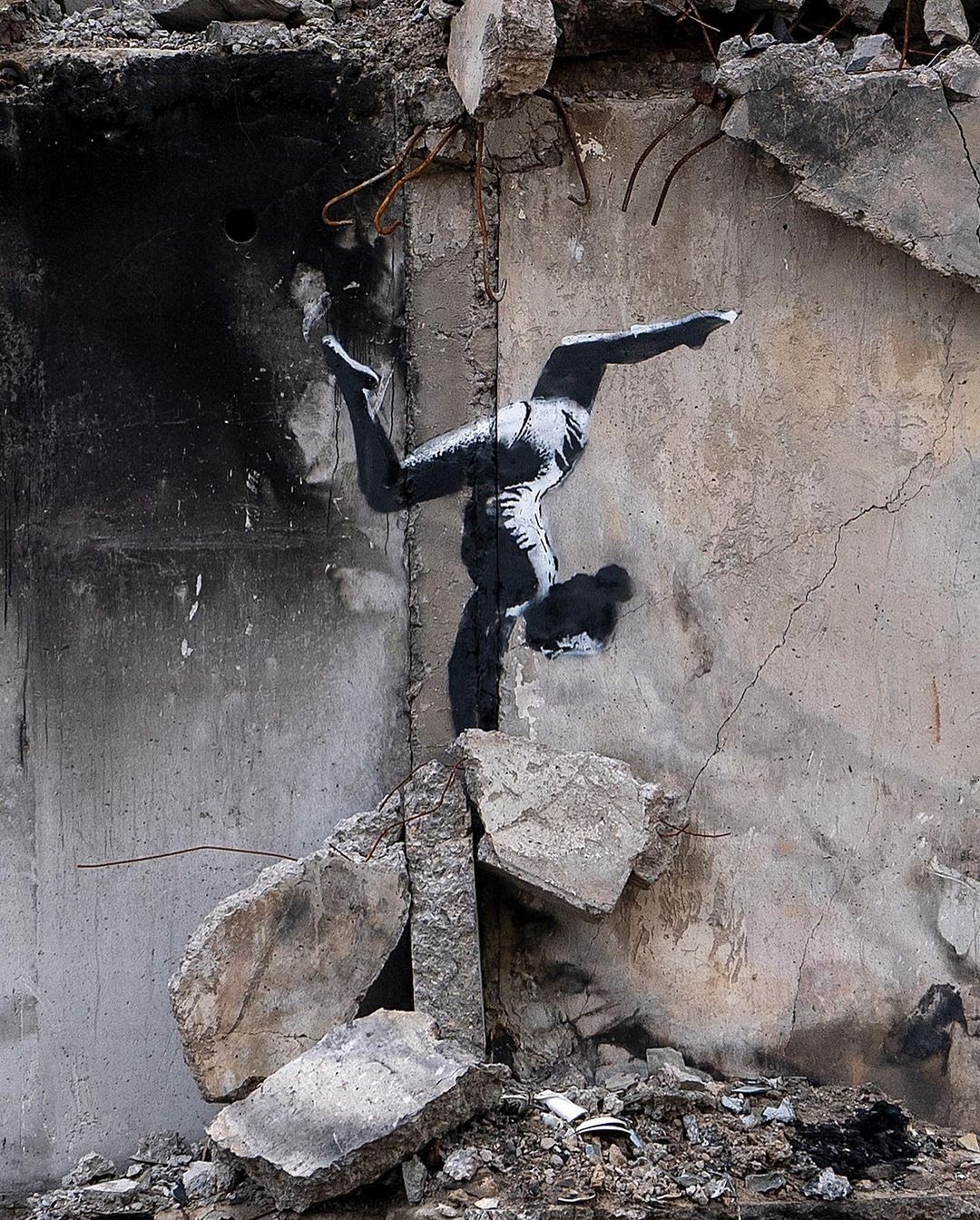
1. The Gymnast (Borodyanka)
A young gymnast, mid-handstand, balances elegantly atop the rubble of a destroyed high-rise building. Her poise and grace contrast strikingly with the fractured concrete beneath her, turning a symbol of ruin into a stage for resilience.


2. The Judo Throw (Borodyanka)


3. Children on a Tank Trap (Kyiv)
Two children play on a seesaw formed by a metal tank trap (a Czech hedgehog). Their joy seems innocent—until you realize they are balanced on an instrument of war.

This piece dissects the surreal coexistence of play and peril. Banksy repositions a brutal object into a playground prop, questioning what kind of world forces children to grow up next to weapons. It’s both a lament and a plea for a return to peace, channeling themes reminiscent of Bruegel’s “Children’s Games” but with modern cruelty.
4. Man in a Bathtub (Horenka)
An old man crouches in a freestanding bathtub, scrubbing himself with awkward care amid the exposed interior of a bombed building.

This image is haunting in its stillness. Daily hygiene becomes an act of resistance, a reclaiming of humanity in an inhumane context. Like the intimate interiors of Bonnard or Hopper, Banksy captures solitude—but here it is magnified by the grotesque backdrop of war.

5. Woman with a gas mask (Hostomel)
A woman in a housecoat and curlers stands precariously on a chair. She wears a gas mask and wields a fire extinguisher—both absurd and defiant.

This image portrays domestic resilience and the everyday heroism of civilians adapting to wartime conditions. Notably, this mural was later removed from the wall, allegedly in an attempt to sell it, leading to legal consequences. In her kitchen garb, she’s a domestic warrior—facing existential threats with the limited tools of everyday life. Her absurdity is tragicomic, echoing Charlie Chaplin’s resistance in The Great Dictator. When looters attempted to steal this mural from its wall, the authorities intervened—testament to the artwork’s perceived civic importance.
6. Missile on a Truck (Kyiv)
Using pre-existing graffiti, Banksy transforms a phallic tag into a Russian military truck carrying a missile adorned with a “Z”—the letter now symbolic of Russian aggression.


7. Gymnast with a Ribbon (Irpin)
A young girl in a neck brace performs a rhythmic gymnastics routine with a flowing ribbon, her body poised atop the remains of a ruined structure.


When Spray Paint Becomes Witness
Banksy’s visit to Ukraine was not an anonymous vacation into geopolitics—it was an act of witnessing. His murals are not just art; they are evidence. Each one engages with the debris of war but finds, within it, metaphors for endurance, irony, hope, and protest. Unlike museum-bound masterpieces, these works breathe in the open air—where real people, in real time, must confront destruction and rebuild lives.
They serve as artistic signposts for history: silent, urgent, and impossible to ignore.