Because I’m Worthless
Editions
Signed Edition: 75
Unsigned Edition: 175
Some in red, some in pink (exact counts not specified)
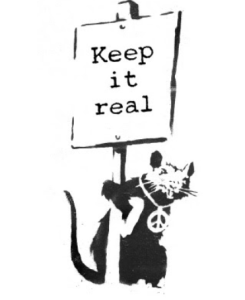
In 2004, Banksy produced one of his most concise and conceptually powerful groups of prints: the Placard Rats, published by Pictures on Walls. In this series, his now-iconic rat, long used as a symbol of marginality, survival, and quiet rebellion, stands upright holding a sign bearing a short, striking message. Drawing inspiration from George Marshall’s Get Out While You Can: Escape the Rat Race, Banksy transforms the rat into both victim and messenger, giving voice to the psychological pressures and contradictions of modern urban life. With their stark visual language and razor-sharp slogans, the Placard Rats distill Banksy’s practice into its purest form: immediate, ironic, and deeply unsettling.
A Voice for the Defeated
Because I’m Worthless belongs to one of the most important small groups in Banksy’s early printed oeuvre: the Placard Rats, issued in 2004 by Pictures on Walls. The series comprises three rat prints in which the animal stands upright like a human protester, holding a sign that delivers a short, brutal sentence. The idea is connected to George Marshall’s book Get Out While You Can, Escape the Rat Race, a title that immediately clarifies the social field in which these works operate: work, pressure, conformity, exhaustion, and the quiet violence of late capitalist life. In these prints, Banksy transforms the rat into both victim and witness, both urban survivor and political commentator.
This matters because the placard is not merely an accessory. It gives the rat a voice. It turns a familiar Banksy motif into a speaking figure, almost a demonstrator, almost a casualty, almost an anonymous citizen holding up the kind of message society produces but prefers not to read. That is the genius of the Placard Rats. They are compact, highly legible, and darkly funny, yet they open onto much larger questions of humiliation, alienation, and resistance.
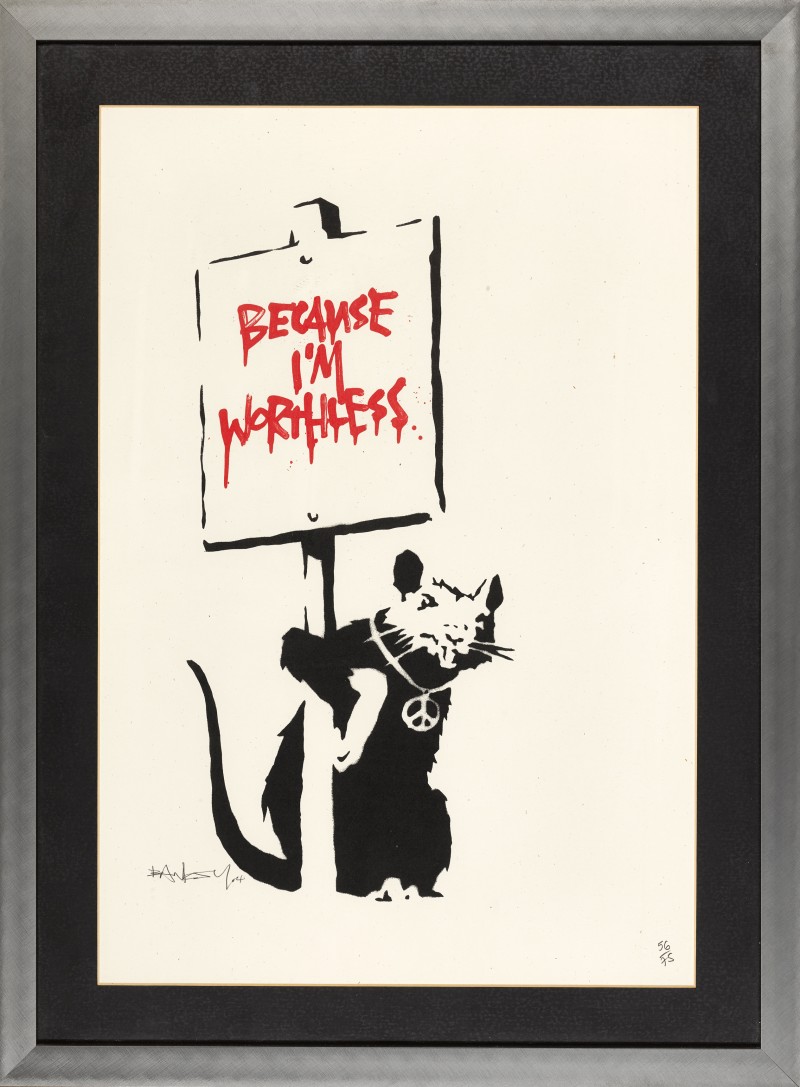
In Because I’m Worthless, Banksy depicts a rat standing on two feet, frontally presented, holding a placard on which the words “Because I’m Worthless” appear in vivid red or pink paint. The figure is rendered in Banksy’s crisp stencil language, with the sharp black silhouette of the rat set against the stark violence of the text. Around its neck hangs a peace-sign necklace, a small but crucial detail that gives the image much of its complexity. The work is visually simple, but not simplistic. Everything has been reduced so that the message hits immediately.
The rat does not appear triumphant. It appears exposed. It stands there like an urban outcast forced to declare its own condition. Yet the red lettering is aggressive, almost splattered, and introduces a completely different register: not submission, but wound, anger, alarm. Your article rightly notes that the red of the sign inevitably recalls blood. That single chromatic intervention changes the emotional temperature of the image. The work oscillates between self-deprecation and accusation, between abjection and protest.
 One of the sharpest aspects of the print is its perverse echo of the famous L’Oréal slogan, “Because I’m worth it.” Banksy twists a phrase of confidence, beauty marketing, and consumer self-affirmation into its exact opposite. In doing so, he exposes the cruelty hidden beneath the cheerful rhetoric of advertising. What consumer culture promises is empowerment; what many people actually experience is disposability. The substitution of “worth it” with “worthless” is simple but devastating. It condenses a whole social critique into three words.

That reversal is entirely characteristic of Banksy. He takes a phrase designed to flatter the individual and turns it into a confession of social defeat. But naturally, Banksy is too intelligent to leave the image there. The peace-sign necklace complicates the tone. It introduces a contradictory note of idealism, gentleness, even moral aspiration. The rat seems at once beaten down and still somehow resistant. That friction between violence and peace, despair and protest, gives the print its lasting charge.
Pest Modernism
The rat is one of Banksy’s most important and persistent motifs. It is not a decorative emblem. It is one of the keys to his worldview. Banksy has long used the rat as an allegorical tool through which to expose the vices and absurdities of human society. The anagram of “rat” and “art” has often been cited, and though the joke is simple, Banksy understood its usefulness perfectly: the rat is the disreputable double of the artist. It lives in the margins, moves at night, survives hostility, and leaves traces where authority would prefer cleanliness and control.
That identification is especially potent in a street-art context. Graffiti writers, like rats, are hunted, denounced, and treated as pests. Yet they are also agile, intelligent, and impossible to fully eradicate. By making the rat speak, Banksy effectively speaks for those whom the social order treats as negligible: the poor, the overworked, the unwanted, the structurally humiliated. In Because I’m Worthless, this becomes painfully clear. The rat is not only an alter ego for the artist; it is also a stand-in for all those reduced to a feeling of worthlessness by systems larger than themselves.
Pest Modernism
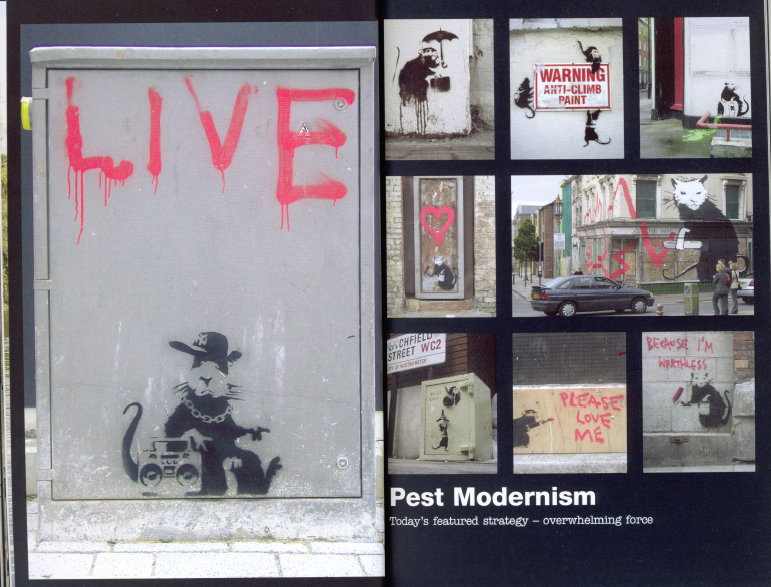
Banksy’s appreciation for rats is often attributed to French stencil artist Blek le Rat, who is widely considered to be the father of stencil graffiti and is famous for introducing urban art to France in the 80’s, some 20 years before Banksy.. Blek is widely regarded as one of the fathers of stencil graffiti and made the rat into a major urban protagonist long before Banksy. Banksy clearly inherits something essential from him: the speed and precision of the stencil, the use of repetition, and the idea that a supposedly low or despised creature can become a bearer of meaning. But Banksy pushes the motif in a more overtly satirical and verbally aggressive direction. His rats are not just there to haunt the city; they arrive with slogans, jokes, warnings, and insults.
In the Placard Rats, that evolution is complete. The rat ceases to be merely symbolic and becomes rhetorical. It does not simply signify marginality; it articulates it. That is why these works matter so much in Banksy’s development. They announce, with remarkable economy, the mature Banksy formula: one iconic figure, one short phrase, one immediate laugh, and then the unpleasant realization that the joke is on us.

All Placard Rats were issued by Pictures on Walls at GBP 74.99 for an unsigned print, and GBP 150 for a signed print.
Today, the irony is exquisite. A print declaring “Because I’m Worthless” has become a highly valued object on the secondary market. But that contradiction does not weaken the work; it sharpens it. Banksy understood very early that value is never stable, never innocent, and never detached from power. This print remains one of the most concise expressions of that insight. Small in scale, brutal in phrasing, and darkly elegant in conception, Because I’m Worthless is not just one of the strongest rat prints. It is one of the clearest statements in Banksy’s early graphic practice.
Auction Results
PLEASE CLICK BELOW FOR AUCTION RESULTS