BANKSY
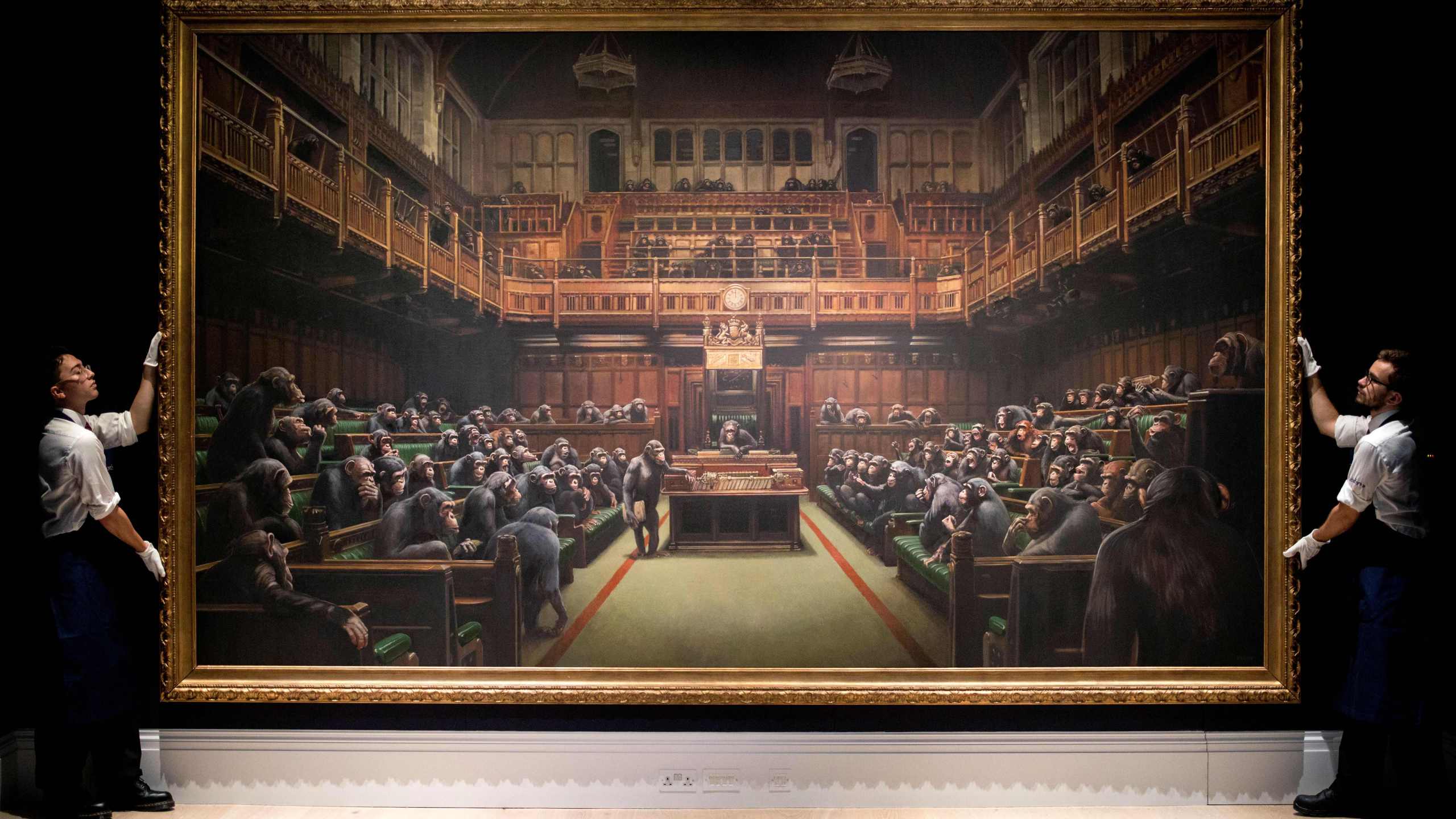
Devolved Parliament, 2009
Oil on canvas
250×420 cm (98 3/8 x 165 3/8 inches)
Signed and dated “09” on the reverse and variously inscribed on the stretcher
Provenance
The Artist
Acquired from the above by the present owner in 2011
Exhibited
Bristol, Bristol Museum & Art Gallery, Banksy versus Bristol Museum, June – August, 2009
Bristol, Bristol Museum & Art Gallery, Banksy’s Devolved Parliament, March – September 2019
Auction History
| Sotheby’s London 3 October 2019 Est.: GBP 1,500,000 – 2,000,000 | Price Realized GBP 9,879,500 / USD 13,590,000 (#28) BANKSY | Devolved Parliament |
Catalogue Essay
Few contemporary artworks have captured the political imagination quite like Devolved Parliament. Since its unveiling in 2009, the painting has transcended the boundaries of the art world to become a cultural icon, endlessly reproduced whenever British politics appears to descend into chaos. During the years of Brexit, newspapers, television broadcasts, and social media repeatedly turned to Banksy’s chamber of chimpanzees as though it were less a painting than a documentary photograph. Yet to regard Devolved Parliament merely as a clever political cartoon is to underestimate both its artistic ambition and its intellectual depth.
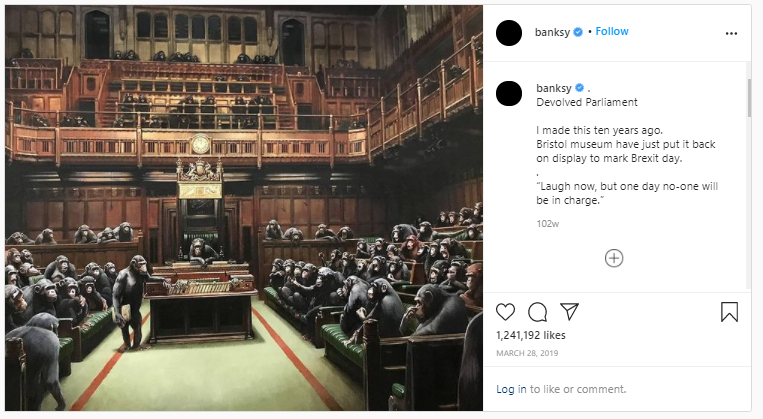
At first glance, the work is disarmingly simple. The House of Commons has been painstakingly reconstructed, every Gothic carving, leather bench, and parliamentary detail rendered with extraordinary precision. Nothing appears out of place until the viewer notices that every Member of Parliament has been replaced by a chimpanzee. The joke lands slowly. For a brief moment, the scene seems strangely plausible before the absurdity gradually reveals itself. It is this hesitation—this uneasy transition between recognition and disbelief—that gives the painting its remarkable psychological power.
Beneath its humor lies one of Banksy’s most sophisticated meditations on power, democracy, and human nature. The monkeys are not simply comic substitutes for politicians; they are mirrors held up to ourselves. Banksy is less interested in mocking individual leaders than in questioning whether the institutions we build are capable of overcoming the instincts we inherit. Have we truly evolved, or have we merely exchanged trees for parliamentary benches?
Although Devolved Parliament became synonymous with Britain’s constitutional turmoil a decade after it was painted, its significance extends far beyond Brexit or any single political crisis. The work belongs to the long tradition of history painting, using a contemporary event—or rather a contemporary institution—to explore timeless questions about authority, civilization, and the fragile nature of democratic order. It is simultaneously satire, philosophy, political commentary, and an extraordinary exercise in painterly craftsmanship.
Perhaps most importantly, Devolved Parliament represents the culmination of one of the longest narratives in Banksy’s career. For nearly ten years before the monkeys occupied Westminster, they had appeared throughout his work as symbols of conformity, consumerism, rebellion, and the absurdity of human behavior. Here, they finally arrive where they were always heading: not outside the system protesting it, but inside it, running the show.
The Day the Monkeys Took Over Parliament
The House of Commons has rarely looked more magnificent. Bathed in warm amber light, the chamber stretches majestically into the distance, its carved oak galleries, green leather benches, and vaulted Gothic architecture painted with a level of care seldom associated with street artists. The composition possesses the scale and authority of a nineteenth-century history painting, inviting the viewer to admire Britain’s oldest democratic institution in all its ceremonial grandeur.
“You paint 100 chimpanzees and they still call you a guerrilla artist.”

Then something feels wrong. Not immediately, but gradually, almost imperceptibly. One by one, the Members of Parliament reveal themselves to be chimpanzees.
Banksy’s genius lies in refusing the obvious. Rather than caricaturing politicians as apes—a familiar device in political cartoons—he simply removes humanity altogether. The monkeys are not exaggerated, grotesque, or comic in the conventional sense. They occupy their seats with complete seriousness, listening, debating, and observing parliamentary procedure with an air of absolute normality. The institution continues to function exactly as before. Only its occupants have changed.
This restraint transforms what could have been a simple joke into something far more unsettling. The viewer begins to ask an uncomfortable question: if nothing else in the chamber has changed, has anything really changed at all?

The painting derives much of its power from this ambiguity. It never tells us whether the monkeys represent politicians behaving like animals or whether human civilization itself remains governed by instincts only thinly disguised beneath suits, traditions, and constitutional rituals. The distinction is crucial. Banksy’s target is not one government, one party, or one ideology. It is the enduring tendency of power to descend into tribalism, vanity, territorial conflict, and spectacle.
The choice of chimpanzees is equally significant. As humanity’s closest living relatives, they occupy an uncomfortable position between familiarity and otherness. They are close enough to resemble us, yet distant enough to expose our own behavior with disarming clarity. Their presence transforms Parliament into an evolutionary mirror, inviting us to consider whether democracy has truly elevated human conduct or merely provided our ancient instincts with a more elaborate stage.

The composition reinforces this idea through its remarkable theatricality. The chamber resembles a vast auditorium, with MPs seated like actors upon a stage and the Speaker presiding almost as the director of an endless performance. Debate becomes ritual. Ceremony becomes choreography. Politics itself appears as a carefully rehearsed spectacle in which roles are played, gestures repeated, and convictions performed before an audience.
There is an irony at the heart of the painting that should not be overlooked. The more meticulously Banksy recreates the architecture of Westminster, the more absurd the monkeys become. Conversely, the more naturally the chimpanzees inhabit the chamber, the more fragile the authority of the institution appears. Civilization and absurdity coexist without contradiction.
This delicate balance between humor and unease explains why Devolved Parliament continues to resonate long after the political events that made it famous. The painting does not ask whether politicians are fools. It asks a far more profound question: what if the institutions we trust to embody reason have never fully escaped the instincts from which humanity itself evolved?
In Banksy’s world, the day the monkeys took over Parliament may not have been a revolution at all. It may simply have been the day someone finally noticed they had been there all along.
The Monkey Before Parliament
An Alter Ego in Fur
By the time the chimpanzees occupied the House of Commons in Devolved Parliament, they had already spent nearly a decade evolving through Banksy’s artistic universe. Far from being a sudden inspiration, the monkey had become one of the artist’s most sophisticated and enduring alter egos—a creature through which he could examine human behavior without ever depicting humanity directly.
The first monkeys appeared in Banksy’s earliest Bristol years, often carrying signs, weapons, or absurd accessories. They were mischievous, anonymous, and strangely sympathetic. Unlike rats, which represented the marginalized and invisible, monkeys occupied a far more ambiguous role. Intelligent enough to resemble us, yet distant enough to expose our contradictions, they became ideal stand-ins for the human condition itself.
Keep It Real
One of the earliest and most important examples is the Keep It Real series. Banksy’s chimpanzees wear placards bearing the slogan “Keep It Real,” a phrase borrowed from the language of popular culture and street authenticity. Yet the irony is immediate. The monkeys, reproduced almost mechanically, are virtually identical. The demand for individuality has itself become standardized. Authenticity, Banksy suggests, risks becoming just another commodity, another fashionable slogan worn by everyone and therefore owned by no one.
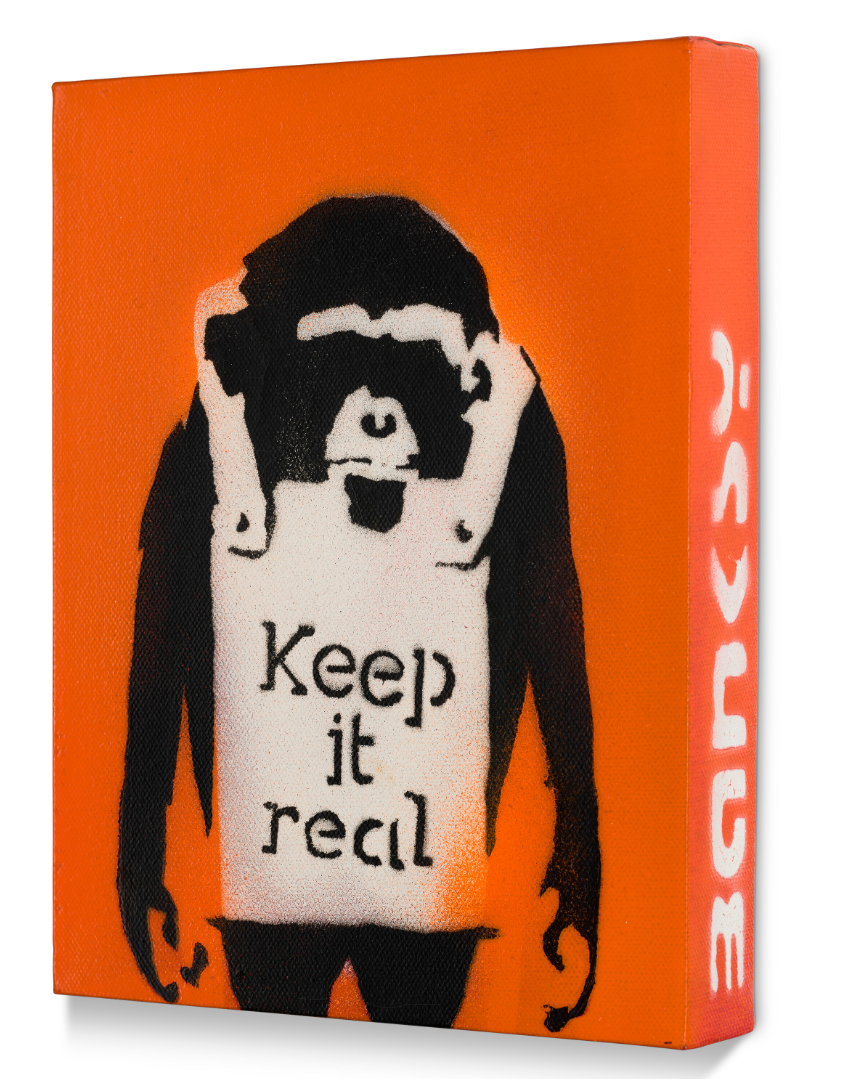
Rather than celebrating rebellion, the series quietly questions whether rebellion itself can survive once it becomes fashionable. It is a theme that would echo throughout Banksy’s career, from Morons to Exit Through the Gift Shop and Gross Domestic Product.
From Protesters to Revolutionaries
As the years progressed, Banksy’s monkeys assumed increasingly ambitious roles. In Monkey Guns, they became armed combatants, transforming violence into absurd theatre. In Monkey Detonator, a chimpanzee calmly prepares to trigger an explosion, presenting destruction with unsettling innocence. Elsewhere, monkeys appeared surfing bombs, confronting police, or adopting the poses of political leaders.
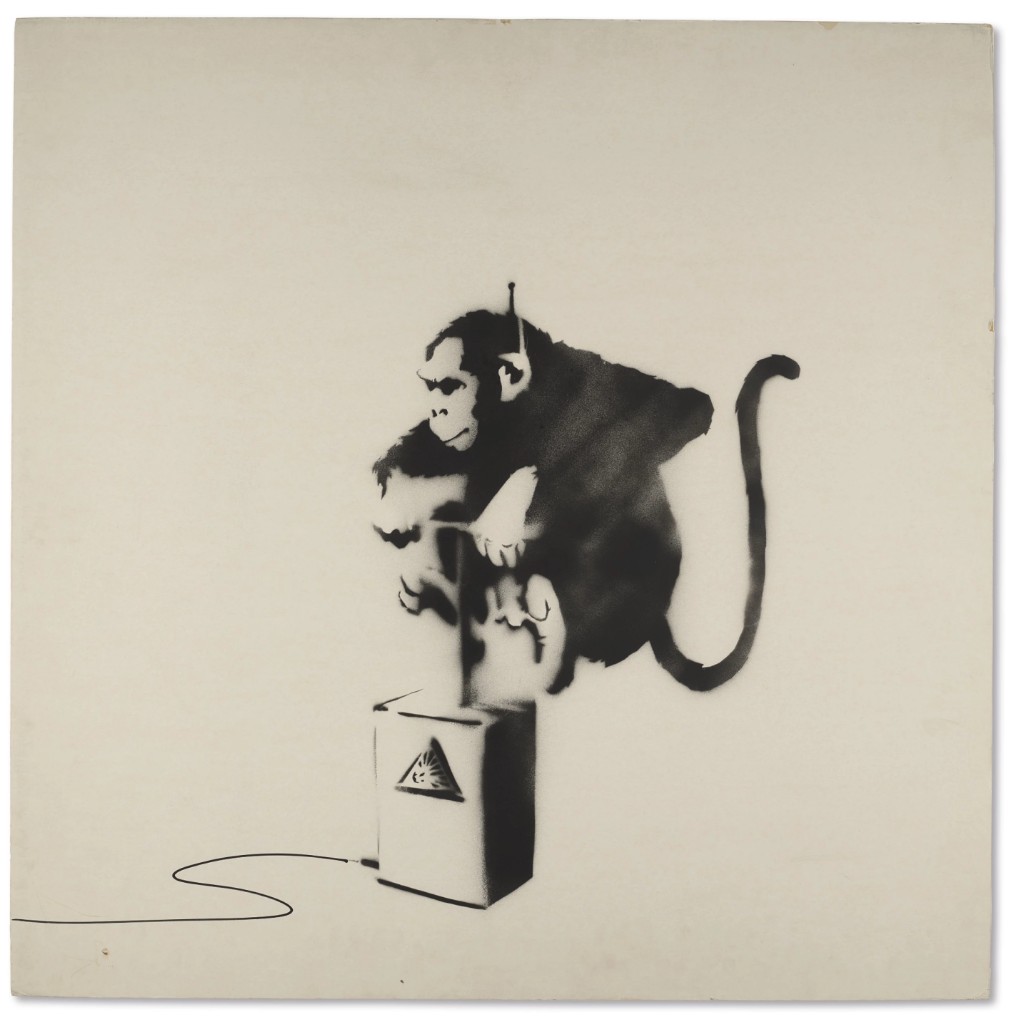
They are never merely comic. Each role allows Banksy to expose one of humanity’s contradictions while maintaining the distancing effect of animal imagery. By replacing people with chimpanzees, the artist invites us to laugh first and recognize ourselves only afterwards.
Laugh Now…
Perhaps the most celebrated of all is Laugh Now, where a procession of monkeys wear sandwich boards reading “Laugh now, but one day we’ll be in charge.” Initially, the statement appears playful—a reversal of Darwinian expectations in which the supposedly inferior species dreams of power. Yet viewed retrospectively, it reads almost like a prophecy.
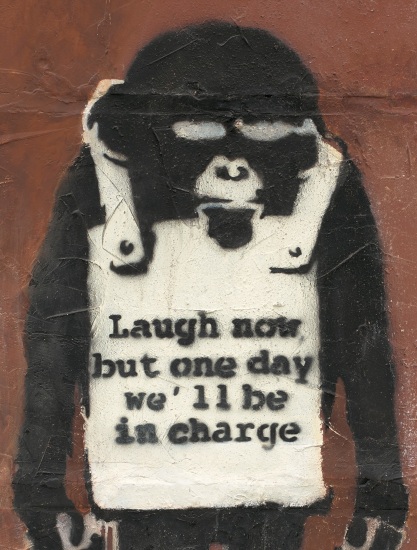
Nine years later, the monkeys do indeed take charge. They are no longer servants, laboratory animals, entertainers, or protesters. They now occupy the green benches of Westminster itself.
The Evolution of a Symbol
This continuity is one of the great strengths of Banksy’s oeuvre. His monkeys are never isolated inventions; they form a coherent visual narrative that unfolds over decades. Like recurring characters in a novel, they evolve alongside the artist’s own concerns. Their roles become increasingly ambitious, their symbolism increasingly layered, until they culminate in the monumental spectacle of Devolved Parliament.
Importantly, the monkey is never simply an insult. Political cartoons have long compared politicians to apes in order to ridicule them, but Banksy’s approach is far more nuanced. His chimpanzees are not fools. They converse, deliberate, observe, and govern with complete seriousness. The satire lies not in their stupidity but in their unsettling familiarity. They force us to acknowledge how little separates civilization from instinct, ritual from performance, or political authority from tribal behavior.
By 2009, the monkey had ceased to be merely one of Banksy’s favorite motifs. It had become his principal vehicle for exploring the contradictions of modern society. Devolved Parliament is therefore not simply another monkey painting. It is the moment when every previous monkey arrives at its inevitable destination.
History Painting for the Twenty-First Century
Reinventing History Painting
One of the greatest misconceptions surrounding Devolved Parliament is that it is simply a political cartoon enlarged to monumental scale. In reality, Banksy is doing something far more ambitious. He is reclaiming one of the oldest and most prestigious traditions in Western art: history painting.
For centuries, history painting occupied the highest rank within the academic hierarchy of artistic genres. Its purpose was not merely to record events but to interpret them, transforming moments of political, military, or religious significance into universal reflections on human nature. Artists such as Jacques-Louis David, Eugène Delacroix, Benjamin West, and Théodore Géricault painted revolutions, battles, and constitutional dramas not simply to illustrate history, but to define it. Banksy adopts precisely this tradition while overturning its conventions.
The House of Commons as a Stage
Rather than depicting kings, generals, or heroic revolutionaries, Banksy paints the British Parliament. Instead of immortalizing national triumph, he presents institutional paralysis. Most strikingly of all, he replaces the protagonists of history with chimpanzees. The grandeur of history painting remains intact, but its heroes have quietly evolved—or perhaps devolved.
The House of Commons itself becomes the principal protagonist. More than a backdrop, it functions as a theatre where democracy unfolds as ritual, performance, and spectacle.
Painting Beyond the Stencil
This inversion is made possible by Banksy’s extraordinary painterly discipline. Unlike the simplified stencils that made his reputation on city walls, Devolved Parliament is executed with remarkable technical sophistication. The House of Commons is reconstructed with painstaking architectural accuracy, from its carved oak panelling and Gothic galleries to the distinctive green leather benches that define Britain’s parliamentary chamber.
Warm, theatrical lighting bathes the scene, recalling the atmospheric interiors of nineteenth-century academic painting and lending the composition a gravity that initially conceals its absurdity.
The effect is deliberate. Banksy does not parody Parliament through crude exaggeration; he dignifies it before introducing the impossible. The more convincing the setting becomes, the more disturbing the substitution of monkeys for politicians appears. Comedy emerges not through distortion but through absolute plausibility.
From Hogarth to Banksy
This strategy places Banksy within a lineage that extends far beyond street art. Like William Hogarth, Honoré Daumier, and George Grosz before him, he employs satire to expose the moral failures of political institutions. Yet unlike those artists, Banksy does not merely caricature individuals. He transforms an entire constitutional system into an allegory, elevating contemporary politics to the scale of myth.
Rather than mocking a single politician or a particular government, Devolved Parliament interrogates democracy itself—its rituals, its performances, and its capacity to become disconnected from those it claims to represent.
A Modern Masterpiece
There is another irony that should not be overlooked. History painting traditionally celebrated the great achievements of civilization. Devolved Parliament asks whether civilization itself deserves such celebration. The magnificent architecture remains untouched, the rituals continue uninterrupted, yet the figures entrusted with governing the nation have become primates. The institution survives; only the illusion of progress has been called into question.
In doing so, Banksy accomplishes something remarkably rare in contemporary art. He demonstrates that history painting has not disappeared—it has simply changed its subject. Where earlier generations commemorated emperors and revolutions, Banksy commemorates the spectacle of democracy itself. The result is not merely one of Banksy’s greatest paintings, but arguably one of the defining history paintings of the twenty-first century, created not by an academic painter, but by an anonymous graffiti artist armed with stencils, irony, and an unerring understanding of political theatre.
Devolution or Evolution?
A Title Rich in Meaning
Banksy’s titles are rarely incidental. More often than not, they provide the conceptual framework through which the work should be understood, and Devolved Parliament is a perfect example. At first reading, the title appears to refer to the constitutional process of devolution within the United Kingdom, whereby legislative powers have gradually been transferred from Westminster to Scotland, Wales, and Northern Ireland. The choice is immediately political, anchoring the painting within a very British context. Yet Banksy deliberately selects a word whose meaning extends far beyond constitutional reform.
The notion of “devolution” carries an inherent ambiguity. While politicians generally use the term to describe the decentralization of power as a sign of democratic maturity, the word also evokes the idea of regression, suggesting a movement backwards rather than forwards. It is this double meaning that transforms the title from a simple political reference into a philosophical question. Is Parliament evolving alongside society, or is it slowly reverting to more primitive forms of behavior concealed beneath centuries of ceremony and tradition? Rather than providing an answer, Banksy invites viewers to consider both possibilities simultaneously.
The Thin Veneer of Civilization
The replacement of Members of Parliament with chimpanzees is often interpreted as a direct insult to politicians. While the satire is unmistakable, such a reading remains surprisingly superficial. If Banksy’s intention had merely been to ridicule elected officials, countless visual metaphors were available to him. The choice of chimpanzees is far more deliberate.
Chimpanzees occupy an uncomfortable position in the human imagination. They are close enough to resemble us in their gestures, social interactions, and expressions, yet distant enough to allow us to observe our own behaviour with a degree of detachment. They function as evolutionary mirrors, reflecting characteristics that civilization prefers to believe it has left behind.
This idea has occupied philosophers for centuries. Thomas Hobbes famously argued that without institutions capable of restraining human passions, life would descend into perpetual conflict. Jean-Jacques Rousseau, by contrast, believed that society itself corrupts an originally innocent nature. Banksy does not explicitly endorse either position, yet Devolved Parliament quietly stages their debate. The elaborate architecture of Westminster, its rituals, traditions and constitutional procedures represent civilization at its most sophisticated. Yet seated within this magnificent institution are creatures governed by instincts that appear remarkably familiar.
The unsettling implication is that institutions may alter appearances without fundamentally transforming human nature.
Power as an Evolutionary Instinct
Seen in this light, Devolved Parliament ceases to be a satire of British politics alone and becomes an exploration of power itself. Throughout history, political systems have changed dramatically. Monarchies have given way to republics, dictatorships have become democracies, and constitutions have been rewritten countless times. Yet the desire for status, influence, dominance and tribal belonging has remained remarkably constant.
Banksy’s chimpanzees embody precisely these enduring instincts. They are not chaotic animals rampaging through Parliament. On the contrary, they occupy the chamber with complete confidence, participating in debate as though they have always belonged there. This normality is precisely what makes the painting so disquieting. The monkeys are not disrupting the institution; they have become the institution.
The work therefore asks a profoundly uncomfortable question. Has democracy fundamentally changed the way human beings exercise power, or has it merely provided ancient instincts with more sophisticated rules, grander architecture, and better tailoring?
Rather than mocking Parliament, Banksy questions one of the central assumptions of modern civilization: that political progress necessarily reflects moral or evolutionary progress.
A Universal Reflection
This philosophical dimension explains why Devolved Parliament continues to resonate far beyond the specific circumstances of British politics. Every society constructs institutions intended to embody reason, justice and collective decision-making. Yet every society must also confront the reality that these institutions remain populated by imperfect human beings, each carrying ambitions, loyalties, prejudices and desires that no constitutional framework can entirely eliminate.
Banksy’s monkeys are therefore not simply politicians in disguise. They represent something far more universal: the persistent tension between civilization and instinct. Their presence reminds us that however sophisticated our institutions become, they remain fragile human creations, continually shaped by the very impulses they were designed to restrain.
Brexit Before Brexit
A Painting That Grew Into History
When Devolved Parliament was first exhibited in 2009, it was widely admired as an intelligent satire of Westminster politics and a striking demonstration of Banksy’s growing ambition as a painter. Few could have anticipated that, within a decade, the work would acquire an entirely new significance. As Britain entered the prolonged constitutional crisis surrounding Brexit, the painting seemed to transform almost overnight from political commentary into historical symbol.
Throughout the years that followed the 2016 referendum, images of Devolved Parliament appeared repeatedly across newspapers, television broadcasts, magazines and digital media whenever political negotiations reached another impasse. It became impossible to discuss Westminster without invoking Banksy’s chamber of chimpanzees. Few contemporary artworks have entered public discourse so completely, becoming not merely illustrations of political events but visual shorthand for an entire era.
Yet this extraordinary relevance often led to a misunderstanding of the painting itself.
Not a Prophecy, but a Diagnosis
It is tempting to describe Devolved Parliament as prophetic. After all, Banksy painted it seven years before the Brexit referendum and a full decade before the parliamentary deadlock that dominated British politics. In hindsight, the image appears almost uncannily predictive.
However, the painting’s true achievement lies elsewhere.
Great political art rarely predicts specific events. Rather, it identifies the underlying conditions that make such events possible. Banksy was not foretelling Brexit; he was observing structural weaknesses that had long existed within democratic politics. Increasing polarization, theatrical confrontation, tribal loyalties, and the growing distance between political institutions and the public were already visible in many Western democracies by the late 2000s. Brexit did not create these tensions so much as expose them with unprecedented clarity. The painting therefore appears prophetic only because history eventually revealed what Banksy had already recognized.

Beyond Westminster
Although the work is deeply rooted in British political culture, its meaning extends far beyond the Palace of Westminster. Viewers unfamiliar with the intricacies of British constitutional law immediately recognize the broader message because the painting addresses dynamics common to virtually every democratic society.
Legislative gridlock, partisan division, performative debate and the increasing transformation of politics into public spectacle are hardly unique to Britain. Similar tensions have emerged across Europe, the United States and many other parliamentary democracies during the twenty-first century. Banksy’s monkeys therefore cease to represent British MPs alone. They become universal figures through which audiences project their own political frustrations, regardless of nationality or ideology.
This universality helps explain why the painting has remained relevant long after the immediate Brexit crisis subsided.
An Enduring Political Icon
Many works of political satire lose their force as governments change and public controversies fade into history. Devolved Parliament has followed the opposite trajectory. Rather than becoming dated, it has grown increasingly resonant with each successive political crisis because its subject is not a particular administration, party or referendum. Its true subject is the fragile relationship between democratic ideals and the imperfect human beings entrusted with preserving them.
For that reason, Devolved Parliament should not be understood primarily as the defining image of Brexit. Brexit simply provided the historical moment through which millions of viewers came to appreciate the broader argument Banksy had been making all along. The painting ultimately reminds us that democracy is never a finished achievement but a perpetual negotiation between reason and instinct, between institutions and the flawed humanity upon which they inevitably depend.