Gangsta Rat
Editions
Main Edition (Red)
Signed Edition: 150
Unsigned Edition: 350

Numbering and Signature
Numbered in pencil with the publisher’s blindstamp, lower right
Tag, Rat & Boombox
Created in 2004, Gangsta Rat stands as one of the most defining expressions of Banksy’s rat motif, where the artist’s alter ego takes on a fully constructed identity. As you explain, the rat is not simply a recurring character but a direct reflection of the artist himself, operating on the margins of society, unwanted yet persistent, invisible yet omnipresent. In this work, that figure is no longer hiding. It is staged, stylized, and unmistakably present.
“They exist without permission. They are hated, hunted, and persecuted.
They live in quiet desperation amongst the filth.
And yet they are capable of bringing entire civilizations to their knees.”
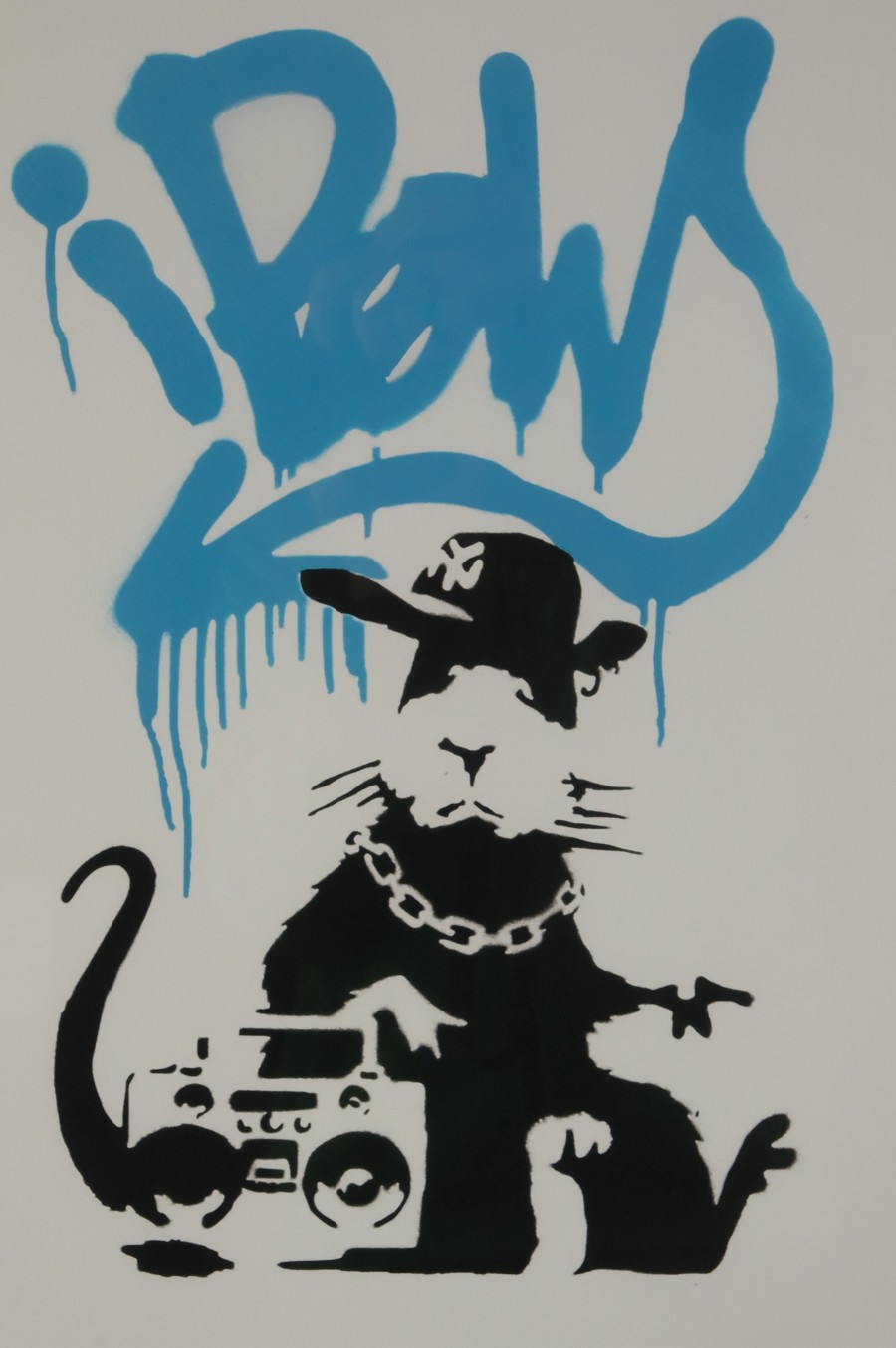
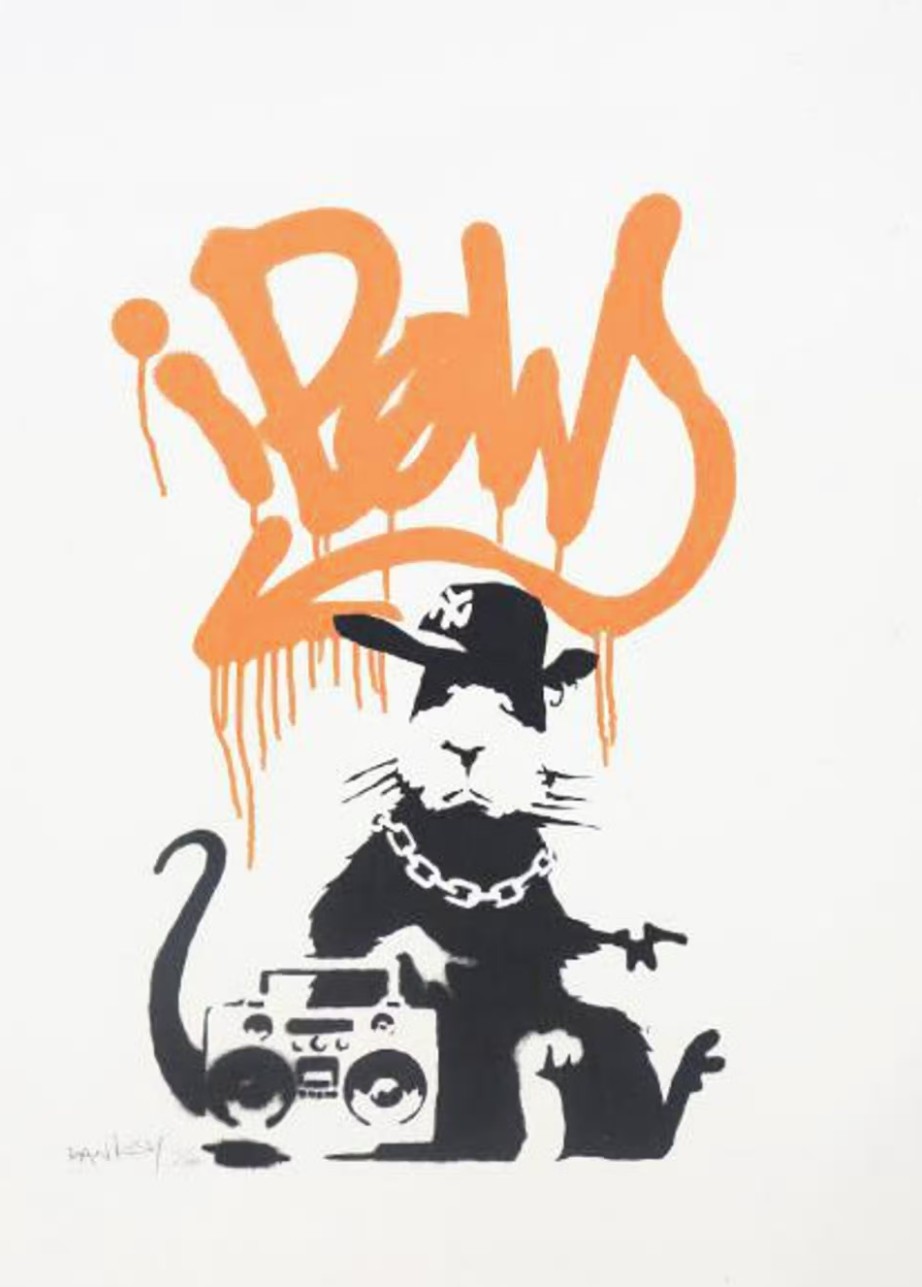
The composition is built with striking clarity and immediacy. At the top, a bold red graffiti tag reading “iPOW” dominates the surface, executed in loose spray paint with visible drips that reinforce its raw and spontaneous nature. The tag sits almost aggressively above the figure, asserting itself before anything else is even read.
Below it stands the rat, rendered in sharp black and white stencil, upright and frontal. It wears a tilted baseball cap marked with “NY,” partially obscuring its eyes, and a thick chain around its neck. At its feet, the rat holds a boombox, positioned prominently and anchoring the entire composition. Its posture is relaxed but deliberate, with one paw slightly raised, suggesting attitude rather than movement. The background remains completely blank, focusing all attention on the figure and its symbols.
iPOW: Image Power
The tag is not decorative but conceptual. “iPOW” stands for “Image Power,” a direct statement about the role of images in Banksy’s work. The placement is critical, as the message appears before the figure, establishing the idea that the image itself carries authority, influence, and reach. POW can also be seen as a reference to Banksy’s print publisher: Pictures on Walls. The dripping red paint reinforces the immediacy of this declaration. It feels urgent, uncontrolled, and public. The image does not wait to be interpreted. It asserts itself.

The work brings together two fundamental forms of expression within urban culture. The graffiti tag marks territory, leaving a visible trace in space, while the boombox projects sound outward, occupying that space in a different but equally powerful way. In Gangsta Rat, the figure controls both. It writes and it broadcasts. It leaves a mark and it amplifies its presence. This duality reflects the concept of image power as something active rather than passive. The image does not simply exist. It moves, it spreads, and it imposes itself.
The composition operates through a deliberate contrast between the freehand graffiti tag and the precision of the stencil figure. The red tag is fluid, expressive, and uncontrolled, while the rat and the boombox are sharply defined and repeatable. This tension reflects the dual nature of Banksy’s practice, where spontaneous intervention meets controlled reproduction.

Within Banksy’s oeuvre, Gangsta Rat functions as more than a character. It is a statement about how images operate in the world. The rat may be small, marginal, and overlooked, but the image it carries is not. It is immediate, repeatable, and impossible to ignore.
Pest Modernism
Rats are traditionally associated with invisibility, survival, and rejection. Banksy transforms that perception entirely. In this work, the rat becomes a constructed identity, adopting the codes of hip-hop culture through the cap, the chain, and the stance. These elements are not incidental. They situate the figure within a broader cultural language tied to visibility, resistance, and expression.
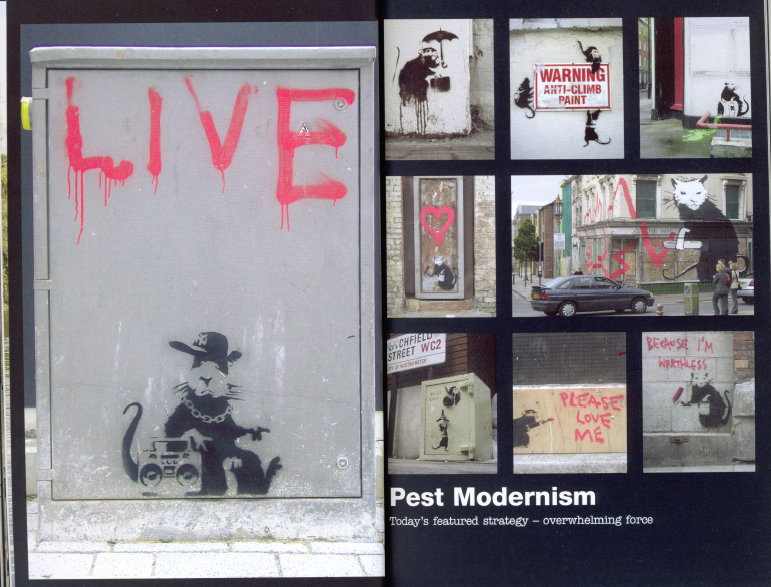
Banksy’s appreciation for rats is often attributed to French stencil artist Blek le Rat, who is widely considered to be the father of stencil graffiti and is famous for introducing urban art to France in the 80’s, some 20 years before Banksy.
Gangsta Rat Colorways
Edition: 61 signed
Edition: 61 signed
Edition: 61 signed

Edition: 46 signed

Edition: 20 signed

Edition: 8 signed

Auction Results
PLEASE CLICK BELOW FOR AUCTION RESULTS