BANKSY MONKEY BUSINESS
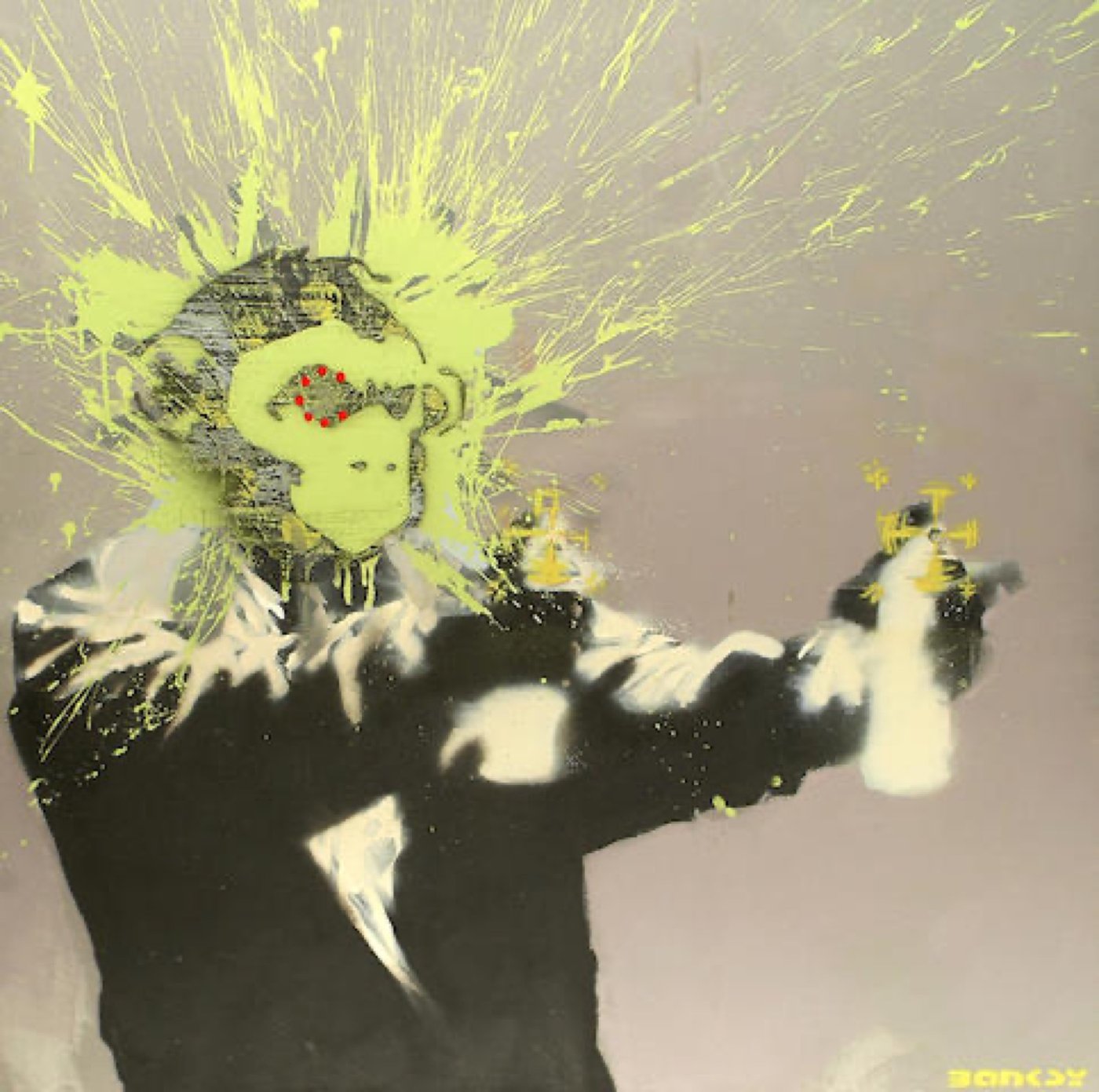
“They say that if you gave a thousand monkeys a thousand typewriters at some point you'd have yourself a novel. I was wondering if you gave a thousand monkeys a thousand sticks of dynamite how long would it take for them to make the city a more beautiful looking place.”
Few artists have embraced the monkey as persistently, or as brilliantly, as Banksy. Throughout more than two decades of artistic production, the primate has appeared as a revolutionary, a servant, a terrorist, a monarch, a laboratory subject, and even as a surrogate for the artist himself. At first glance, these figures seem humorous, irreverent, or simply absurd. Yet beneath their playful appearance lies one of the richest and most sophisticated visual motifs in Banksy's entire oeuvre.
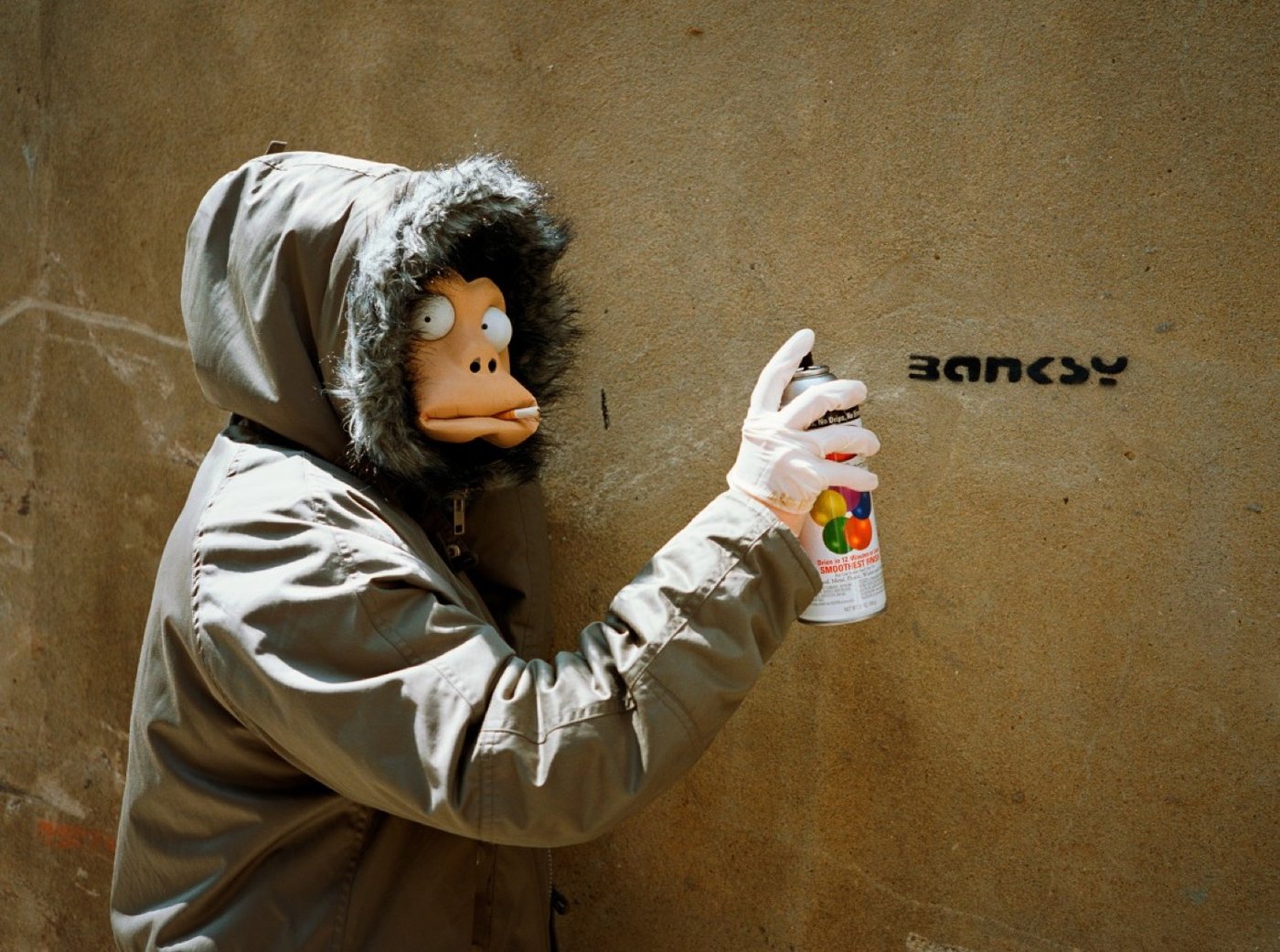
Unlike many of his recurring characters, the monkey is not tied to a single political event or social issue. Instead, it serves as a remarkably versatile metaphor through which Banksy explores power, authority, conformity, rebellion, identity, consumerism, and the contradictions of modern society. Sometimes his monkeys appear comic, sometimes tragic, and occasionally even heroic, but they always reveal more about humanity than about the animals they depict.
This versatility explains why the monkey has become one of the artist's most enduring symbols. Much like the rat, it functions as an alter ego through which Banksy can question the structures that govern our lives while avoiding direct representation. By replacing humans with monkeys, he strips away status, ideology, nationality, and social convention, exposing universal patterns of behavior that transcend time and place. We instinctively recognize ourselves in their expressions, gestures, ambitions, and failures, making the satire all the more effective.
From his earliest paintings in 2000 to later murals, prints, and sculptures, Banksy's simian characters evolve into a coherent cast of protagonists, each embodying a different facet of the human condition. Whether carrying a detonator, holding a protest placard, wearing the Crown Jewels, or quietly urging us to “Keep It Real,” they challenge our assumptions about civilization and remind us that the line separating humanity from instinct is often thinner than we care to admit.
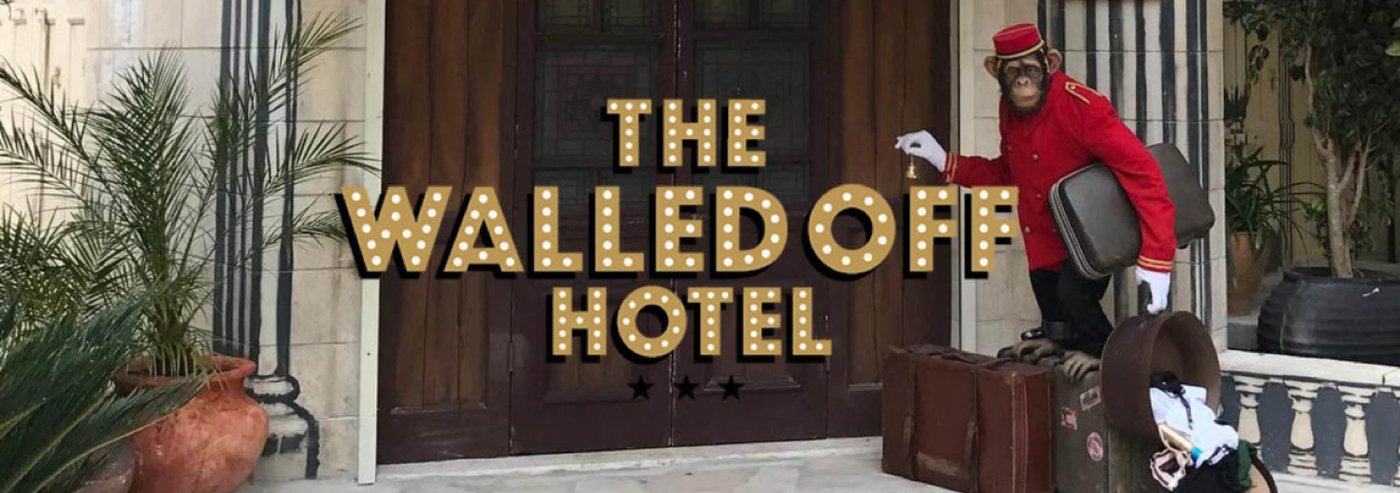
Their importance within Banksy's visual universe is perhaps best illustrated at the Walled Off Hotel in Bethlehem, where a monkey dressed as a bellboy welcomes guests into what the artist famously describes as “the hotel with the worst view in the world.” It is a fitting choice. Before visitors encounter the hotel's political commentary on conflict, occupation, and division, they are first greeted by one of Banksy's oldest companions—a humorous yet unsettling figure whose courteous smile conceals a far deeper reflection on the human condition. There could hardly be a more appropriate host for the strange, satirical world that Banksy has spent his career inviting us to explore.
The Monkey Before Banksy
A Tradition of Satire
Long before Banksy transformed the monkey into one of the defining protagonists of his artistic universe, primates had occupied a privileged place in the history of art, literature, and political satire. Their extraordinary resemblance to humans has fascinated artists for centuries, making them ideal stand-ins through which to explore our virtues, our flaws, and the often-thin line separating civilization from instinct. Familiar enough to evoke empathy yet sufficiently different to invite ridicule, the monkey has long served as one of art's most effective mirrors of the human condition.
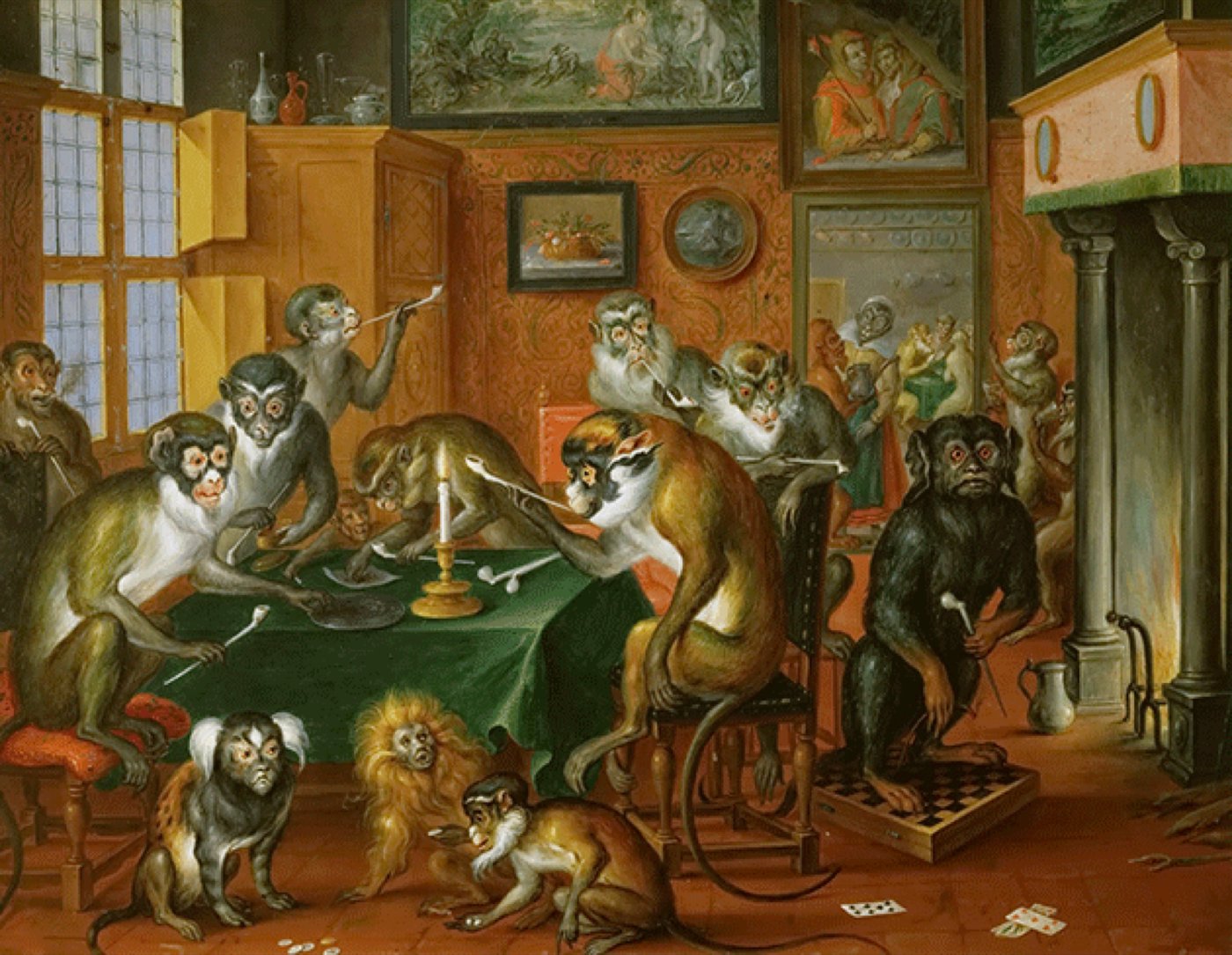
One of the earliest and most celebrated examples of this tradition is the Singerie, a genre of painting that flourished in France during the late seventeenth and eighteenth centuries. Derived from the French word singe (“monkey”), Singeries depicted monkeys dressed as aristocrats, soldiers, musicians, scholars, merchants, or judges, faithfully imitating the rituals and conventions of human society. Far from being simple comic scenes, these works offered sophisticated social commentary, gently mocking the vanity, pretension, and theatricality of the ruling classes. By replacing people with monkeys, artists suggested that much of what we call civilization may itself be little more than carefully rehearsed performance.
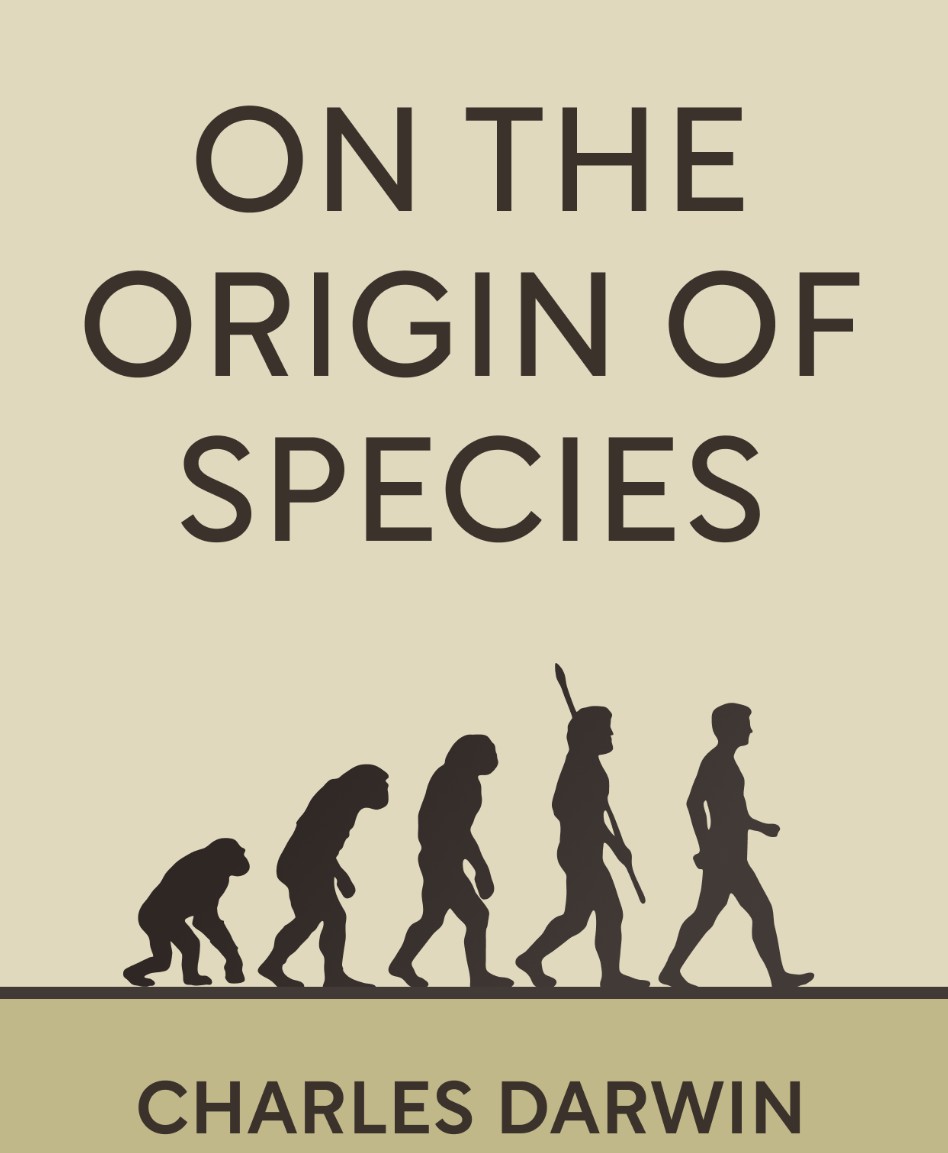
The symbolic power of the monkey evolved further during the nineteenth century. Charles Darwin's On the Origin of Species (1859) fundamentally altered humanity's perception of its place within the natural world. No longer merely comic imitators of mankind, primates became our closest biological relatives, forcing society to confront an unsettling possibility: perhaps the distance separating humans from animals was not as great as previously imagined. Since then, the monkey has embodied a fascinating duality, representing both our evolutionary origins and our enduring capacity for reason, folly, violence, compassion, and contradiction.
Writers, philosophers, and artists have repeatedly returned to this imagery. From the satirical worlds of Jonathan Swift and George Orwell to political cartoons, advertising, and popular culture, monkeys have remained remarkably versatile symbols through which society can examine power, conformity, hierarchy, and human behavior. Their unique ability to imitate our actions while exposing their absurdity makes them enduring vehicles for satire, capable of provoking laughter while delivering uncomfortable truths.
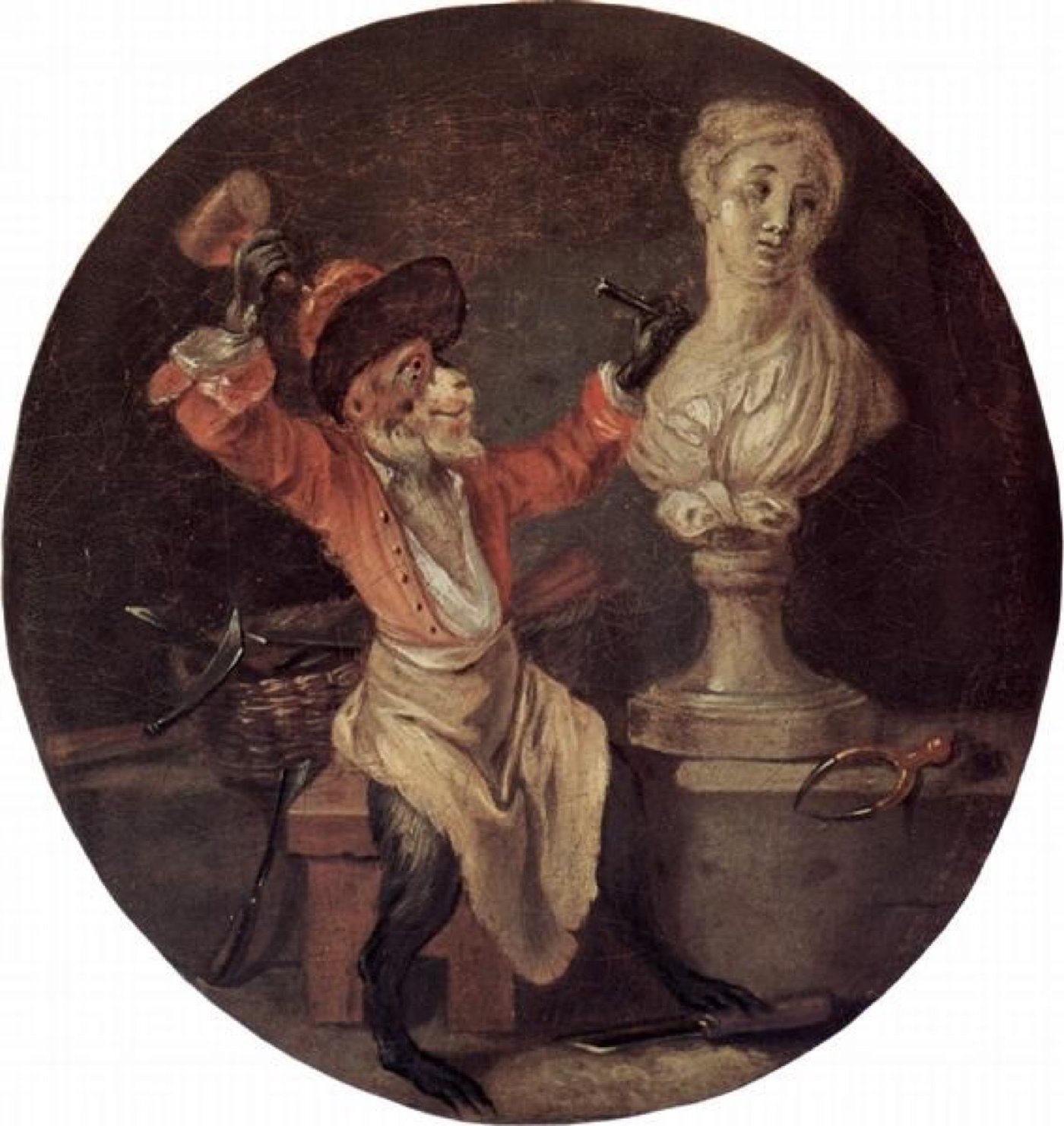
Banksy inherits this rich artistic tradition but adapts it brilliantly to the contemporary world. His monkeys are no longer powdered aristocrats or courtly entertainers. They inhabit city streets, museums, auction houses, parliaments, and the machinery of modern consumer society. They become workers, protesters, terrorists, monarchs, celebrities, and even the artist himself. Each appearance explores a different aspect of human nature, yet together they form a remarkably coherent visual language that evolves throughout his career.
Unlike the rat, which often represents resistance from the margins of society, Banksy's monkey functions as a universal surrogate for humanity itself. Whether submissive or rebellious, comic or tragic, dignified or ridiculous, every monkey ultimately reflects our own behavior back at us. We may laugh at these characters, but the humor is always accompanied by an uncomfortable realization: the satire is not directed at the animal. It is directed at us.
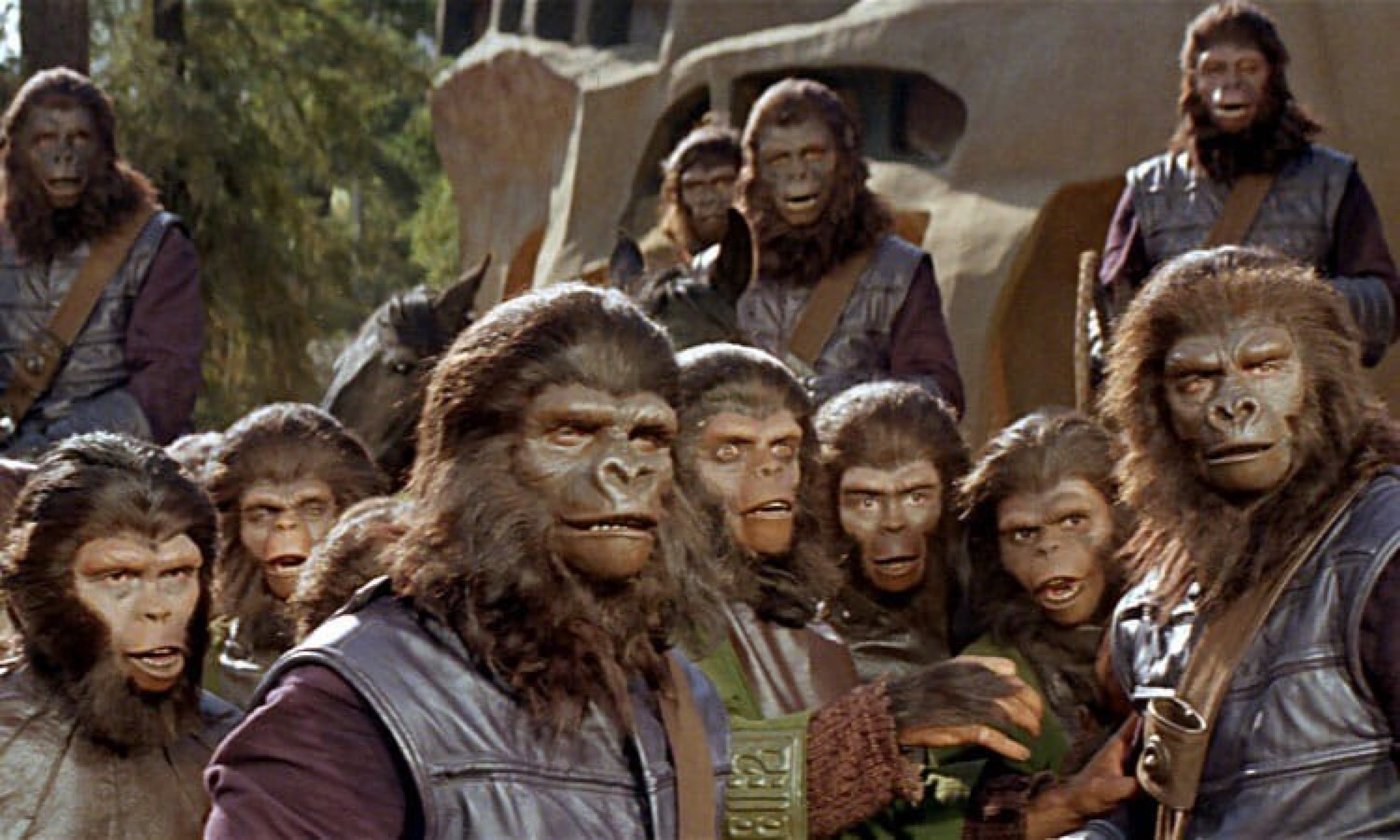
In contemporary popular culture, this is famously explored in the internationally iconic franchise, Planet of the Apes, a trilogy of science-fiction classics set on a futuristic planet where apes rule and humans are slaves. In their clash for control, complex sociological themes are explored, reflecting tensions relating to humanity and power that are also probed in Banksy's satiric work.
Understanding this long artistic lineage is essential to appreciating Banksy's monkey works. They are not isolated images created for immediate visual impact, but contemporary chapters in a centuries-old conversation about who we are, how we behave, and how easily the masks of civilization can slip away. Banksy did not invent the satirical monkey. He reinvented it for the twenty-first century, making it one of the most powerful and enduring symbols in his artistic vocabulary.
The Artist Behind The Mask
When Banksy painted Self Portrait around 2000, he made a curious and revealing decision. Rather than depicting his own face, he replaced it with that of a monkey. At first, the choice seems perfectly logical. Since his identity remains one of the art world's best-kept secrets, portraying himself literally would have defeated the very principle upon which his career was built. Yet Banksy rarely makes artistic decisions for purely practical reasons. The monkey was not chosen simply to conceal his identity; it was chosen because it says something about it.
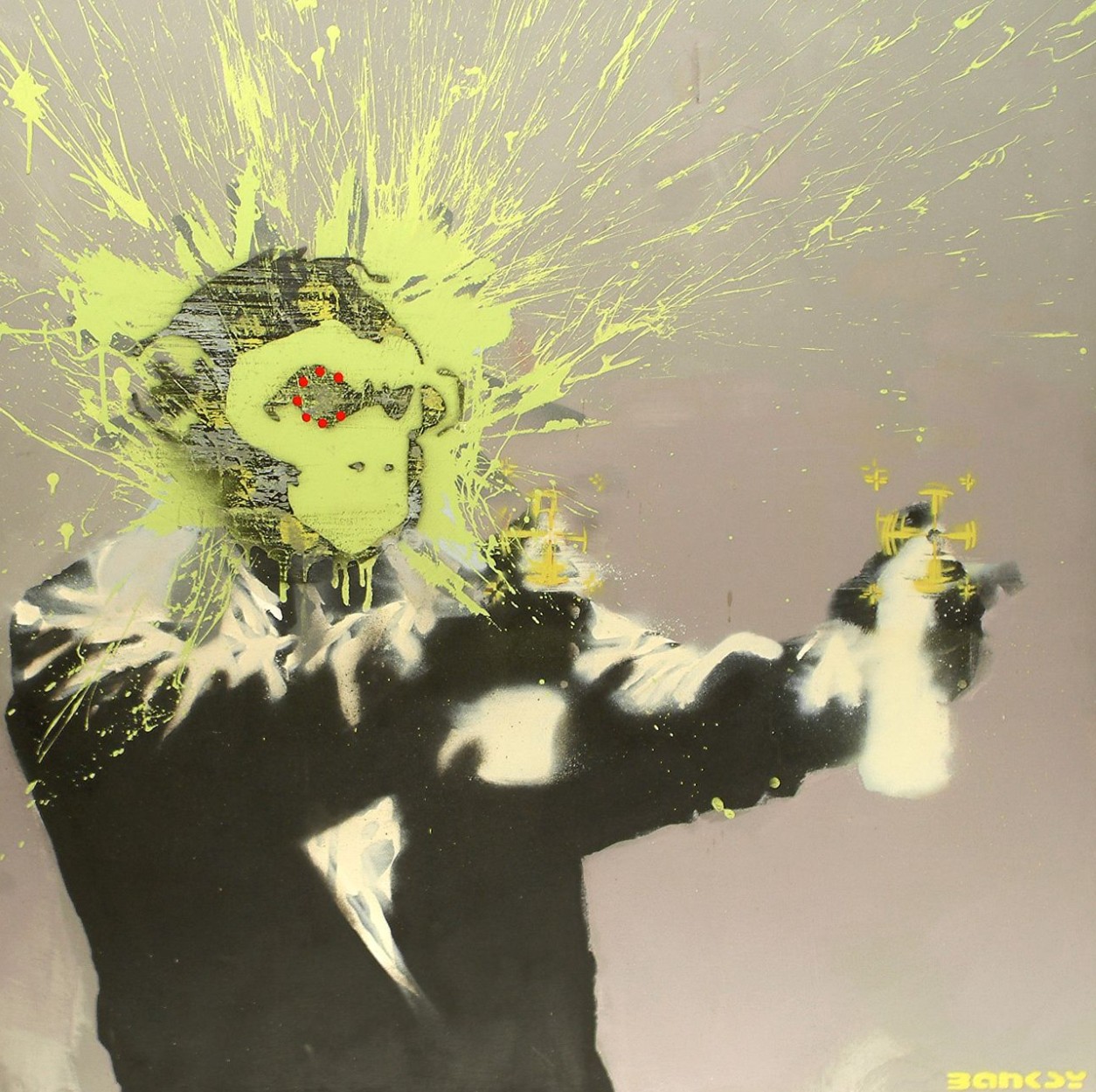
From the very beginning of his career, Banksy has resisted the cult of personality that increasingly surrounds contemporary artists. While graffiti demanded anonymity for legal reasons, his refusal to reveal his face gradually evolved into something far more profound. Ironically, despite remaining invisible, Banksy has become one of the most recognizable artists in the world, followed by millions and discussed endlessly by the media, collectors, and critics alike. His anonymity has become part of his artistic language rather than merely a means of self-protection.
In many respects, Banksy represents the complete opposite of Andy Warhol.
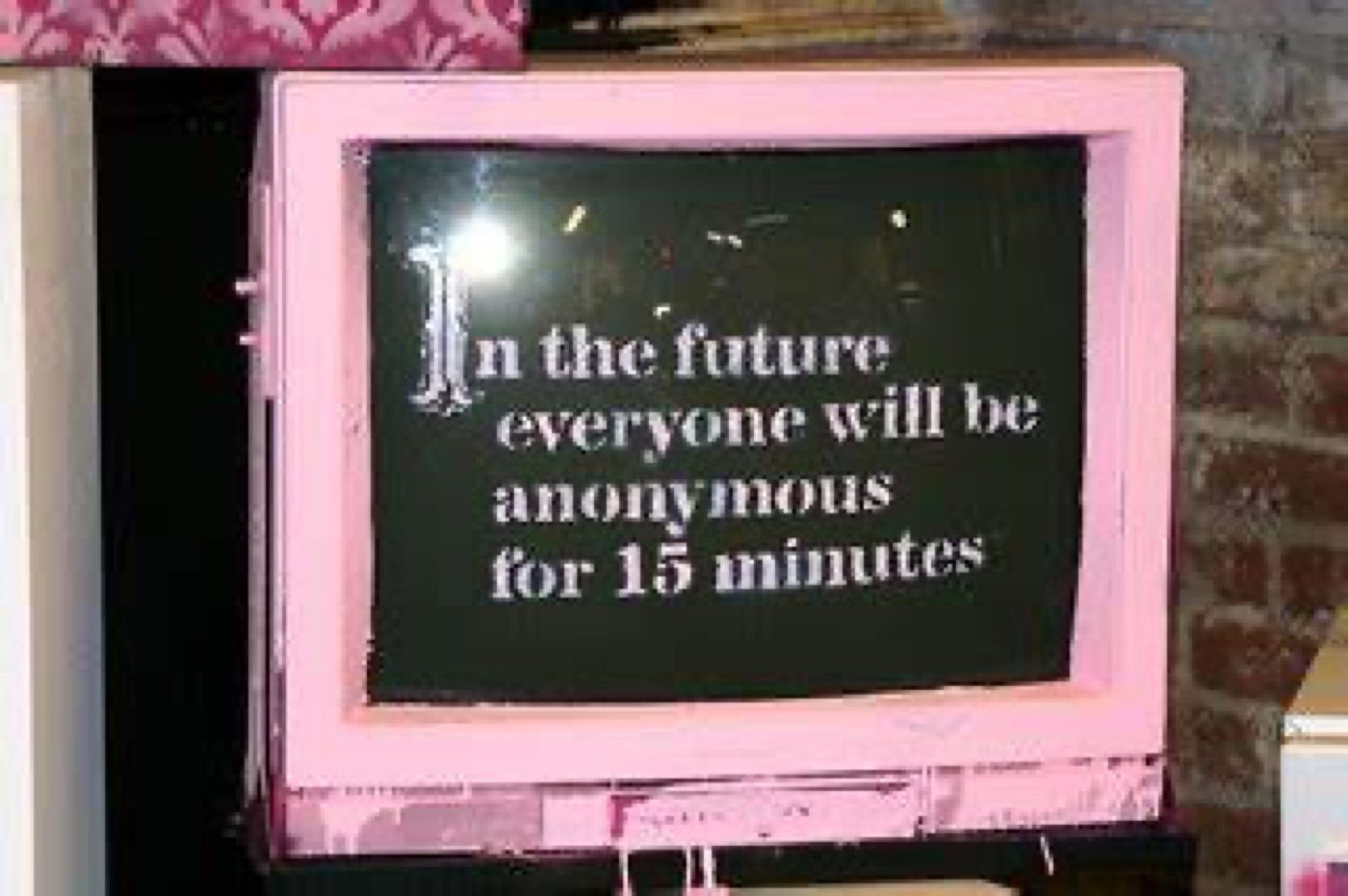
Warhol famously observed that, “In the future, everyone will be world-famous for fifteen minutes.” Few predictions have proved more accurate. Social media has transformed celebrity into a commodity, creating a culture in which visibility itself has become a form of success. Today, millions aspire to become influencers, accumulating followers, likes, and fleeting moments of recognition. Banksy has consistently rejected that model. Instead of placing himself at the center of attention, he removes himself from the equation entirely, allowing the artwork to eclipse the artist.
The monkey therefore becomes far more than a disguise. It functions as Banksy's alter ego, a surrogate through which he can observe and critique society while remaining deliberately anonymous. Rather than presenting himself as an artistic genius or cultural icon, he adopts a figure traditionally associated with imitation, instinct, irreverence, and satire. The gesture is characteristically self-deprecating, quietly suggesting that the artist is no more important than the society he observes.
This visual identity soon extended beyond Self Portrait. During the early 2000s, Banksy was photographed on several occasions wearing his now-famous monkey mask, most notably in James Pfaff's celebrated Monkey Mask Session of 2003. These rare images rapidly became iconic, offering the public a paradoxical portrait of an artist determined never to reveal his true face. The monkey mask concealed his identity while simultaneously becoming one of the most recognizable symbols associated with it.
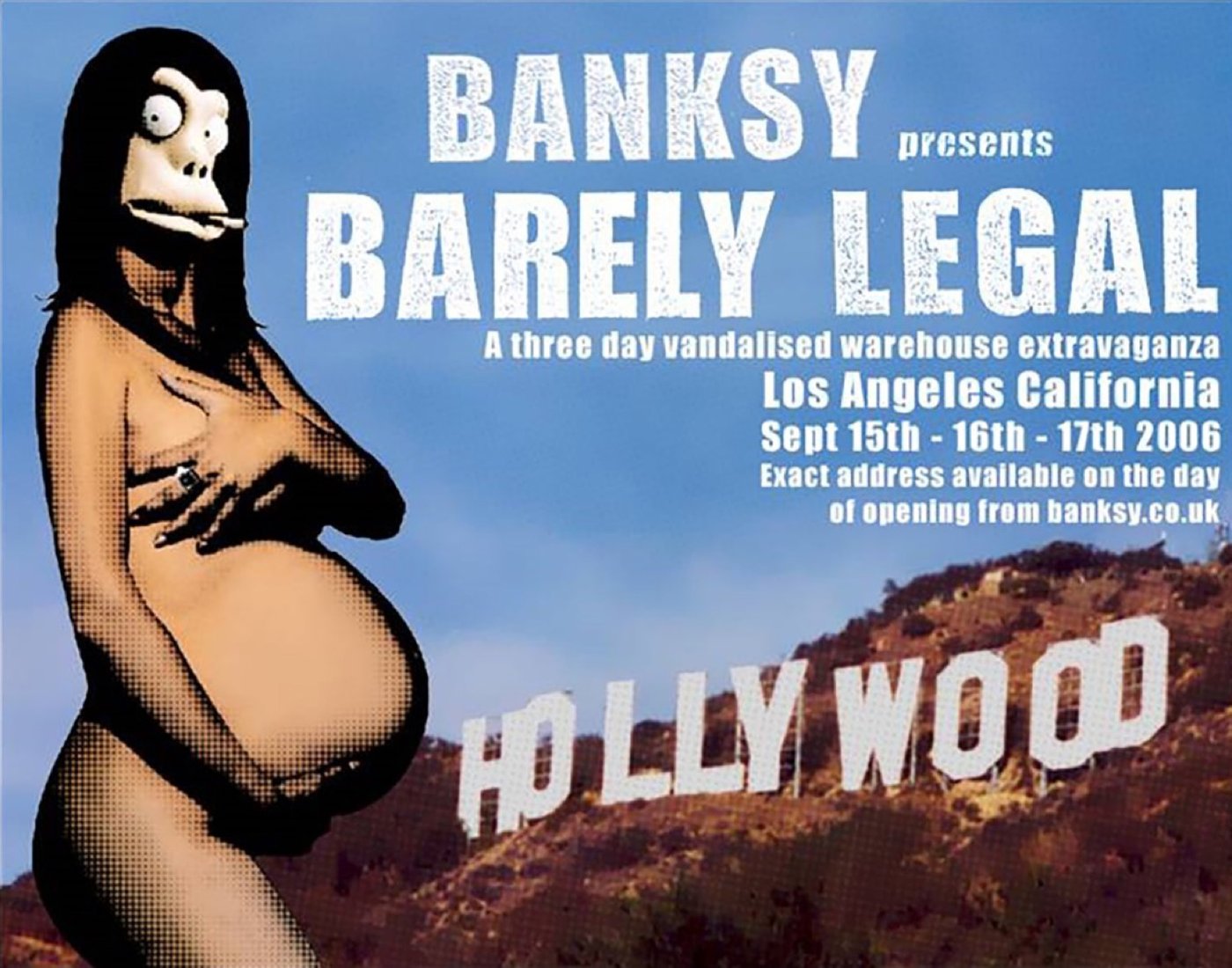
Banksy would revisit this imagery several years later for one of the defining moments of his career. In 2006, to promote his landmark Barely Legal exhibition in Los Angeles, he produced Original Concept for Barely Legal Poster (After Demi Moore), a witty parody of Annie Leibovitz's celebrated 1991 Vanity Fair portrait of the pregnant Demi Moore.
Original Concept for Barely Legal Poster (After Demi Moore), 2006
In Banksy's version, the glamorous actress is replaced by a pregnant figure wearing the unmistakable monkey mask. The result is both hilarious and deeply subversive. At the very heart of Hollywood—the global capital of fame, image, and celebrity—Banksy chose to present himself not as an artist seeking recognition, but as an anonymous monkey.
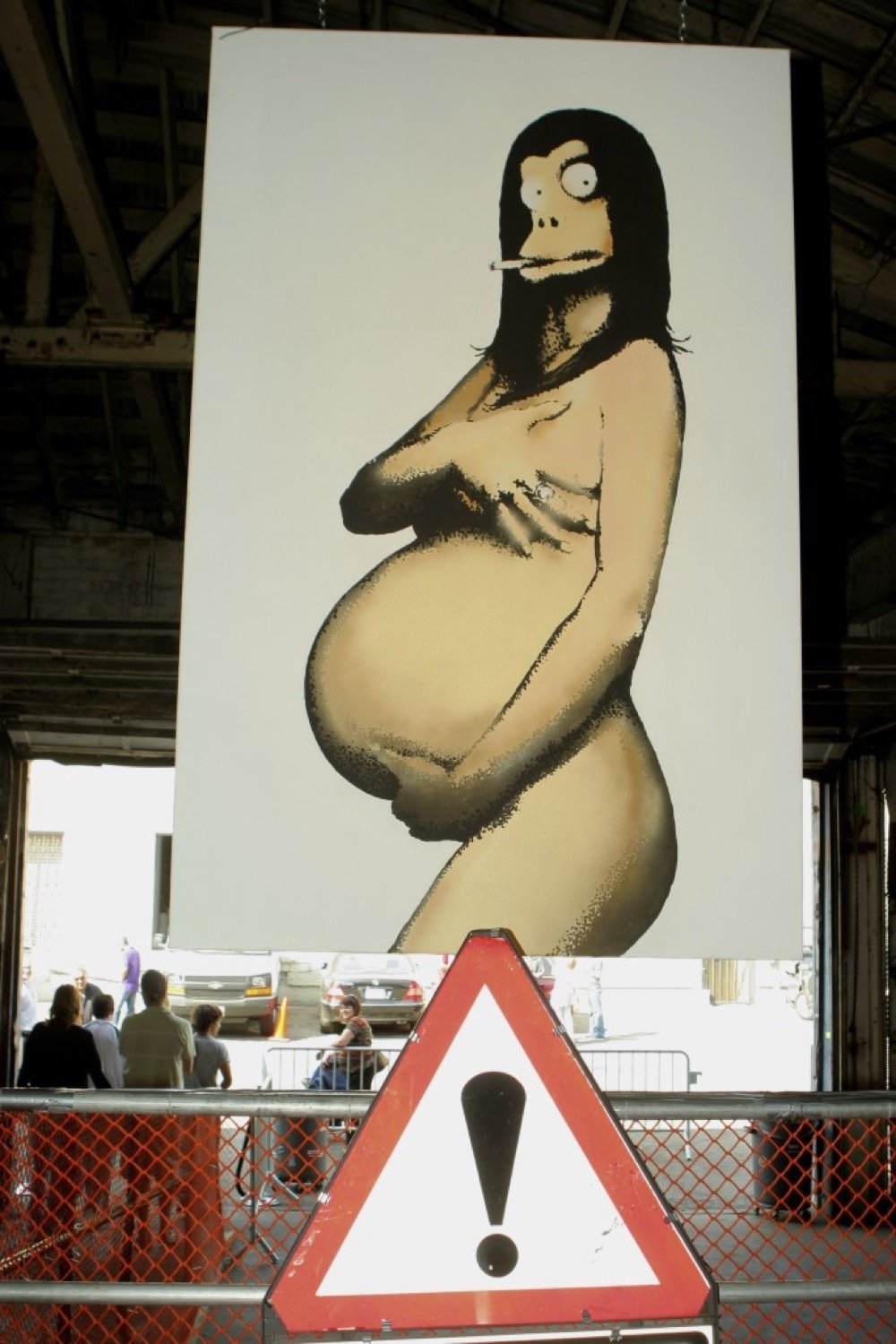
Seen together, Self Portrait, the monkey mask photographs, and the Barely Legal poster reveal that the monkey is far more than one of Banksy's recurring characters. It is, perhaps, his most personal creation. It embodies his rejection of celebrity, his embrace of anonymity, and his conviction that ideas should always matter more than the individual who produces them. In an age increasingly obsessed with visibility, Banksy's greatest act of self-portraiture may well have been to erase himself altogether.
The Evolution of Conformity
Simple Intelligence Testing in Dumb Animals
Created around 2000, Simple Intelligence Testing in Dumb Animals is one of Banksy's earliest and most conceptually intriguing monkey works. At first glance, the image appears almost absurd: a monkey sits before a table, confronted with two buttons beneath a sign that reads “Simple Intelligence Testing in Dumb Animals.” One button is labelled BANANA, the other SHOCK. Unsurprisingly, the monkey reaches for the banana.
The humor lies in its apparent simplicity. The monkey has passed the test by making the obvious choice. Yet, as is so often the case with Banksy, the real subject of the work is not the monkey at all. It is us.
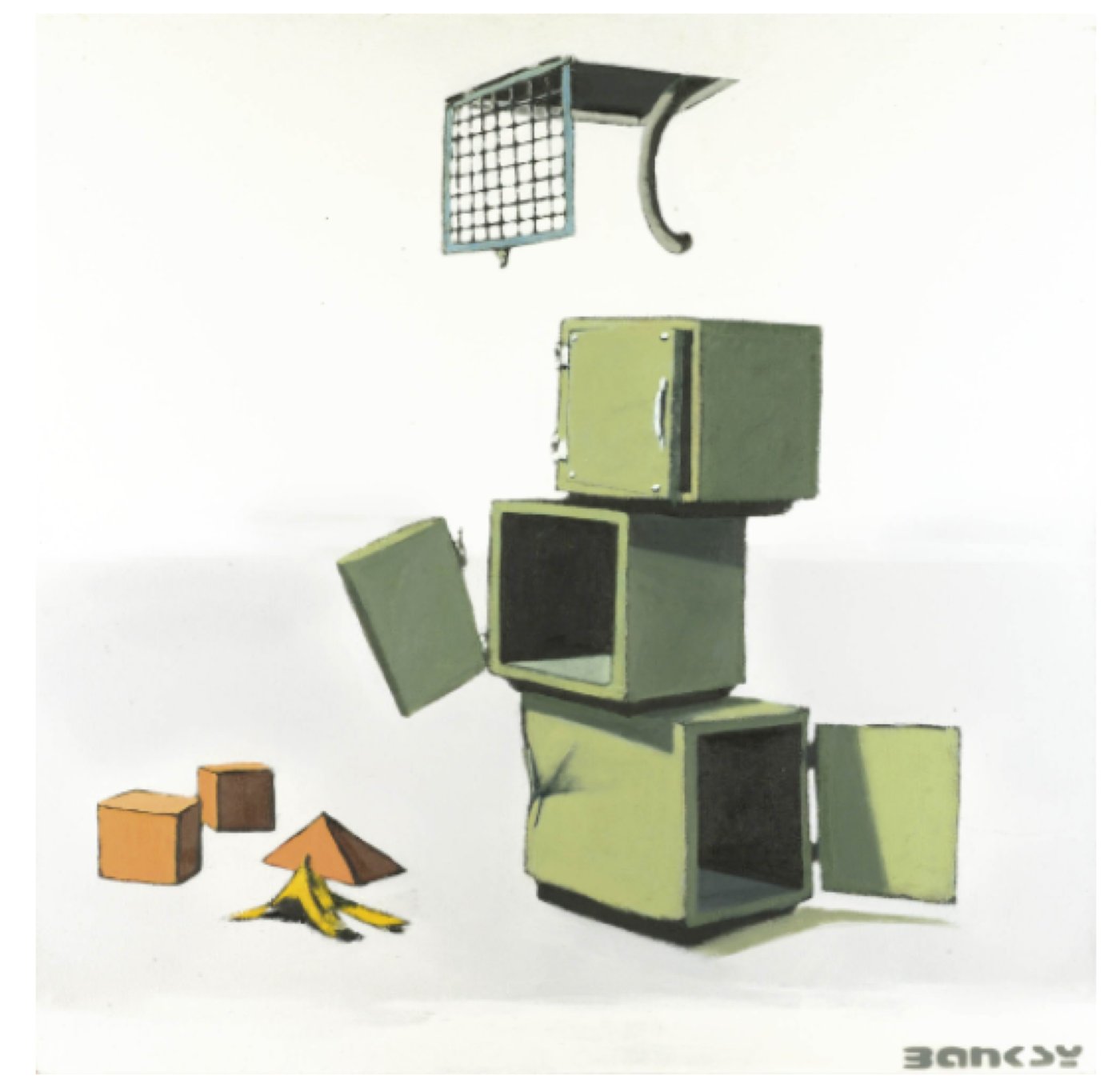
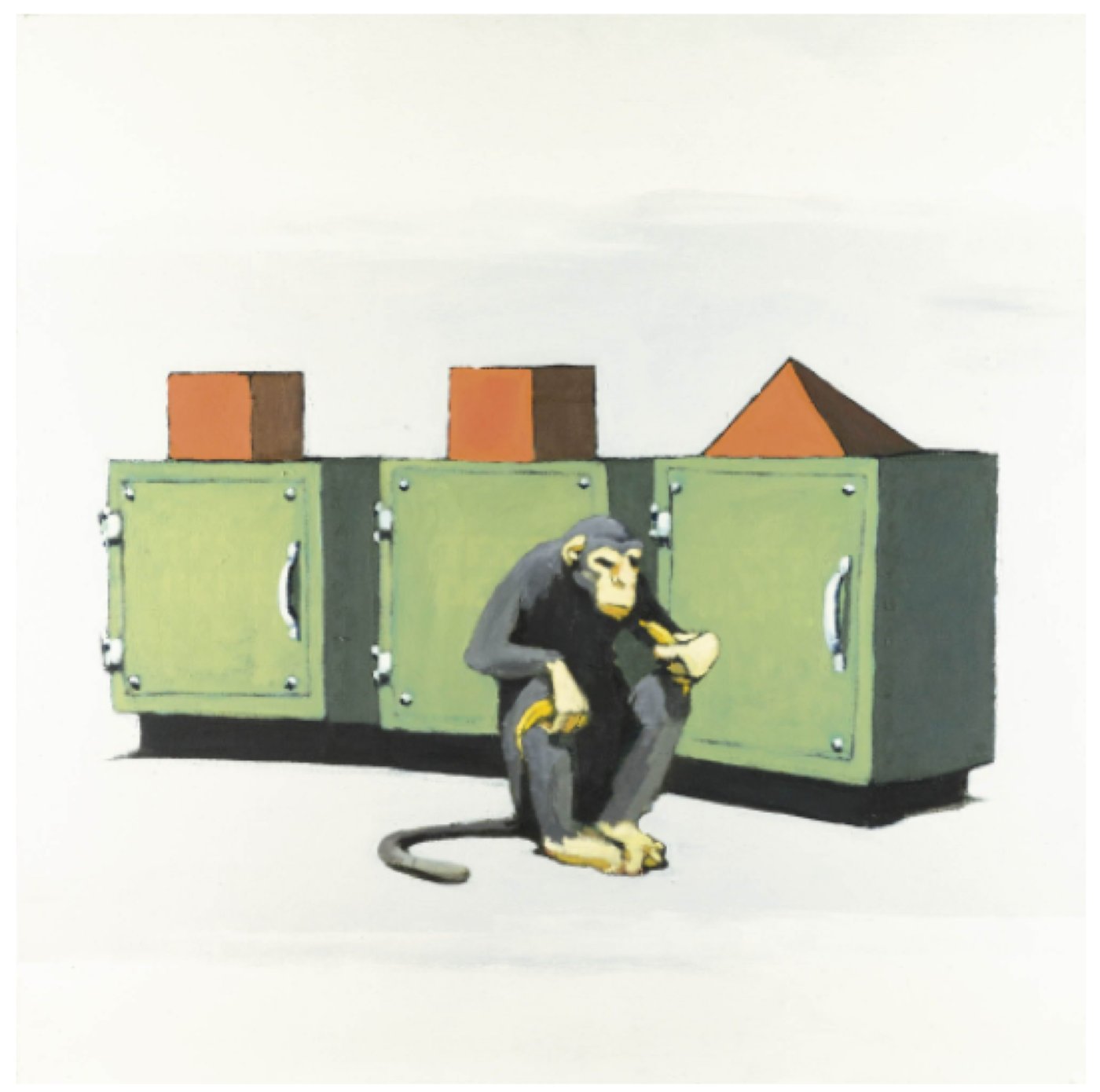
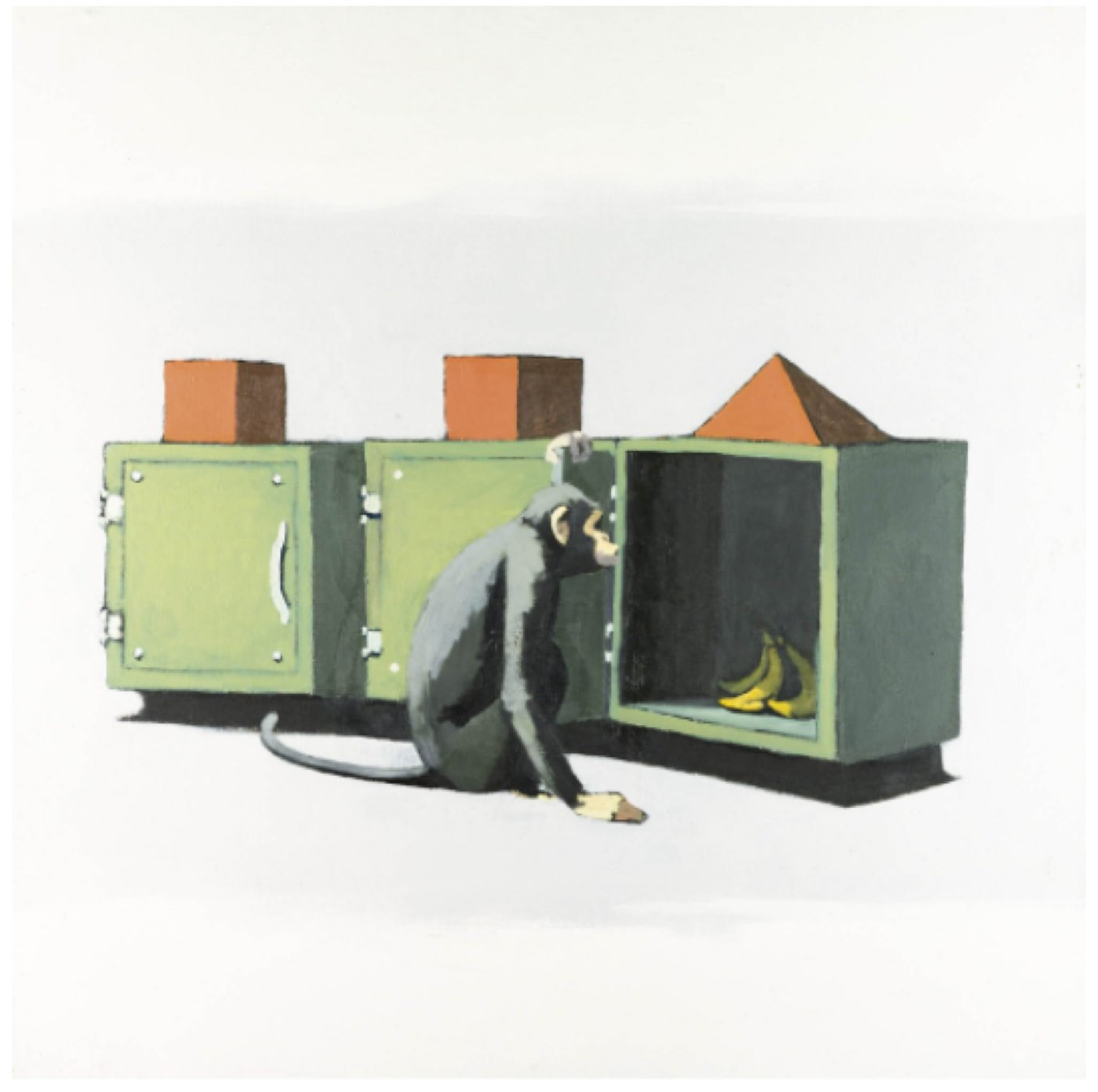
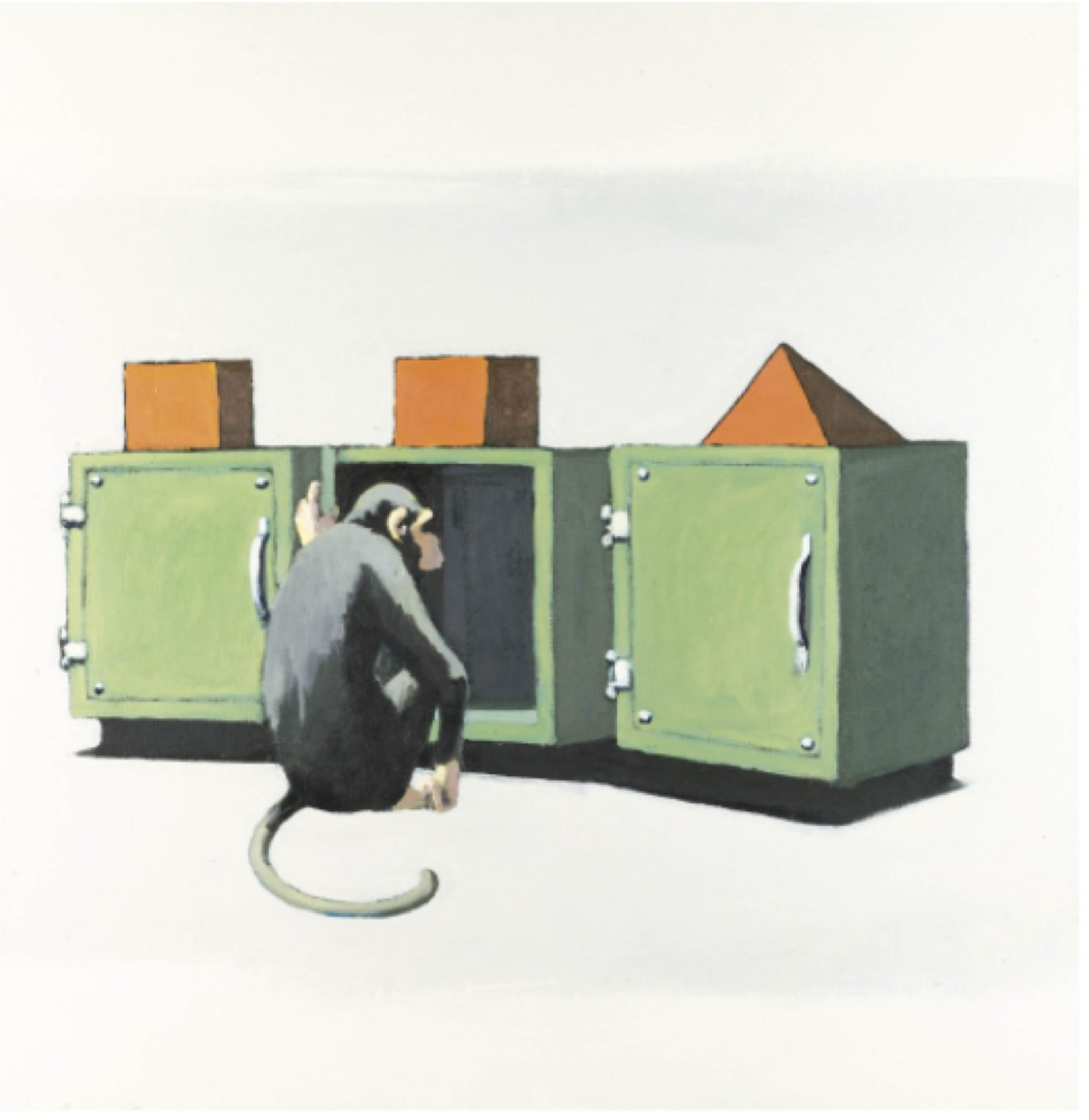
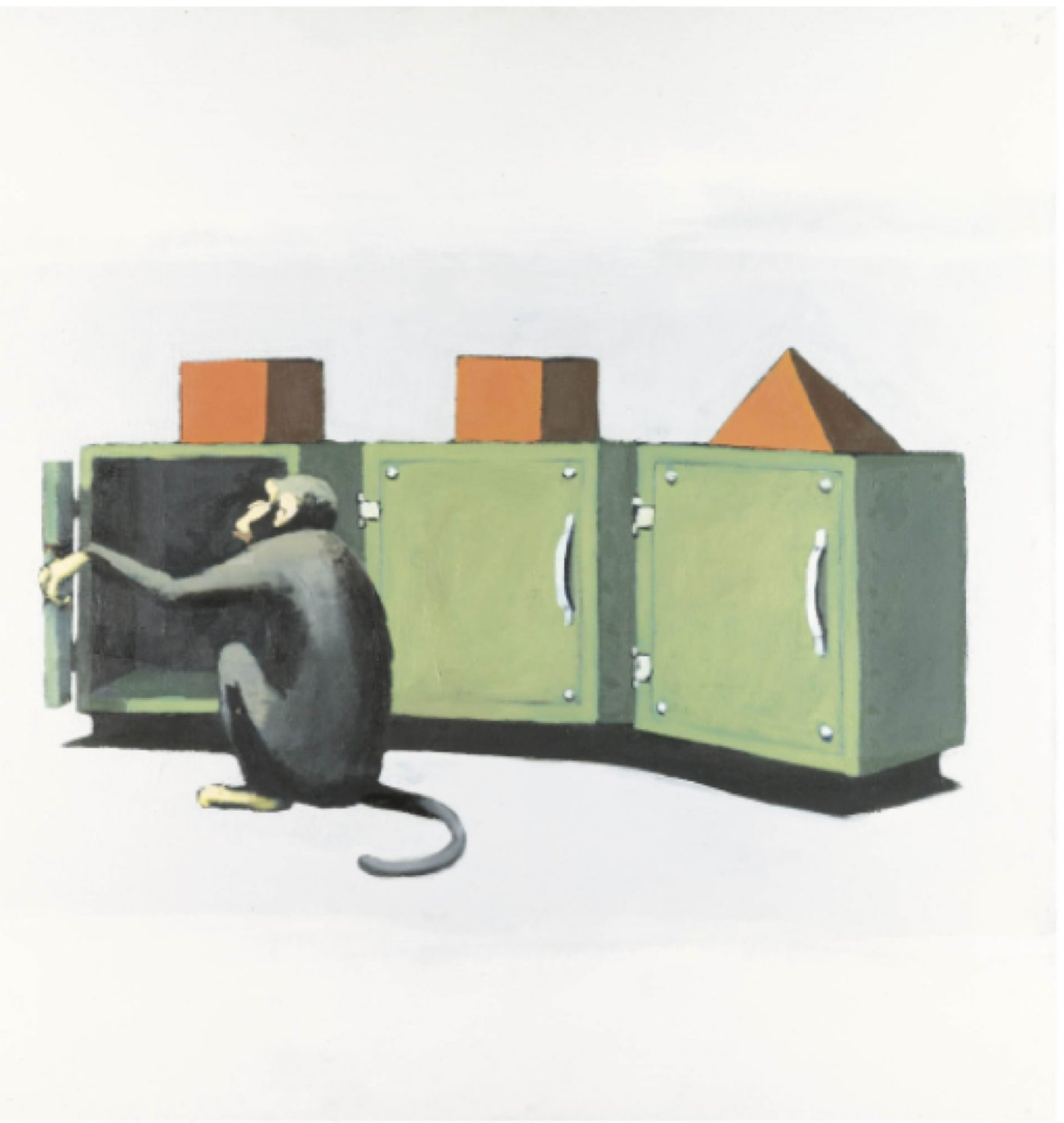
The title immediately introduces a delicious ambiguity. Who exactly are the “dumb animals”? Is the monkey being tested, or are the humans conducting the experiment revealing something about themselves? By turning the traditional laboratory experiment into a satirical image, Banksy invites the viewer to question the very notion of intelligence and the systems through which it is measured.
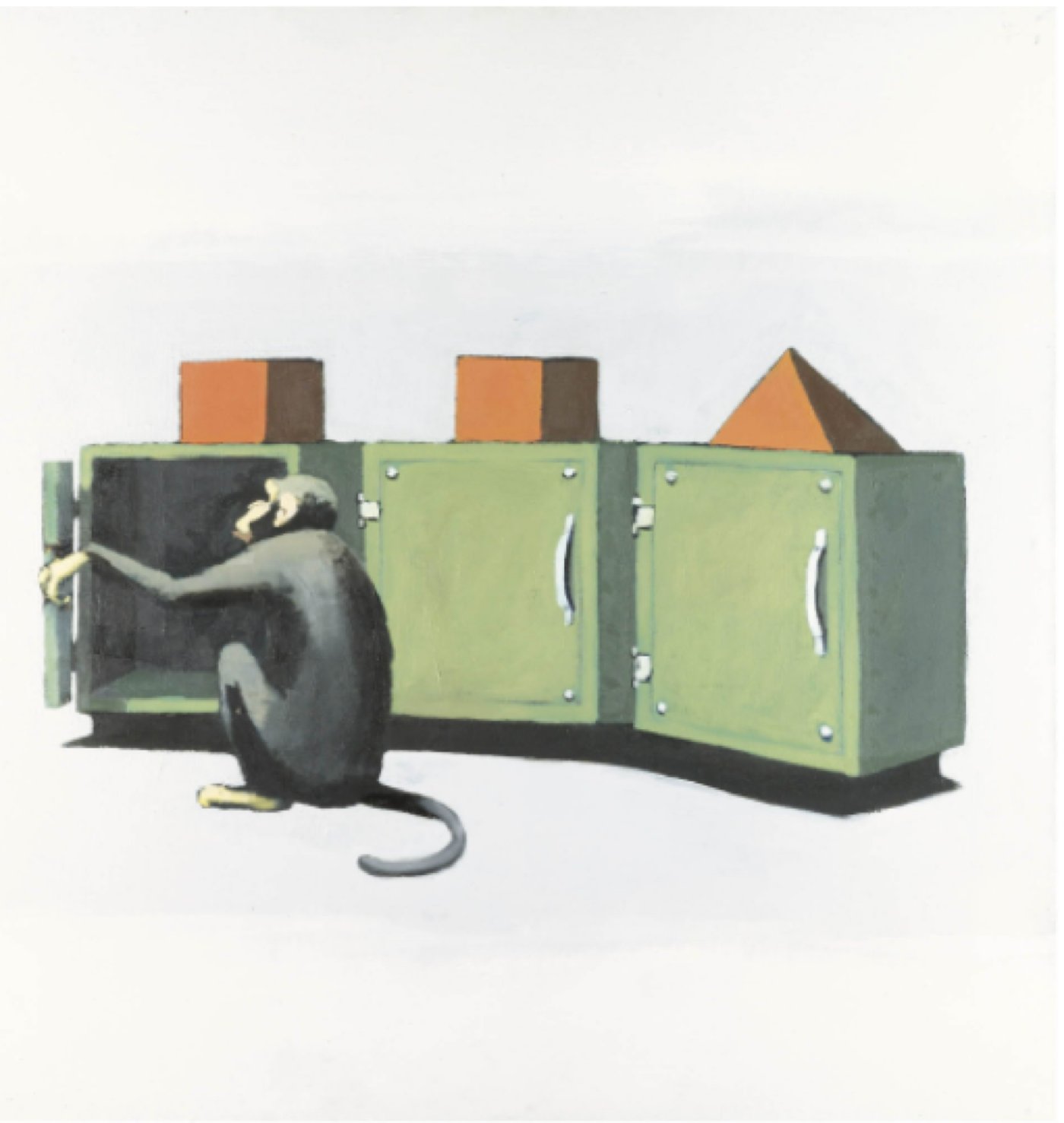
The composition also reflects one of the artist's recurring concerns: conformity. The monkey succeeds because it follows instinct and chooses the expected answer. Human societies, however, often reward exactly the opposite. From an early age, we are taught to follow rules, pass examinations, obey authority, and repeat accepted ideas rather than question them. Intelligence is frequently confused with compliance. Banksy gently mocks this tendency, suggesting that modern society sometimes resembles one vast behavioral experiment in which success depends less on independent thought than on learning which button those in power expect us to press.
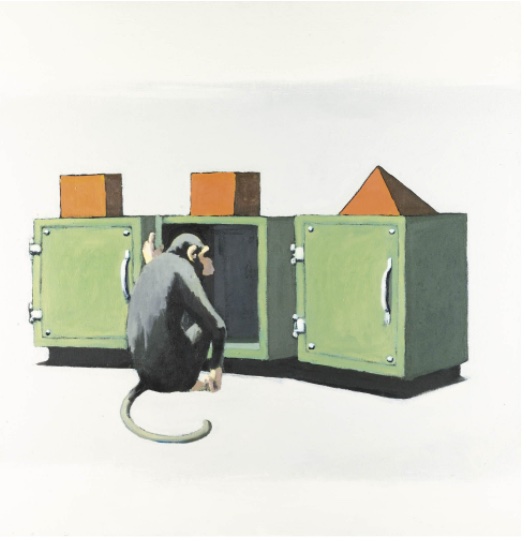
There is an unmistakable echo of the behavioral psychology experiments conducted throughout the twentieth century, particularly those involving conditioned responses and reward systems. Whether consciously or not, Banksy evokes the world of laboratory science, where animals were trained to associate specific actions with pleasure or punishment. By transplanting this imagery into the realm of social satire, he raises an uncomfortable question: are we fundamentally different? How many of our own daily decisions are genuinely free, and how many are simply conditioned responses to rewards, incentives, and social expectations?
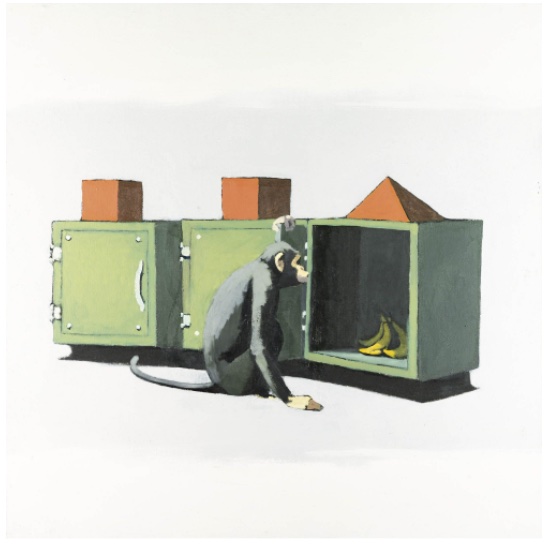
The monkey once again proves to be the perfect surrogate for humanity. Its presence softens what might otherwise be a harsh critique, allowing humor to disarm the viewer before the underlying message becomes apparent. We laugh at the obviousness of the monkey's decision, only to realize that our own lives are often shaped by equally predictable mechanisms. Consumer culture, political discourse, education, advertising, and even social media all operate through systems of reward and reinforcement that subtly encourage conformity while creating the comforting illusion of choice.
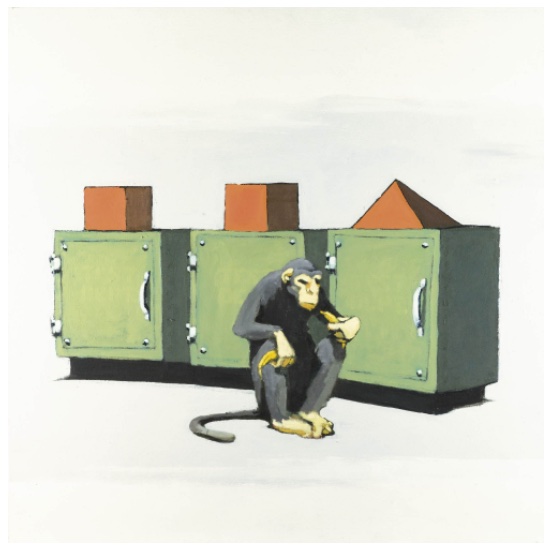
In retrospect, Simple Intelligence Testing in Dumb Animals feels remarkably prescient. Created before the rise of smartphones, algorithms, and the attention economy, it anticipates many of the questions that dominate contemporary society. Every notification, recommendation, advertisement, and digital reward nudges us towards particular behaviours, transforming modern life into an endless series of carefully designed choices. We believe we are exercising free will, yet increasingly we respond to invisible systems not unlike the monkey responding to the promise of a banana.
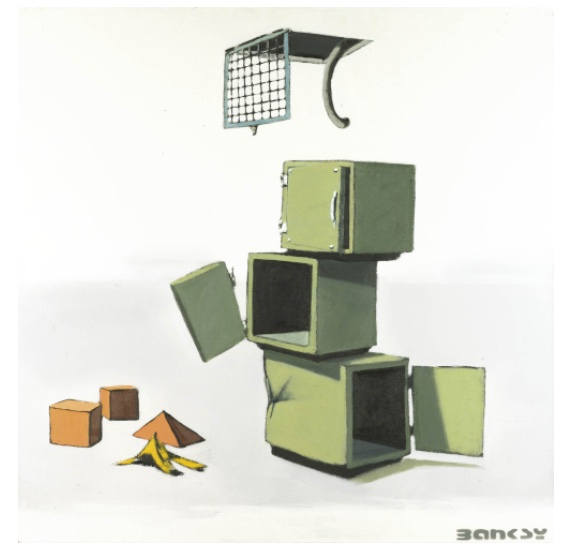
Although less famous than Laugh Now or Monkey Queen, this early work introduces ideas that would resonate throughout Banksy's career. Behind its deceptively playful composition lies a timeless reflection on intelligence, obedience, and the invisible mechanisms that shape human behavior. Once again, the monkey is not the object of satire. It is merely the mirror in which we recognize ourselves.
Born To Serve?
Laugh Now (2002)
If one image can be said to define Banksy's monkey series, it is undoubtedly Laugh Now. First painted as a mural in Brighton in 2002 for the Ocean Rooms nightclub before later being released as one of the artist's most celebrated editions, the work has become one of Banksy's most recognizable and enduring creations. Its remarkable simplicity is precisely what gives it such extraordinary power.
“Laugh Now, but one day we'll be in charge”
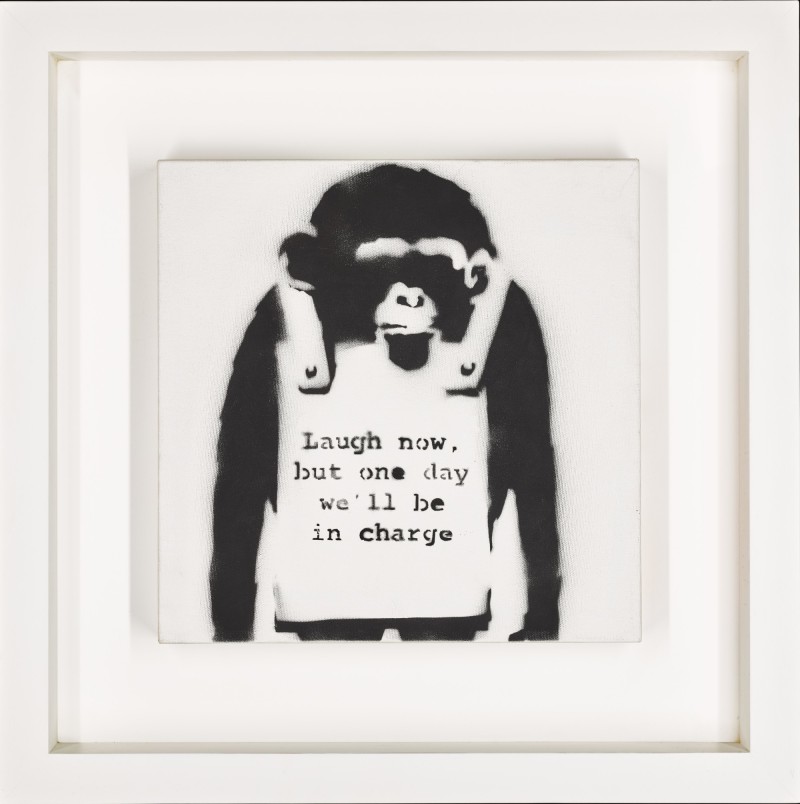
The composition depicts a forlorn monkey standing in profile, its shoulders slightly hunched and its expression resigned. Around its neck hangs a large placard bearing the now-famous inscription: “Laugh now, but one day we'll be in charge.” At first glance, the sentence reads like a joke. Yet, as with so many of Banksy's greatest works, the humour quickly gives way to something far more unsettling.
The monkey immediately evokes the long and often uncomfortable history of animals performing for human entertainment. For centuries, monkeys were exhibited in travelling circuses, fairs, and street performances, dressed in human clothing and trained to imitate their masters for the amusement of paying audiences. They occupied an ambiguous position: intelligent enough to resemble us, yet treated as objects of ridicule and exploitation. Banksy draws directly upon this historical imagery, transforming the performing monkey into a symbol of all those expected to entertain, obey, and remain in their assigned place.
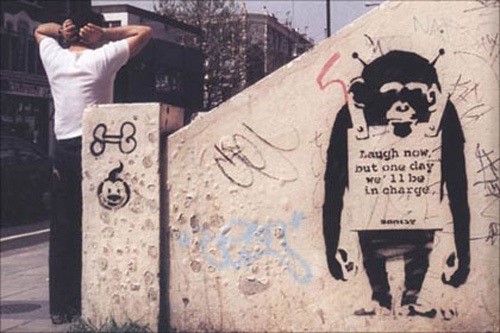
The placard fundamentally alters the meaning of the image. Rather than expressing resignation, it delivers a warning. The monkey accepts today's humiliation with remarkable patience, but only because history has not yet reached its conclusion. The promise that “one day we'll be in charge” transforms the work from social observation into political prophecy. Every established hierarchy, Banksy suggests, contains within it the seeds of its own reversal.
The identity of the “we” remains deliberately ambiguous, which partly explains the work's enduring appeal. The monkey may represent the working class, the marginalized, immigrants, political dissidents, street artists, or any community dismissed by those in positions of authority. Banksy never identifies the oppressor because the image functions as a universal metaphor for power itself. Every generation finds its own meaning within the sentence.
There is, however, another reading that is equally compelling. The monkey can also be understood as the artist. At the time Laugh Now was created, graffiti writers were still largely dismissed as vandals rather than recognised as legitimate artists. Banksy himself was frequently ridiculed by institutions that would later compete to exhibit and acquire his work. The monkey's quiet confidence therefore carries a distinctly autobiographical undertone. Those laughing today may not be laughing forever.
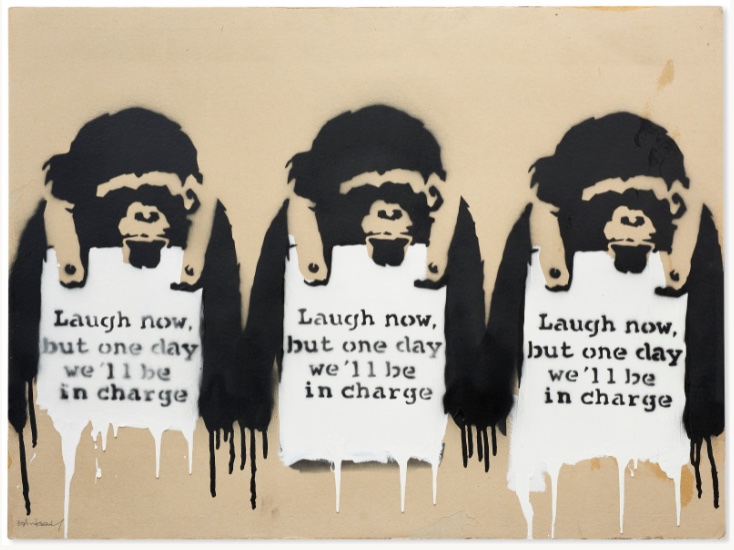
History has, in many respects, vindicated that prediction. What began as an illegal mural on the streets of Brighton has become one of the defining images of contemporary art. Museums, auction houses, and major collectors now celebrate the very artist who once operated outside the establishment. In retrospect, the monkey's prophecy appears almost uncannily accurate. The outsider has, in many ways, become the insider.
Yet the work ultimately transcends Banksy's personal success. Its enduring relevance lies in its ability to describe the cyclical nature of power itself. Throughout history, those who are mocked, underestimated, or marginalized often become the forces that reshape society. Revolutions begin on the fringes, not at the centre. Today's fool may become tomorrow's leader; today's dissident, tomorrow's hero.
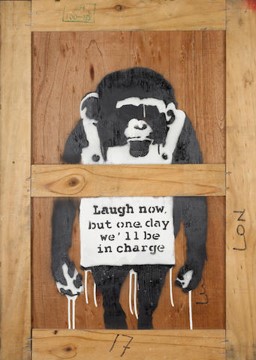
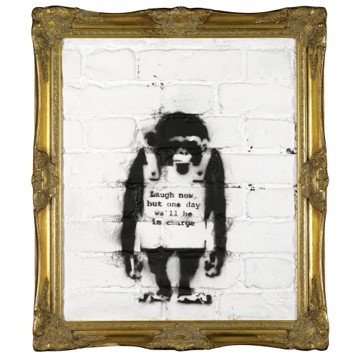
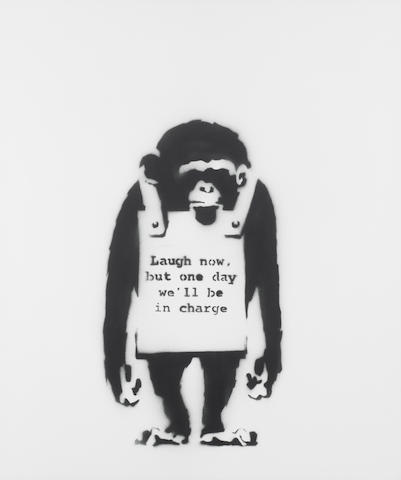
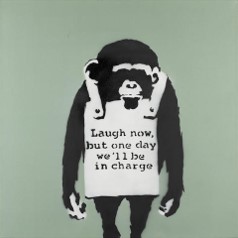
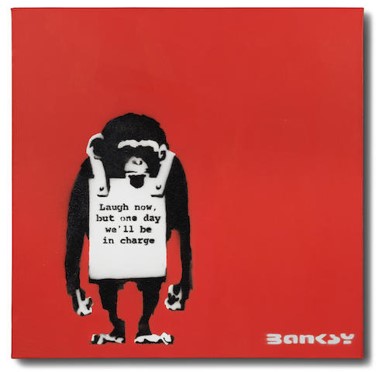
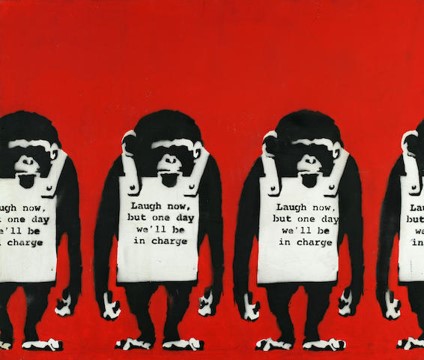
More than two decades after it first appeared, Laugh Now remains one of Banksy's most poignant and philosophically rich creations. Beneath its deceptively simple composition lies a meditation on dignity, oppression, and hope. The monkey stands quietly, offering neither anger nor revenge, only a patient certainty that power is never permanent. It is this delicate balance between humour and warning, vulnerability and confidence, that has transformed Laugh Now into one of the defining icons of Banksy's entire oeuvre.
The Last Honest Monkey
Keep It Real (2003)
Among Banksy's many monkey images, Keep It Real is perhaps the most disarmingly gentle. Created in 2003, the work depicts a monkey standing calmly while holding a simple cardboard sign bearing the words “Keep It Real.” There are no explosions, no dramatic gestures, and no overt political slogans. Yet beneath its apparent simplicity lies one of Banksy's most enduring reflections on authenticity in an increasingly artificial world.
The phrase itself belongs to the language of popular culture. Popularized by hip-hop during the 1990s, “keep it real” became shorthand for remaining authentic, honest, and true to one's values despite social pressure or commercial success. Banksy appropriates this familiar expression but places it in the hands of a monkey, immediately transforming an everyday slogan into something far more ironic and thought-provoking.
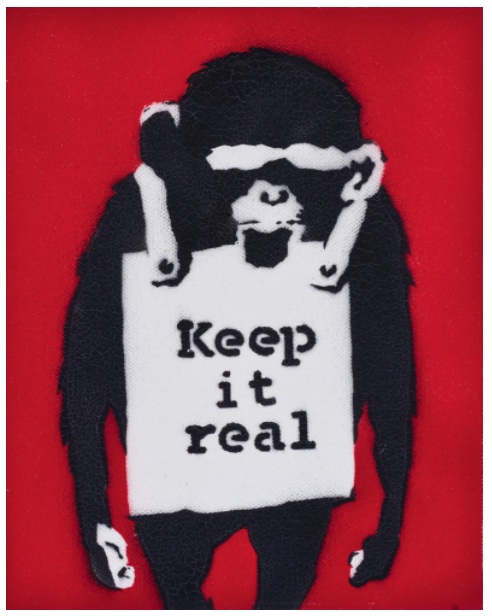
The choice of messenger is essential. Monkeys have traditionally symbolized imitation, mimicry, and performance. They copy gestures, behaviours, and appearances, making them unlikely advocates for authenticity. It is precisely this contradiction that gives the image its strength. If even the monkey is urging us to “keep it real,” Banksy seems to ask, what does that say about the increasingly performative nature of modern society?
The work can also be read as a subtle self-portrait. By 2003, Banksy's reputation was growing rapidly, yet he continued to resist the temptations of celebrity and commercialisation. Unlike many artists who cultivate public personas as carefully as their artwork, Banksy chose to remain anonymous, refusing interviews, avoiding publicity, and allowing his work to circulate independently of his identity. The monkey's placard therefore reads almost like a personal manifesto—a quiet reminder to remain faithful to the ideals that first inspired his practice.
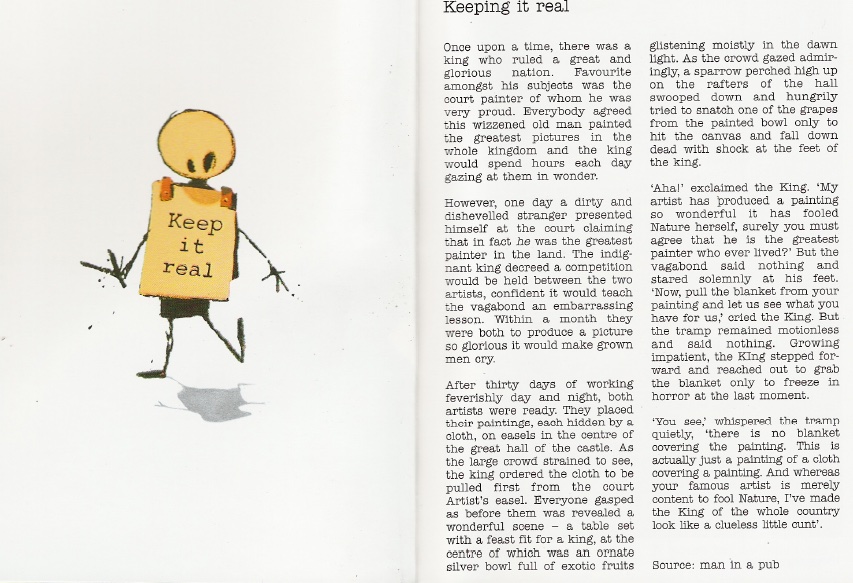
At a broader level, Keep It Real speaks to a society increasingly dominated by image rather than substance. Advertising encourages us to consume carefully manufactured lifestyles, politics often rewards performance over conviction, and social status is frequently measured through appearance rather than character. Although the work predates the explosion of social media, it now feels remarkably prophetic. In an age of curated online identities, filters, influencers, and digital self-branding, Banksy's simple message has acquired an almost philosophical resonance. The challenge of remaining authentic has arguably never been greater.
Unlike Laugh Now, which looks towards future revolution, or Monkey Detonator, which explores violence and manipulation, Keep It Real offers no threat and no accusation. Instead, it presents an invitation. The monkey does not lecture the viewer or claim moral superiority. It simply holds up a modest piece of cardboard carrying two words that seem almost embarrassingly obvious. Yet the longer one looks, the more difficult those words become to live by.
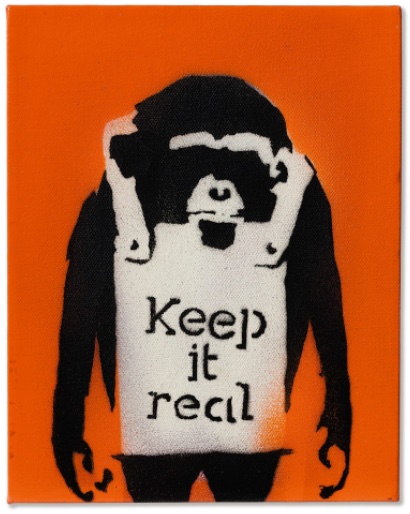
There is also a subtle irony at the heart of the composition. The creature most commonly associated with imitation becomes the spokesperson for authenticity, while human society—the supposedly rational and enlightened species—often appears trapped in endless cycles of conformity, status-seeking, and social performance. Once again, Banksy reverses expectations. The monkey behaves with honesty while humanity increasingly resembles the imitator.
More than twenty years after its creation, Keep It Real remains one of Banksy's most quietly profound works. Its message is neither political nor ideological in the conventional sense, but deeply human. It reminds us that authenticity is not something we possess naturally, but something we must constantly defend against the pressures of fashion, ambition, and public opinion. Through one calm monkey holding one modest sign, Banksy delivers a timeless lesson: in a world increasingly built on appearances, perhaps the most radical act of all is simply to remain true to oneself.
Violence at the Push of a Button
Monkey Detonator (2000)
Created around 2000, Monkey Detonator is one of Banksy's earliest monkey images and among his most unsettling. The composition is deceptively straightforward: a monkey stands calmly while gripping the plunger of a classic box detonator, the kind traditionally associated with cartoon explosions and cinematic acts of sabotage. As with many of Banksy's strongest images, the apparent simplicity conceals a far more disturbing meditation on violence, responsibility, and the ease with which destructive power can be placed in the wrong hands.
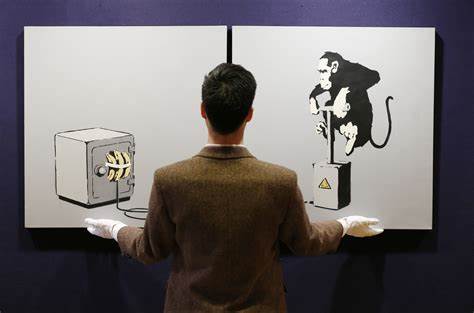
At first glance, the work appears almost comical. The sight of a monkey holding such an object feels inherently absurd, inviting the viewer to smile at the incongruity. Yet that humor quickly evaporates. The detonator introduces a latent tension, suggesting that catastrophe is only a single movement away. The monkey itself appears neither aggressive nor enraged. It simply waits. The uncertainty surrounding what will happen next becomes the true subject of the work.
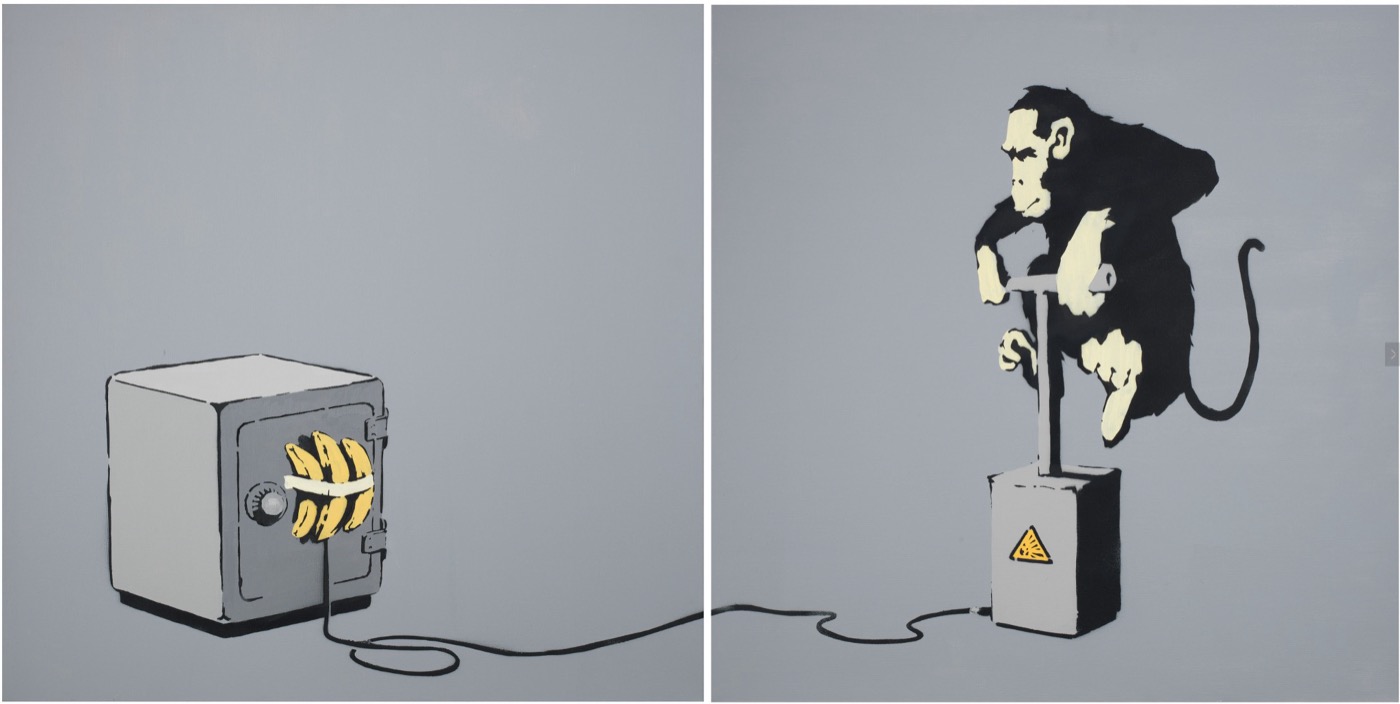
Banksy deliberately avoids depicting the explosion itself. Instead, he focuses on the moment immediately beforehand, when everything still remains possible. This suspended instant gives the image its psychological power. The viewer instinctively anticipates disaster, even though none has yet occurred. In doing so, Banksy reminds us that the greatest danger often lies not in violence itself, but in the decision to unleash it.
The monkey once again functions as humanity's surrogate. Throughout history, acts of war, terrorism, and political violence have frequently been explained through ideologies, religions, or national interests. Banksy strips away all of those justifications. By replacing the human actor with a monkey, he reduces the situation to its most essential question: what happens when immense destructive power is entrusted to creatures whose judgement may be driven by instinct, manipulation, fear, or ignorance?
The work can also be interpreted as a reflection on obedience. The monkey does not appear to have built the bomb or conceived the plan. It merely holds the mechanism capable of setting events in motion. In this respect, Monkey Detonator evokes one of the recurring themes throughout Banksy's oeuvre: the ease with which ordinary individuals can become instruments of violence when directed by those in positions of authority. The monkey is less a terrorist than an unwitting participant, raising uncomfortable questions about manipulation, responsibility, and the consequences of blind obedience.
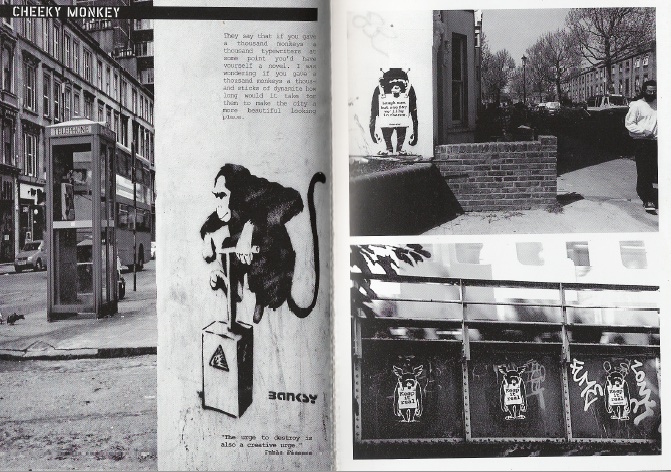
Created at the beginning of the twenty-first century, the image would acquire an even greater resonance in the years that followed. In a world increasingly shaped by terrorism, military intervention, and political extremism, the simple act of pressing a button came to symbolize forms of violence that are often distant, anonymous, and technologically mediated. Whether launching missiles from thousands of miles away or spreading destruction through ideological radicalization, modern conflict frequently reduces life-and-death decisions to surprisingly small gestures. Banksy's monkey captures that unsettling reality with remarkable economy.
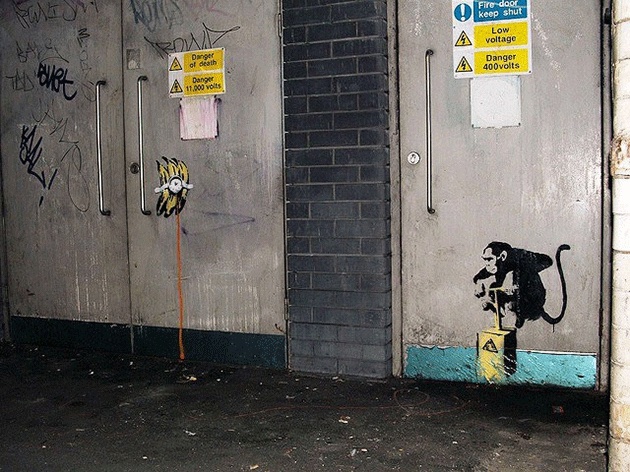
There is another, more universal reading. The detonator need not represent literal explosives at all. It can be understood as a metaphor for the countless moments in which human beings possess the power to unleash irreversible consequences through impulsive decisions, angry words, or reckless actions. The monkey therefore embodies not simply political violence, but the fragile relationship between power and self-control that exists within us all.
Viewed alongside Laugh Now and Keep It Real, Monkey Detonator reveals another facet of Banksy's simian alter ego. Here, the monkey is neither victim nor philosopher, but the custodian of immense destructive potential. The work reminds us that civilization is often separated from chaos by little more than a single decision. The monkey may be holding the detonator, but the responsibility, as always in Banksy's work, ultimately belongs to us.
Long Live The Monkey King
Monkey Queen (2003)
Few images demonstrate Banksy's talent for satire more elegantly than Monkey Queen. Created in 2003, the work depicts a monkey dressed in the ceremonial robes and diamond crown of Queen Elizabeth II, replacing one of the most recognizable figures in British history with one of the artist's oldest and most familiar symbols. The image is immediately humorous, but like the finest political caricatures, its comedy conceals a far more sophisticated reflection on authority, symbolism, and the nature of power itself.
The British monarchy has long occupied a unique place within Banksy's artistic universe. Throughout his career, the artist has repeatedly questioned institutions that derive their authority from tradition rather than merit, exposing the rituals, ceremonies, and symbols that sustain political and social hierarchies. By replacing the Queen with a monkey, Banksy does not merely mock an individual. He challenges the very mechanisms through which authority is constructed and maintained.
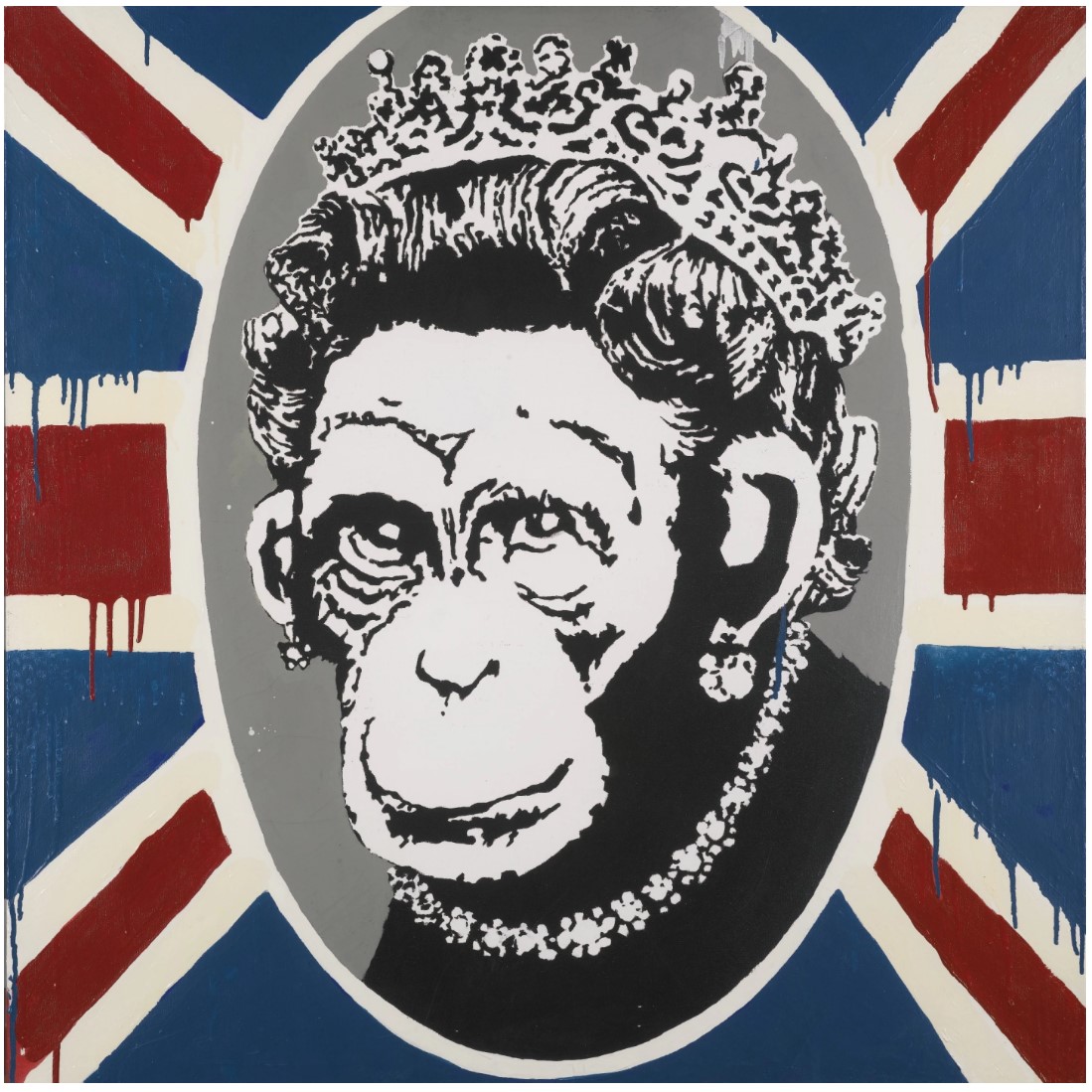
The substitution is remarkably effective because the composition itself remains almost entirely unchanged. The monkey adopts the Queen's familiar pose, wears the same robes, and displays the same jewels. Everything associated with royal dignity is preserved except the face. Banksy thereby suggests that much of institutional authority resides not in the individual but in the symbolism that surrounds them. The crown, the robes, the ceremony, and centuries of tradition create legitimacy, regardless of who happens to wear them.
The monkey has always occupied a privileged role in satire precisely because it imitates human behavior so convincingly. Here, however, the imitation becomes almost perfect. The absurdity lies not in the monkey pretending to be Queen, but in how little appears to change once the substitution has been made. Banksy gently invites us to ask an uncomfortable question: if authority depends largely upon costume, ritual, and collective belief, how much of it is genuine and how much is performance?
Deride and Conquer
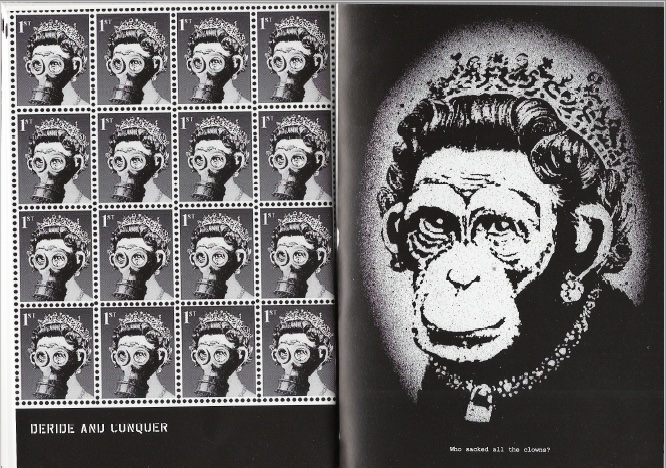
There is also a broader reflection on inherited power. Modern democracies often pride themselves on equality, meritocracy, and individual achievement, yet many continue to preserve institutions whose legitimacy derives principally from birth. Banksy does not offer a direct political argument for or against monarchy. Instead, he exposes its theatrical dimension, encouraging viewers to reflect on why societies continue to invest such extraordinary symbolic significance in hereditary figures.
As with many of Banksy's greatest works, Monkey Queen extends well beyond its immediate British context. Around the world, countless political, religious, and corporate institutions rely upon carefully choreographed images of authority. Uniforms, titles, ceremonies, and architecture all contribute to an illusion of permanence and legitimacy. By replacing one of history's most recognizable sovereigns with a monkey, Banksy demonstrates how surprisingly fragile those symbols may be once viewed through the lens of satire.
The work also reveals an important evolution in Banksy's monkey imagery. In Laugh Now, the monkey belonged to the oppressed. In Keep It Real, it became the moral observer. In Monkey Detonator, it embodied humanity's destructive potential. Here, the monkey ascends to the very summit of power. The transformation is deliberate. Banksy suggests that the monkey is capable of occupying every level of society because, ultimately, it represents society itself.
More than twenty years after its creation, Monkey Queen remains one of Banksy's most iconic and enduring images. It exemplifies the artist's remarkable ability to dismantle centuries of political symbolism through the simplest of visual substitutions. With little more than a monkey's face and a royal crown, Banksy transforms one of Britain's most revered institutions into a playful yet profound meditation on power, legitimacy, and the enduring absurdity of human civilization.
When The Monkeys Take Over
Devolved Parliament (2009)
If Laugh Now ends with the warning that “one day we'll be in charge,” Devolved Parliament imagines that day has finally arrived.
Completed in 2009, this monumental painting transforms one of the most recognizable chambers of British democracy—the House of Commons—into a parliament populated entirely by chimpanzees. Members of Parliament shout across the benches, debate passionately, gesture animatedly and occupy every seat, yet not a single human being remains. The image is instantly humorous, but its extraordinary scale and meticulous execution elevate it far beyond political caricature. It stands today as one of Banksy's most ambitious and important paintings.
At first sight, the work appears to be a straightforward attack on British politics. By replacing elected representatives with monkeys, Banksy ridicules the behaviour that so often characterizes parliamentary debate: theatrical confrontation, tribal loyalty, empty rhetoric, and performative outrage. The joke is obvious, yet its implications are considerably more profound. The monkeys are not behaving like animals. They are behaving exactly like politicians.
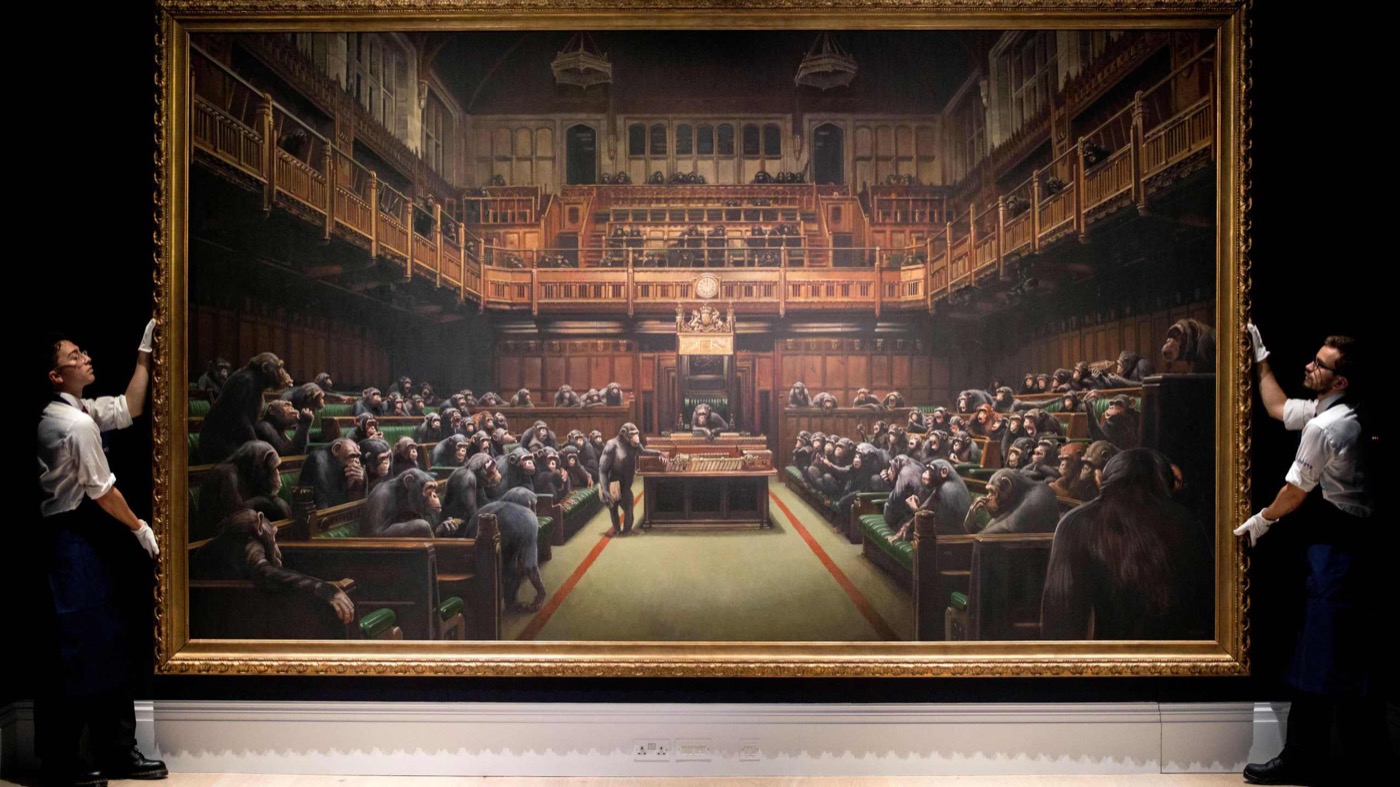
In doing so, Banksy reverses the traditional satirical formula. Rather than suggesting that politicians resemble monkeys, he implies that monkeys are perfectly capable of reproducing the rituals and absurdities of political life. The distinction between civilization and instinct begins to disappear. Parliamentary procedure, with all its elaborate conventions and centuries-old traditions, suddenly appears strangely primitive when viewed through this unexpected substitution.
The title itself deserves careful attention. “Devolved” refers not only to the constitutional transfer of political powers to Scotland, Wales, and Northern Ireland, but also carries its ordinary meaning of regression or decline. Banksy deliberately exploits this double meaning. Has Parliament evolved into the highest expression of democratic government, or has it, in fact, devolved into something far less rational? The ambiguity lies at the very heart of the painting.
Although rooted in British politics, the work speaks far beyond Westminster. Every democracy struggles with polarization, populism, spectacle, and the increasing tendency for political debate to resemble performance rather than genuine deliberation. By removing the human faces altogether, Banksy transforms a specifically British institution into a universal allegory of power. The painting is not ultimately about Parliament. It is about politics itself.
With hindsight, Devolved Parliament has acquired an almost prophetic quality. Painted a decade before Brexit reached its political climax and years before parliamentary divisions dominated international headlines, the work appears uncannily to anticipate an era of unprecedented political instability. When it was exhibited again in 2019 at the Bristol Museum, Banksy renamed it Question Time, a subtle reminder that the painting's relevance had only grown stronger with time.
Viewed within the broader context of Banksy's monkey imagery, Devolved Parliament represents the logical conclusion of a story that began nearly a decade earlier. The anonymous monkey of Self Portrait rejected celebrity. The monkey in Simple Intelligence Testing in Dumb Animals questioned conformity. Laugh Now predicted the reversal of power. Keep It Real defended authenticity. Monkey Detonator explored humanity's capacity for destruction. Monkey Queen mocked inherited authority. Here, finally, the monkeys no longer observe human society—they have become it.
Perhaps that is the painting's most unsettling message. The true satire is not that Parliament has been invaded by monkeys. It is that, after a few moments of looking, the scene begins to feel strangely plausible. The monkeys do not diminish the dignity of politics; they merely reveal how thin the boundary can be between civilization and instinct, authority and theatre, democracy and performance. In the end, Banksy's vision is not one of animals pretending to be humans, but of humans quietly recognizing themselves in the animals.
STAY INFORMED
Receive the latest news, exhibitions, artworks and market updates on Banksy.