CURRENTLY BEING UPDATED
There Is Always Hope…
The Birth of An Icon
Few artworks created during the last decades have achieved the extraordinary status of Banksy’s Girl with Balloon. Originally sprayed onto public walls in London, the image of a young girl reaching toward a drifting red heart-shaped balloon became something much larger than graffiti. It transformed into a universal symbol capable of speaking across countries, generations and social boundaries. The remarkable achievement of the image lies in its simplicity. With minimal visual information and almost no narrative context, Banksy created a work capable of triggering deeply personal reactions. Some see hope, others see loss. Some perceive freedom, while others see heartbreak. Like the best symbols in art history, Girl with Balloon offers no single answer.
Original Graffiti Mural
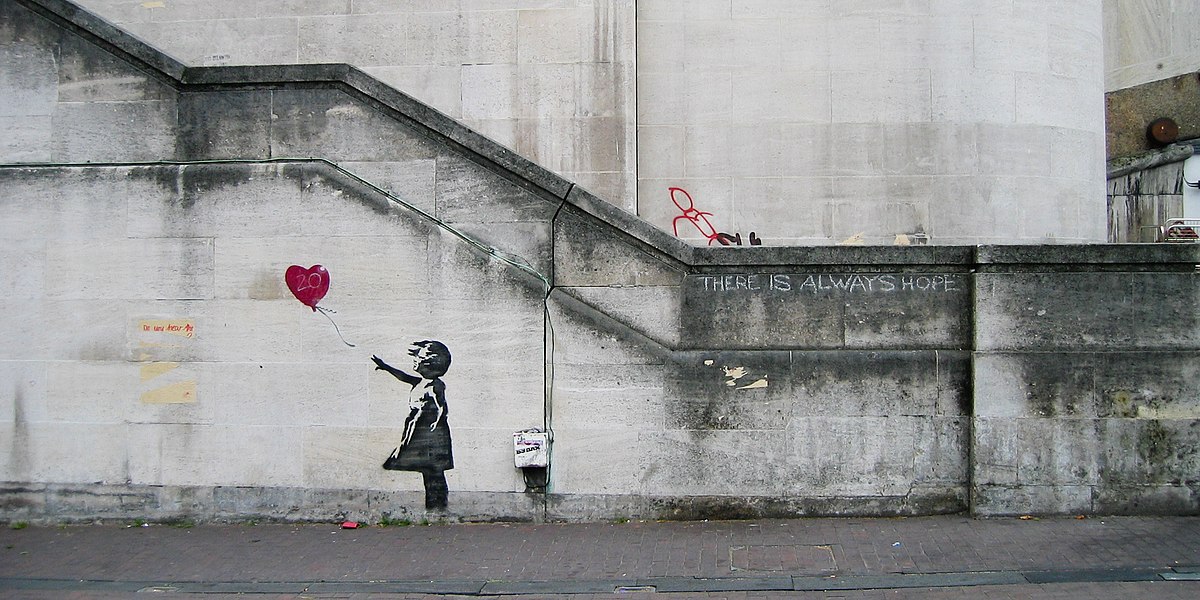
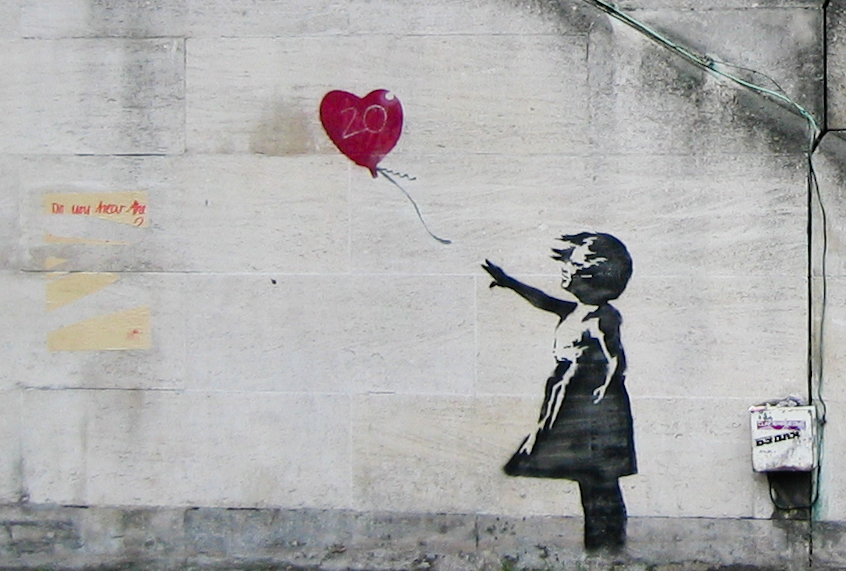
Ironically, despite becoming perhaps Banksy’s most famous image, the original street works themselves disappeared. Painted over, removed or damaged over time, they followed the temporary destiny common to street art. Yet the disappearance of the original murals only seemed to strengthen the image itself. The artwork escaped the wall and entered collective memory.
Description and Visual Language

The heart-shaped balloon immediately becomes the focal point because of Banksy’s deliberate use of color. Against the monochromatic stencil, the vivid red interrupts the composition and pulls the eye directly toward the symbol. This restrained approach reflects one of Banksy’s greatest strengths: saying very much while showing very little. The work almost functions like visual poetry. Remove one element and the emotional structure collapses.
Banksy rarely explains his works directly, preferring ambiguity over instruction. This ambiguity is central to Girl with Balloon. The viewer immediately encounters an unresolved question: Is the child trying to catch the balloon, or has she just released it? The distinction changes everything. If the balloon is escaping, the image becomes a meditation on loss and the fleeting nature of innocence. If the child has willingly released it, then the scene becomes one of freedom, growth and acceptance. Banksy leaves us suspended precisely at the point where certainty disappears.
The power of the image may lie in this moment of uncertainty. Human life itself often unfolds in similar ways — relationships drift away, childhood disappears, opportunities arrive and vanish, hopes rise and collapse. The work captures that emotional tension in a single gesture.

“There Is Always Hope”
Some versions of the mural appeared beside the phrase: “There Is Always Hope.” These four words completely alter the emotional reading of the image. Without them, Girl with Balloon risks becoming an image about disappearance and sadness. With them, it becomes an image about resilience. Hope becomes meaningful precisely because something appears beyond reach.
The statement itself also reflects an important characteristic of Banksy’s practice. Despite his criticisms of political systems, consumer culture and authority, many of his works contain a surprisingly human optimism beneath their cynicism. Even in moments of social criticism, there often remains a possibility of change.
Childhood and Lost Innocence
Children frequently appear throughout Banksy’s work. Rather than portraying childhood as carefree, Banksy often places children within uncomfortable environments shaped by politics, war, surveillance or social conflict. Works such as Napalm, No Ball Games, Bomb Hugger and Very Little Helps similarly rely upon the collision between innocence and harsh reality.
In Girl with Balloon, however, the confrontation is quieter. The child is not threatened by violence or authority. Instead, she confronts something universal: impermanence. The balloon may represent dreams, love, memory, security or childhood itself — all things that inevitably shift and change. The emotional force of the work comes partly from its familiarity. Most people recognize the feeling immediately, even if they struggle to explain why.
Girl with Balloon Across Different Media
Unlike many street artworks that remain tied to a single location or intervention, Girl with Balloon developed into an entire body of works and adaptations throughout Banksy’s career. The image gradually escaped the wall and began to exist in multiple forms, each carrying slightly different meanings and reaching different audiences.
The original mural versions first appeared as stencil interventions on public walls in London. Executed quickly in Banksy’s characteristic black-and-white style with the single red accent of the balloon, these early examples belonged to the fleeting world of street art. Like many public works, they were vulnerable to weather, urban redevelopment and removal. Their disappearance only reinforced the myth surrounding the image.
Banksy later translated the composition into screenprints, allowing the image to move from public space into private collections. Released in editions that rapidly became among the artist’s most sought-after works, the print versions preserved the simplicity of the original composition while giving collectors access to an image that had already become iconic. The heart-shaped balloon retained its vivid red color while the child remained rendered in monochrome, maintaining the visual tension that made the original so memorable.
Over time, numerous variations emerged. Some versions reversed the composition, others altered the color of the balloon or introduced subtle modifications. The image became flexible, almost functioning as a visual language rather than a fixed artwork.
Perhaps the most historically significant evolution came through canvas versions. These transformed the original street intervention into autonomous artworks intended for exhibition and eventually for the art market itself. Here a fascinating paradox appears. Banksy, who repeatedly criticized commercialization and systems of value, saw one of his most anti-materialistic images become one of the most valuable and recognizable objects within contemporary collecting culture.
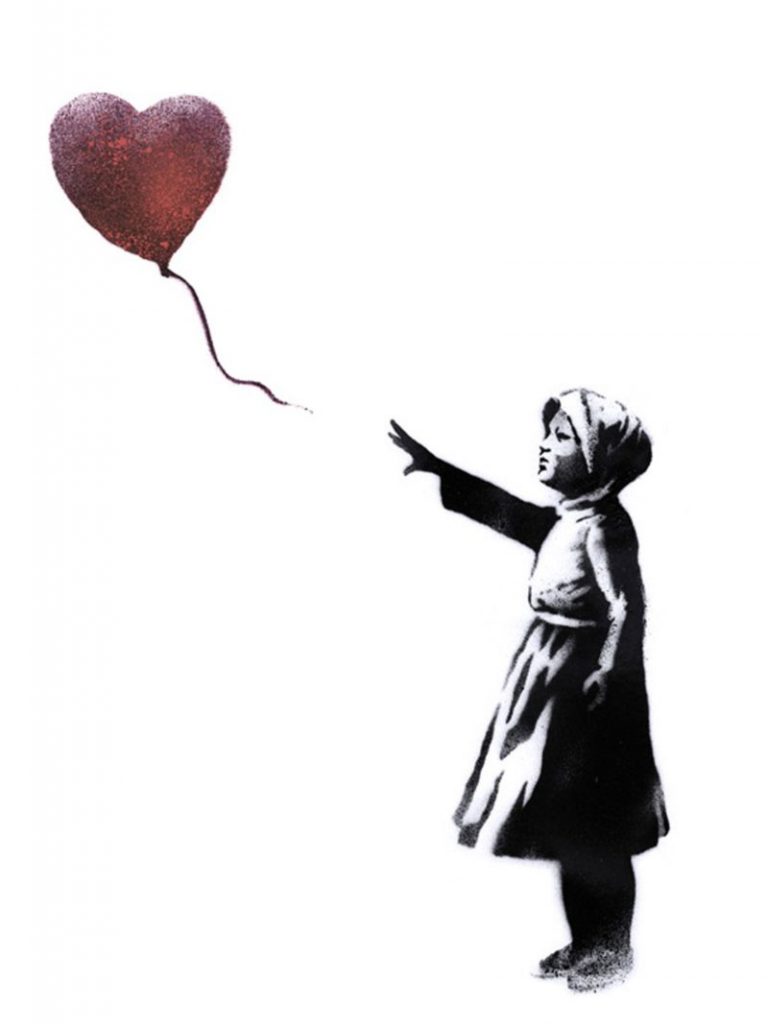
The image also appeared repeatedly in installations, publications and political campaigns. During Banksy’s support campaign for Syria, the girl was adapted with a headscarf and became a symbol of humanitarian concern. Through projections and public actions, the work demonstrated an unusual ability to migrate between artistic categories and social causes without losing its emotional force.
Then came perhaps its most famous transformation of all. During the Sotheby’s auction event in 2018, a framed version of Girl with Balloon passed through a hidden shredding mechanism immediately after the sale. The partially destroyed work emerged with a new identity: Love Is in the Bin. In a single gesture, Banksy transformed a print into a performance, a performance into an event, and an event into an entirely new artwork.
Few images in contemporary art have experienced such a journey. What began as paint on a wall eventually existed simultaneously as graffiti, print, canvas, political symbol, performance piece and cultural icon. The image itself never really remained still. Like the balloon drifting through the composition, it continued moving.
Girl with Balloon Prints
Banksy first translated the image into editioned screenprints, allowing the work to leave the street and enter private collections. Indeed, Banksy released a screenprint on paper in 2004 in editions of 150 signed, and 600 unsigned prints. Furthermore, a special run of 88 signed Artist’s Proofs (in 4 different colorways) were released.

Today these works are among the most sought-after prints from Banksy’s career and have become fundamental references within the Banksy market. The print versions preserve the striking simplicity of the original image while giving it a new permanence. Unlike the graffiti versions vulnerable to disappearance, the editions transformed the image into an object capable of circulating internationally among collectors.
Girl with Balloon (unsigned)
Girl with Balloon (unsigned), 2004
Bonhams LA: 24 March 2021
Estimated: USD 140,000 – 180,000
USD 450,312 / GBP 323,965
AUCTION RECORD FOR GIRL WITH BALLOON (UNSIGNED)

Screenprint in red and black on wove paper
Numbered in pencil 201/600, with the publisher’s blindstamp
Girl with Balloon (signed)
Estimated: GBP 200,000 – 300,000
AUCTION RECORD FOR GIRL WITH BALLOON (SIGNED)

Girl with Balloon (signed), 2004
Screenprint in colors on wove paper
Girl with Balloon (signed AP)
Girl with Balloon (Dark Pink AP), 2004
Sotheby’s London, 30 June 2022
Estimated: GBP 250,000 – 450,000
GBP 403,200 / USD 495,935

BANKSY
Girl with Balloon (Dark Pink AP), 2004
Screenprint in colors on wove paper
Signed in pencil, lower right
Inscribed AP26 in pencil with the publisher’s blindstamp, lower left
One of 88 Artist’s Proofs printed in various colorways
Girl with Balloon (Gold AP), 2004
Estimated: GBP 400,000 – 600,000
GBP 1,104,000 / USD 1,513,885

Girl with Balloon (Gold AP), 2004
Girl with Balloon (Dark Purple AP), 2004
Estimated: GBP 250,000 – 350,000
GBP 791,250 / USD 1,044,450

Girl with Balloon (Dark Purple AP), 2004
Screenprint in colors on wove paper
Girl with Balloon and Morons Sepia

Girl with Balloon & Morons Sepia, 2007
Phillips London: 20 October 2020
Estimated: GBP 500,000 – 700,000
GBP 1,232,500 / USD 1,609,580
Banksy – 20th Century & Contemporary … Lot 8 October 2020 | Phillips

BANKSY
Girl with Balloon & Morons Sepia, 2007
Girl with Balloon: Spray paint on paper
Morons Sepia: Screenprint on paper, double-sided
56.5 x 76 cm (22 1/4 x 29 7/8 inches)
Signed, numbered and dated ‘Banksy 07 2/8’ lower right
This work is number 2 from an edition of 8
Editions on Canvas
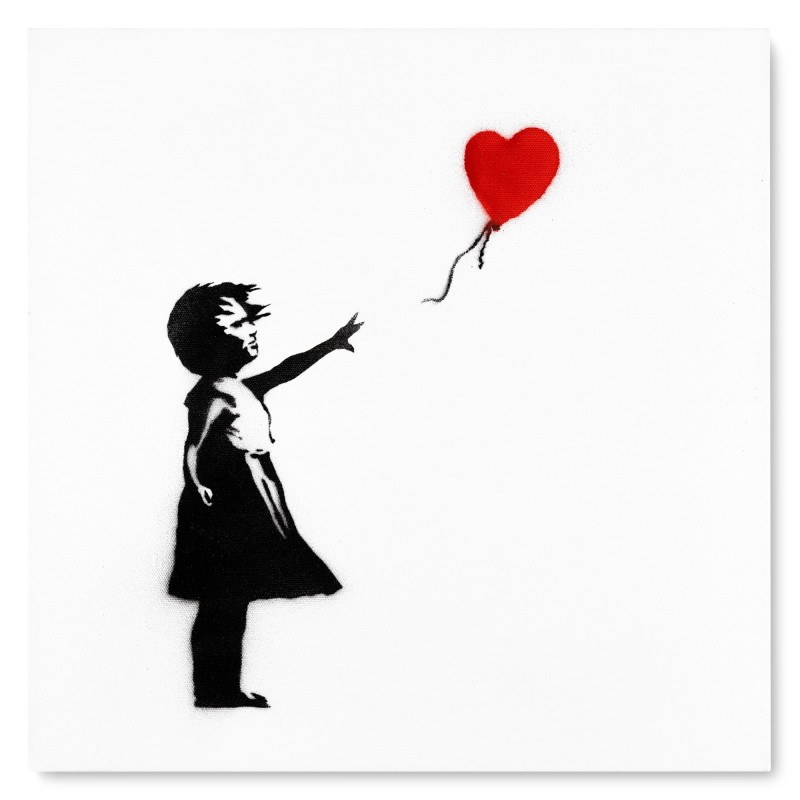
Banksy also produced a series of editioned canvas works based on the composition. These works moved Girl with Balloon further away from its origins as an ephemeral intervention and into the world of traditional fine art. Some examples exist as single canvases, while others were executed as diptychs and larger compositions. This transition creates an interesting contradiction. Banksy frequently criticized systems of commercial value, yet one of his simplest and most emotionally direct images became one of the most desirable objects within contemporary collecting culture.
Girl and Balloon, 2003
Balloon Girl (Diptych), 2005
Girl with Balloon Diptych is perhaps of the most distinctive reinterpretations. By dividing the image across two separate canvases, Banksy introduced a new sense of distance and fragmentation. The physical separation creates tension within the composition, emphasizing the emotional distance already present between the child and the drifting balloon. The diptych format transforms a fleeting moment into something more contemplative, almost cinematic.

PLEASE CLICK BELOW TO DISCOVER THE AMAZING STORY
BEHIND HERITAGE AUCTIONS NEXT OFFERING ON 5 JUNE 2026
Kids on Guns, 2003

Girl with Balloon Originals
Girl with Balloon, 2006
Sotheby’s London: 2 March 2022
Estimated: GBP 2,000,000 – 3,000,000
GBP 2,818,000 / USD 3,766,875
Girl with Balloon | The Now Evening Auction | | Sotheby’s (sothebys.com)
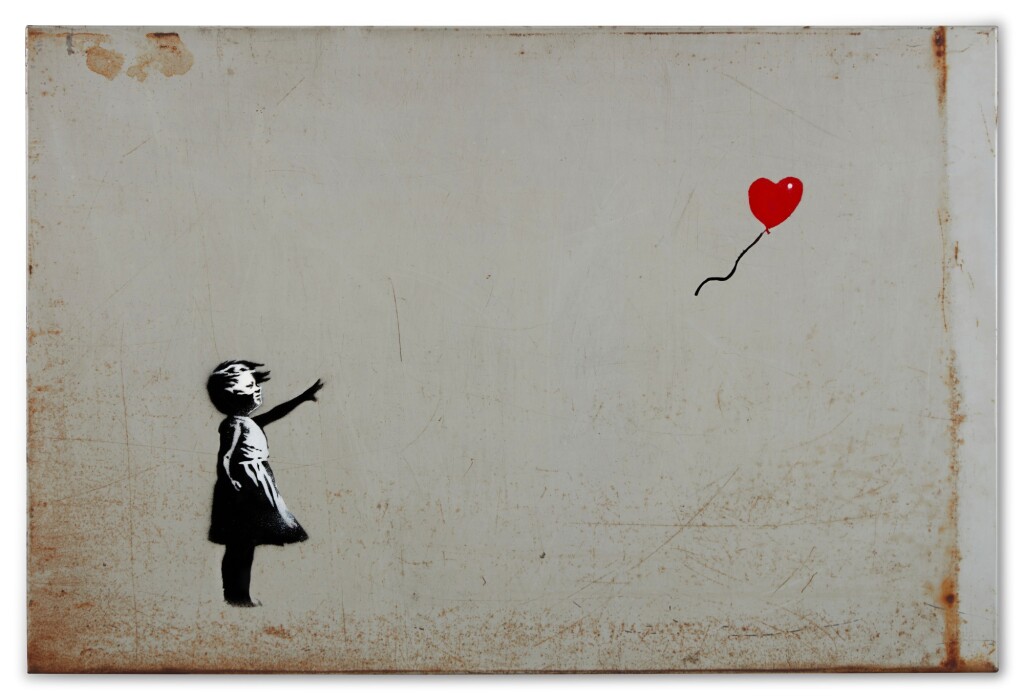
Girl with Balloon, 2006
Spray-paint on metal
60×90 cm (23.7 x 35.5 inches)
This work is from an edition of 5
Girl with Balloon, 2006
Sotheby’s London: 5 October 2018
Estimated: GBP 200,000 – 300,000
GBP 1,042,000 / USD 1,365,480
(#67) BANKSY | Girl with Balloon
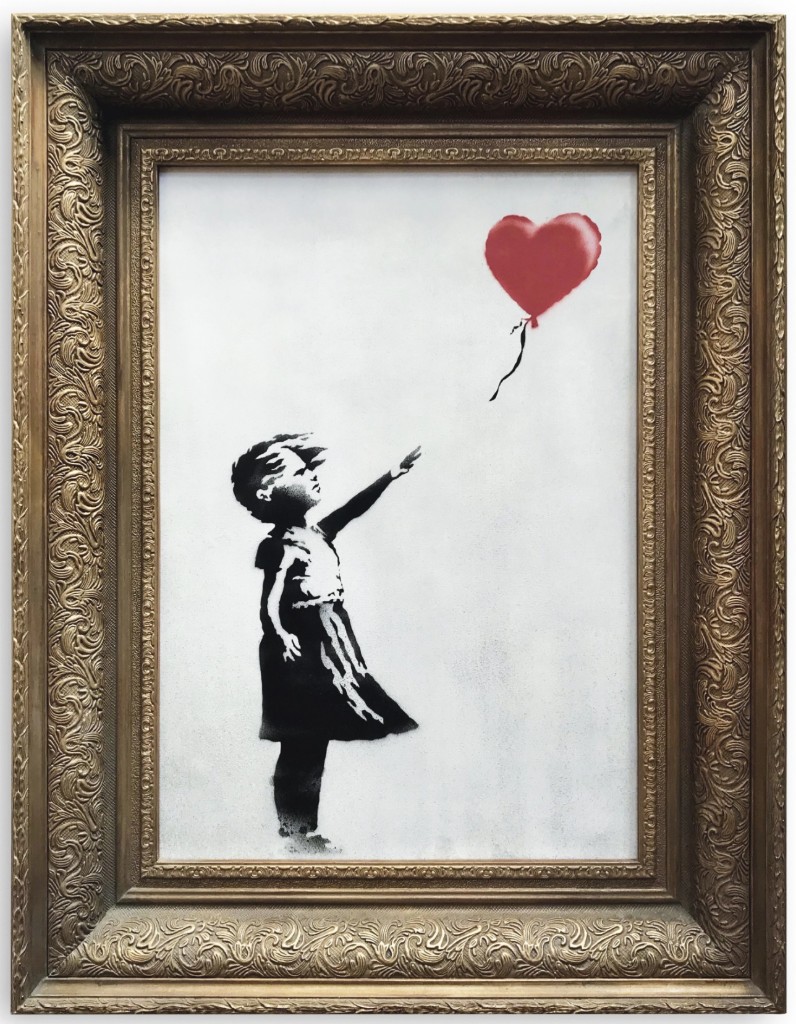
BANKSY
Girl with Balloon, 2006
Spray-paint and acrylic on canvas mounted on board, in artist’s frame
101x78x18 cm (39 3/4 x 30 3/4 x 7 inches)
Unique, signed and dedicated on the reverse


Political Reinterpretations
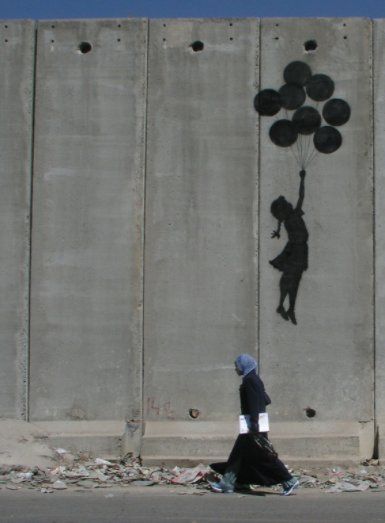
West Bank

Syrian Girl


Union Jack


Love Hurts


Love Is In The Bin

M.V. Louise Michel


Girl with Balloon at Auction
Auction Results Rankings in Decreasing Order
PLEASE CLICK ON ANY VISUAL TO ACCESS THE CATALOGUE ENTRY
Love Is In The Bin, 2018
Sotheby’s London: 14 October 2021
Estimated: GBP 4,000,000 – 6,000,000
Price realized: GBP 18,582,000 / USD 25,457,340
Love is in the Bin | Contemporary Art Evening Auction | 2021 | Sotheby’s
NEW RECORD AT AUCTION FOR BANKSY

BANKSY
Love Is In The Bin, 2018
Spray-paint and acrylic on canvas mounted on board, framed by the artist
Decommissioned, remote controlled shredding mechanism remains in the frame
142x78x18 cm (60 x 30 7/8 x 7 inches)
Unique
Signed on the reverse
XXXXXXXXXX
Girl and Balloon on Found Landscape, 2012
Fair Warning Auction: 20 May 2026
Estimated: USD 13,000,000 – 18,000,000
USD 17,940,000
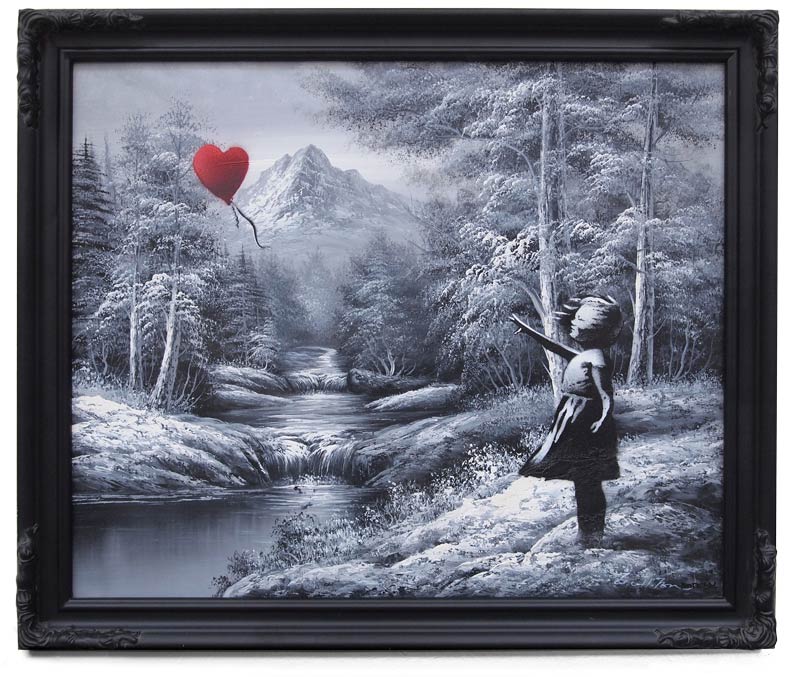
BANKSY
Girl and Balloon on Found Landscape, 2012
Spray paint on canvas
59 x 69.5 cm (23-1/4 x 27-3/8 inches)
Signed on the front and on the reverse
XXXXXXXXXX
Girl with Balloon (Diptych), 2005
Christie’s London: 15 October 2021
Estimated: GBP 2,600,000 – 3,500,000
GBP 3,042,500 / USD 4,183,940
AUCTION RECORD FOR GIRL WITH BALLOON (DIPTYCH)
BANKSY, Girl with Balloon (Diptych) | Christie’s (christies.com)

BANKSY
Girl with Balloon (Diptych), 2005
Spray paint on canvas, in two parts
Each: 30.2 x 30.2 cm (11 7/8 x 11 7/8 inches)
(i) numbered ‘6/25′ (on the stretcher)
(ii) tagged ‘BANKSY’ (on the overlap); signed and dated ‘BANKSY 5⁄9/05‘ (on the stretcher)
This work is number six from an edition of twenty-five
XXXXXXXXXX
Girl with Balloon, 2006
Sotheby’s London: 2 March 2022
Estimated: GBP 2,000,000 – 3,000,000
GBP 2,818,000 / USD 3,766,875
Girl with Balloon | The Now Evening Auction | | Sotheby’s (sothebys.com)
Girl with Balloon, 2006
Spray-paint on metal
60×90 cm (23.7 x 35.5 inches)
This work is from an edition of 5
Girl with Balloon, 2003
Sotheby’s London: 29 June 2021
Estimated: GBP 1,000,000 – 1,500,000
GBP 2,072,000 / USD 2,851,549
AUCTION RECORD FOR GIRL AND BALLOON
Girl with Balloon | British Art Evening Sale: Modern/Contemporary | 2021 | Sotheby’s (sothebys.com)

BANKSY (b. 1974)
Girl with Balloon, 2003
Spray paint on canvas
40.5 x 40.5 cm (16×16 inches)
Stenciled with the artist’s name on the overlap
Numbered 24/25 on the stretcher
This work is number 24 from an edition of 25
XXXXXXXXXX
Girl with Balloon & Morons Sepia, 2007
Phillips London: 20 October 2020
Estimated: GBP 500,000 – 700,000
GBP 1,232,500 / USD 1,609,580
Banksy – 20th Century & Contemporary … Lot 8 October 2020 | Phillips
BANKSY
Girl with Balloon & Morons Sepia, 2007
Girl with Balloon: Spray paint on paper
Morons Sepia: Screenprint on paper, double-sided
56.5 x 76 cm (22 1/4 x 29 7/8 inches)
Signed, numbered and dated ‘Banksy 07 2/8’ lower right
This work is number 2 from an edition of 8
Girl with Balloon (Gold AP), 2004
Estimated: GBP 400,000 – 600,000
GBP 1,104,000 / USD 1,513,885
Girl with Balloon (Gold AP), 2004
Girl with Balloon, 2006
Sotheby’s London: 5 October 2018
Estimated: GBP 200,000 – 300,000
GBP 1,042,000 / USD 1,365,480
(#67) BANKSY | Girl with Balloon
BANKSY
Girl with Balloon, 2006
Spray-paint and acrylic on canvas mounted on board, in artist’s frame
101x78x18 cm (39 3/4 x 30 3/4 x 7 inches)
Unique, signed and dedicated on the reverse
Girl with Balloon (Dark Purple AP), 2004
Estimated: GBP 250,000 – 350,000
GBP 791,250 / USD 1,044,450
Girl with Balloon (Dark Purple AP), 2004
Screenprint in colors on wove paper
