Jack and Jill
aka Police Kids
Editions
Signed Edition: 350
Unsigned Edition: 350
Artist’s Proofs
Jack & Jill (Pink): 22 signed AP
Numbering and Signature
Numbered in pencil with the publisher’s blindstamp, lower right or lower left
Signed and dated in pencil, lower right (signed edition)

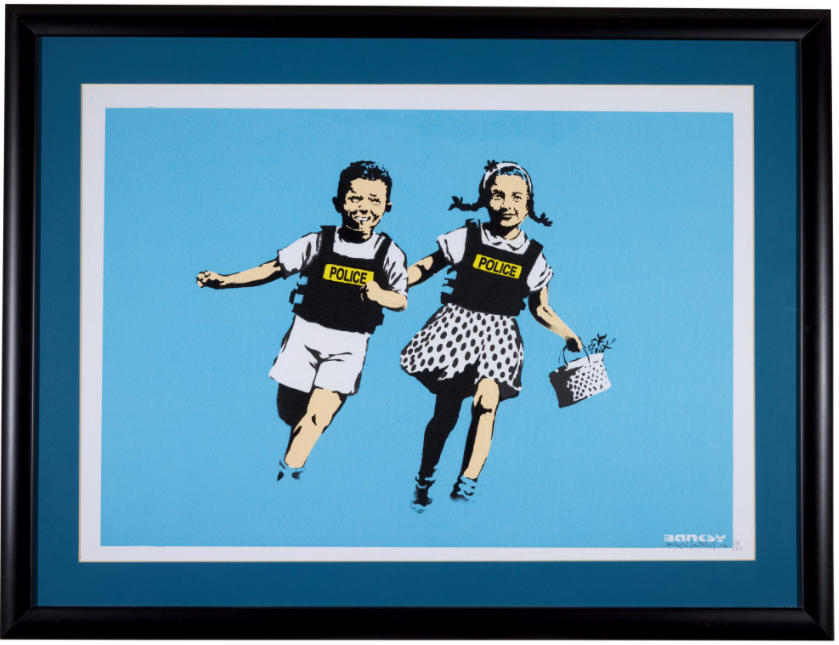
With Jack and Jill, also known as Police Kids, Banksy constructs one of his most unsettling images of childhood. At first glance, the work appears light, playful, even idyllic: two children run together against a bright field of color, smiling and seemingly untouched by the world. But, as so often with Banksy, the image turns on a single visual disruption. The children are wearing bulletproof police vests. In that instant, innocence is not destroyed so much as reframed placed under pressure by the language of authority, security, and control
The Militarization of Childhood
The composition is deceptively simple. A boy and a girl run hand in hand, their movement buoyant and carefree. The girl carries a small basket, reinforcing the nursery-rhyme atmosphere and the gentle theatricality of childhood. Behind them stretches a flat sky-blue background in the standard edition, a field of color that suggests open air, freedom, and a kind of cheerful suspension. Yet across both of their chests appears the word “POLICE”, emblazoned on oversized bulletproof vests. The collision is immediate: lightness meets armor, play meets force, childhood meets the architecture of state power.
“A lot of parents will do anything for their children,
except let them be themselves.”

This visual opposition is exactly what gives the work its charge. The children are not depicted as frightened or oppressed. They still appear happy, still appear to run freely. That ambiguity matters. Banksy does not illustrate a simple loss of innocence; he shows innocence moving forward while already dressed in the symbols of surveillance and protection. The image therefore remains open, and all the more disquieting for it.
Protection as Constraint
As it is always the case with Banksy’s prints, this work permits multiple readings, and that plurality should be preserved. On one level, Jack and Jill can be understood as a critique of overbearing parenting: adults so anxious to protect children that they wrap them in systems of defense before they have even begun to live. In that reading, the vests become symbols of fear passed down from one generation to the next. Childhood, which should be exploratory and open, is pre-armored against danger.

Police Kids (Pink AP), 2005
Edition: 22 signed AP
More broadly, the work can be read as a metaphor for the way law enforcement and security culture restrict freedom. The blue background suggests liberty; the police vests negate it. Banksy’s characteristic strategy is at work here: what first appears picturesque and innocent reveals, on closer inspection, a condition of control. The children seem to float through an open world, yet they are already marked by institutional power. The image asks whether security protects freedom or quietly replaces it.
A further reading is that modern crime and modern fear steal childhood innocence before adulthood even begins. That interpretation fits the image well: the children are still smiling, but they have already inherited the paraphernalia of threat. In Banksy’s hands, protection does not reassure. It reveals the psychological climate of the society that produced it.
Title and Nursery Rhyme
One point that deserves to be retained because it distinguishes this work within Banksy’s oeuvre is that Jack and Jill appears to be one of the rarer images without a firmly documented original mural. At least in currently visible public records, it is known principally through the print rather than through an iconic wall piece. That absence is interesting in itself. It gives the work a slightly different status from prints that derive from famous murals: the edition is not simply a translation of a known public image but, for many viewers, the primary site of the work’s existence.
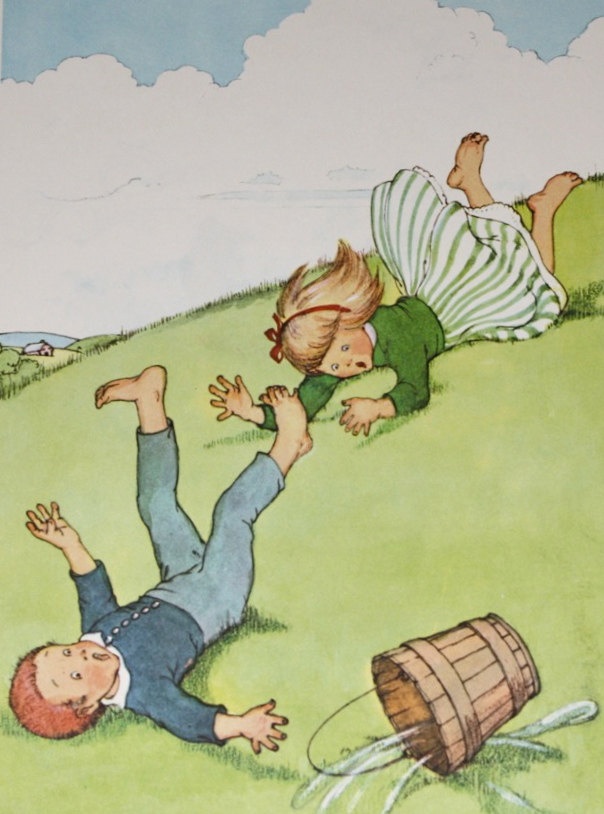
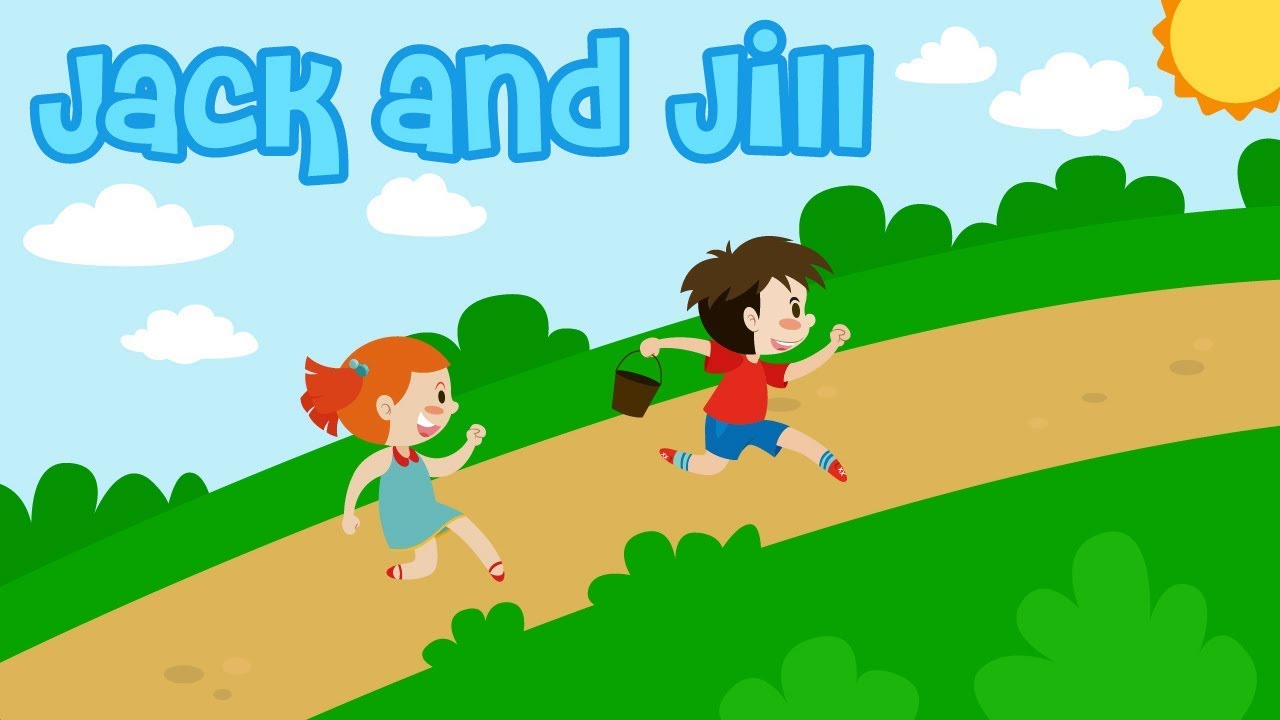
The title matters. The names “Jack and Jill” draw directly on the traditional English nursery rhyme, in which the two children go up the hill and fall. Childhood should be a time to explore freely, to run, to risk, to discover. By attaching this nursery-rhyme framework to children dressed in police armor, Banksy turns a familiar cultural memory into something more complicated. The rhyme lingers in the work as a reminder of vulnerability, but also as a reminder that falling, testing limits, and learning through freedom are part of growing up.
That tension is central to the print’s success. The title softens the image just enough to make the shock more effective. Banksy does not choose anonymous children. He chooses archetypal children, figures already embedded in English cultural memory, and then outfits them for a world governed by force, liability, and anxiety.
Jack and Jill endures because it is both immediate and unresolved. The image is easy to grasp, but difficult to settle. Are the children being protected, indoctrinated, burdened, or merely reflected back at us as symbols of a society that no longer trusts innocence to survive on its own? Banksy never forces the answer. He builds the contradiction and lets it stay active. That method gives the work unusual longevity. It can be read through parenting, policing, fear culture, or the broader militarization of public life. And unlike more aggressive anti-police imagery in Banksy’s corpus, Jack and Jill is almost tender in appearance. Its softness is what makes it bite.
Jack and Jill is one of Banksy’s clearest demonstrations that the most effective critique does not always arrive through spectacle. Sometimes it arrives through two smiling children, a bright background, and one unbearable detail. They are running freely. They are dressed for danger. And between those two facts lies the whole unease of the image. Banksy does not tell us whether the vests are there to protect childhood or to announce its end. He simply makes sure we can no longer look at innocence without also seeing the systems that surround it.
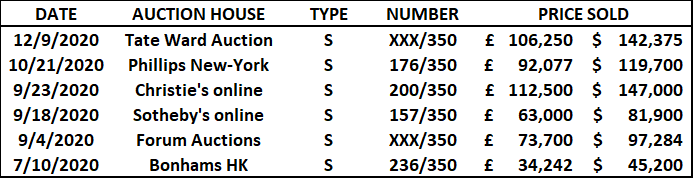
Auction Results
PLEASE CLICK BELOW FOR AUCTION RESULTS