BANKSY
Lenin on Skates, 2002
Acrylic and spray-paint on canvas
60.9 x 35.5 cm (24×14 inches)
From a series, unique in this format
Stenciled “BANKSY” on the left edge
Titled and dated “2002” on the reverse
Provenance
Acquired directly from the artist
Auction History
| Sotheby’s New-York 12 November 2008 Est.: USD 60,000 – 80,000 |
Price Realized |
Catalogue Note
“Who put the Revolution on Ice?”
Executed in 2002, Lenin on Skates is one of Banksy’s earliest and most incisive political satires, exemplifying his remarkable ability to dismantle powerful historical symbols through a single unexpected intervention. Painted in his characteristic stencil technique, the work appropriates one of the twentieth century’s most recognizable revolutionary figures and transforms him into an image that is simultaneously humorous, unsettling and deeply symbolic.
The composition is based upon the familiar iconography of Vladimir Lenin, whose outstretched arm became synonymous with Soviet propaganda, embodying revolutionary leadership, certainty and ideological conviction. Banksy preserves the commanding gesture but radically alters its meaning. Rather than confidently leading the masses toward a promised future, Lenin appears precariously balanced on a pair of Nike roller skates, his famous pose becoming less a political proclamation than an awkward attempt to maintain his equilibrium.
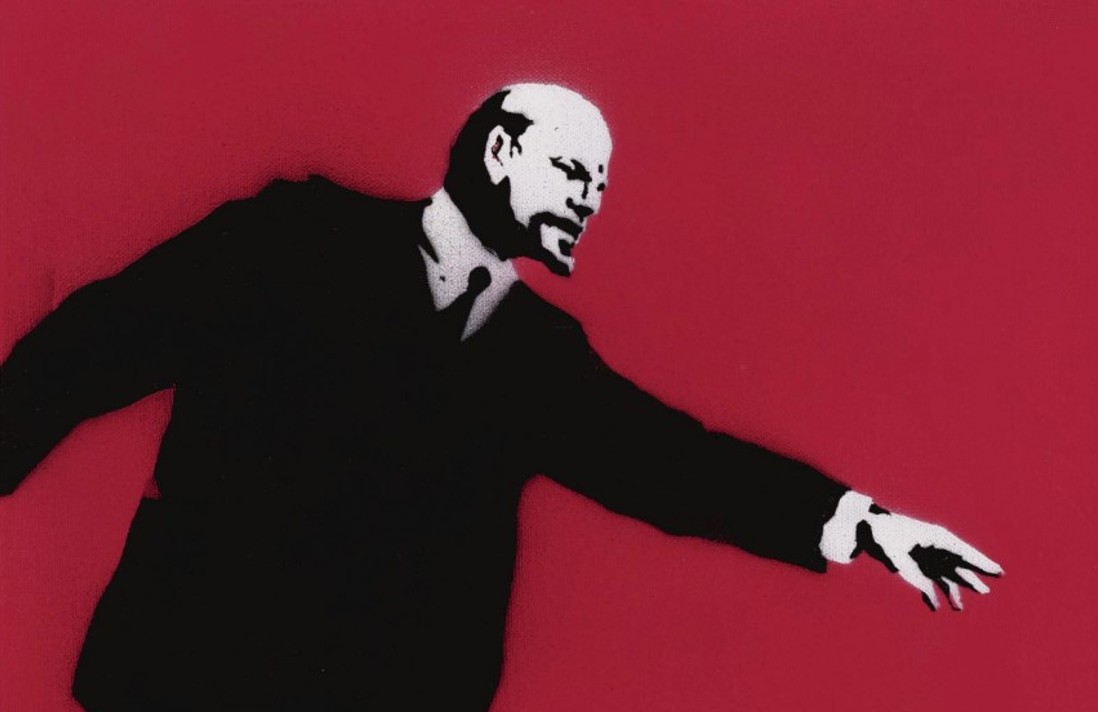
The genius of the image lies in this subtle transformation. Banksy does not ridicule Lenin through caricature or exaggeration. Instead, he quietly disarms one of history’s most imposing political icons by placing him in a context where authority appears unexpectedly fragile. The revolutionary leader is no longer directing history; he is simply trying not to fall.
The juxtaposition of Lenin with Nike, one of the world’s most recognizable symbols of global capitalism, introduces a second layer of irony. The collision between communist ideology and multinational consumer culture creates an impossible historical paradox. The founder of the Soviet state glides effortlessly upon one of capitalism’s most successful commercial products, suggesting that even the most uncompromising political systems ultimately become absorbed into the culture they once sought to overthrow. Banksy offers no explicit judgement. Instead, he allows the absurdity of the pairing to expose the contradictions of twentieth-century political history.
Executed against a striking crimson background, the work further amplifies these tensions. Red, traditionally associated with revolution, socialism and political struggle, saturates the composition with ideological significance while simultaneously functioning as a powerful abstract field that isolates the solitary figure. The monochromatic backdrop strips away all narrative context, encouraging the viewer to contemplate Lenin not as a historical individual but as a universal symbol whose meaning has become unstable over time.

As with many of Banksy’s early political portraits, the composition demonstrates remarkable visual economy. Every unnecessary detail has been eliminated until only the essential contradiction remains. The familiar silhouette, the iconic gesture and the incongruous roller skates are sufficient to communicate a sophisticated reflection on ideology, power and historical memory. Banksy trusts the viewer to recognize the image and to appreciate how a single alteration can fundamentally transform its meaning.
Viewed today, Lenin on Skates feels less like a satire of one political figure than a meditation on the fate of all ideologies. Revolutions, however absolute they once appeared, eventually become history. Their heroes become cultural icons, their certainties become objects of reinterpretation, and the symbols that once inspired millions acquire new meanings as they pass from politics into popular culture. In reducing Lenin from an untouchable revolutionary leader to a skater struggling to maintain his balance, Banksy reminds us that authority, like history itself, is never fixed. It is continually rewritten by those willing to look at it from a different angle.