BANKSY
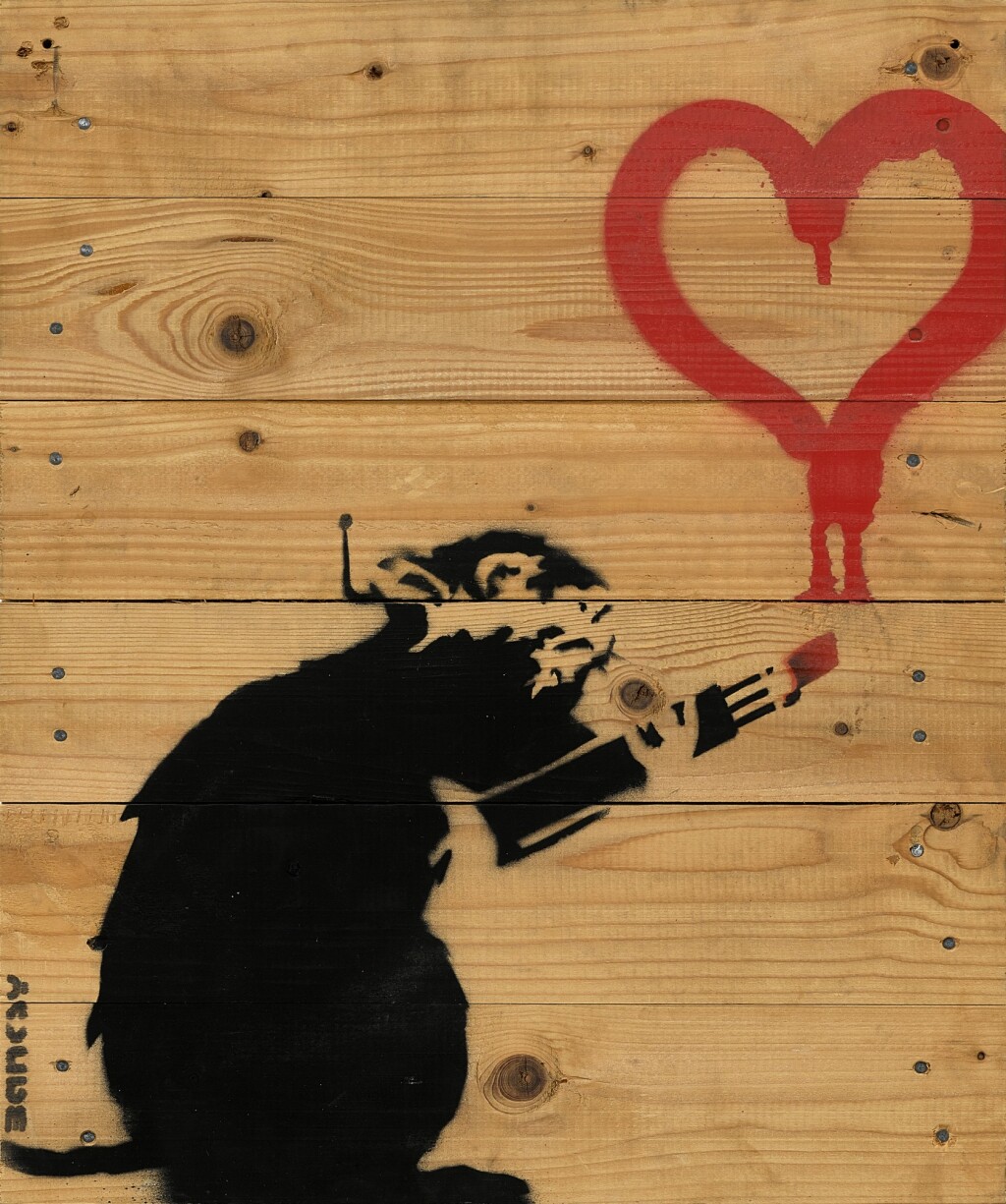
Love Rat on Palette, 2003
Stencil spray-paint on wooden palette
60×50 cm (23 5/8 x 19 1/16 inches)
Stenciled signed “BANKSY” on the side, lower left
Provenance
East London Warehouse, London
Private Collection
Bonhams, London, 16 April 2008, Lot 373
Private Collection, United Kingdom
Phillips, Hong Kong, Selling Exhibition: Banksy Who’s Laughing Now?, Lot 5
Acquired from the above selling exhibition by the present owner
Exhibited
London, East London Warehouse, Turf War, July 2003
Auction History
| Sotheby’s Hong-Kong 28 April 2022 Est.: HKD 6,000,000 – 9,000,000 |
Price Realized |
REPEAT SALE
| Bonhams London 16 April 2008 Est.: GBP 30,000 – 40,000 |
Price Realized |
Catalogue Note
Executed in 2003, Love Rat on Palette is one of the most distinctive early interpretations of Banksy’s celebrated rat motif. Exhibited at the landmark Turf War exhibition in London, the work combines one of the artist’s most enduring characters with an unconventional industrial support, transforming an ordinary wooden shipping pallet into an integral part of the composition. More than a simple painting, the work embodies Banksy’s determination to blur the boundaries between street intervention, found object and contemporary art.

Long regarded as Banksy’s unofficial mascot, the rat occupies a unique place within his visual vocabulary. Anonymous, resilient and remarkably adaptable, it survives by inhabiting the forgotten spaces of the city, thriving beyond the reach of authority. Often described as a subtle alter ego for the artist himself, the rat embodies the very qualities that define both graffiti and street art: invisibility, persistence and quiet resistance. Here, however, Banksy replaces confrontation with unexpected tenderness. Holding a lipstick like a spray can, the rat has just painted a large bleeding heart whose fresh red drips remain suspended on the wooden surface. The gesture is simultaneously mischievous and deeply human, transforming an act of vandalism into an unexpected declaration of affection.
The symbolism of the image lies in its striking inversion of expectations. Traditionally associated with disease, decay and urban neglect, the rat becomes an unlikely messenger of love. The vivid red heart introduces an emotional warmth that contrasts sharply with the animal’s dark silhouette, while its dripping form remains deliberately ambiguous. It may evoke fresh paint, blood or the fragile impermanence of human emotion. As so often in Banksy’s work, humor becomes a vehicle for something far more poignant. Love itself emerges as a quiet act of rebellion, capable of surviving even the harshest urban environments.
This version is particularly distinguished by its execution on a wooden shipping pallet, one of the most evocative supports employed during Banksy’s early career. Far from serving as a neutral surface, the pallet carries its own history and associations. Designed to transport goods across factories, warehouses and ports, it speaks directly to the global movement of commerce and consumer culture. By transforming this discarded industrial object into a work of art, Banksy performs an act of creative reclamation, rescuing an overlooked utilitarian object and investing it with entirely new meaning.

The natural grain of the timber, visible knots, exposed screws and construction joints remain fully apparent beneath the stencil, preserving the authenticity of the material rather than disguising it. The wooden surface recalls the hoardings, fences and temporary barriers upon which much of Banksy’s early street practice developed, reinforcing the work’s origins in the urban landscape while simultaneously granting it the permanence of an autonomous artwork. The support is therefore not merely a backdrop but an essential component of the composition, anchoring the image firmly within the physical environment from which it emerged.
Exhibited in Turf War, a defining moment in Banksy’s early career, Love Rat on Palette perfectly encapsulates the artist’s ability to transform the ordinary into the extraordinary. Combining one of his most iconic characters with an object synonymous with labour, transport and everyday industry, the work demonstrates how even the most humble materials can become vehicles for wit, poetry and social commentary. More than twenty years after its creation, it remains one of the most compelling examples of Banksy’s ability to elevate the language of the street into enduring contemporary art while never losing sight of its origins.