BANKSY
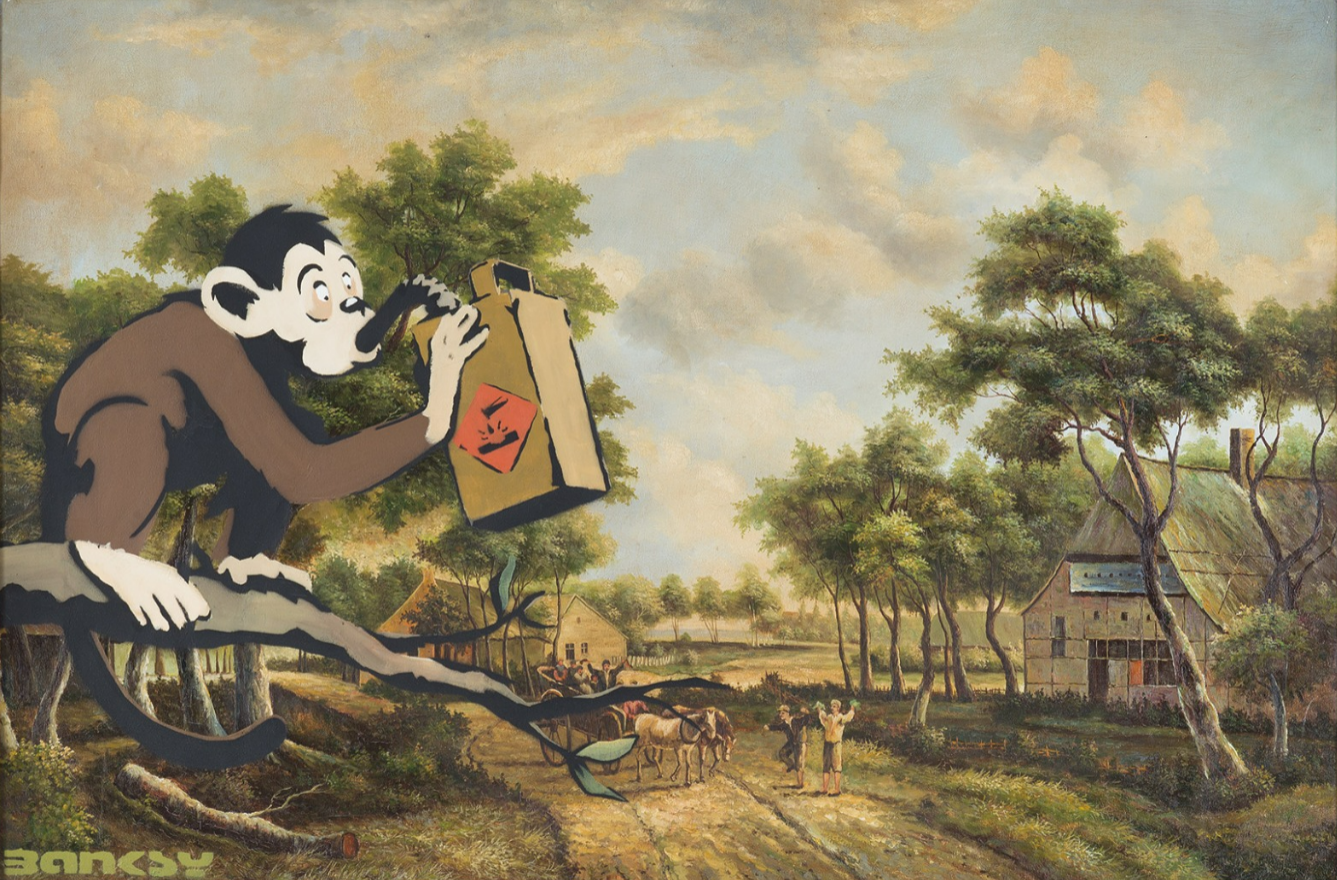
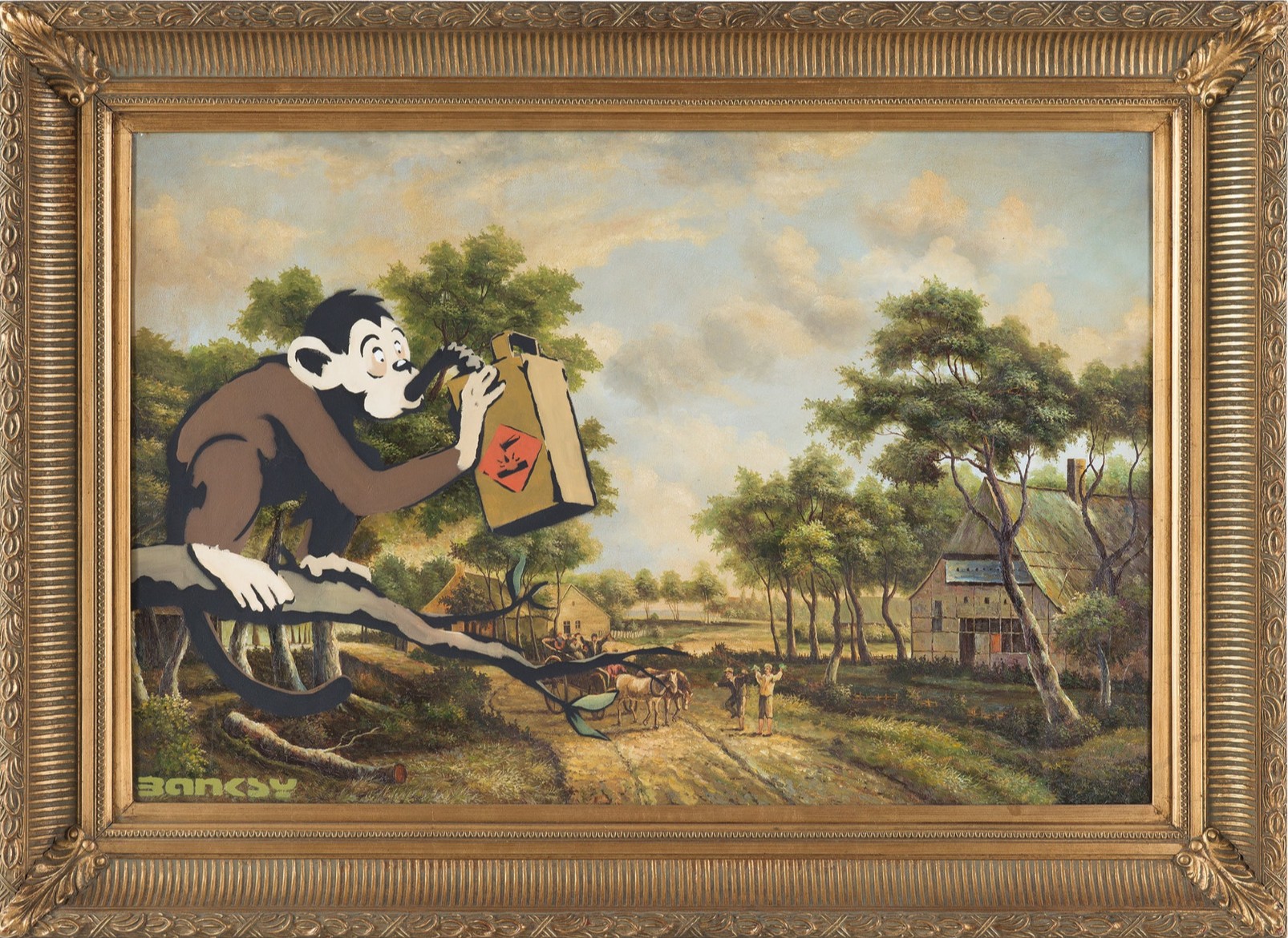
Monkey Poison, 2004
Oil and spray enamel on found canvas in artist’s frame
61x91cm (24 x 35 5/8 inches)
Stenciled-signed “BANKSY”, lower left
Further signed and dated “Banksy 2004” on the stretcher
Provenance
Private Collection, United Kingdom
Private Collection, United States
Acquired from the above by the present owner
Auction History
| Phillips New-York 2 July 2020 Estimated: USD 1,800,000 – 2,500,000 | Price Realized |
Catalogue Note
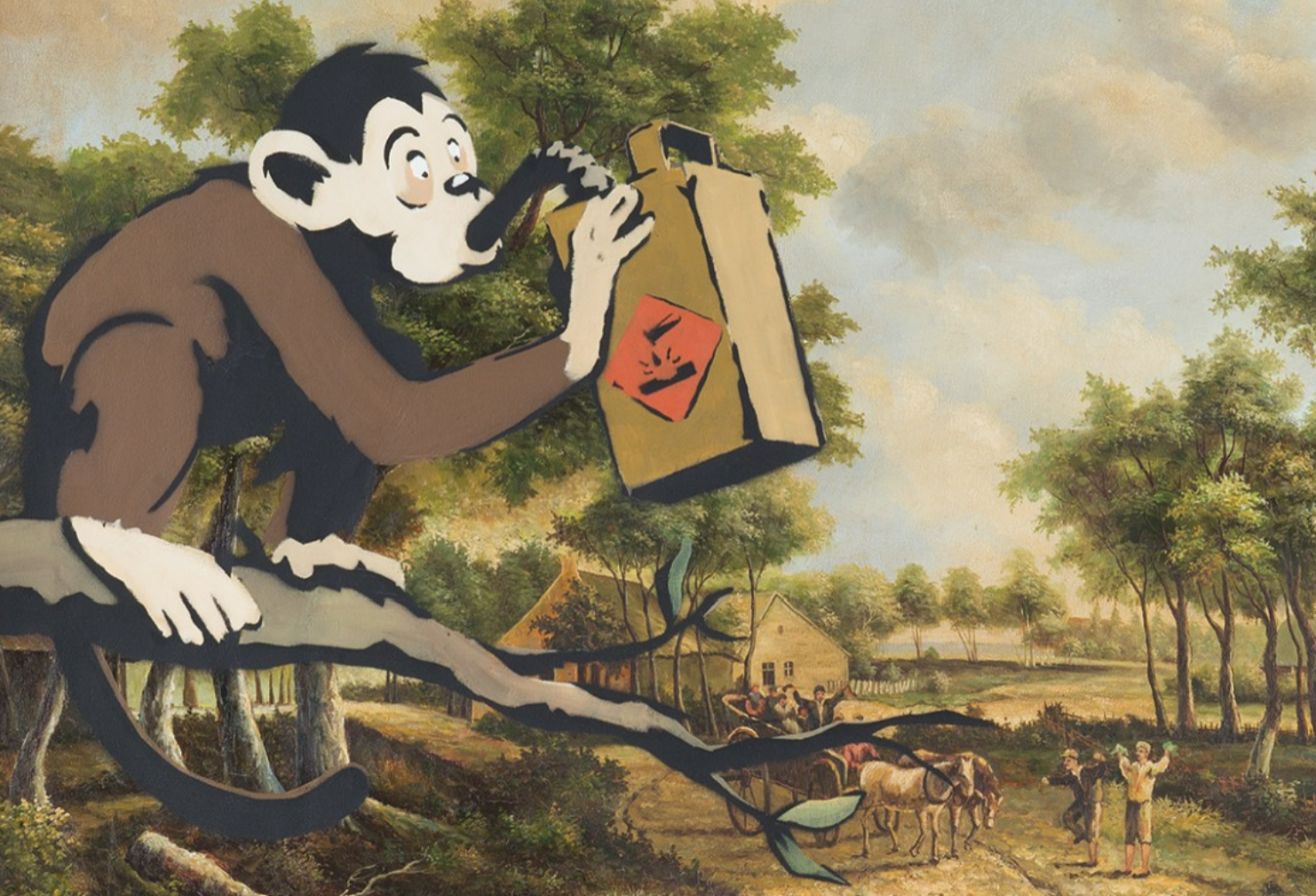
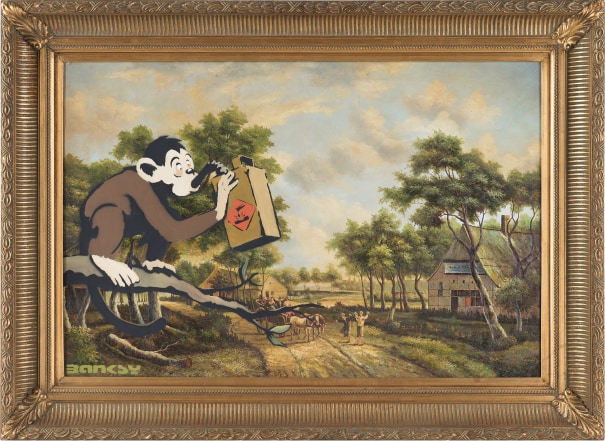
With Monkey Poison, Banksy once again invades the reassuring world of the Old Masters, transforming an anonymous pastoral landscape into a contemporary moral fable. Perched upon the branch of a tree overlooking an idyllic countryside, one of his familiar chimpanzees calmly drinks from a can of gasoline marked with a hazardous warning symbol. The gesture is absurd, humorous and immediately alarming. Like so many of Banksy’s most successful images, the joke arrives first; the realization follows moments later.
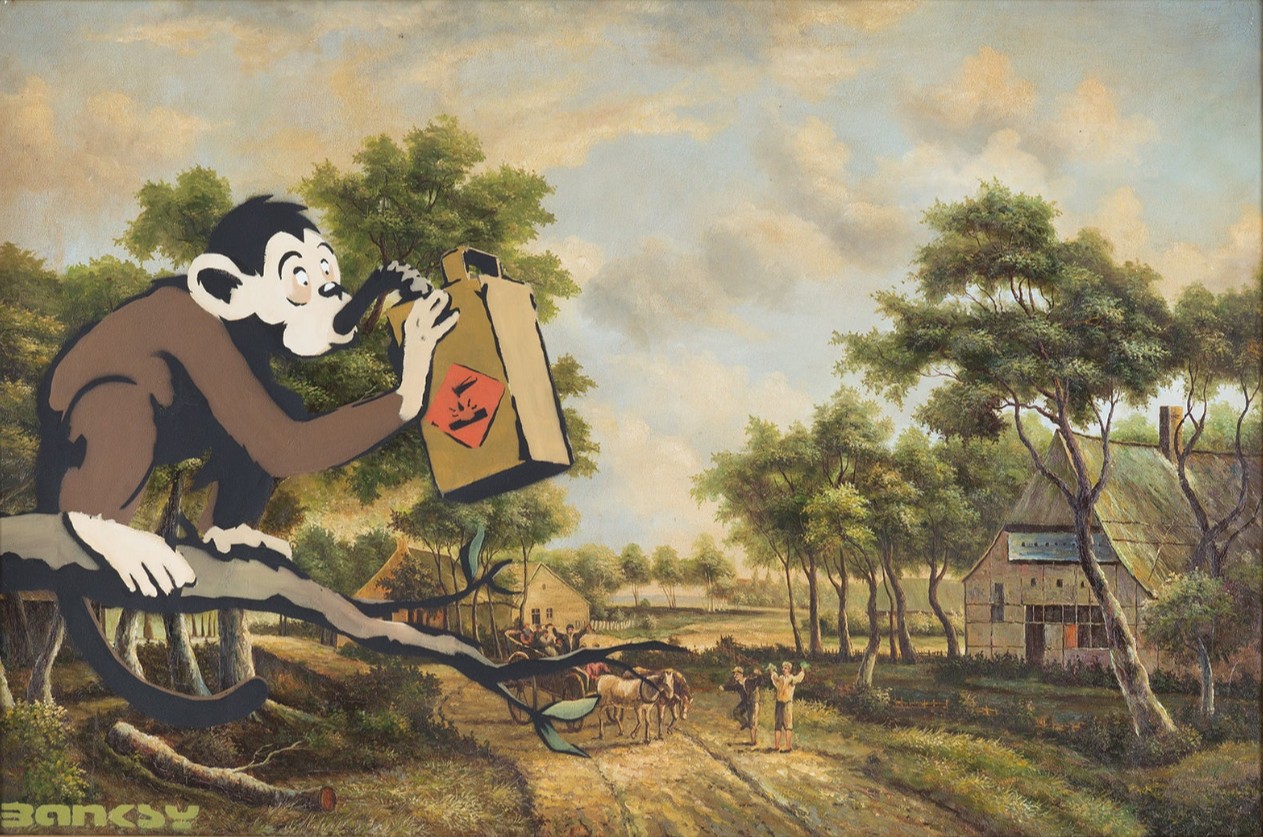
The monkey has occupied a central place in Banksy’s visual vocabulary since the early 2000s. Appearing in works such as Laugh Now, Monkey Queen, and ultimately Devolved Parliament, it serves as a thinly veiled surrogate for humanity itself. Rather than depicting mankind directly, Banksy invites us to observe ourselves through our closest evolutionary relative. Here, the chimpanzee is neither rebellious nor threatening. Instead, it appears perfectly content, innocently consuming the very substance that will ultimately destroy it. The image becomes an unsettling allegory for modern civilization, willingly feeding its dependence on fossil fuels, consumerism and unsustainable progress without fully acknowledging the consequences.
The choice of support is equally significant. Rather than beginning with a blank canvas, Banksy appropriates a nineteenth-century pastoral landscape, complete with winding paths, peaceful farmhouses and harmonious nature. These inexpensive paintings, often rescued from flea markets, embodied an idealized vision of rural life, untouched by the anxieties of the modern world. Banksy does not erase that illusion; he contaminates it with a single intervention. Paradise remains intact, yet it has been quietly poisoned from within. In this respect, Monkey Poison belongs to the artist’s celebrated series of reworked paintings—including Bird and Grenade, Study for Happy Chopper, and later Show Me the Monet—in which the reassuring language of traditional landscape painting collides with the political realities of the twenty-first century.
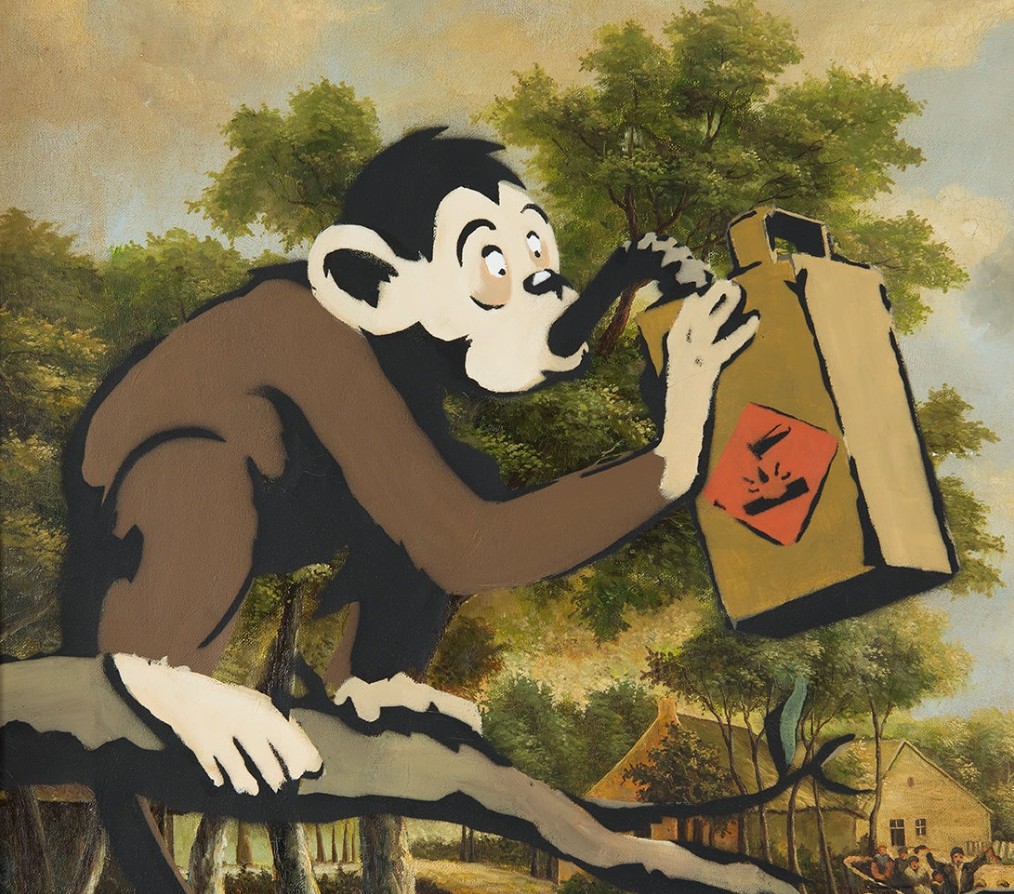
The work also reflects Banksy’s enduring dialogue with art history. Like William Hogarth before him, he employs satire to expose the contradictions of contemporary society, while echoing Marcel Duchamp’s radical appropriation of existing works of art. Yet Banksy’s intervention is remarkably restrained. Rather than overwhelming the original composition, he inserts a single graphic figure whose presence is enough to transform the entire narrative. The collision between classical oil painting and the immediacy of the stencil perfectly encapsulates his ambition to dissolve the boundaries between the museum and the street.
Ultimately, Monkey Poison is less a warning about environmental destruction than a meditation on human nature itself. The tragedy does not lie in the poisoned fuel, but in the monkey’s complete ignorance of what it is consuming. Banksy suggests that civilization rarely destroys itself through malice alone. More often, it does so through habit, convenience and complacency. With characteristic economy, he transforms an anonymous landscape into a modern parable in which humanity, comfortably perched upon its own branch, mistakes poison for sustenance.