POLICE SNIPER AND PAPER BAG BOY

A Very Small Distraction
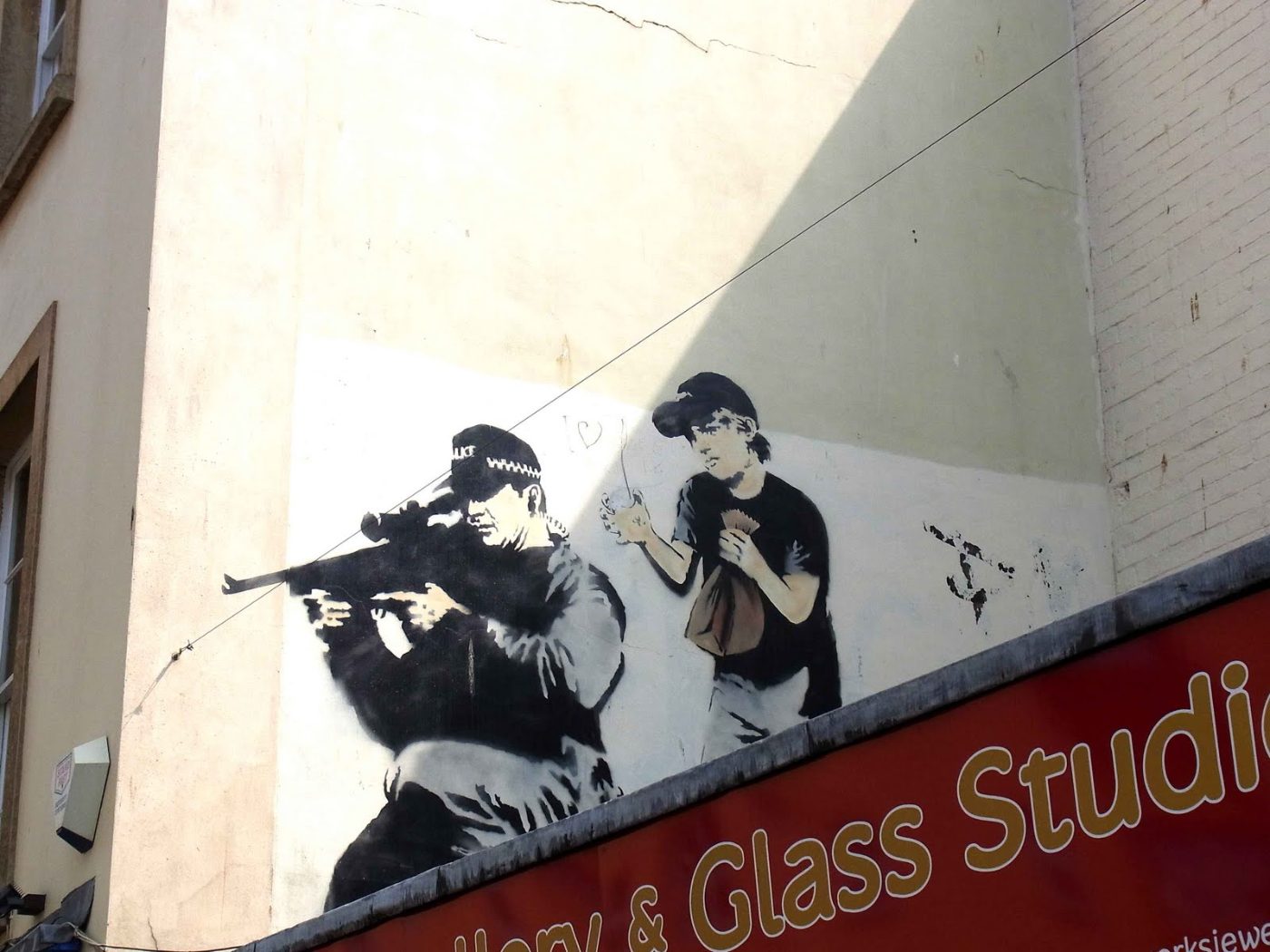
In 2007, Banksy placed an armed police marksman high on a wall opposite the Bristol Royal Infirmary and Bristol Children's Hospital. The sniper crouches behind his rifle, apparently concentrating on a target somewhere beyond the picture. Immediately behind him, however, a young boy prepares to burst an inflated paper bag.
It is a wonderfully economical Banksy joke. The marksman possesses a rifle, protective equipment, training and presumably the authority of the state; the child possesses a paper bag. Yet within the tiny narrative Banksy has constructed, there is little doubt about who has the upper hand.
The humor depends upon timing. Banksy freezes the scene immediately before the inevitable BANG. We never see the sniper's reaction because we do not need to. The viewer completes the action mentally, transforming an image of potentially lethal force into something approaching slapstick.
Power and Innocence
The opposition between the two figures is almost perfectly balanced. The sniper is an adult; his opponent is a child. One carries a firearm; the other a paper bag. One is trained to anticipate threats; the other stands directly behind him unnoticed.
Banksy repeatedly places children beside the machinery of adult power. In Bomb Hugger, a young girl embraces an aerial bomb; in No Ball Games, children play beneath a prohibition; in Girl with Balloon, childhood vulnerability is reduced to a girl and a disappearing balloon. Here, innocence becomes something slightly different: mischief.
The child is not frightened by authority. He is about to make fun of it.
That distinction prevents the work from becoming a heavy-handed political statement. The sniper is not defeated through violence, nor is Banksy suggesting that the child possesses equivalent physical power. Instead, authority is made ridiculous. The enormous apparatus of armed vigilance has failed to notice the smallest possible threat standing immediately behind it.
Banksy and the Police
Police officers occupy a particularly important place in Banksy's visual vocabulary. From his earliest Bristol work onwards, they repeatedly appear as representatives of regulation and surveillance, but Banksy rarely portrays them as straightforward villains. More often, he removes their dignity.
The policemen in Kissing Coppers embrace. In Graffiti Area, an officer patrols with a poodle. Elsewhere they search children, inspect documents or become absorbed in absurd situations. Police Sniper and Paper Bag Boy belongs firmly to this tradition. Banksy does not challenge authority by making it terrifying; he undermines it by making it vulnerable to a joke.
There is also an obvious connection with Banksy's own history as a graffiti artist. Graffiti requires precisely the sort of vigilance the marksman is supposed to represent: watching streets, anticipating movement and remaining aware of who might appear unexpectedly. Here the roles are reversed. The authority figure is watching in the wrong direction.
The Bristol Location
The mural occupied a prominent first-floor gable wall on Upper Maudlin Street, opposite the Bristol Royal Hospital for Children and close to Bristol Royal Infirmary. Academic documentation describes it specifically in this location and records that it remained visible for several years.
There is a minor discrepancy over the precise street number: current Banksy mapping sources give 22 Upper Maudlin Street, while another local guide gives No. 16. I would therefore use Upper Maudlin Street, opposite Bristol Royal Hospital for Children in the catalogue rather than assert a building number we cannot yet establish conclusively.
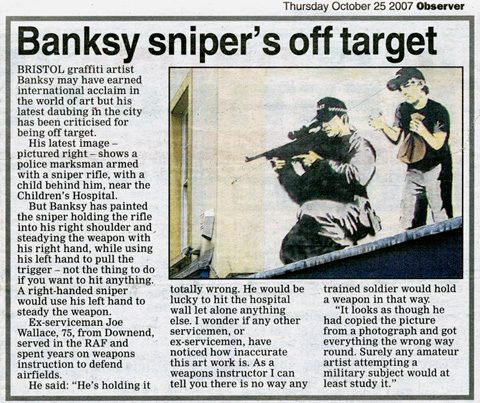
Its placement opposite a children's hospital inevitably sharpened the visual contrast between armed authority and childhood, although we should be cautious about claiming this was Banksy's intended meaning without evidence.
There is, however, an intriguing local story. When the mural was attacked in 2011, staff from Wallace & Gromit's Grand Appeal, the charity supporting Bristol Children's Hospital, said they had grown affectionately accustomed to regarding the image as “our Banksy.” Contemporary reporting also records their belief that it appeared after they had appealed to Banksy for help discouraging graffiti on their building. That account is interesting local testimony, though not enough on its own to establish that Banksy created the work at their request.
Team Robbo
The mural survived relatively intact until October 2011, when it was covered with black paint and tagged with references to Team Robbo. Contemporary reporting interpreted the attack as another episode in the increasingly public conflict between Banksy and supporters of London graffiti pioneer King Robbo.
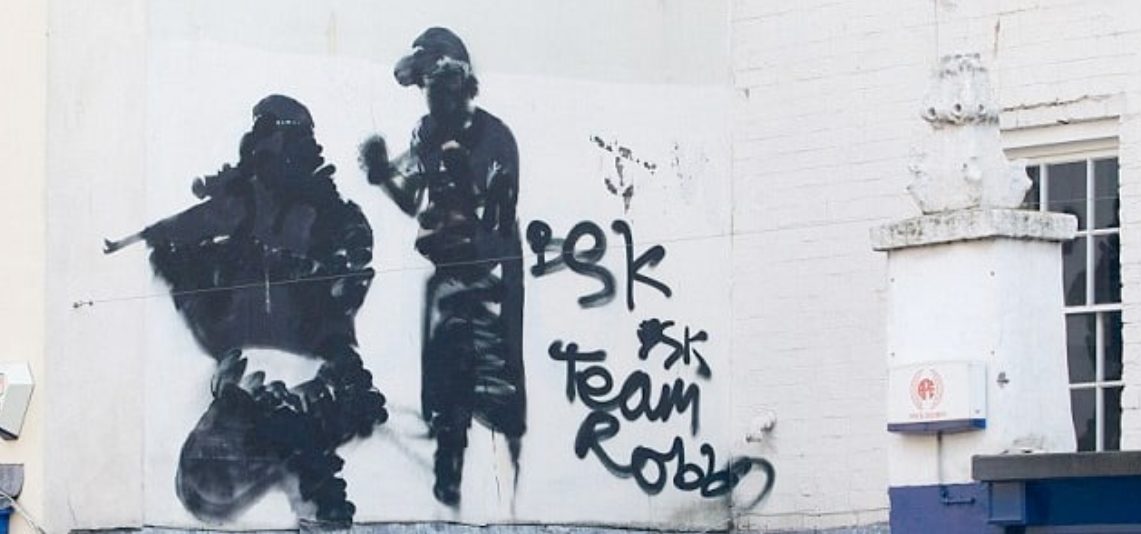
The Banksy–Robbo conflict had begun around a Regent's Canal work in Camden and developed into an extraordinary visual conversation in which paintings were repeatedly altered, answered and altered again. What had begun on a London canal wall consequently reached Banksy's hometown.
Academic documentation records that after the sniper had been obliterated, the same wall acquired another political stencil depicting David Cameron and Boris Johnson throwing petrol bombs, generally associated with the title Eton Posse. That image was itself subsequently painted over.
The wall therefore became exactly what street-art walls frequently become: not a permanent exhibition space but a sequence of arguments, jokes, territorial claims and erasures.
Police Sniper and Paper Bag Boy demonstrates how effectively Banksy can reverse a relationship of power without changing its physical reality. The sniper remains armed. The child remains defenseless. Nothing about their actual capabilities has changed. What changes is who knows what.
The sniper can see through the sights of a precision rifle but cannot see the child standing immediately behind him. The boy, meanwhile, understands the entire situation. Banksy turns superior firepower into inferior awareness, and the humor emerges from the gap between the two.
It is also quintessentially Banksy in its refusal to become solemn. A conventional anti-authoritarian image might confront the weapon with another weapon. Banksy confronts it with a child, an inflated paper bag and a joke. The sniper is prepared for almost anything. Just not this.
STAY INFORMED
Receive the latest news, exhibitions, artworks and market updates on Banksy.