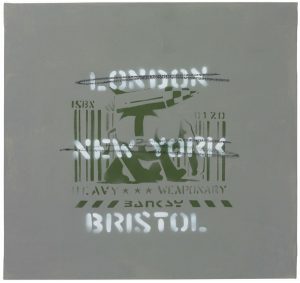
Radar Rat
Editions
Signed Edition: 75
Unsigned Edition: 25
All hand-finished by the artist
Some in Red, Some in Orange
Following the Placard Rats of 2004, Radar Rat marks a subtle but important shift in Banksy’s visual language. The rat no longer holds a sign, no longer delivers a written statement. Instead, the message becomes invisible: translated into waves. Banksy moves away from explicit slogans toward something more elusive, more atmospheric. The rat remains, but its function changes. It is no longer a speaker. It becomes a transmitter.
Reading The Invisible
Radar Rat depicts a black stenciled rat positioned in profile, typically facing left, from whose head or snout emanate a series of curved, radiating lines. These lines, rendered in orange or red, expand outward in rhythmic arcs, evoking the visual language of sound waves, radar signals, or broadcast frequencies. The composition is once again strikingly minimal. The rat is reduced to its essential silhouette, while the radiating lines introduce movement and energy into an otherwise static figure. There is no text, no caption, no immediate explanation. The image feels active, but its meaning is not immediately fixed.
There is an ambiguity in these waves. Are they signals being emitted, or received? Is the rat communicating, or listening? Banksy leaves this deliberately unresolved. The reference to radar introduces a vocabulary of surveillance, detection, and control. Radar systems are designed to locate, track, and anticipate movement: often invisibly, often without the subject’s awareness. By associating the rat with this technology, Banksy introduces a tension between vulnerability and awareness. The rat, traditionally hunted and hidden, now appears connected to a system of signals that may allow it to navigate, evade, or expose.
At the same time, the waves can be read more metaphorically: as ideas, influence, or presence spreading outward into the urban environment. In this reading, the rat becomes a node in a network, quietly transmitting something that cannot be easily contained.
A New Form of Communication
Compared to the Placard Rats, where language is direct and confrontational, Radar Rat operates through suggestion. There is no slogan to interpret, no phrase to decode. The viewer is forced into a more active role, constructing meaning rather than receiving it. This shift reflects a broader sophistication in Banksy’s practice. The message is no longer declared: it is embedded.
This aligns with the nature of street art itself. Like a signal, it appears unexpectedly, travels quickly, and leaves traces that are not always immediately understood. The rat becomes less of a protester and more of a presence. Despite this evolution, the rat remains central to Banksy’s symbolic system. As your article notes, it continues to function as a reflection of human society: its contradictions, its marginal figures, its hidden mechanisms.
The connection to Blek le Rat remains visible, but Banksy pushes the motif further into abstraction. The rat is no longer just an emblem of the outsider; it becomes a carrier of unseen forces. In Radar Rat, the animal is not simply surviving the system: it is interacting with it, navigating it, perhaps even manipulating it.
Radar Rat, also known as Sonic Rat, is one of the most coveted works by Banksy due to its small edition size and because each print is signed and hand-finished by the artist himself, some in orange. Radar Rat is shown standing on its hind legs, wearing headphones and holding a tape recorder in one hand and a sonic radar in the other. Behind him is a hand-painted red spiral. He appears to be listening intently to the world around him, in what seems to be a comment on the ever-increasing presence of surveillance equipment in cities such as London.