HMV, 2003
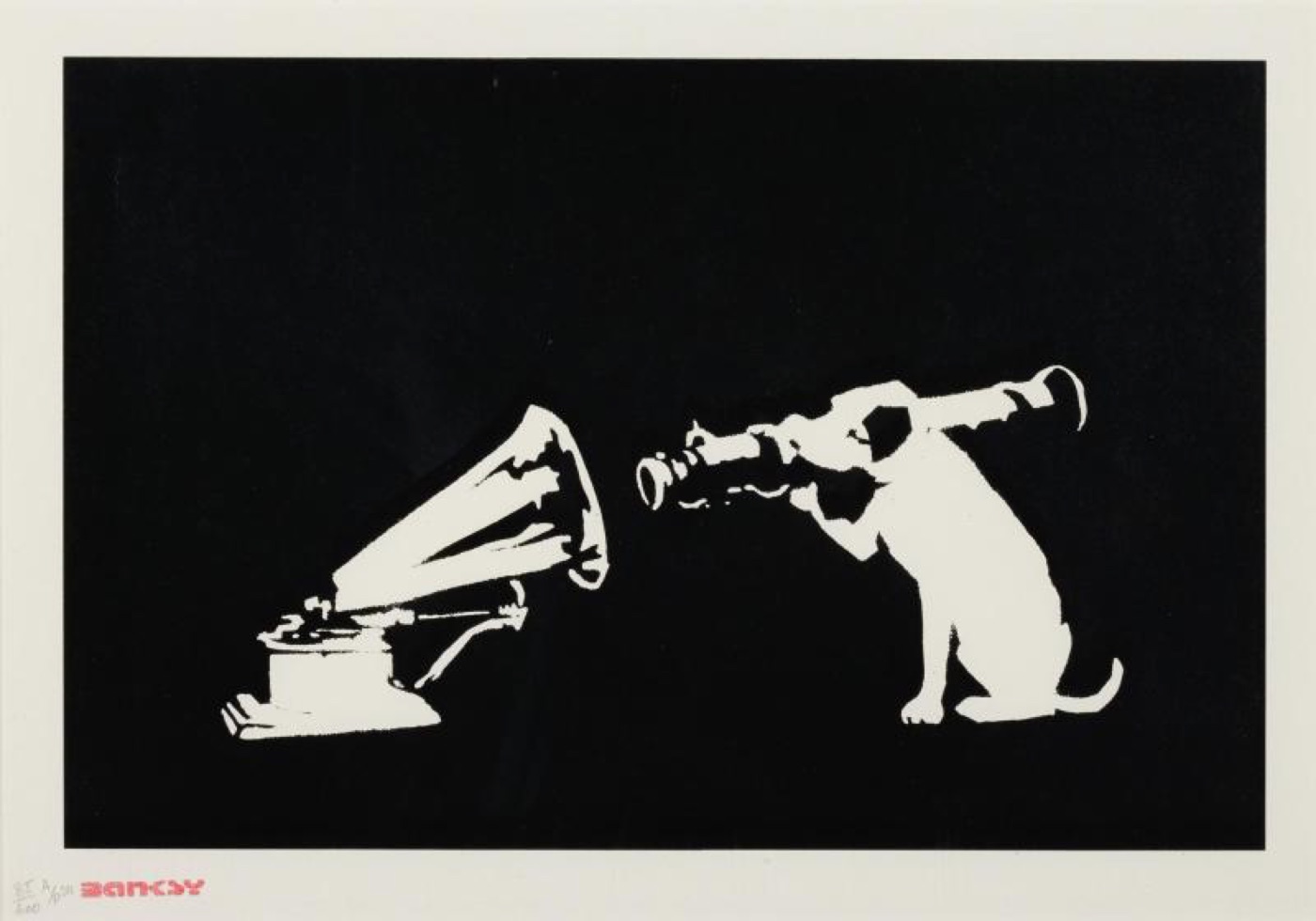
With HMV, also known as His Master's Voice or Rocket Dog, Banksy takes one of the most recognizable trademarks in the history of recorded music and turns it against itself. The result is both funny and destructive, absurd and exact. A loyal dog, once associated with listening, recognition, and brand fidelity, is transformed into an armed insurgent. In one of Banksy's most concise appropriations, nostalgia is placed in the crosshairs.
The small print that packs a powerful punch. It would say if this was the Argos catalogue.
Destroying the Voice of the Past
The image is stark and unforgettable. A white dog stands in profile beside a nineteenth-century gramophone, but instead of listening intently to its master's voice, it points a bazooka directly at the machine. Rendered in dense black and white, the composition is stripped of ornament and built for impact. The visual economy is part of its force: a single figure, a single target, and an immediate inversion of meaning. What was once an emblem of obedience becomes an image of attack.

Banksy's intervention is simple, but its implications are broad. In the original logo, the dog listens faithfully. In Banksy's version, it refuses. More than that, it threatens to annihilate the machine altogether. The work can be read as a critique of the old music industry, with its entrenched structures, gatekeeping habits, and heavy attachment to obsolete formats. The gramophone becomes a symbol not only of a past technology, but of conservatism itself—of inherited systems that persist long after their cultural authority has started to crack.
This is why the work still feels sharp. It does not merely parody a logo; it stages a rupture between generations. The gramophone stands for the established order, while the armed dog embodies rebellion from within the image itself. The critique can also be extended to the wider decline of physical music retail in the digital era. In that reading, HMV becomes a mordant image of an industry losing ground to new modes of circulation, distribution, and listening.
From Francis Barraud to a Global Trademark
Banksy appropriates the iconic logo of the British music and entertainment firm of the same name, created in the 1920s. The company logo itself derives from a painting by the English painter Francis Barraud that depicts a dog, called Nipper, listening intently to a cylinder phonograph. The original painting was created in 1899.
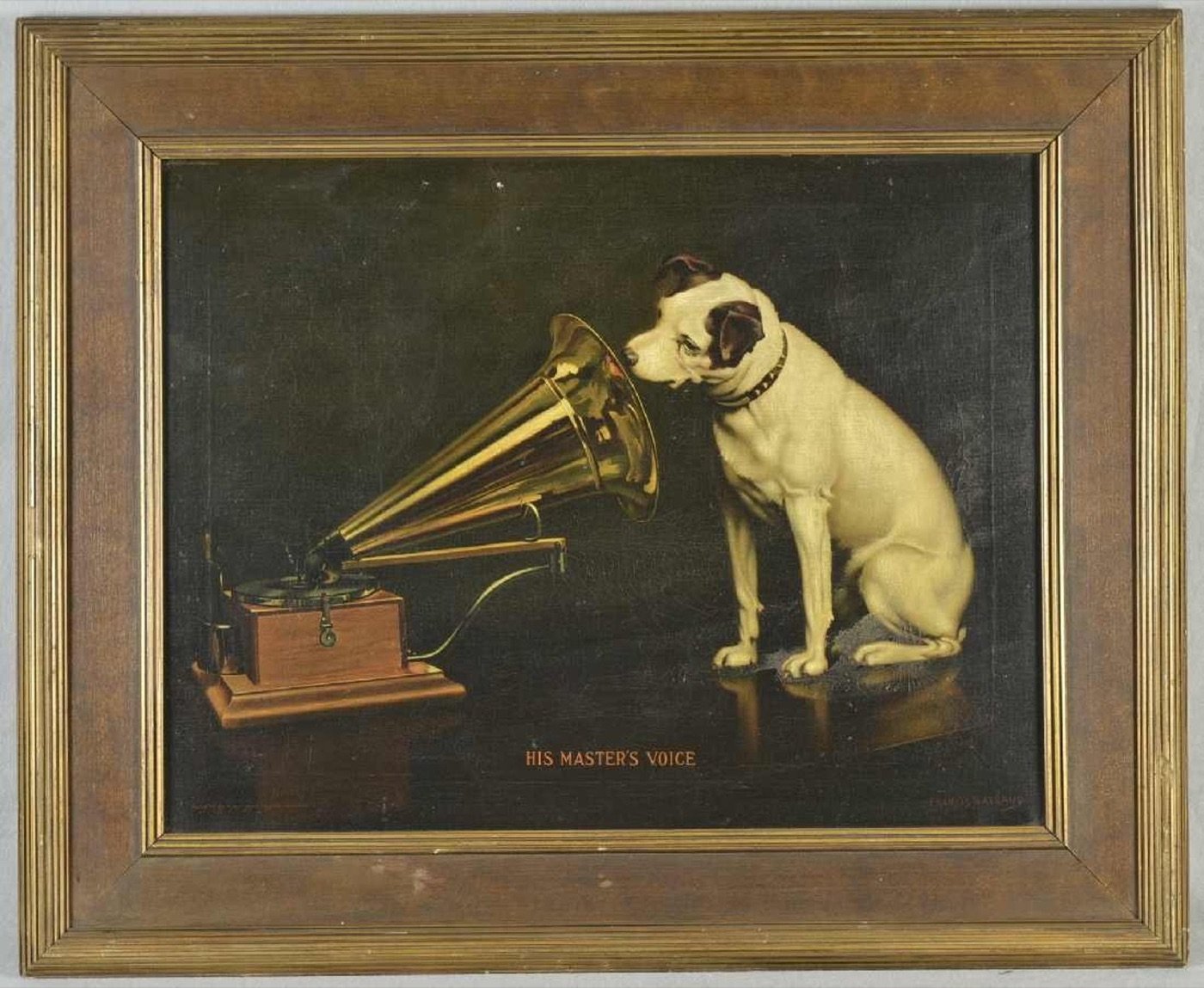
The original painting was made by Barraud in 1898 and showed a dog named Nipper listening to a phonograph. Barraud registered the image in 1899, and after revising the machine in the painting from a cylinder phonograph to a disc gramophone, he sold the work and slogan to the Gramophone Company for £100. The image went on to become one of the most famous trademarks in the recording industry, later associated with HMV, EMI, RCA, music stores, records, and sound equipment across generations.
Banksy is not choosing an obscure source. He is seizing a visual monument of twentieth-century listening culture. Even the later bronze HMV award trophies given by EMI underline how thoroughly the dog-and-gramophone image came to represent prestige, success, and institutional approval within the music business. In Banksy's hands, that same emblem is no longer reverential. It is insurgent.
What makes HMV so effective is its clarity. There is no clutter, no overstatement, no need for explanatory theatrics. The piece works because the original logo is so deeply embedded in popular memory, and because Banksy alters it with ruthless efficiency. One gesture changes everything. Listening becomes targeting. Fidelity becomes revolt. Heritage becomes dead weight.
Release Context
HMV Dog was first tagged in Bristol, Banksy's hometown, before being developed more prominently in London in 2003. That year, he painted the motif on the walls of the courtyard of the Cargo nightclub on Rivington Street in Shoreditch. There, the black-and-white stencil was set against a more colorful background of yellow and orange forms, giving the work a different energy from the print: still severe in outline, but more alive within the urban environment.
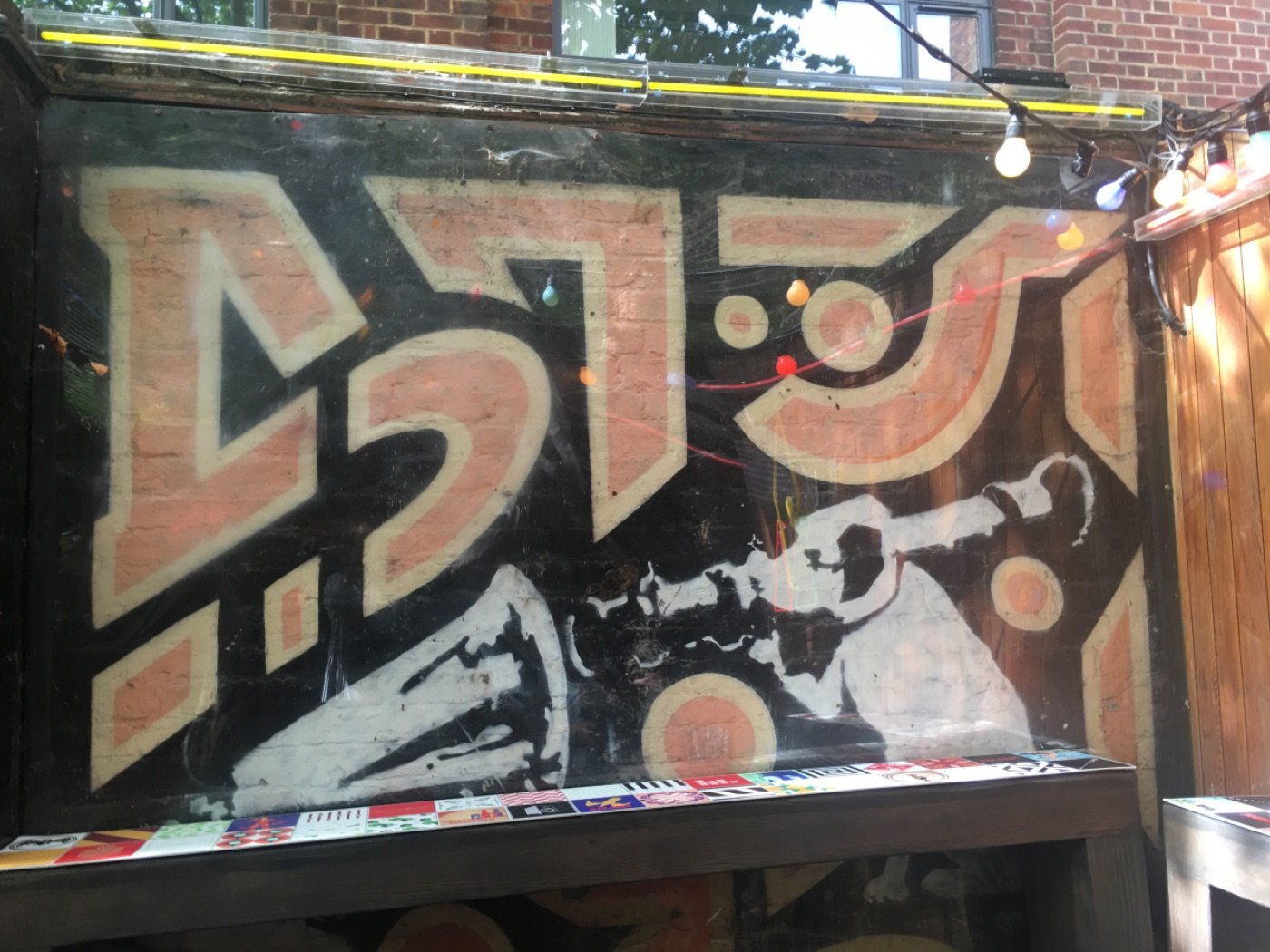
This mural context matters. Cargo, set inside an old railway tunnel and known for hosting important urban artworks, was precisely the kind of site where Banksy's visual language could move between subculture, nightlife, and public myth. The work was inaugurated there in June 2003, and has since been protected by perspex for roughly fifteen years, continuing to attract visitors as a local masterpiece. That endurance is telling. The work may mock the authority of legacy culture, but it has itself become part of London's street-art canon.
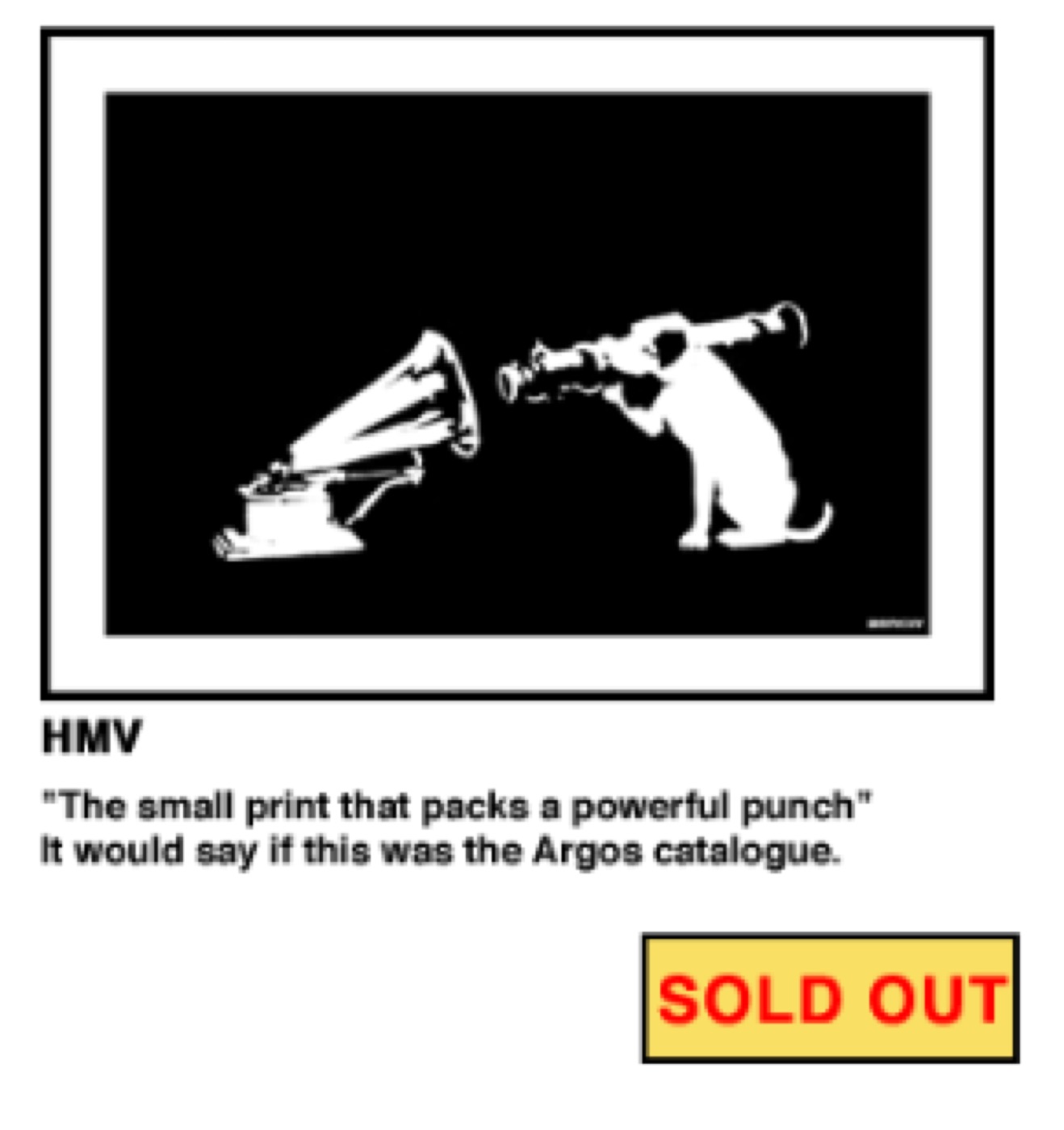
As a print, HMV was published by Pictures on Walls in 2003 as a screenprint in black on wove paper. The edition comprised 150 signed impressions and 600 unsigned ones. These details place the work squarely within Banksy's early print period, when his most memorable street images were being translated into portable, collectible form without losing their graphic bluntness.
That portability is part of the irony. A work attacking the inertia of a corporate music icon enters the market as an editioned image. But this contradiction is not a flaw in Banksy's practice; it is one of its engines. His pictures often critique systems while circulating through them. HMV is a perfect early example.
HMV is one of Banksy's most elegant acts of sabotage. A famous dog no longer listens. A beloved emblem no longer obeys. A machine once associated with prestige becomes a target. What Banksy destroys here is not only a gramophone, but a whole cultural posture: reverence for the established voice, faith in inherited structures, and nostalgia for systems already losing their grip.
STAY INFORMED
Receive the latest news, exhibitions, artworks and market updates on Banksy.