ANARCHY RAT, 2006
Provenance
- Acquired from the artist by the present owner
Auction History
Prices are inclusive of buyer’s premium unless stated otherwise, as reported by the auction houses.
Catalogue Note
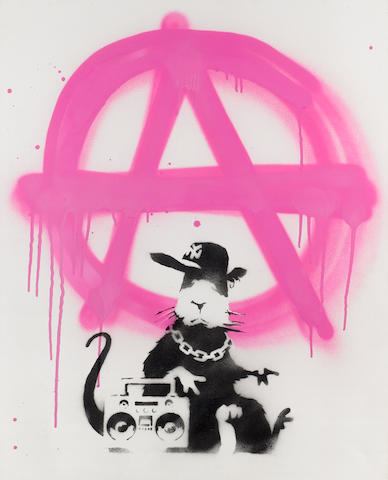
Few images embody Banksy’s artistic identity as completely as Anarchy Rat. Combining one of his earliest and most enduring protagonists with the unmistakable symbol of anarchism, the work functions almost as a self-portrait of the artist’s philosophy. The rat is no longer merely an inhabitant of the city; it has become its rebel, equipped not with weapons but with music, attitude and irreverence.
The rat occupies a unique place within Banksy’s visual universe. Like graffiti artists themselves, rats thrive unnoticed, move under the cover of darkness, survive despite relentless attempts at eradication, and leave their mark wherever they go. Banksy famously observed that “they exist without permission,” making them the perfect metaphor for the street artist. Small, underestimated and impossible to eliminate, the rat became his emblem long before it became one of his most recognizable commercial icons.
Here the animal is transformed into an urban revolutionary. Wearing an oversized chain and baseball cap while casually resting beside a boombox, the rat borrows the visual language of hip-hop culture as much as that of political activism. Towering behind it, the fluorescent pink anarchy symbol dominates the composition like a freshly sprayed piece of graffiti, its deliberate drips preserving the immediacy and energy of the street. The juxtaposition is characteristic of Banksy: rebellion is presented not through violence but through style, humor and cultural appropriation.
The work also illustrates Banksy’s remarkable ability to elevate graffiti into fine art without stripping it of its original spirit. Although executed on canvas, Anarchy Rat deliberately retains the aesthetic vocabulary of an illegal wall: sprayed paint, overspray, drips and the rapid execution of the stencil remain visible. Rather than sanitizing graffiti for the gallery, Banksy transports the street indoors, forcing the white walls of the art world to accommodate an art form they had long dismissed as vandalism.
Created in 2006, the work also marks a pivotal moment in Banksy’s career. By then he had progressed from painting illegally on the streets of Bristol and London to staging international exhibitions such as Barely Legal in Los Angeles, attracting Hollywood collectors while maintaining the visual language of anti-establishment culture. This paradox lies at the heart of Anarchy Rat. The symbol of rebellion has entered the gallery, yet refuses to behave. The canvas remains loud, provocative and defiantly unfinished, reminding viewers that institutional success has not erased its subversive origins.
More broadly, Anarchy Rat belongs to the extraordinary family of rat images that spans Banksy’s entire career—from the early placard rats and stencil interventions of the late 1990s to later masterpieces such as Radar Rat, Love Rat, Gangsta Rat, Parachuting Rat, Rat with 3D Glasses, and the celebrated bathroom rats created during the Covid-19 lockdown. No other motif accompanied the artist with such consistency or proved so adaptable. The rat became Banksy’s surrogate: mischievous yet intelligent, humorous yet political, insignificant in appearance but capable of quietly disrupting entire systems of power.
Ultimately, Anarchy Rat is not a celebration of chaos for its own sake. Banksy’s anarchism has never advocated destruction; rather, it questions authority, convention and inherited structures. The oversized pink symbol behind the rat therefore represents less a call for disorder than an assertion of intellectual independence. It reminds us that genuine freedom often begins with the refusal to accept the world exactly as it is—a lesson that has animated Banksy’s art from the walls of Bristol to the walls of the world’s greatest museums.
STAY INFORMED
Receive the latest news, exhibitions, artworks and market updates on Banksy.