Provenance
- Acquired directly from the artist by the present owner in 2006
UPCOMING LOT
Prices are inclusive of buyer’s premium unless stated otherwise, as reported by the auction houses.
AN APPARITION IN THE DARK
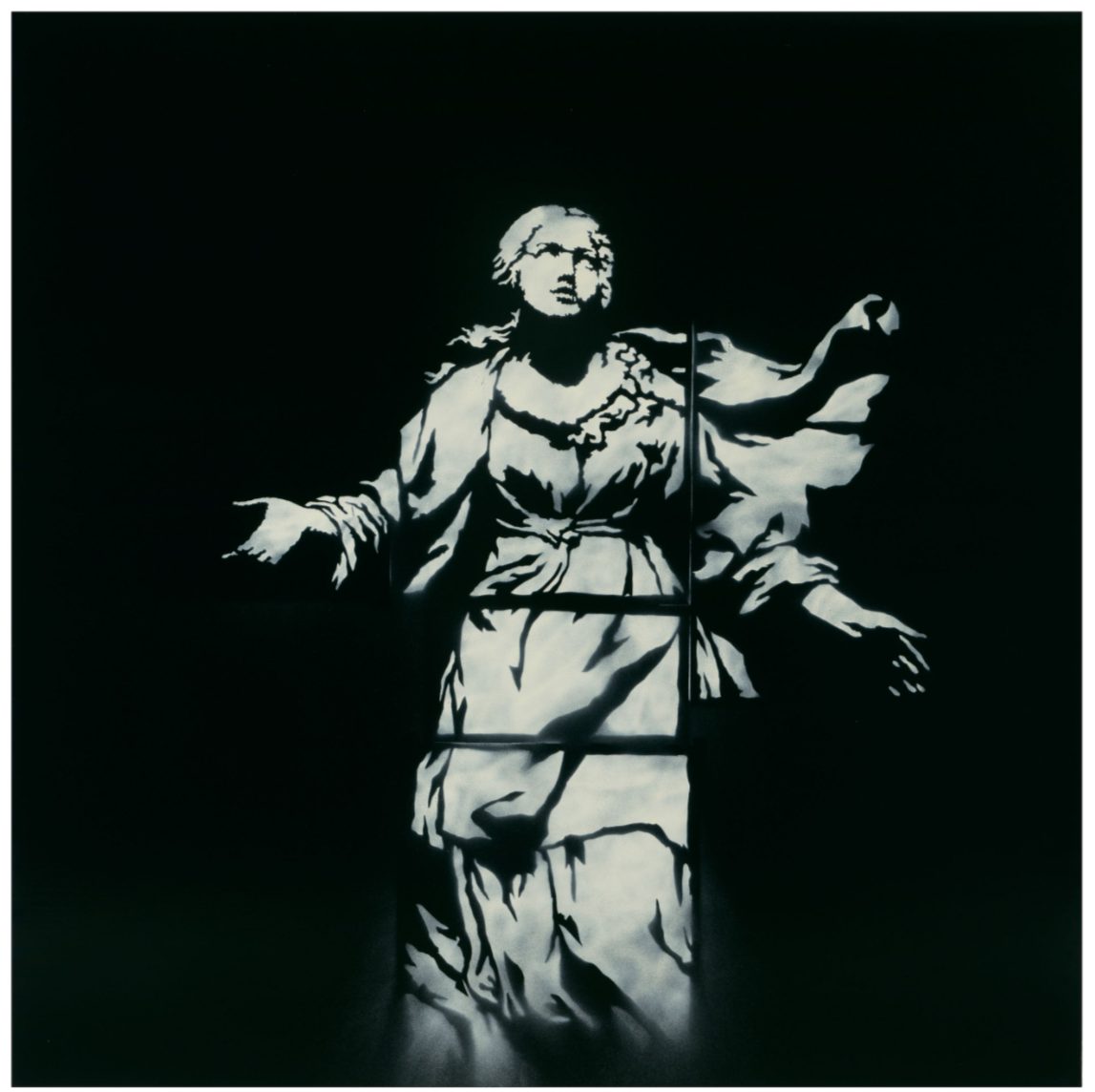
Painted in 2006 and exhibited at Barely Legal in Los Angeles that September, Angel is a monumental example of Banksy's stencil painting at a moment when his practice was moving decisively beyond the scale and physical conditions of the street. Measuring more than two meters square, the canvas presents a solitary female figure emerging from an almost absolute black field, her body articulated through pale areas of spray paint and emulsion while the surrounding darkness simultaneously defines and consumes her form.
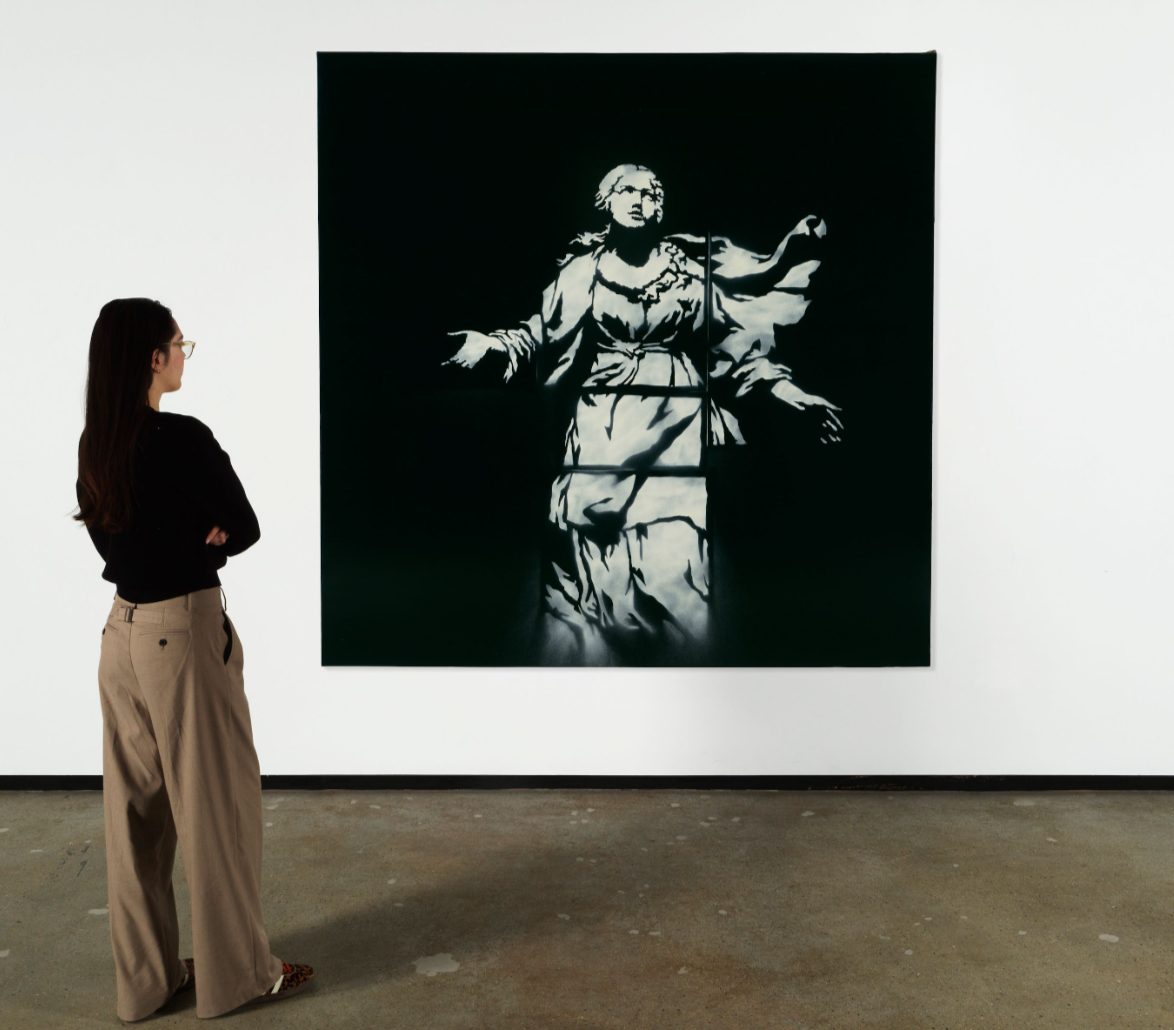
The composition draws upon the visual language of religious painting, particularly representations of saints, angels and female figures experiencing revelation or divine encounter. Banksy strips that tradition of virtually all its conventional attributes. There is no landscape, architecture, halo or celestial light. The figure has no visible wings. Instead, her face turns upward while her arms extend outward in a gesture suspended somewhere between surrender, supplication and astonishment. Her clothing billows dramatically behind her, suggesting movement or ascent, yet Banksy offers no narrative capable of explaining what we are witnessing.
This ambiguity is central to the painting's power. The title tells us that she is an angel, but the image refuses to provide the reassuring iconography through which an angel would traditionally be recognized. Banksy retains the emotional and theatrical vocabulary of sacred painting while removing the religious certainty that once sustained it.
THE STENCIL BECOMES MONUMENTAL
The physical construction of the figure is unusually important. Horizontal and vertical interruptions divide the body into distinct sections, openly revealing the mechanics through which the large stencil image was assembled. Banksy makes no attempt to disguise these divisions. Instead, they become part of the work itself, fragmenting the apparition while simultaneously holding it together.
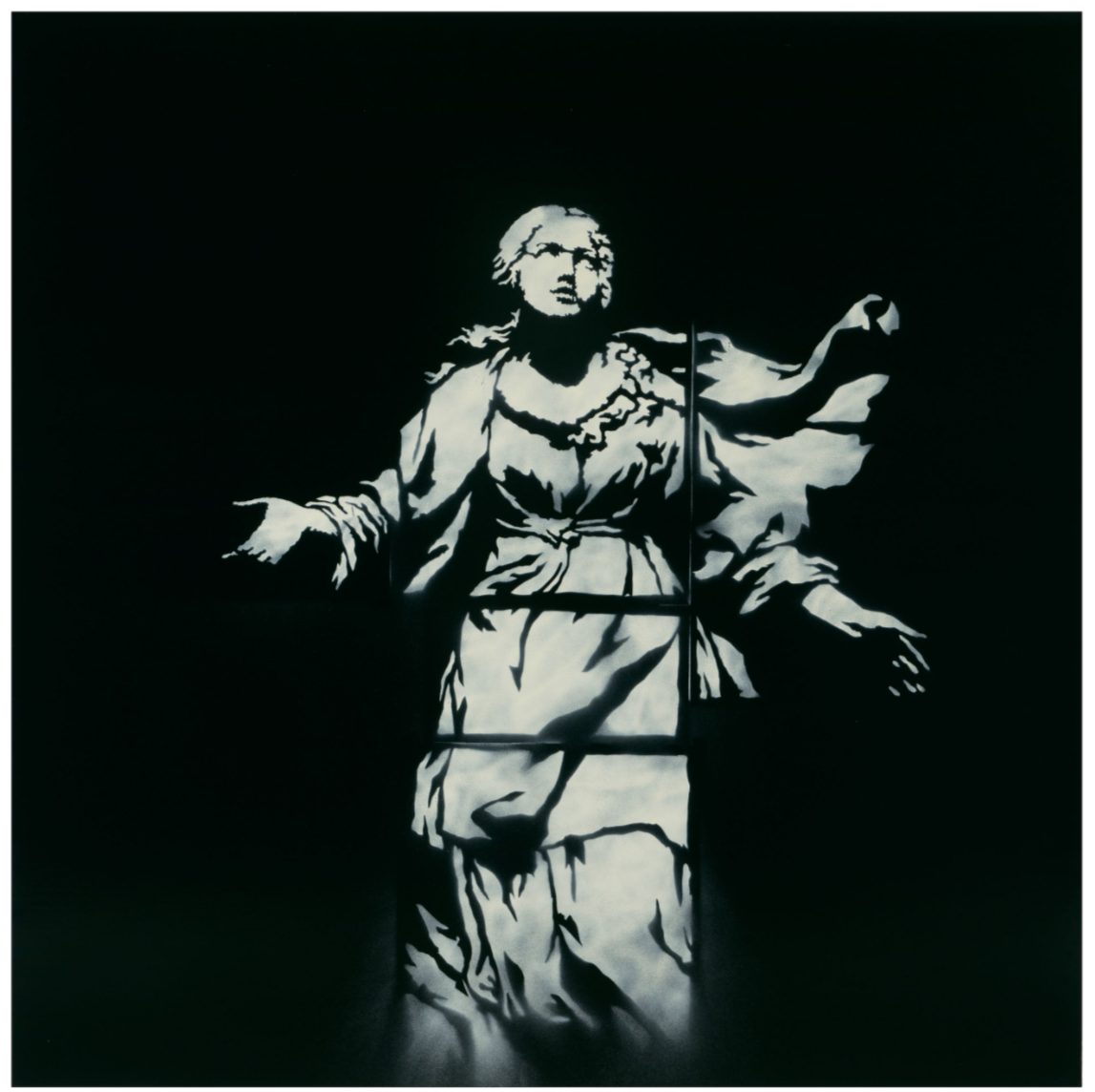
At street level, the stencil offered Banksy speed, reproducibility and the ability to construct complex images under conditions in which time mattered. In Angel, that fundamentally utilitarian technique has been expanded to the dimensions of history painting. The joins that might ordinarily betray the limitations of the process become compositional devices. Seen across 213 centimetres of canvas, the figure appears almost cinematic: a succession of frames briefly aligning to produce a single human presence.
The result embodies one of the fascinating contradictions of Banksy's practice during this period. A technique inseparable from illicit street intervention is being used to produce an object of imposing physical scale, intended to occupy the same wall space as a major traditional painting. Rather than abandoning the language of the street as his work entered galleries and collections, Banksy monumentalizes it.
BARELY LEGAL: BANKSY IN LOS ANGELES
Angel was exhibited at Barely Legal, Banksy's three-day exhibition held in a warehouse in Los Angeles from 15 to 17 September 2006. The exhibition represents one of the defining moments of his career, bringing together paintings, sculpture, installations and modified found works within an environment conceived entirely by the artist. Its most notorious element—the live elephant painted to resemble the room in which it stood—generated international attention, but the exhibition also contained an exceptionally important concentration of studio works.
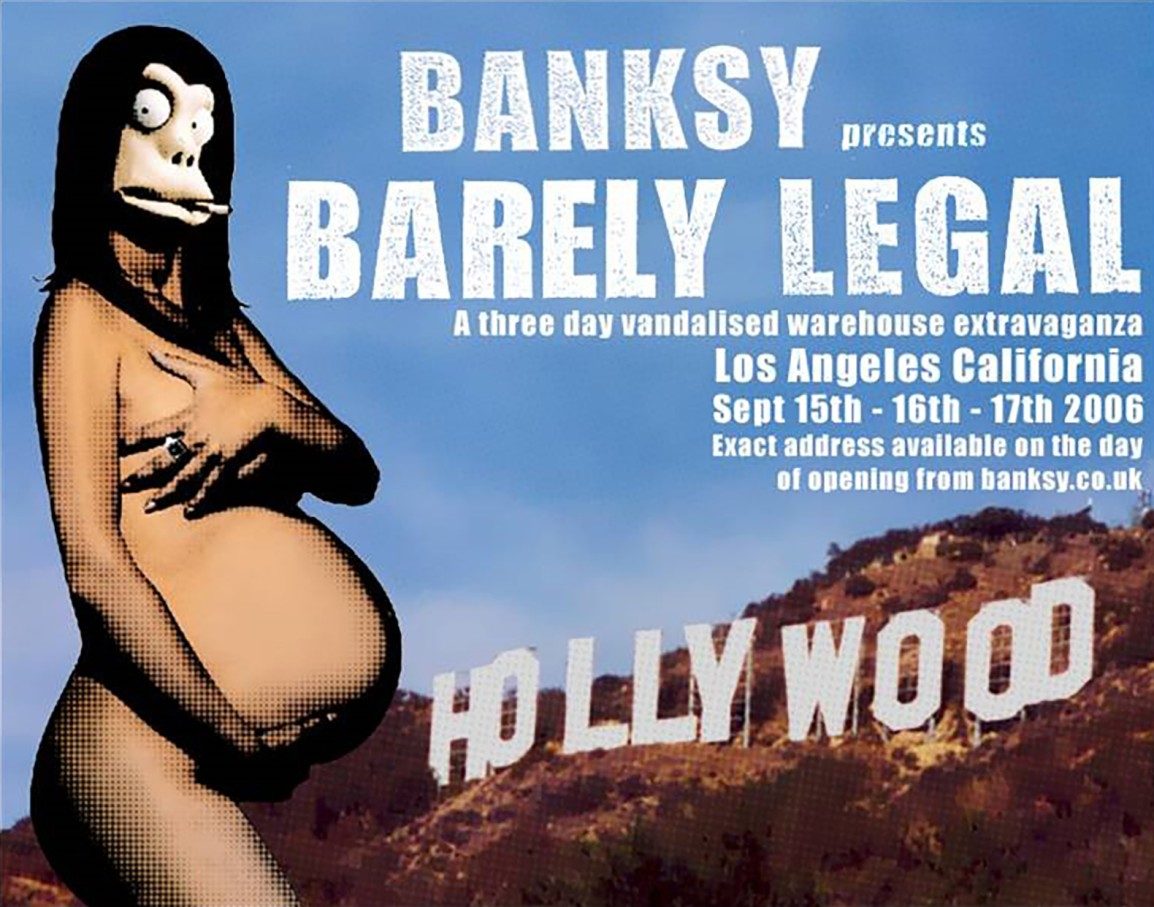
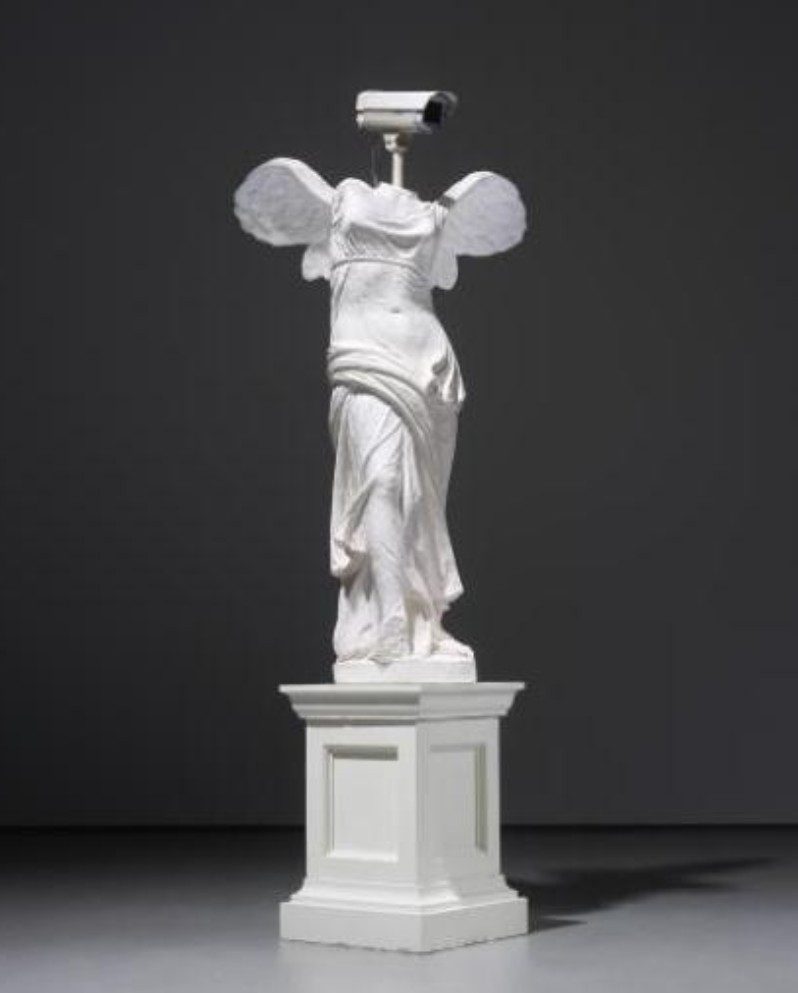
Within this context, Angel belongs to a remarkable moment of experimentation. Barely Legal included works ranging from the monumental Sale Ends Today and politically charged Festival (Destroy Capitalism) to Trolley Hunters, Applause, Grannies and Banksy's sculptural CCTV Angel. The exhibition demonstrated how far his visual vocabulary had expanded beyond the small stencil interventions with which his reputation had initially been established.
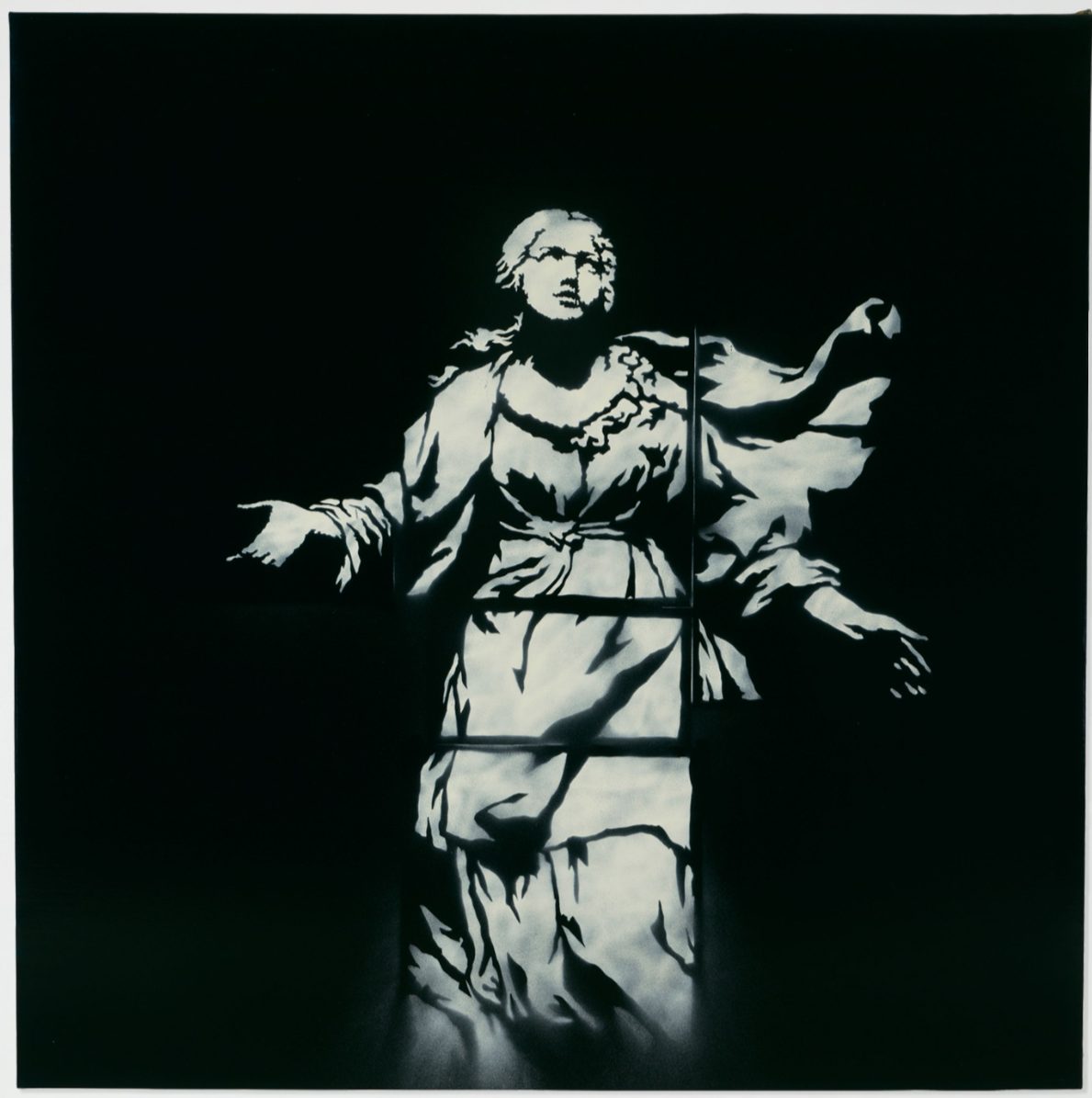
The simultaneous presence of Angel and CCTV Angel is particularly significant. Banksy's engagement with angelic imagery was not simply devotional or decorative. In his hands, the angel repeatedly becomes compromised, displaced or brought into collision with contemporary reality. The sacred figure can become an instrument of surveillance, a damaged or fallen body, or—as here—an apparition whose very physical integrity has been fractured by the stencil through which it is created.
Barely Legal also followed only a year after Crude Oils in London, where Banksy had systematically interfered with the conventions of traditional painting. In Los Angeles, that dialogue with art history continued but became more ambitious. Rather than merely inserting contemporary disruptions into existing paintings, works such as Angel demonstrate Banksy constructing images of his own that appropriate the scale, theatricality and visual authority historically associated with museum painting.
BETWEEN THE SACRED AND THE STREET
The upward gaze, extended arms and dramatically animated drapery of Angel place the figure within the centuries-old visual tradition of Christian revelation and ascension. A particularly illuminating comparison can be made with Titian’s Assumption of the Virgin (1516–18), the monumental altarpiece created for the high altar of Santa Maria Gloriosa dei Frari in Venice. The comparison should not imply that Titian was Banksy’s direct source; rather, it reveals how Banksy draws upon a deeply embedded vocabulary of sacred representation. The Frari itself describes Titian’s painting as a radically powerful and realistic representation of Mary’s assumption into heaven.
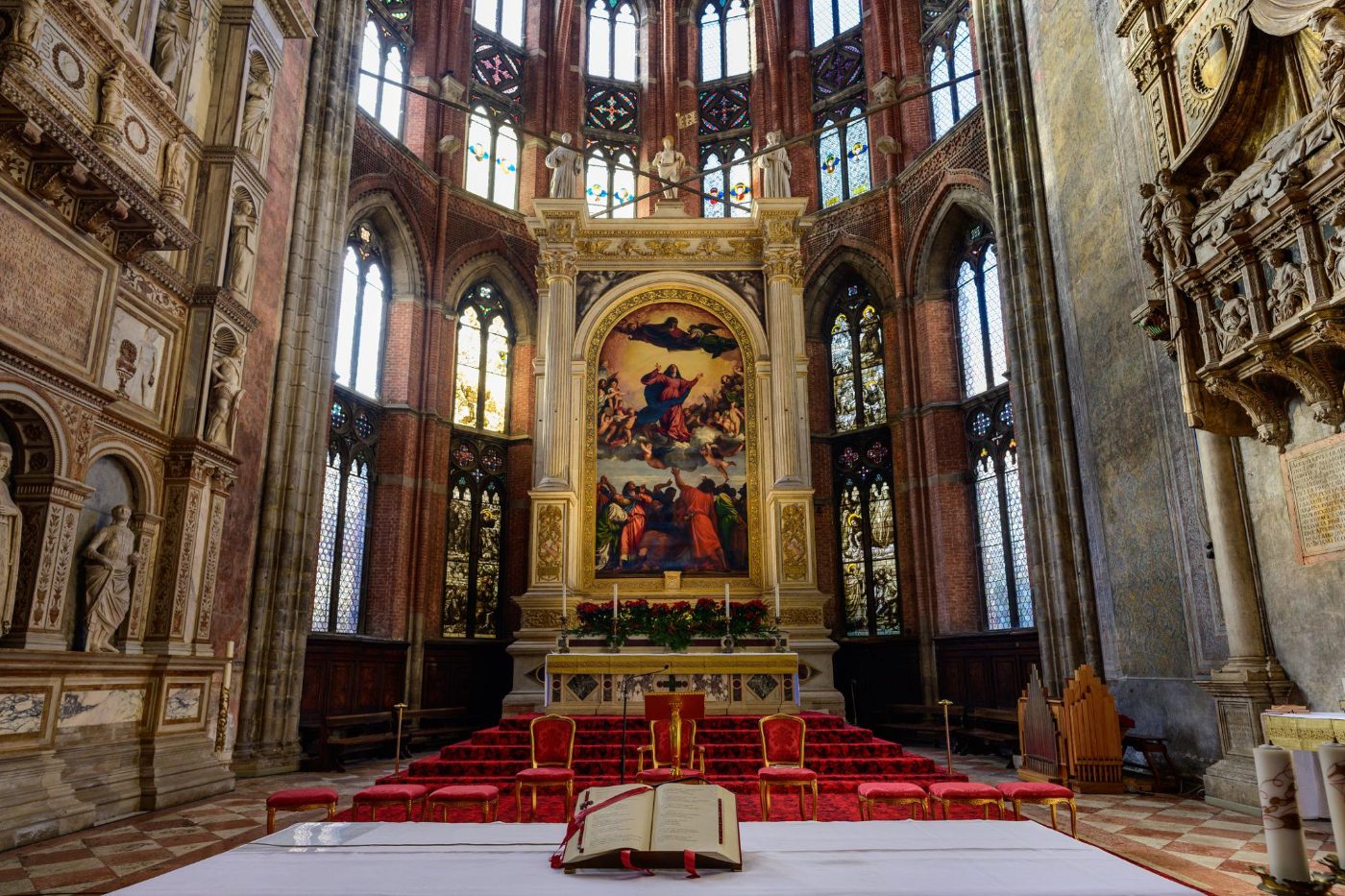
In Titian’s composition, Mary rises between the earthly and divine realms, her face turned upward and her arms opened as her red and blue garments billow around her. Everything surrounding her explains the miraculous event: the Apostles react below, angels carry her upward, and God awaits within a field of golden celestial light. Gesture, movement, colour and architecture combine to make transcendence unequivocal.
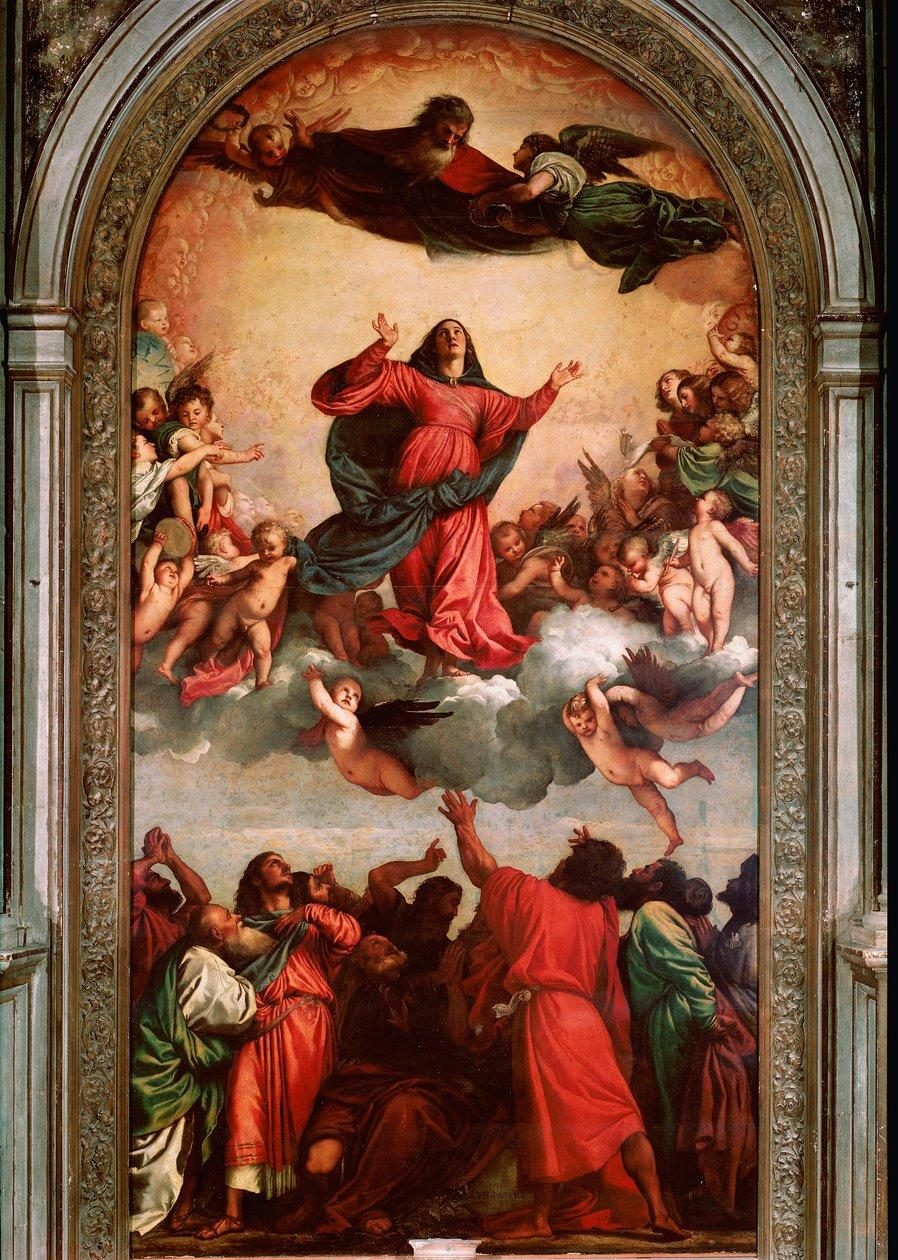
Banksy preserves much of this bodily rhetoric while systematically removing its religious certainty. His figure similarly looks upward, opens her arms and appears animated by flowing drapery, but there is no God, no congregation, no cherubim, no clouds and not even visible wings. Most significantly, Titian’s golden heaven has become Banksy’s almost absolute blackness. We cannot determine whether the figure is ascending from the darkness, emerging from it or disappearing into it.
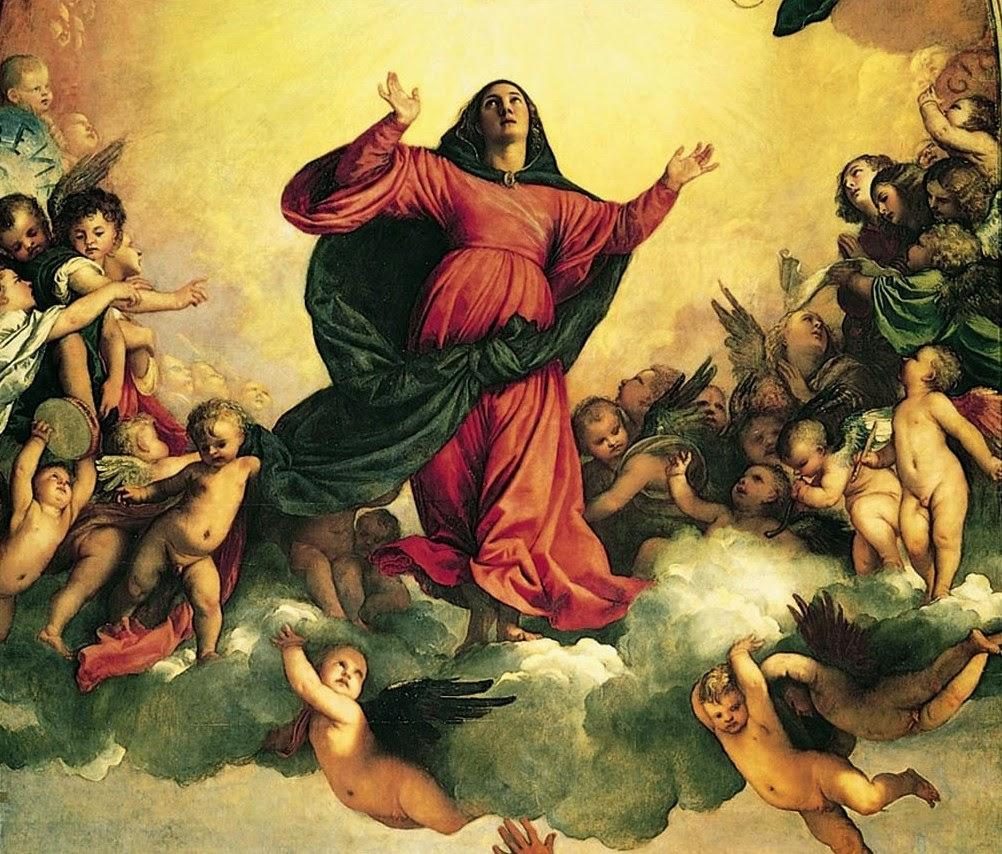
The contrast extends to the construction of the body itself. Titian’s Virgin remains a coherent physical presence despite her miraculous ascent; Banksy’s Angel is visibly fractured by the horizontal and vertical divisions of the monumental stencil. The mechanics of street art remain exposed within an image carrying the visual memory and scale of sacred painting. Banksy therefore does not need to quote a Renaissance masterpiece directly: he retains the inherited gesture of transcendence while removing the world that once guaranteed its meaning.
The sacred image survives, but its certainty has disappeared.
STAY INFORMED
Receive the latest news, exhibitions, artworks and market updates on Banksy.