ANY PERSON FOUND, 2011
Catalogue Note
From Criminal to Commodity
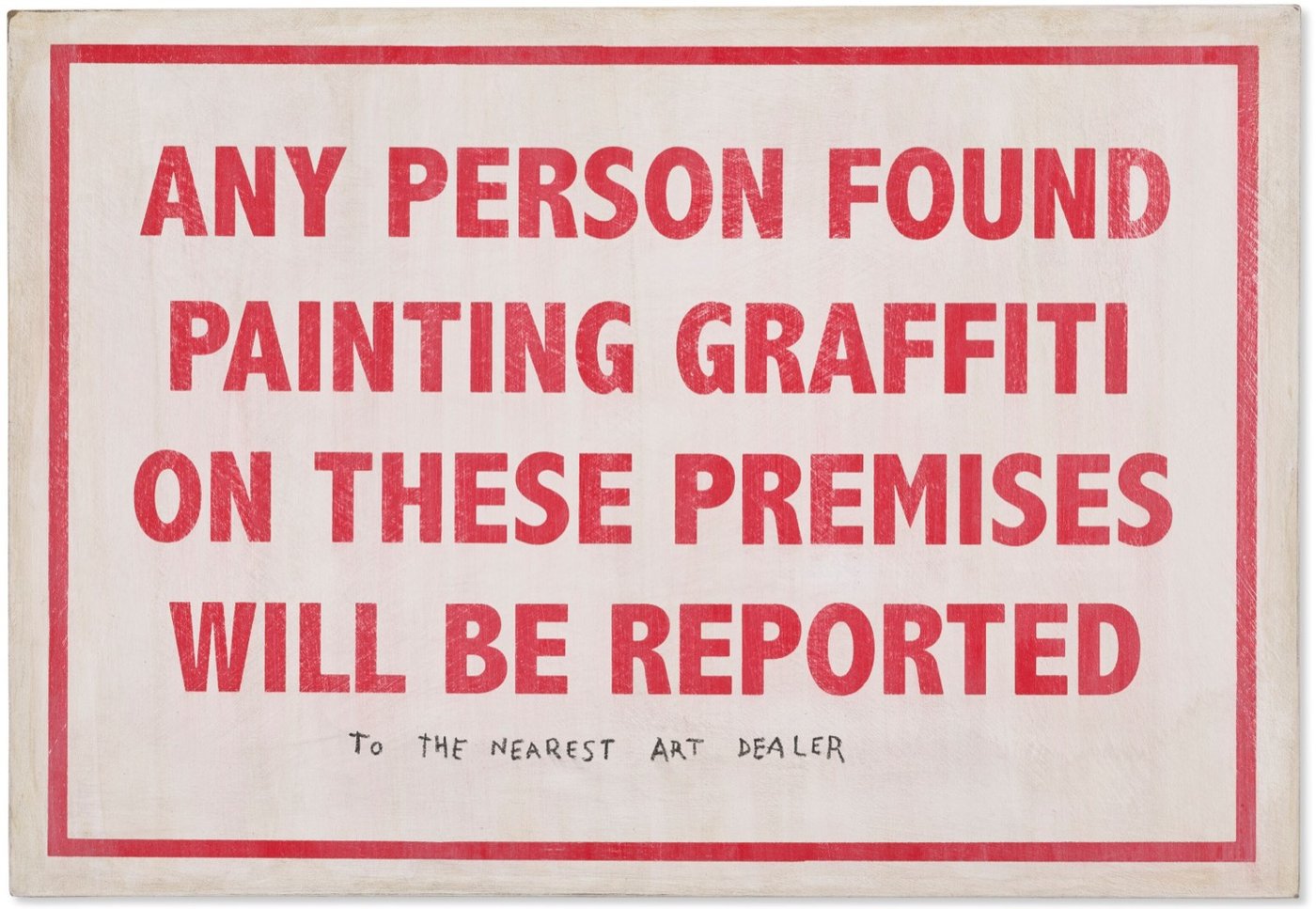
Any Person Found adopts the visual language of an official warning notice and turns it into one of Banksy's neatest jokes about the transformation of graffiti into contemporary art. What initially appears to be a prohibition against trespassing or vandalism delivers an unexpected punishment: the graffiti artist will not be handed over to the police, but to an art dealer.
The substitution is everything. For much of graffiti's history, the principal institutional response to the graffiti writer was prosecution. By 2011, Banksy had experienced the extraordinary reversal of that relationship firsthand. The same visual culture once removed from walls as vandalism was being exhibited, collected and traded for increasingly substantial sums. The outlaw had become an asset.
A Different Kind of Threat
Yet Banksy's joke is more complicated than a simple criticism of the art market. Being sent to an art dealer is presented as a threat. The humour depends upon the possibility that commercialization may represent another form of capture: the rebellious artist escapes the police only to be apprehended by the market.
That makes the work unusually self-aware. By 2011, Banksy himself occupied precisely this uncomfortable territory. His anonymity, anti-establishment imagery and origins in illegal street painting had become inseparable from the desirability of his work as a commodity. The more effectively Banksy challenged the machinery of the art world, the more eagerly that machinery absorbed Banksy.
The physical object makes the contradiction even better. Any Person Found criticizes the conversion of graffiti into merchandise while itself existing as a signed and numbered edition of fifteen—a rare, collectible Banksy object destined for exactly the market it mocks.
Any Person Found captures one of the great paradoxes running through Banksy's career: society first criminalizes rebellion and then, once sufficiently desirable, learns how to sell it. Banksy does not resolve that contradiction because he is part of it. Instead, he converts it into a warning sign. For the graffiti artist, apparently there are worse things than getting arrested. You could get an art dealer.
STAY INFORMED
Receive the latest news, exhibitions, artworks and market updates on Banksy.