BANGING YOUR HEAD AGAINST A BRICK WALL, 2001
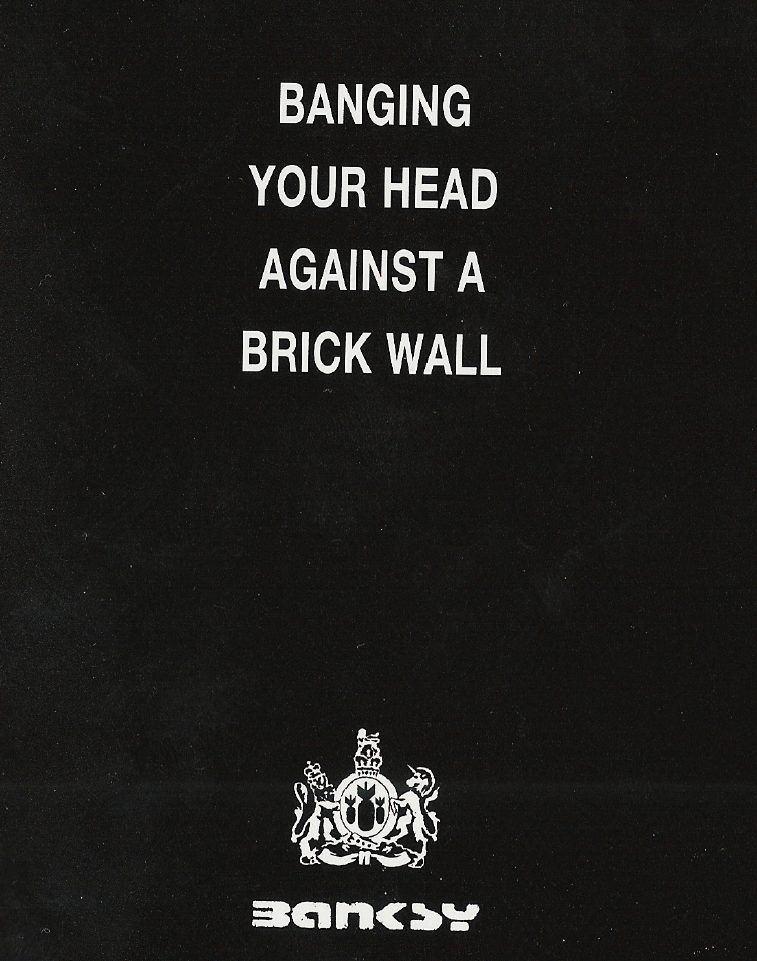
THE FIRST BLACK BOOK
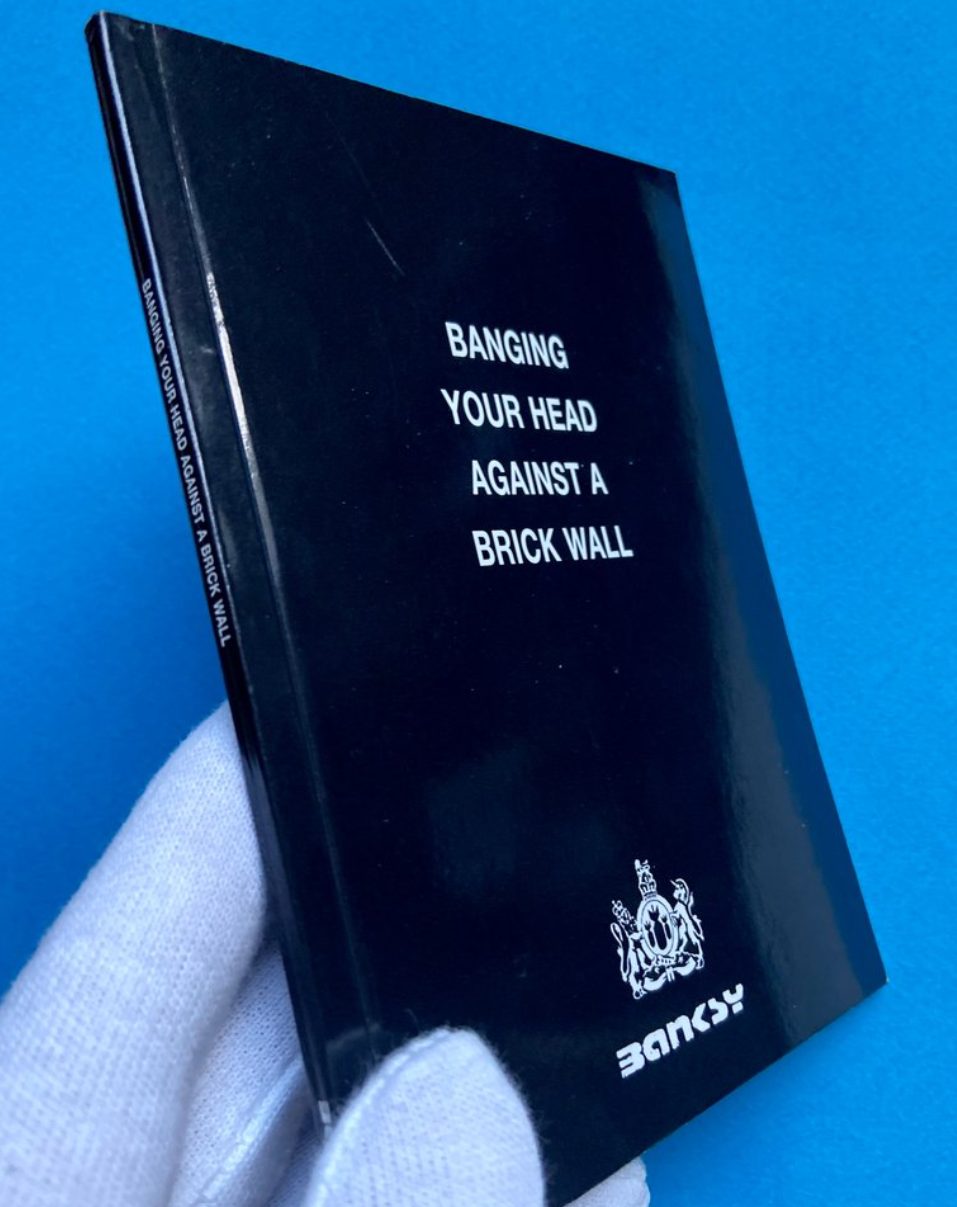
Published in 2001, Banging Your Head Against a Brick Wall was Banksy's first book and the first of the three small publications now generally known as his early “black books.” It was followed by Existencilism in 2002 and Cut It Out in 2004, before much of the material from the trilogy was subsequently reworked and brought to a far larger audience through Wall and Piece. Contemporary bibliographic records describe the book as a pocket-sized A6 publication, originally selling for approximately £5.
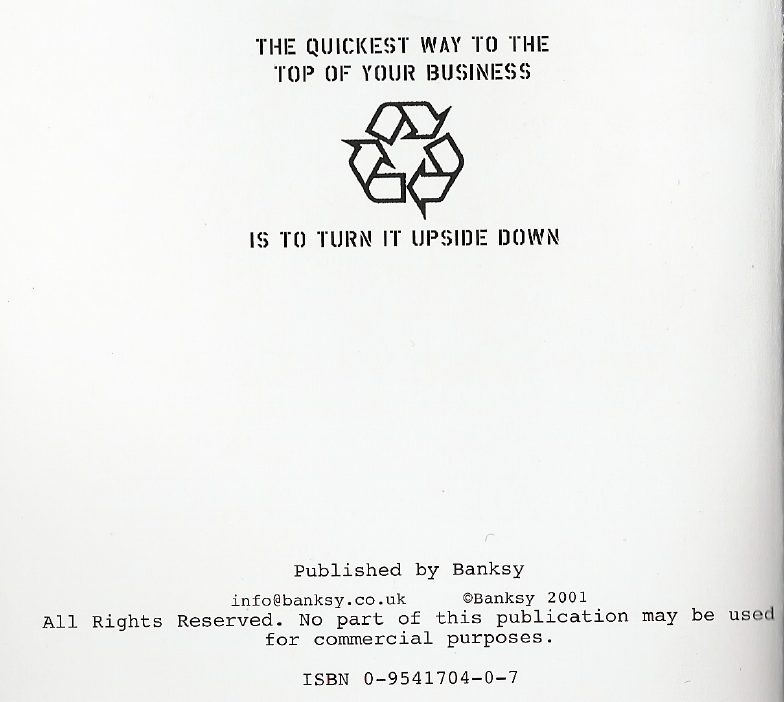
The book itself is emphatically self-published. Its opening pages state simply “Published by Banksy,” alongside the artist's early banksy.co.uk contact details and copyright notice. Opposite appears The South Banksy Show, documenting Banksy's intervention beneath the railway arches at London's Southbank in 2001. There is no conventional institutional introduction, critical essay or curatorial apparatus. Banksy presents Banksy.
That independence is fundamental to understanding the publication. Banging Your Head Against a Brick Wall appeared before Banksy's international celebrity, before Pest Control, before the major auction market and before the institutional paradoxes that would eventually surround his work. The book belongs instead to the culture from which his practice emerged: graffiti, independent publishing, inexpensive multiples, flyers, skate culture and material circulated directly among people rather than validated from above.

Its modest format is therefore not incidental. Small enough to be carried in a pocket, predominantly monochrome, assembled from photographs, stencil graphics, short texts, quotations, letters and apparently casual observations, the book resembles a sophisticated underground zine more than an artist's monograph. Yet behind that apparent informality lies an exceptionally coherent statement of artistic intent.
A MANIFESTO IN POCKET FORM
The opening text is perhaps the most important document in the book. Banksy confronts the accusation that graffiti is ugly, selfish and motivated by a desire for attention, only to turn the argument back upon society itself. More significantly, he explicitly rejects the idea that graffiti is merely an apprenticeship undertaken in the hope of eventual acceptance by the conventional art world. For Banksy, working directly on the street already constitutes an alternative system of artistic communication.
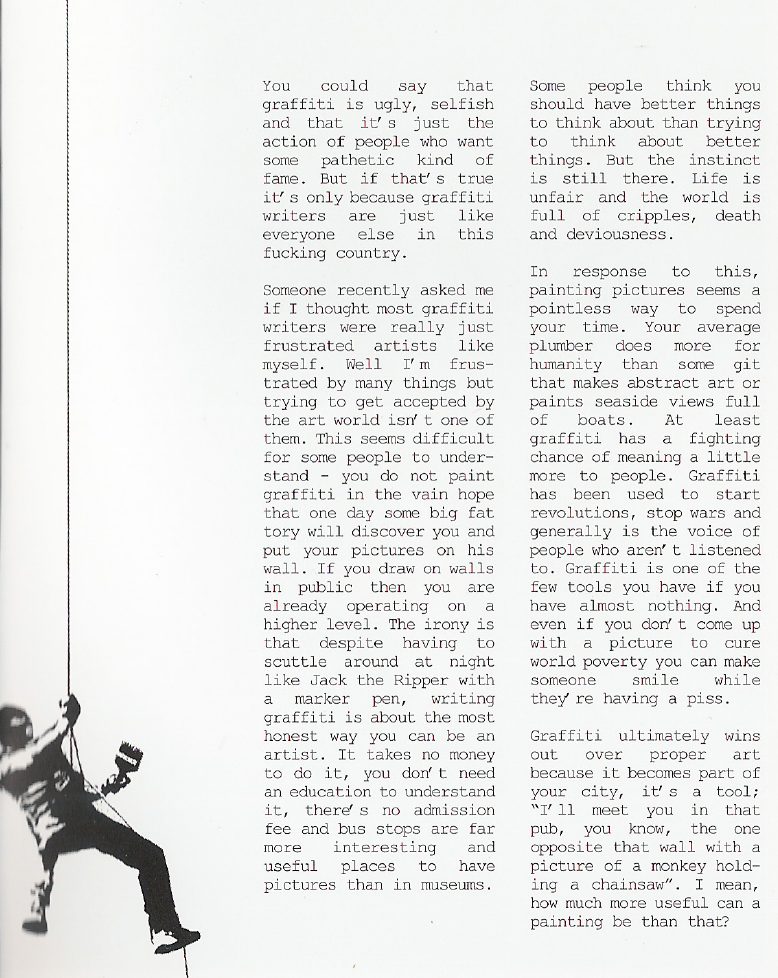
This is crucial because it establishes, extraordinarily early, a position Banksy would spend the following decades exploring. The street is not presented as the route into the museum; it is presented as an alternative to it. Public space eliminates admission fees, curators and much of the apparatus determining who is entitled to encounter art. The bus stop, wall, bridge and pavement become exhibition spaces precisely because nobody has formally designated them as such.
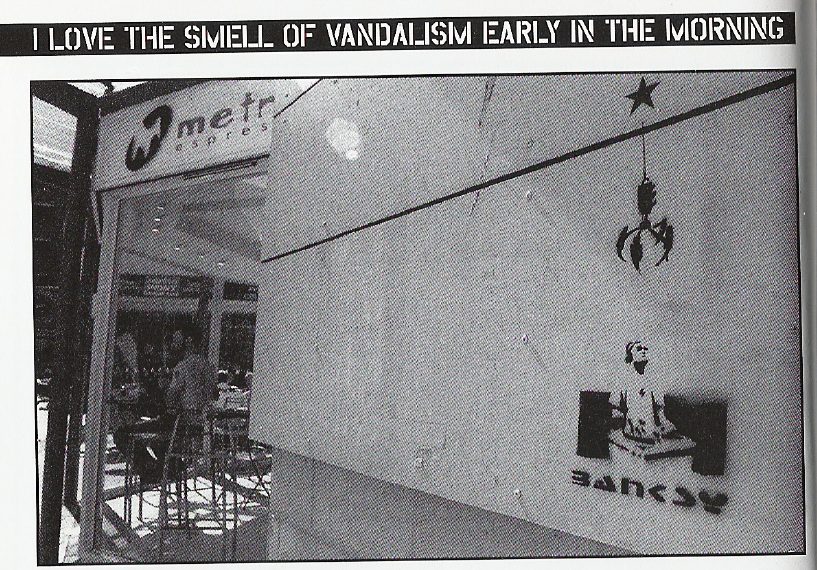
The contradiction that would later define Banksy's career is consequently already embedded in his first publication. He is producing an object that records and circulates an art form whose power partly derives from its resistance to commodification and institutional control. The book documents ephemeral works while simultaneously giving them permanence. It disseminates an anti-establishment practice through something that can be owned, collected and preserved. Banksy does not attempt to resolve that contradiction. Increasingly, it would become one of the engines of his work.
INSIDE THE BOOK
The density of ideas across the publication is remarkable. What initially appears to be a compilation of early graffiti gradually reveals itself as something closer to a visual essay about authority, surveillance, violence, consumer culture, public space and the legitimacy of art itself.
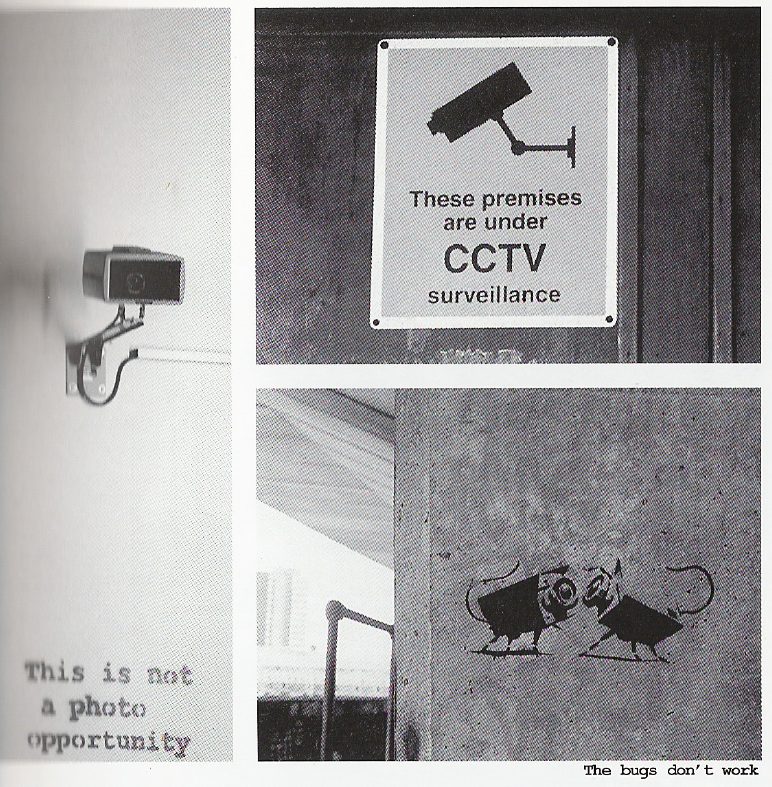
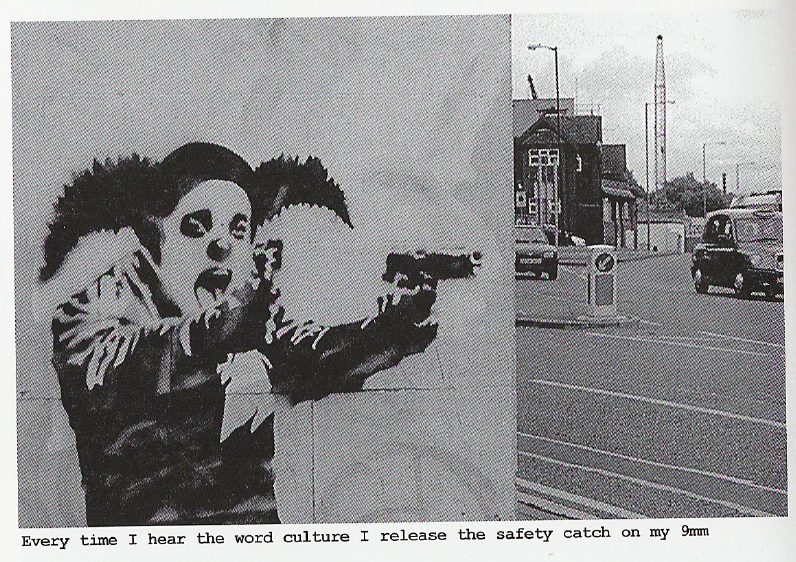
CCTV cameras become characters watching one another under the heading Secrets, Lies and Beady Little Eyes. Banksy juxtaposes real surveillance infrastructure with his own stencilled cameras and remarks upon the paranoia generated by being permanently observed. On the following spread, the now familiar Golf Sale composition places an absurd commercial sign beside a line of tanks, reducing military power and consumer advertising to the same brutally economical visual language.
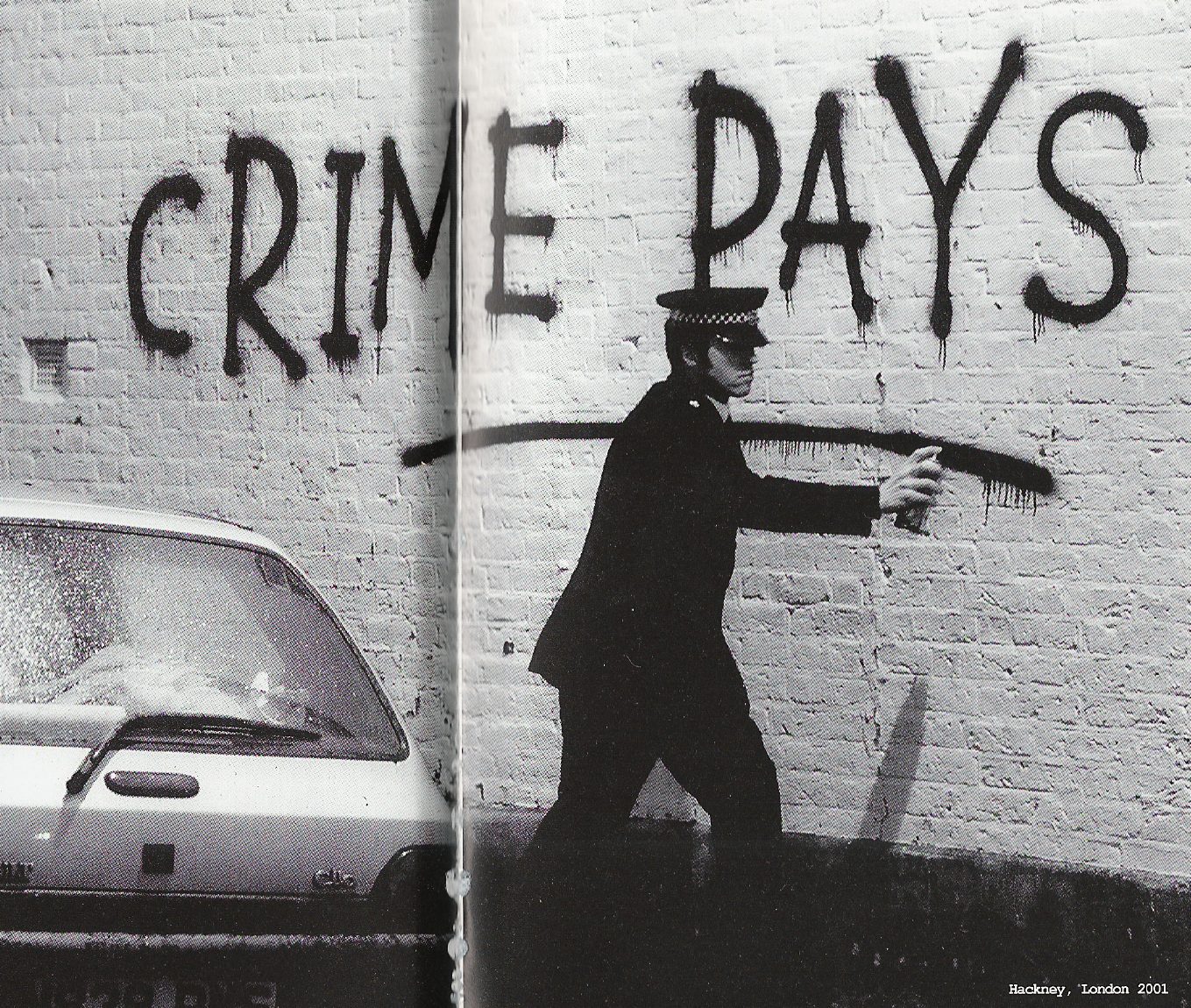
Elsewhere, a policeman paints the enormous words CRIME PAYS across a wall, collapsing the distinction between vandal and authority. Another section bears the characteristically Banksy title Anyone Who Believes in Capital Punishment Should Be Shot. The targets shift continually—police, government, war, advertising, surveillance, cultural authority—but the mechanism remains consistent: Banksy takes an apparently stable social category and introduces a contradiction that makes it unstable.
Even the section titles already sound unmistakably like the Banksy of later years: Pests Control, Cheeky Monkey, Don't Believe the Type, Existencilism, Weapons of Mass Distraction, Only the Ridiculous Survive, Every Picture Tells a Lie and Zen and the Art of Mindless Vandalism. The linguistic identity is nearly as developed as the visual one. Puns, reversals, borrowed slogans and apparently throwaway jokes become mechanisms for questioning received language.
THE BANKSY UNIVERSE IS ALREADY THERE
Perhaps the most historically important aspect of Banging Your Head Against a Brick Wall is the extraordinary number of ideas that would remain central to Banksy's practice.
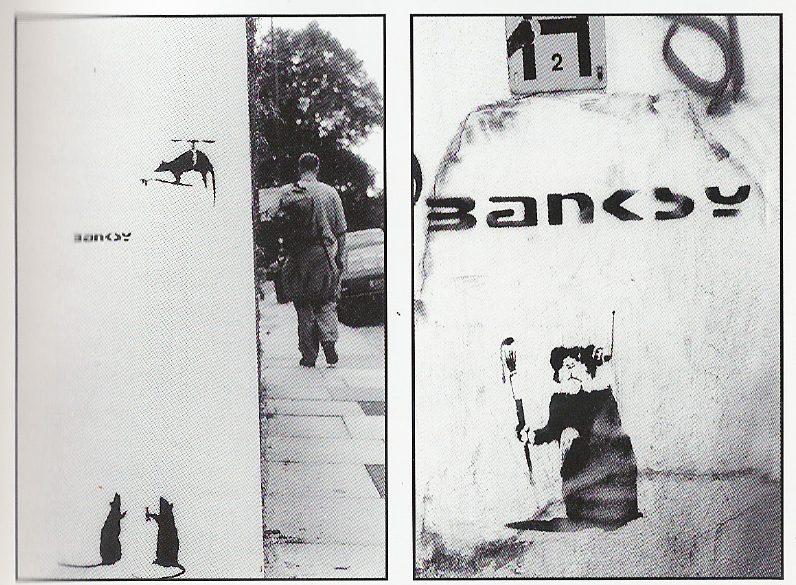
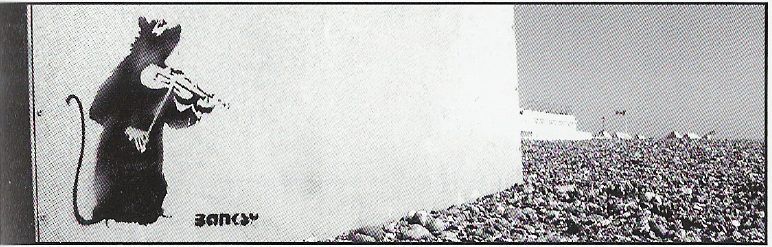
The rat is already present as an alter ego for the graffiti artist: small, unwanted, resourceful and capable of inhabiting the infrastructure of the city without permission. The book's Pests Control section brings together early examples of the motif, while the following pages introduce monkeys and other characters that would become fundamental to Banksy's visual vocabulary.
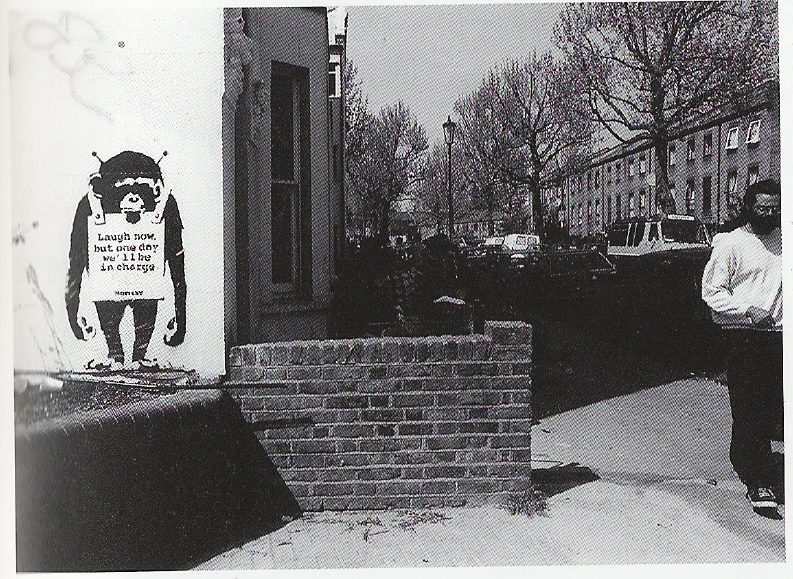
The monkey is equally important. Cheeky Monkey includes the early Monkey Detonator imagery and photographs of monkeys carrying signs, establishing the animal as both an evolutionary joke and a substitute for human political behavior. Near the end of the book, Banksy pushes the motif directly into British national iconography, transforming the Queen into a chimpanzee and reproducing the image as an entire sheet of mock postage stamps under the heading Deride and Conquer.
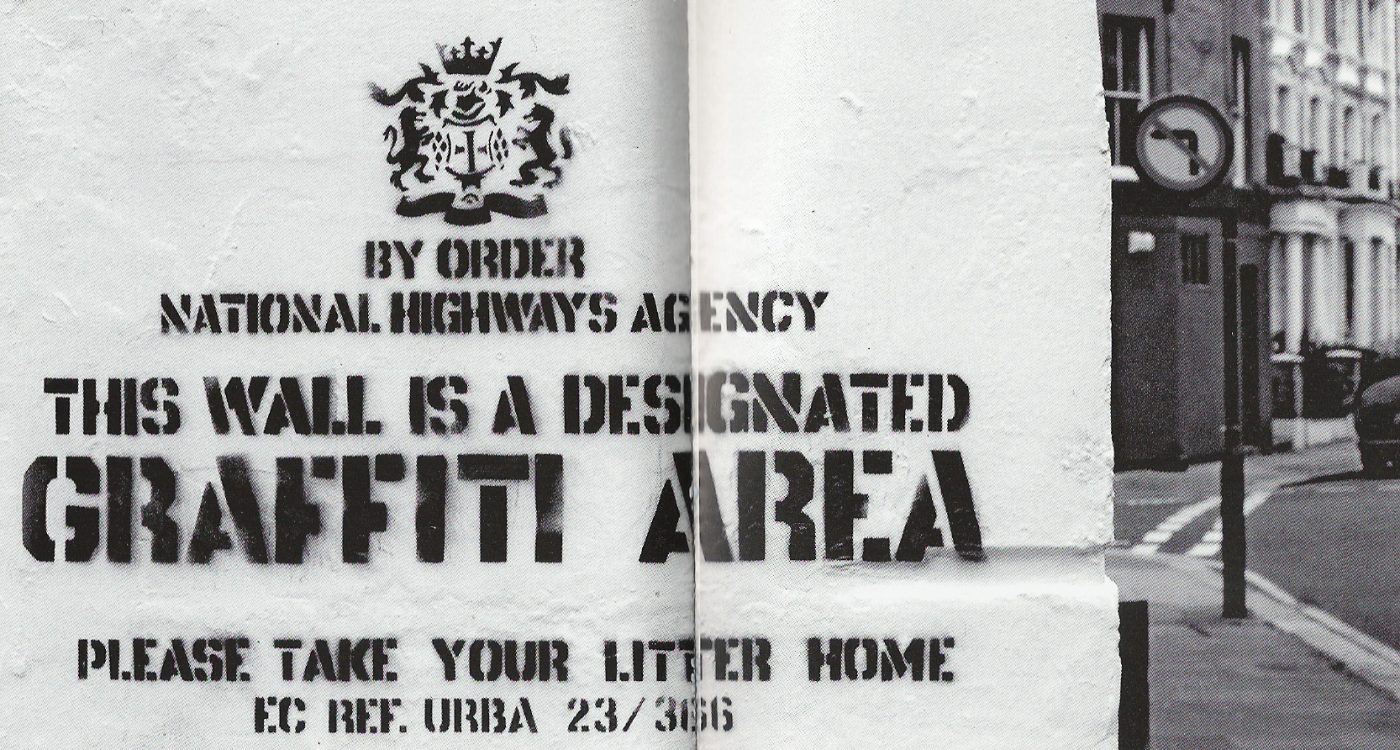
The mechanisms of institutional appropriation are already being tested as well. Banksy's counterfeit National Highways Agency notice declares a wall to be a designated graffiti area, borrowing the visual authority of government signage to authorize precisely what government normally prohibits. The following Existencilism sequence documents what happens afterwards as other graffiti accumulates around the apparently official notice. Banksy is no longer simply placing an image on a wall: he is creating a situation and allowing the public to complete it.
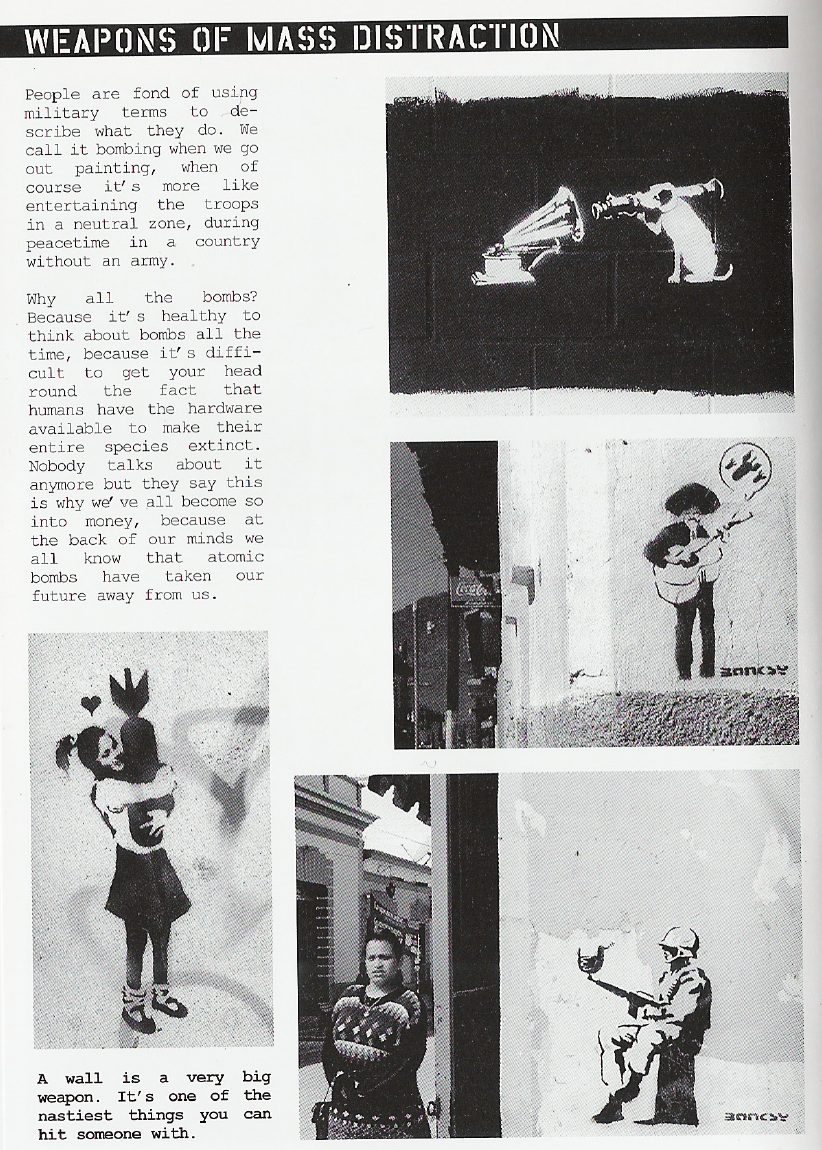
War imagery is equally established. Under Weapons of Mass Distraction, soldiers, children, weapons and apparently innocent figures coexist within compositions that destabilize conventional distinctions between security and threat. These are not preliminary experiments awaiting a mature political Banksy. The political Banksy is already here.
FROM STREET ART TO ART HISTORY

One of the most revealing spreads is Only the Ridiculous Survive. Banksy reproduces traditional framed landscape paintings that have been invaded by contemporary elements, including a military helicopter.
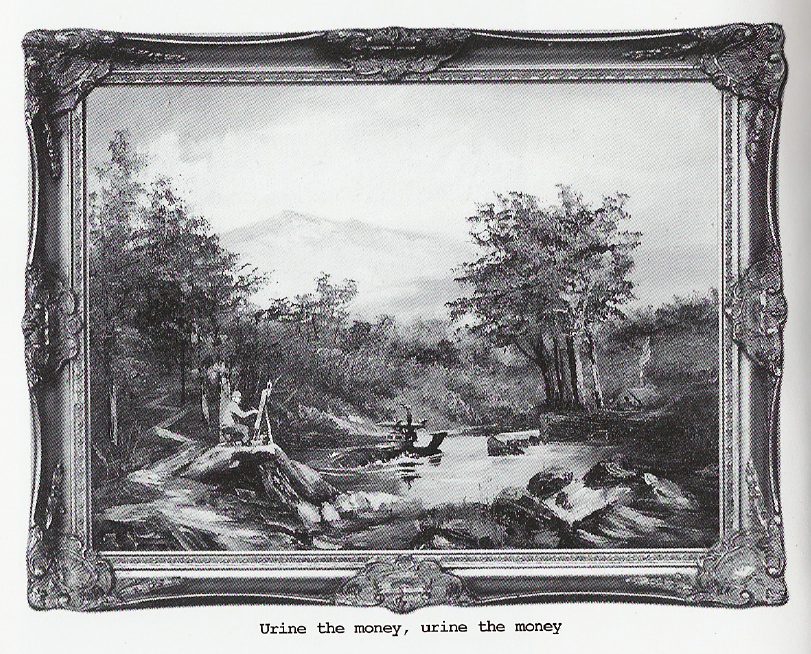
This is particularly significant in retrospect. The strategy anticipates the Vandalised Oils that would become one of the most important strands of Banksy's studio practice: existing or conventionally styled paintings interrupted by war machines, urban debris, police tape, shopping trolleys or other contemporary intrusions. The conceptual principle is already clearly articulated in 2001—the inherited visual language of respectable art is treated as another surface available for vandalism.
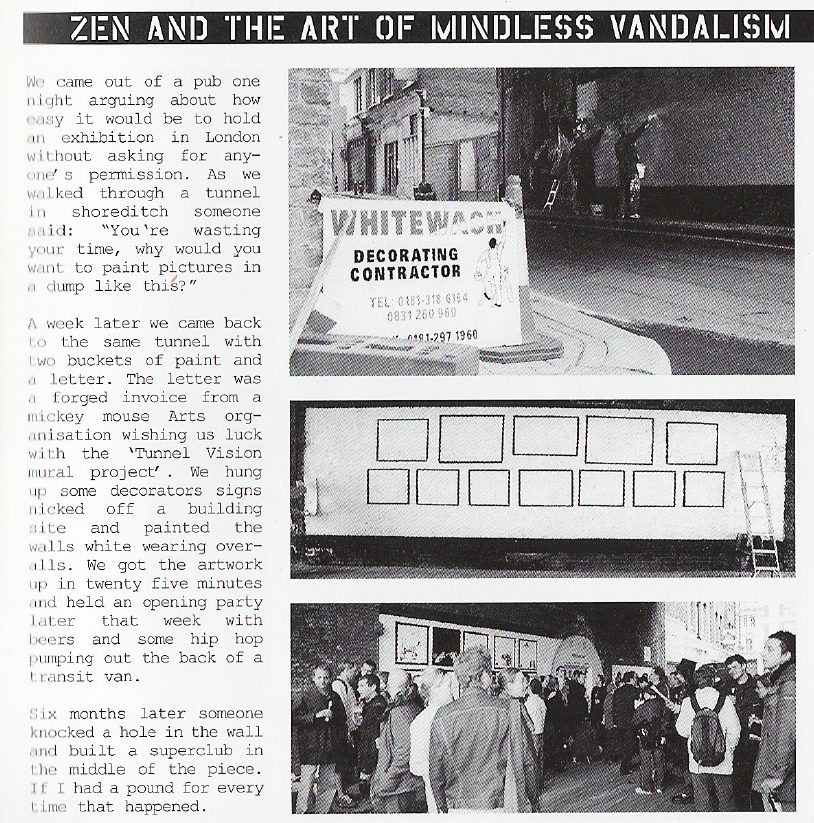
The same attitude extends to the art system itself. In Zen and the Art of Mindless Vandalism, Banksy recounts hanging his own work in an exhibition context without permission, an early formulation of the unauthorized museum interventions that would become celebrated episodes of his career a few years later. Again, the significance is retrospective but unmistakable: ideas generally associated with Banksy's mature international career are already being rehearsed at the beginning of the decade.
WORDS AND IMAGES
The publication also demonstrates why Banksy cannot adequately be understood simply as a stencil artist. Words are everywhere. Sometimes they accompany images; sometimes they contradict them; sometimes they are the work.
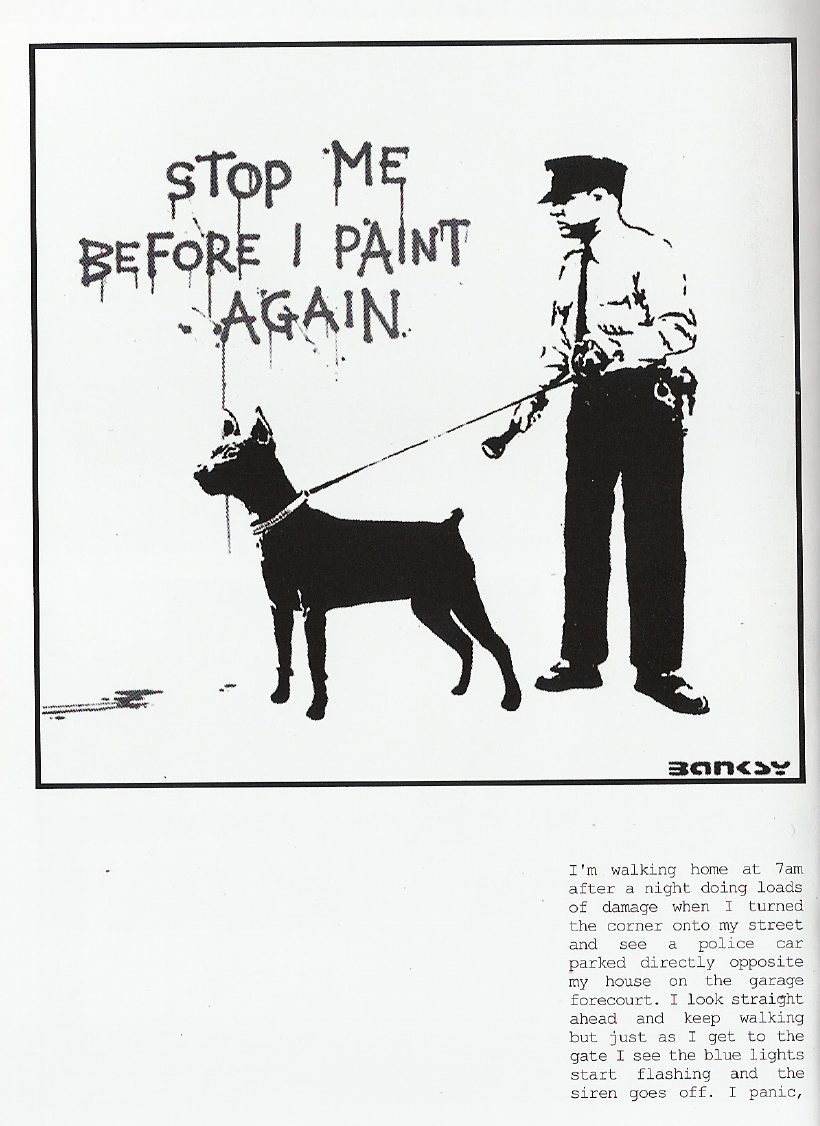
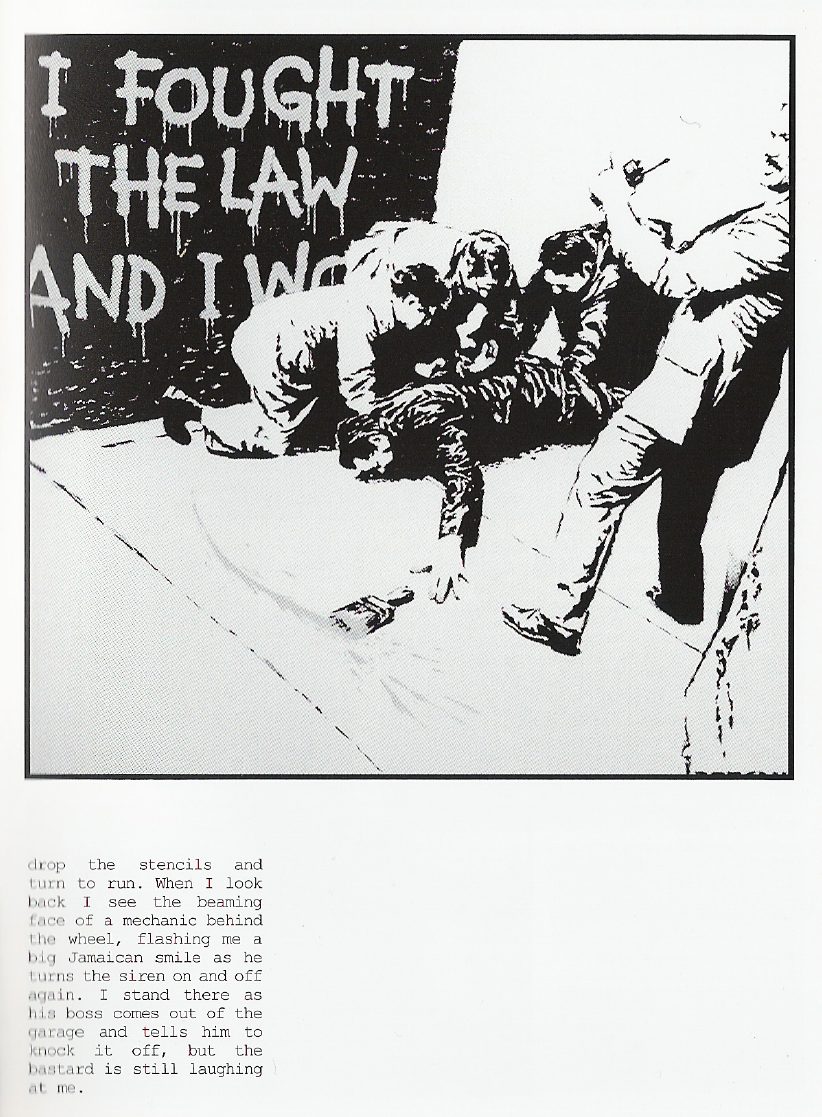
Stop Me Before I Paint Again and I Fought the Law appear side by side, already demonstrating Banksy's ability to combine familiar phrases with economical imagery to create something simultaneously humorous and politically charged. Elsewhere, the book combines photographs of street interventions with aphorisms, correspondence and borrowed quotations. The resulting voice oscillates between anger, irony, paranoia, idealism and self-deprecation.
This voice matters enormously. Banksy's anonymity meant that there could be no conventional artist persona built through portraits, interviews and biography. Instead, the voice itself became the persona. The terse captions, jokes, political observations and deliberately anti-authoritarian statements found in these early books helped establish the character of “Banksy” every bit as much as the rats and monkeys did.
A DOCUMENT OF A DISAPPEARING WORLD
The book has acquired another importance that could scarcely have been anticipated in 2001. Many of the street works it reproduces have disappeared. Walls have been painted over, buildings demolished, interventions removed and neighborhoods transformed. Banging Your Head Against a Brick Wall has consequently become an important primary record of Banksy's earliest practice.
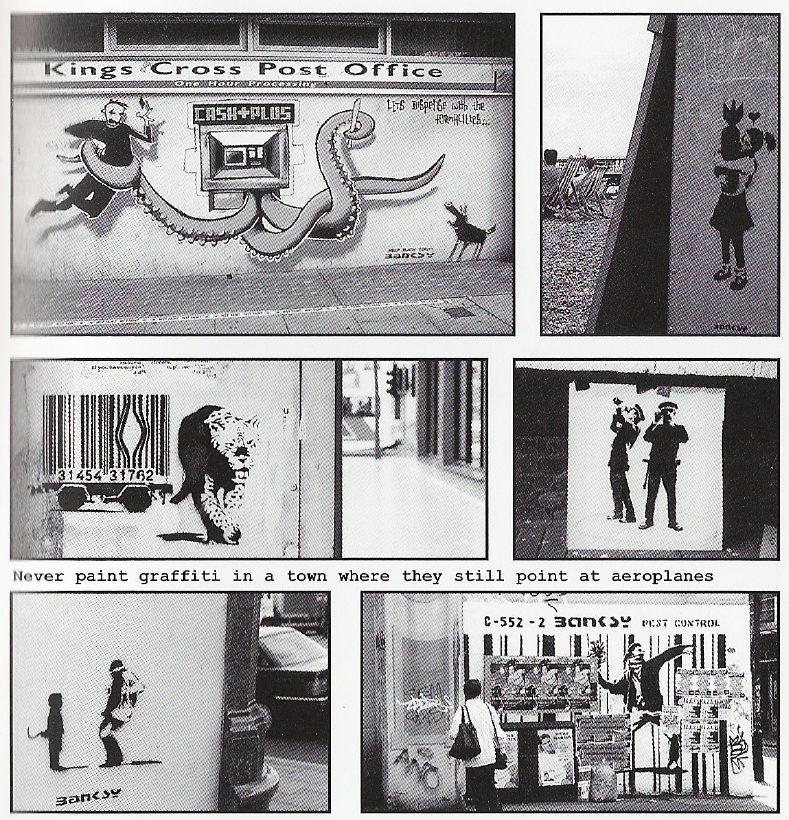
Its photographic pages preserve not simply individual stencils but their original urban contexts: telephone boxes, alleys, council buildings, street signs, parked cars, railway infrastructure and weathered walls. The photographs remind us that these images were not initially conceived as isolated commodities against white backgrounds. They existed in dialogue with particular places.
The book therefore occupies an intriguing position somewhere between artwork, manifesto, archive and autobiography. Banksy is documenting his own history almost while it is happening, but he is also editing that history—selecting which works matter, juxtaposing them with particular texts and constructing the intellectual framework through which the reader should understand them.
PUBLICATION, DISTRIBUTION AND THE BEGINNING OF AN AUDIENCE
The precise publishing history is characteristically informal. The book appeared in November 2001, according to Art of the State, in a small A6 format and at an original price of approximately £5. Different impressions are known, including copies with different paper finishes and variations in the publishing information. The surviving scan explicitly identifies Banksy himself as publisher.
The publication was closely connected to the increasingly active London phase of Banksy's career. Earlier that year he had mounted Banging Your Head Against a Brick Wall: An Exhibition of Graffiti, Lies and Deviousness at Cargo on Rivington Street, where outdoor works were incorporated into the club's courtyard. Sources documenting the exhibition date it to June–July 2001. The shared title connects the publication with the process by which Banksy was beginning to consolidate disparate street interventions, exhibitions, texts and images into a recognizable artistic identity.
Claims surrounding the exact first print run should be treated cautiously. A specialist bookseller gives 1,000 copies for the earliest issue, while bibliographic evidence confirms later impressions and variations. What can be said with confidence is that the publication was conceived as an inexpensive, accessible object rather than a luxury artist's book. Later impressions circulated more widely, and the three black books eventually became familiar objects within the emerging Banksy audience before falling out of print.
That distribution model was entirely consistent with the philosophy expressed inside the book. Banksy was not asking permission from an established art publisher to explain his work any more than he was asking permission from a property owner to paint a wall. He controlled the image, the commentary, the sequencing, the reproduction and ultimately the story.
A PATHETIC CRY FOR HELP
Seen more than two decades later, Banging Your Head Against a Brick Wall is remarkable precisely because so little of the essential Banksy remains to be invented.
The rats are here. The monkeys are here. CCTV, police, soldiers, children, anti-war imagery, manipulated signs, corrupted slogans, vandalized paintings, interventions into institutional spaces and attacks on consumer culture are all here. So too are the mechanisms that would become characteristic of his practice: appropriation, juxtaposition, site specificity, black humor, semantic reversal and the collision between a simple image and an unexpectedly complicated idea.

Even the tension between anti-establishment artist and cultural phenomenon has begun. Banksy mocks the art world's systems while carefully documenting his own practice. He celebrates ephemerality while publishing an archive. He rejects institutional validation while developing one of the most recognizable artistic identities of his generation.
And perhaps most importantly, the book demonstrates that the apparent simplicity of Banksy's later imagery was not the result of intellectual simplification. It was the product of compression. By 2001 he was already learning how to reduce complicated arguments about power, war, capitalism, surveillance and art itself into images capable of being understood in seconds.
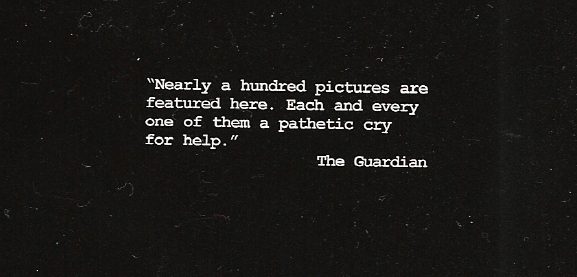
The final back cover completes the exercise with characteristic self-mockery. Beneath the severe black cover, Banksy reproduces a line attributed to The Guardian describing the collection as almost a hundred images amounting to “a pathetic cry for help.” The joke is an appropriate ending to a publication built upon contradictions: manifesto and gag, archive and vandalism, politics and entertainment, seriousness and ridicule.
In Banging Your Head Against a Brick Wall, Banksy had not yet become the cultural phenomenon that would follow. But Banksy was already Banksy.
STAY INFORMED
Receive the latest news, exhibitions, artworks and market updates on Banksy.