BANKSY AT THE LUCAS MUSEUM OF NARRATIVE ART
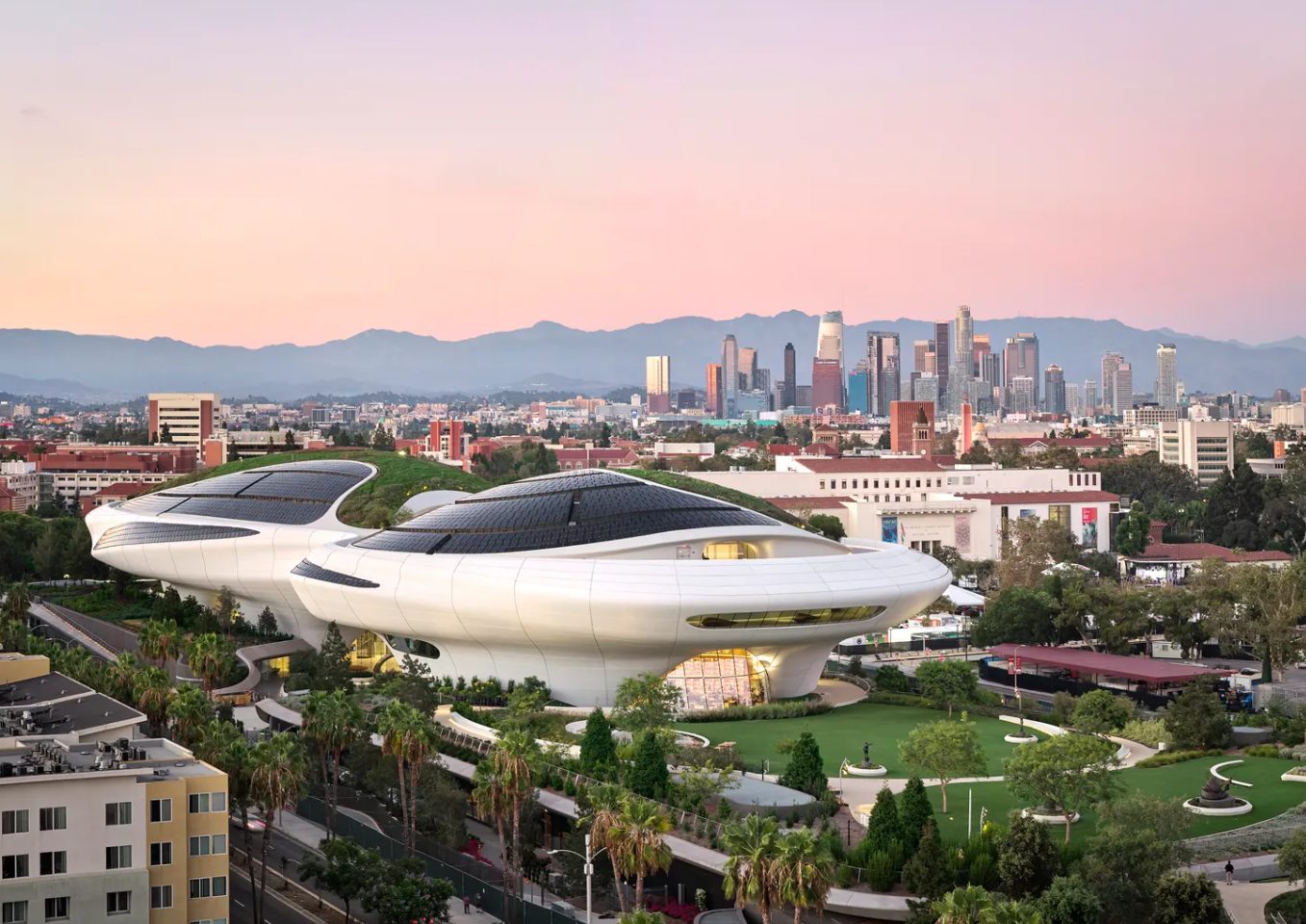
When the Lucas Museum of Narrative Art opened in Los Angeles on 22 September 2026, one of the most intriguing surprises was waiting on its fifth floor. Within a gallery devoted to murals and monumental storytelling in public space, Banksy was placed in conversation with Diego Rivera, Judith F. Baca and JR—artists separated by generations, geography and technique, but united by an understanding of the wall as a medium through which stories can enter public life.
Visit The Lucas Museum of Narrative Art
The context matters. Founded by George Lucas and Mellody Hobson and housed in the vast building designed by Ma Yansong of MAD in Exposition Park, the Lucas Museum describes itself as an institution devoted to storytelling through images. Its collection encompasses more than 40,000 objects, while its inaugural displays extend from painting and illustration to comics, photography, cinema and murals. Rather than organizing art according to the conventional hierarchies of medium or period, the museum asks what images do: how they communicate stories, construct beliefs and enter collective memory.
Within that proposition, Banksy suddenly makes considerable sense.
THE WALL AS A PLACE TO TELL STORIES
The fifth-floor gallery is devoted specifically to large-scale storytelling in public contexts. The museum describes murals as vehicles through which history, identity and shared social memory can be communicated, and places Banksy alongside the extensive archive relating to Judith F. Baca's monumental The History of California (The Great Wall of Los Angeles), works and studies associated with Diego Rivera, and large-scale contemporary work by JR.
The comparison is more substantial than it might initially appear. Rivera used walls to address workers, revolution, industry and political power. Baca transformed an immense Los Angeles flood-control channel into a counter-history of California, foregrounding communities frequently excluded from official historical narratives. Banksy's approach is radically different in form and scale, yet his underlying premise belongs to the same lineage: the public wall can communicate directly with an audience without requiring the mediation of the traditional art institution.
Senior curator Ryan Linkof has characterized this section of the museum as addressing public space as a vehicle for socially charged storytelling. That framing avoids reducing Banksy to either graffiti history or the contemporary art market. Instead, it situates the work within a longer history of artists treating the city itself as a narrative surface.
FROM THE STREET TO THE MUSEUM
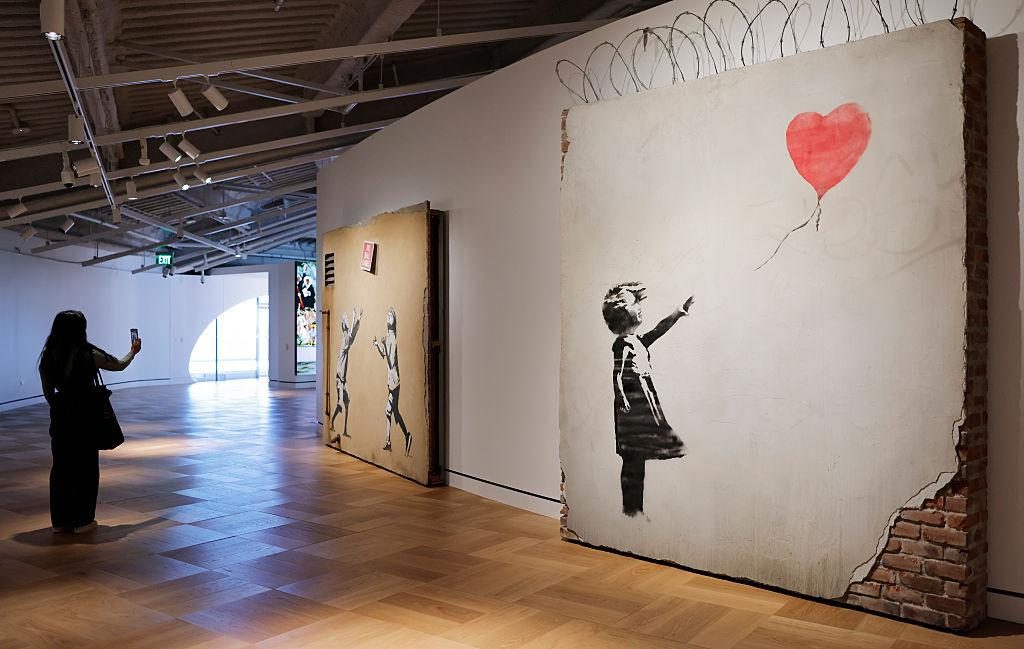
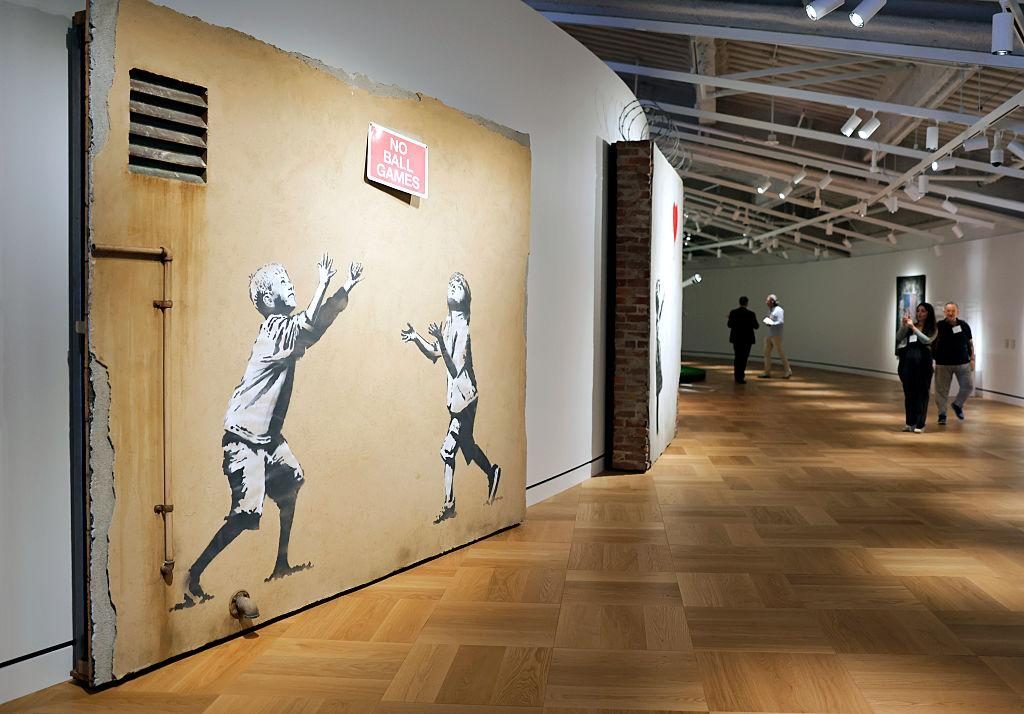
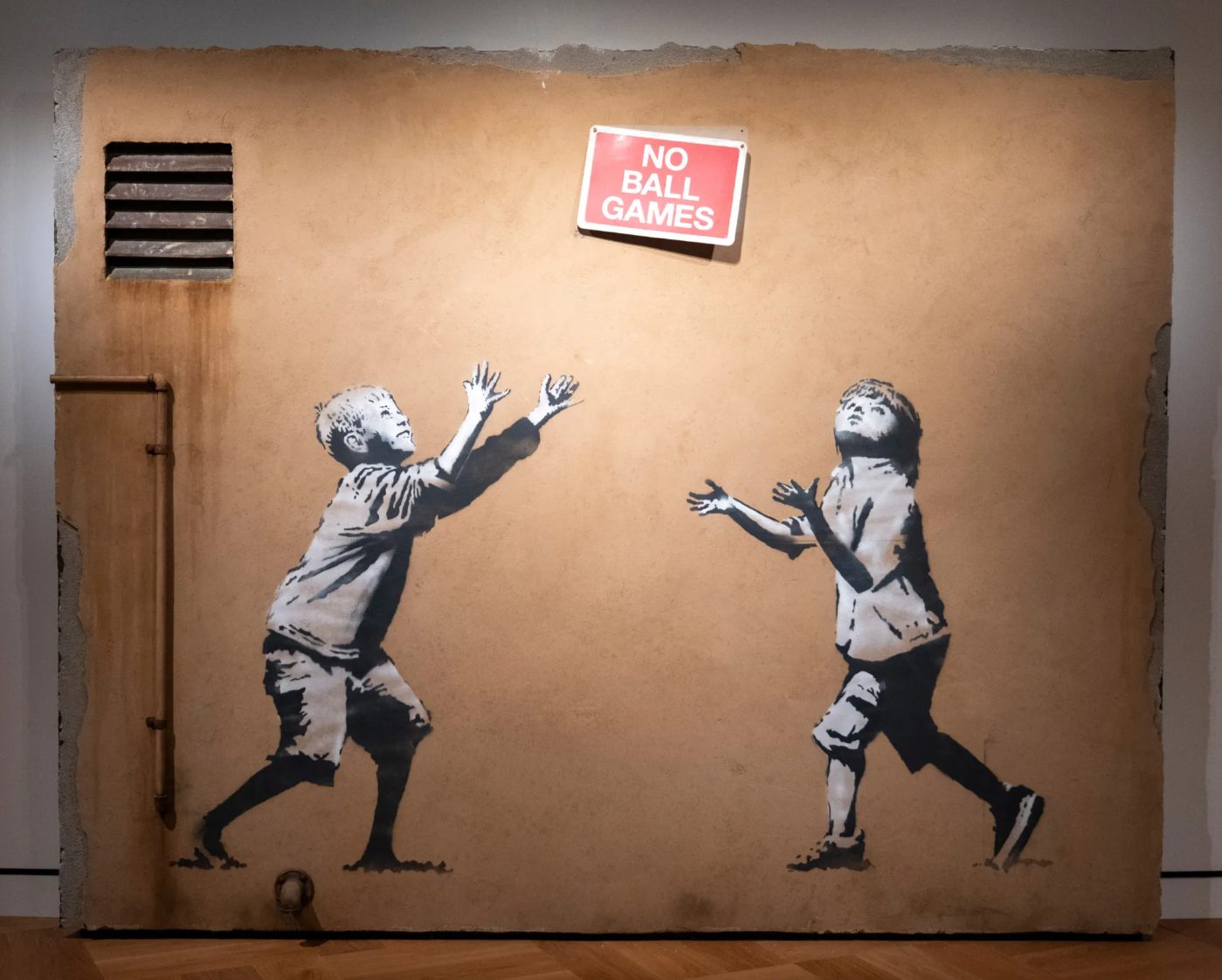
Banksy's presence is substantial. Among the familiar images documented in the galleries are Girl with Balloon, No Ball Games, Love Is in the Air (Flower Thrower), Mobile Lovers and Flying Copper, alongside other material associated with his street practice. The museum also presents the working maquette for Banksy's 2026 flag statue, the sculpture installed anonymously near Pall Mall in London earlier this year.
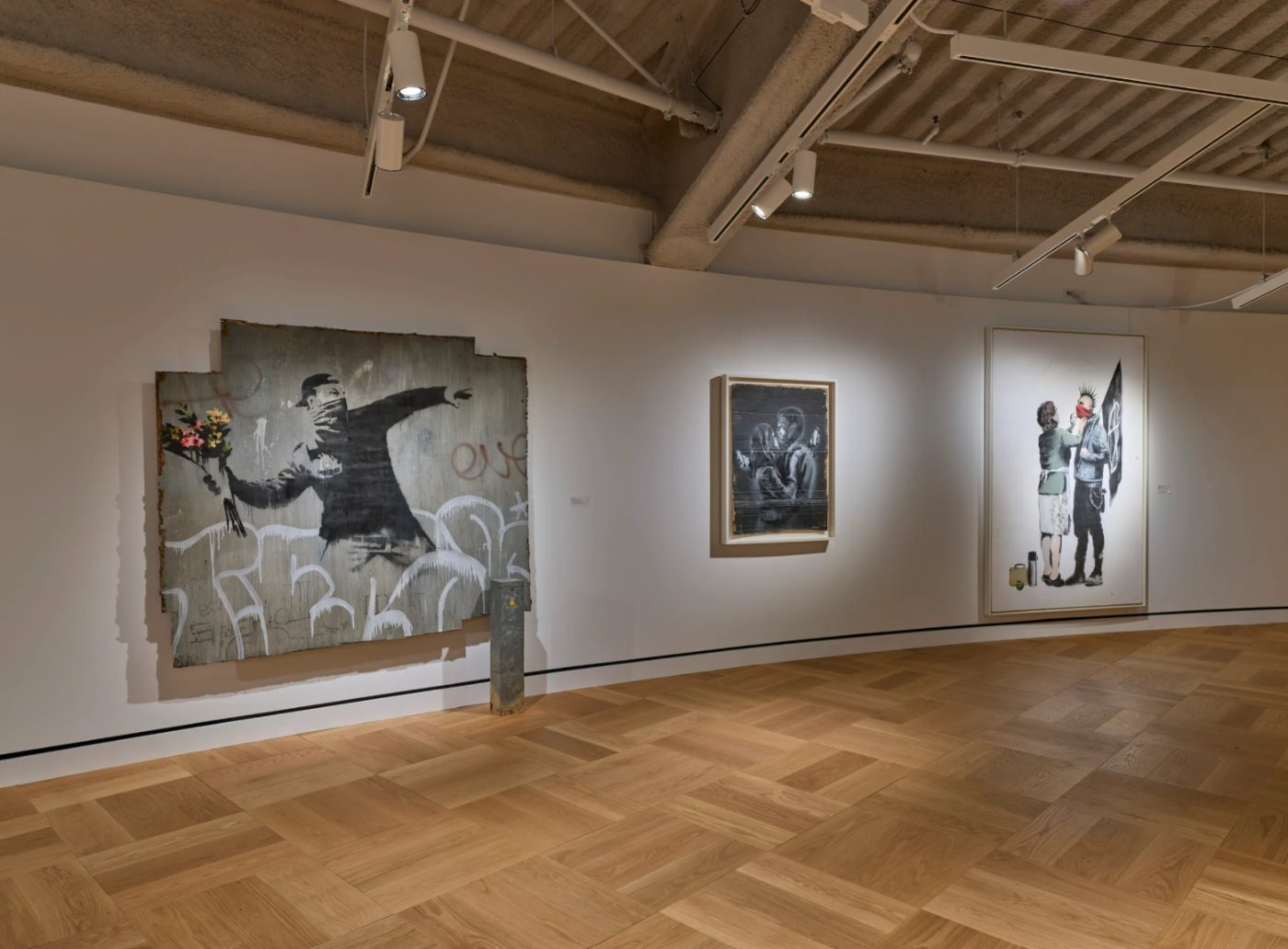
Crucially, these images have not simply been converted into conventionally framed pictures. Installation photographs show Girl with Balloon and other motifs occupying substantial fragments of simulated or reconstructed architecture, complete with exposed brick, damaged plaster, barbed or concertina wire and other physical characteristics associated with urban walls. No Ball Games similarly retains the relationship between image, sign and architectural surface that gives the original intervention much of its meaning.
That decision addresses one of the fundamental problems involved in exhibiting street art inside a museum. A Banksy mural is not simply an image. The surface is part of the work. Brick, plaster, architectural obstruction, deterioration and the surrounding street determine how the stencil is encountered. Remove the image from those conditions and something essential risks disappearing.
At the Lucas Museum, the installation attempts to preserve that relationship. The museum environment inevitably changes the work, but rather than pretending otherwise, the presentation reconstructs enough of its architectural language to remind the viewer that these images were conceived for walls rather than white canvases.
According to Banksy Unofficial, Banksy himself was involved in the installation, with a museum spokesperson stating that the artist “worked with the museum on the installation himself.” The museum's own announcement independently confirms that previously unseen acquisitions came directly from Banksy's studio.
A RARE MUSEUM RELATIONSHIP
The significance becomes clearer when considered against Banksy's unusual exhibition history. Despite becoming one of the world's most recognizable living artists, Banksy has maintained a remarkably complicated relationship with museums. His early interactions with institutions were often unauthorized: works were clandestinely installed inside major collections, temporarily inserting his own objects into the structures of art history.
There have been notable exceptions. Banksy versus Bristol Museum in 2009 transformed the artist's hometown museum into an enormous intervention, while CUT & RUN at Glasgow's Gallery of Modern Art in 2023 was conceived by Banksy as an exhibition of the stencils and working processes behind decades of his practice. Both, however, were essentially Banksy projects occupying museums rather than conventional institutional surveys assembled around him. Banksy Unofficial therefore rightly emphasizes the unusual nature of the Lucas Museum arrangement.
Los Angeles represents something different again. Banksy has not merely taken over an institution temporarily. His work has entered the inaugural presentation—and apparently the collection—of a major new American museum.
That distinction is important.
BANKSY, RIVERA AND BACA
The most consequential aspect of the installation may ultimately be neither the number of Banksy works nor their scale, but where the museum has chosen to place them.
Banksy is not presented primarily alongside contemporary auction-market artists or within a history of graffiti. Instead, his work appears in a genealogy of public narrative that includes Rivera and Baca. The comparison implicitly shifts the discussion away from the increasingly repetitive question of whether street art belongs inside museums and toward the more interesting question of what public images have historically been capable of accomplishing.
The differences between these artists remain enormous. Rivera's murals developed complex political narratives across monumental architectural surfaces. Baca's Great Wall unfolds history across extraordinary physical distance and through collective production. Banksy's method is almost the opposite: compression rather than expansion. A girl releasing a balloon, children reaching toward a prohibition sign, or a masked protester throwing flowers can reduce an argument to a single instantly legible encounter.
Yet that economy is precisely what makes Banksy such an effective narrative artist. His most successful images function almost like contemporary visual fables. They require only seconds to understand but remain sufficiently unresolved to permit competing interpretations.
For a museum dedicated specifically to narrative art, that makes him a remarkably logical inclusion.
FROM OUTSIDER TO ART HISTORY
There is nevertheless a delicious contradiction in seeing Banksy installed within an ambitious new museum founded by one of the central figures of global popular culture. An artist who spent years infiltrating museums without permission now occupies a carefully curated gallery within a billion-dollar cultural institution.
But perhaps the contradiction is less severe than it first appears.
George Lucas has described the museum's subject as “the people's art”—images that communicate beyond specialist audiences and become embedded within popular consciousness. Few contemporary artists fit that definition more comfortably than Banksy. Girl with Balloon, Flower Thrower and other images have long since escaped the particular walls on which they first appeared. They circulate through photography, reproduction and digital culture as part of a shared visual vocabulary.
That makes the Lucas Museum installation potentially more significant than another Banksy exhibition. It represents a change in institutional framing. Banksy is no longer presented merely as the anonymous graffiti artist who somehow entered the museum.
He is being positioned within the history of artists who used public space to tell stories.
And alongside Rivera and Baca, that history suddenly looks much longer than the history of street art.
STAY INFORMED
Receive the latest news, exhibitions, artworks and market updates on Banksy.