BASQUIAT FERRIS WHEEL
Basquiat at the Funfair
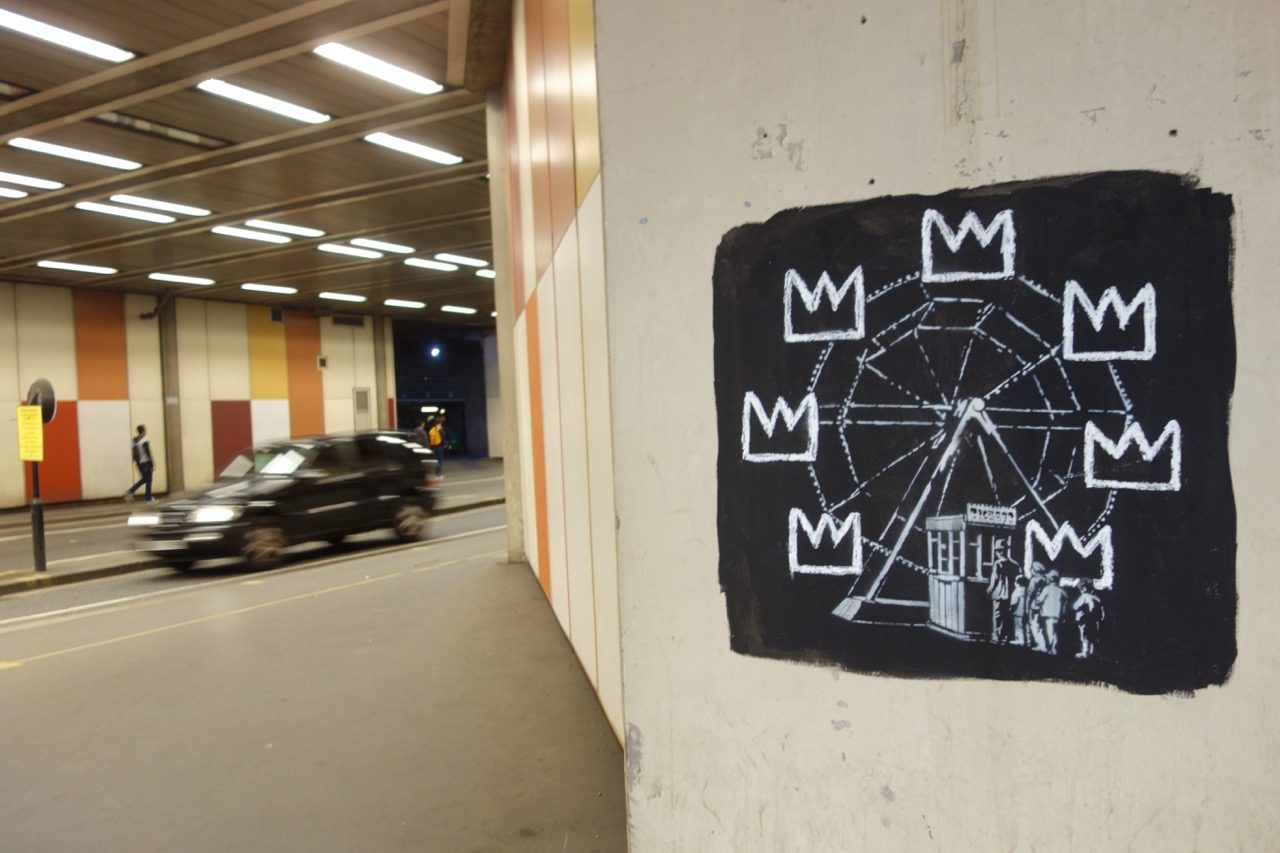
On 17 September 2017, four days before the opening of Basquiat: Boom for Real at the Barbican Centre, Banksy created two unauthorized murals on the institution’s exterior walls. While the first imagined Jean-Michel Basquiat being stopped and searched by Metropolitan Police officers, the second approached the museum’s celebration of the artist from a very different direction.
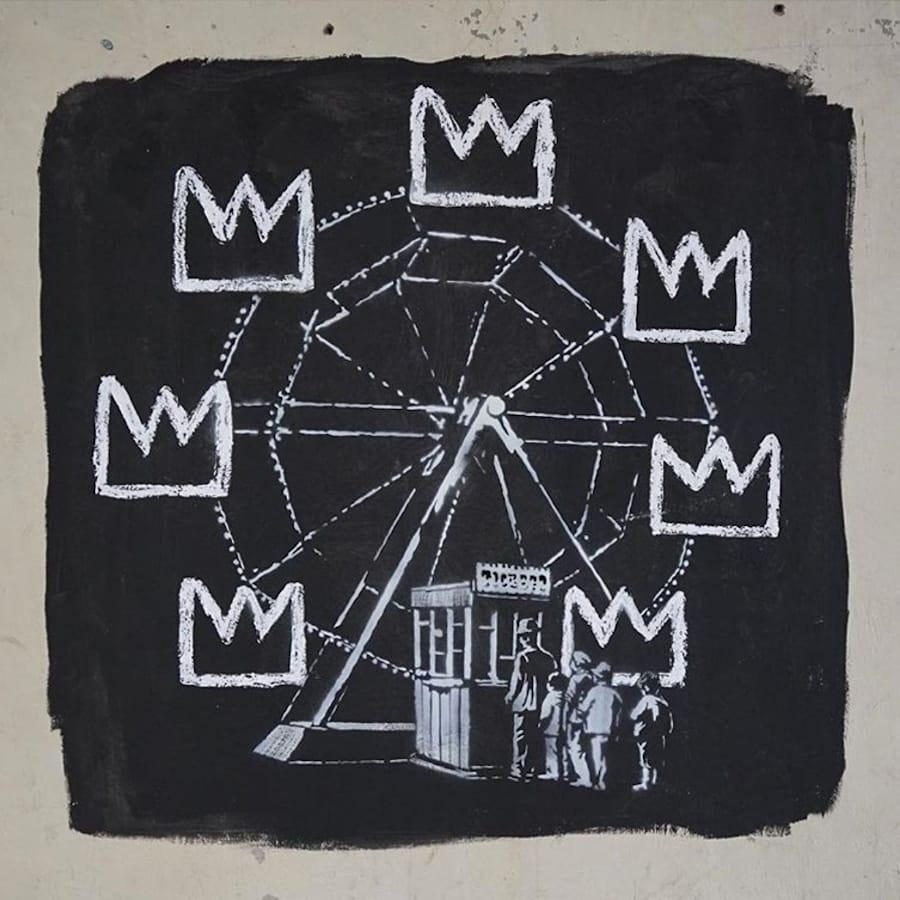
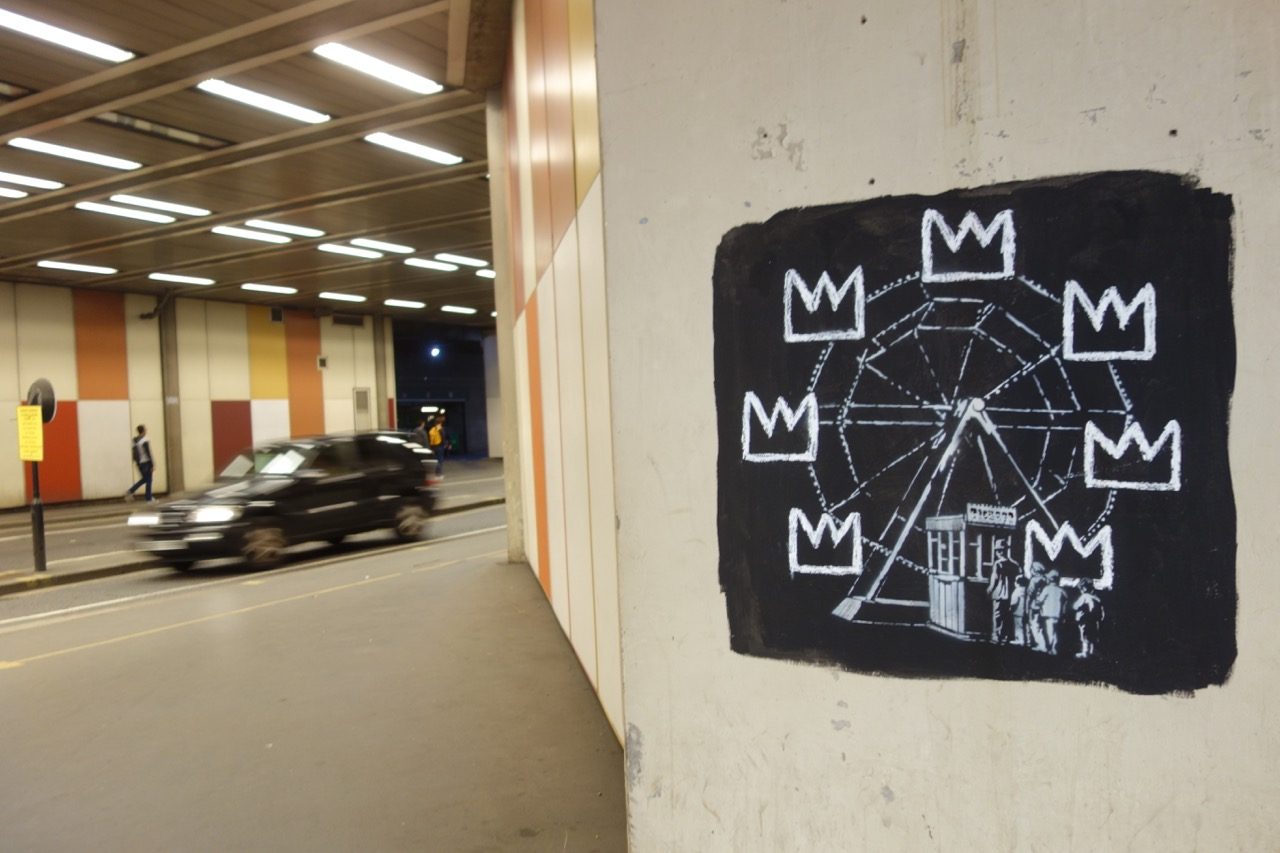
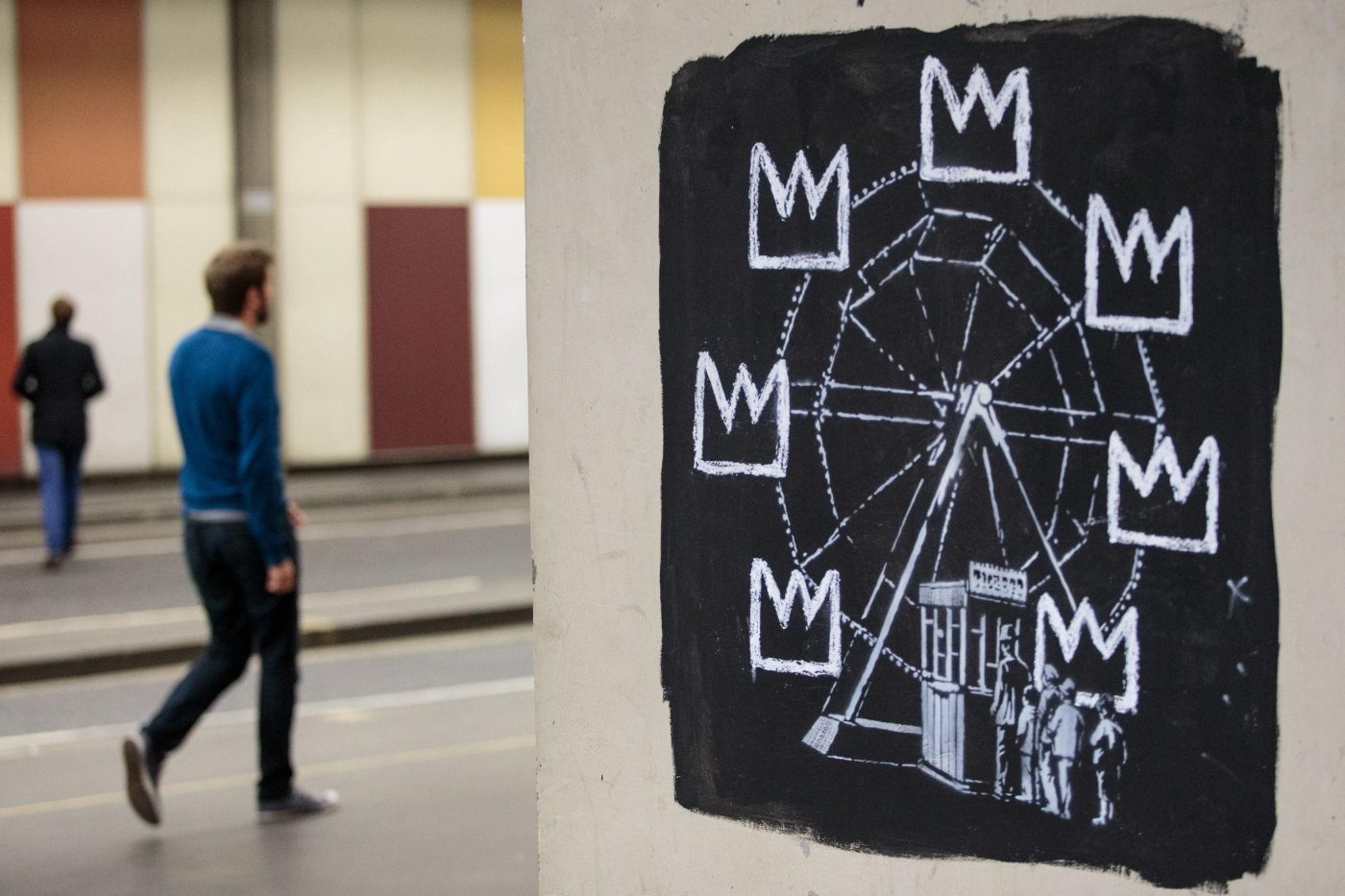
Banksy transformed one of Basquiat’s most recognizable symbols—the three-pointed crown—into the passenger cars of a Ferris wheel. Beneath it, a small crowd queues behind barriers while an attendant stands beside what appears to be a ticket booth. Basquiat’s emblem of identity, ambition and power has become an amusement-park attraction.
Banksy introduced the image with the caption:
“Major new Basquiat show opens at the Barbican – a place that is normally very keen to clean any graffiti from its walls.”
Together, the two murals formed what Banksy jokingly presented as an unofficial collaboration with the exhibition.
The Crown
The crown occupies a special place in Basquiat’s visual vocabulary. Repeated throughout his paintings and drawings, it could identify heroes, elevate marginal figures, suggest kingship or proclaim the authority of the artist himself. Its meaning was never entirely fixed, but it became so closely associated with Basquiat that it eventually functioned almost as a personal emblem.
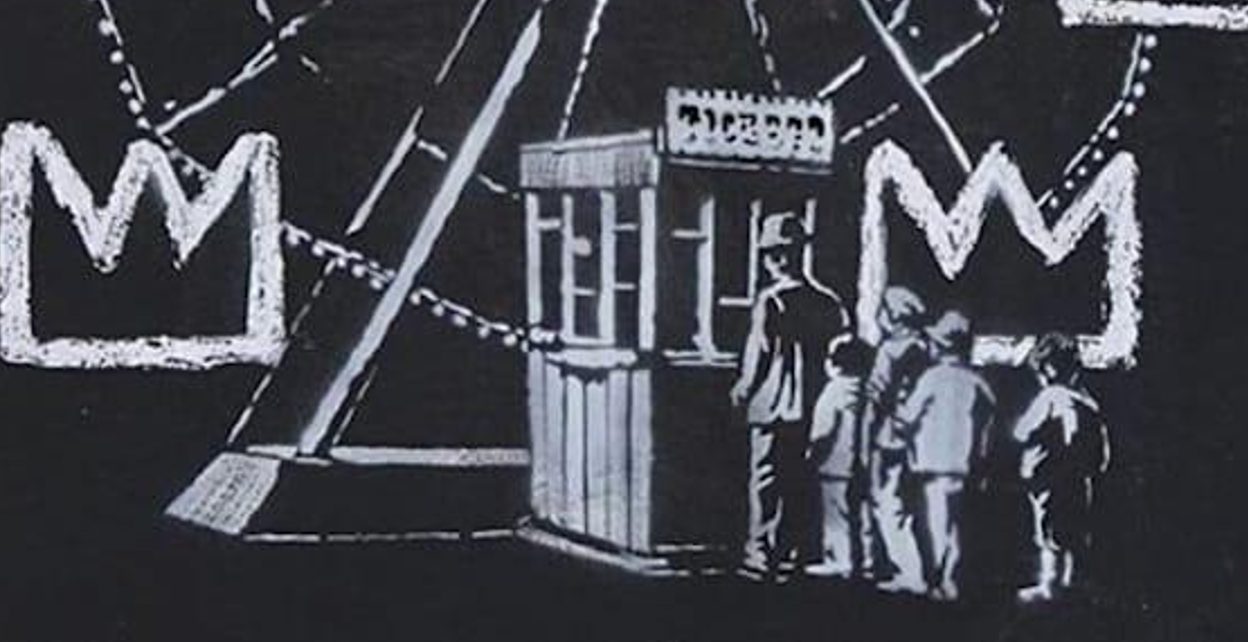
Banksy recognizes precisely that familiarity. Rather than reproducing one particular Basquiat painting, he appropriates the symbol that had come to represent Basquiat as a cultural phenomenon.
The transformation is wonderfully simple. Banksy takes the crown and repeats it around the circumference of a Ferris wheel. What once operated as an unstable sign of power and self-invention becomes something visitors can literally ride.
The symbolism has become an attraction.
From the Street to the Spectacle
Where the companion police mural addresses race, authority and the policing of public space, the Ferris wheel turns its attention towards the cultural institution itself.
By 2017, Basquiat had undergone an extraordinary transformation. The young artist associated with SAMO inscriptions on the streets of Lower Manhattan had become one of the most celebrated figures in contemporary art. Only months before Banksy created the Barbican murals, Basquiat’s 1982 Untitled had sold at Sotheby’s New York for $110.5 million, then the highest auction price ever achieved for an American artist.
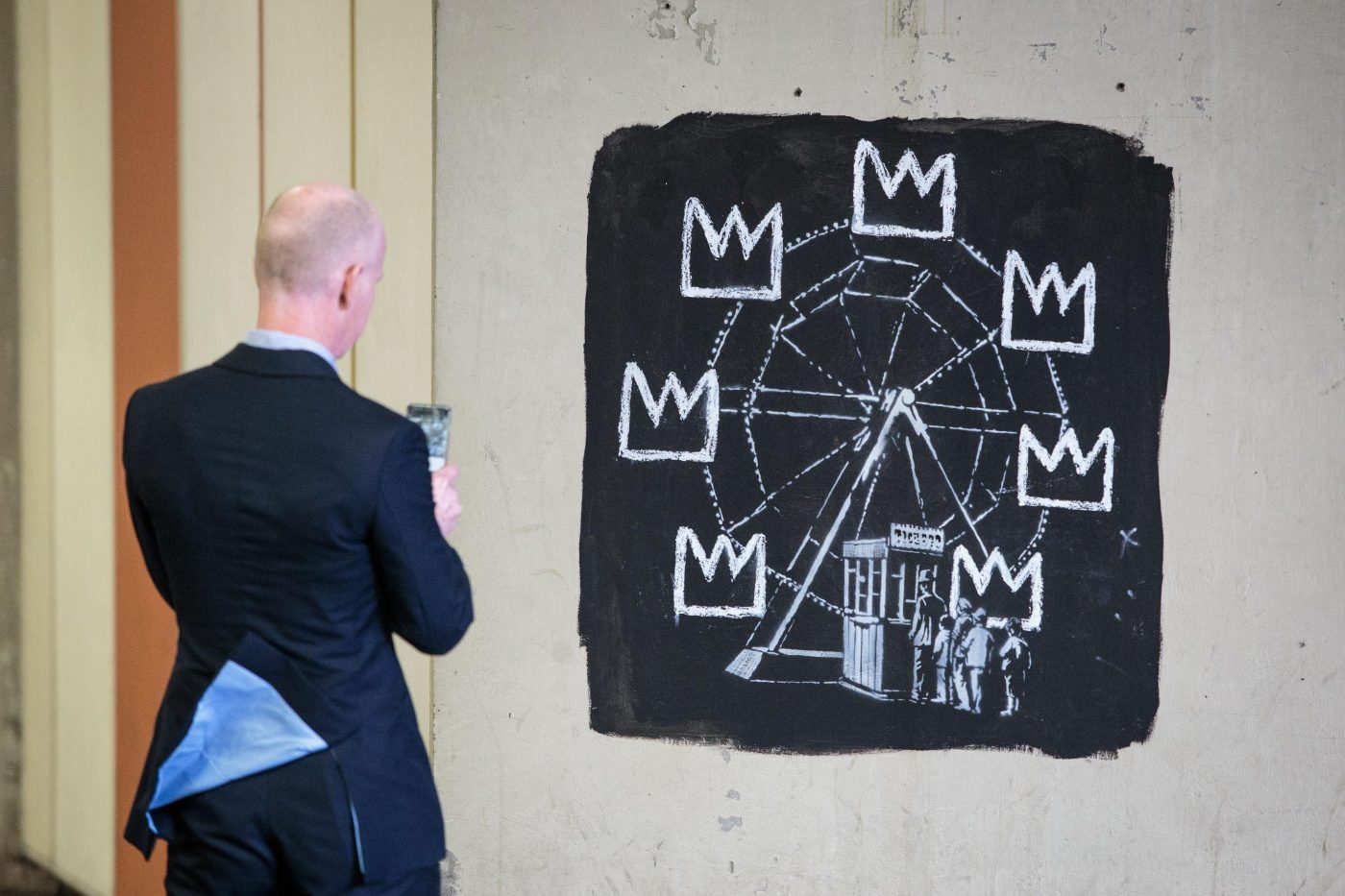
At the same time, Basquiat: Boom for Real was preparing to introduce his work to a vast museum audience. The exhibition would ultimately become, at that point, the Barbican Art Gallery’s most visited exhibition, attracting more than 210,000 visitors.
Banksy’s Ferris wheel sits directly inside that contradiction. The institutional recognition was deserved; Basquiat’s importance was undeniable. Yet the machinery of museums, exhibitions, ticketing, merchandising and the art market inevitably transformed the rebellious young artist into a cultural attraction.
Banksy makes that transformation literal. Visitors queue for Basquiat.
An Unofficial Exhibition Outside the Exhibition
The location is essential. Banksy could have painted the Ferris wheel anywhere in London, but outside the Barbican it became inseparable from Boom for Real.
Inside the building, visitors would pay admission to encounter Basquiat through more than one hundred works, photographs, films and archival material. Outside, Banksy offered his own commentary free of charge and without permission.
The contrast is particularly pointed because Basquiat’s relationship with the street had itself become part of the mythology being celebrated by the museum. His early SAMO texts—created with Al Diaz across Lower Manhattan—were once unauthorized interventions in public space. Decades later they belonged to the history of an artist being honoured by one of London’s major cultural institutions.
Banksy responded by creating another unauthorized intervention on the institution itself.
The wall therefore became a threshold between two definitions of artistic value: Basquiat protected and celebrated inside; Banksy technically vandalizing the building outside.
From Vandalism to Heritage
The subsequent reaction completed the work.
Rather than remove Banksy’s unauthorized murals, the Barbican and the City of London moved quickly to protect them. Within days, discussions were underway about their preservation, and both works were subsequently covered with protective transparent screens. They remain visible today.
The irony closely parallels the companion Metropolitan Police mural. Banksy had mocked an institution that, in his words, was normally eager to remove graffiti from its walls. Once the graffiti was identified as a Banksy, however, removal became preservation.
But the Ferris wheel adds another dimension. It describes the cultural cycle through which something created outside institutional structures can eventually become absorbed by them: first graffiti, then art; first nuisance, then attraction; first something removed from the wall, then something visitors travel to see.
Basquiat had already completed that journey. Banksy painted the Ferris wheel at the precise moment the museum invited everyone aboard.
STAY INFORMED
Receive the latest news, exhibitions, artworks and market updates on Banksy.