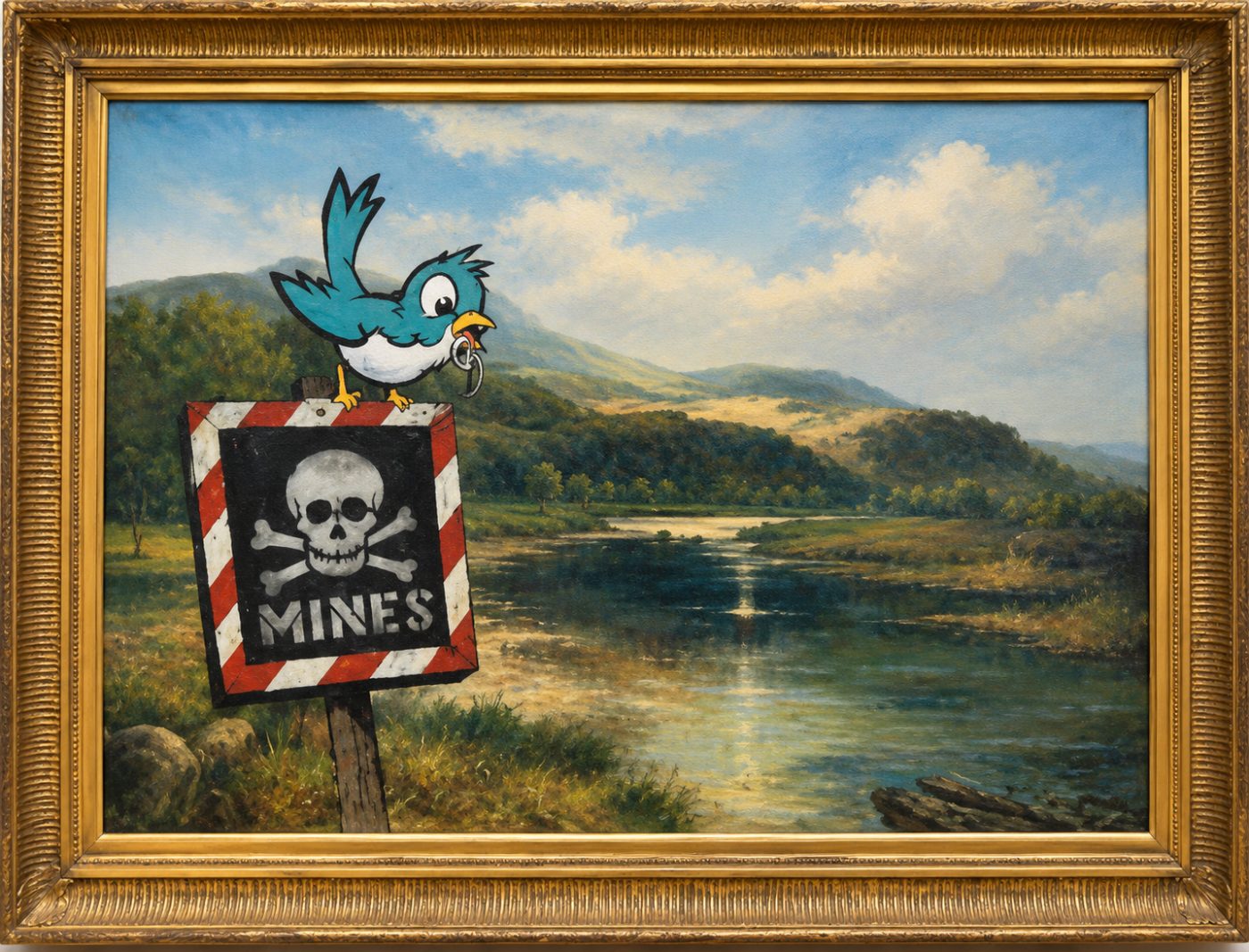
Catalogue Note
Bird Mine belongs to the small but important group of vandalized paintings exhibited at Banksy's landmark Turf War exhibition in London in July 2003. Contemporary photographs by Steve Cotton document the work in the exhibition under the descriptive title Mines, while subsequent scholarly reconstruction of the show identifies it more specifically as Bird Mine.
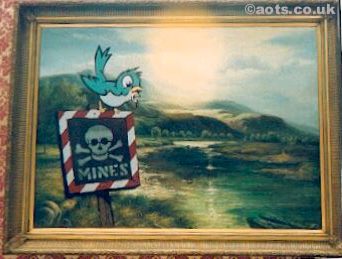
The composition develops one of Banksy's most characteristic early contradictions: an apparently harmless cartoon bird is placed in direct contact with the machinery of violence. Here the bird holds the ring of a grenade while perched upon a warning sign marked by a skull and crossbones and the word MINES. The visual language deliberately collapses innocence and threat. What might initially resemble a children's-book character becomes implicated in an environment defined by explosives, military warning systems and death.
The work is closely related to Banksy's better-known Bird and Grenade motif, already established by the early 2000s, in which a cartoon bird carries a hand grenade by its pin. In Bird Mine, however, the motif is expanded into a more elaborate corrupted-painting composition. Rather than presenting the bird as an isolated stencil, Banksy integrates it into an existing pictorial field and introduces the mine-warning device as a second layer of meaning. The absurdity of the bird apparently manipulating the very mechanism capable of destroying it gives the image its characteristic mixture of humor and menace.
From Turf War to Crude Oils
Its presence at Turf War is particularly significant. The exhibition contained a distinct group of vandalized or “corrupted” oils, including Even a Suicide Bomber Needs a Hug, Crude Oil Jerry, the work subsequently known as Monkey Poison, a corrupted landscape incorporating a Happy Chopper, Bird Mine, and a smaller landscape crossed by police tape. The Heidelberg reconstruction documents these works together as “Vandalized Oil Paintings/Prints in Gold Frames.”
This makes Bird Mine important beyond its individual imagery. It provides further evidence that Banksy's systematic appropriation and disruption of traditional painting was already an established part of his studio practice by 2003, two years before the celebrated Crude Oils exhibition gave the strategy its most comprehensive expression. Turf War therefore represents an important intermediate stage between Banksy's earliest altered paintings—including works dating back to 2000–01—and the much more ambitious assault on the conventions of Western painting staged in Notting Hill in 2005.
The original's subsequent history remains unclear. I have not yet found a reliable auction appearance, Pest Control record, later exhibition provenance or confirmed present location. We should leave those fields blank rather than manufacture a provenance from secondary references. What we can document securely is the work itself, its approximate title history, its dimensions, and—most importantly—its presence at Turf War in July 2003.
STAY INFORMED
Receive the latest news, exhibitions, artworks and market updates on Banksy.