BOMBING MIDDLE ENGLAND, 2002
A Very English Kind of Warfare
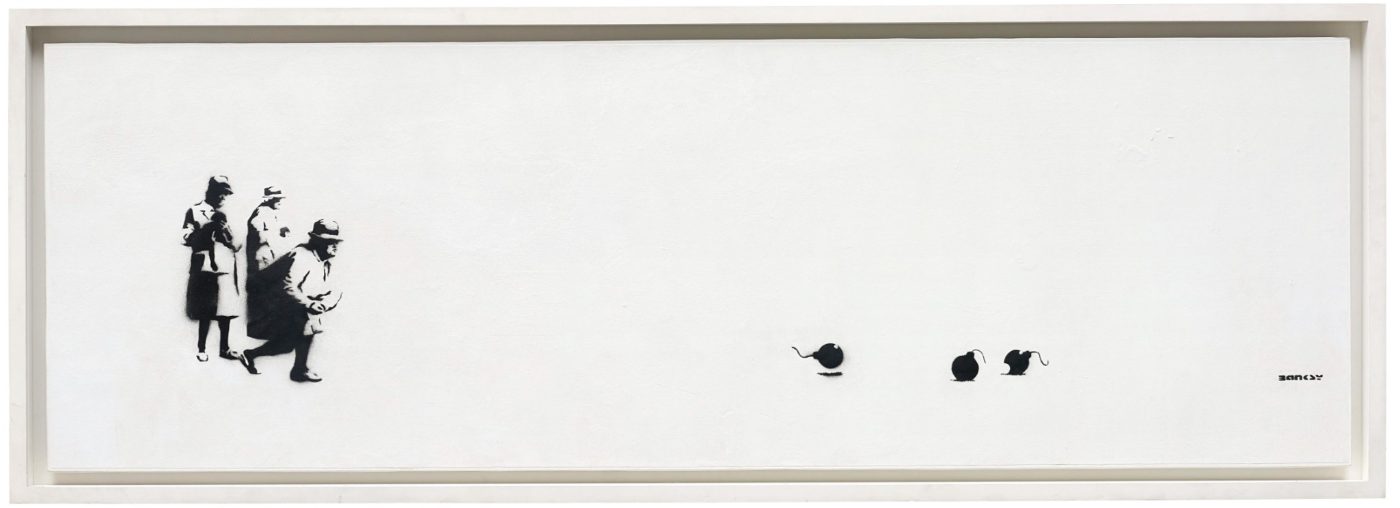
Bombing Middle England is an early and characteristically mischievous Banksy composition in which the rituals of respectable British life collide with the visual language of urban violence. Three elderly women, dressed with almost exaggerated propriety, appear to be engaged in a leisurely game of bowls. The joke becomes apparent only on closer inspection: the objects rolling across the ground are not bowls at all, but cartoon-like bombs complete with burning fuses.
The title provides the second half of the punchline. “Middle England” evokes not simply a geographical place but a particular idea of Britain: suburban, respectable, conservative and reassuringly conventional. Banksy infiltrates this apparently harmless world with explosives, transforming a genteel afternoon pastime into an absurdly polite act of warfare. The violence is never graphic; indeed, its effectiveness depends upon how perfectly calm everything remains.
Executed in 2002, the work belongs to the crucial early period during which Banksy established many of the visual strategies that would define his mature practice: appropriated photographic figures, stark stencil silhouettes, deliberately incongruous objects and a narrative that can be understood almost instantaneously.
The Power of Almost Nothing
The work is particularly striking for its extreme formal restraint. Executed in spray paint on paper laid on plaster, Bombing Middle England retains something of the physical vocabulary of the street while reducing the image almost entirely to black against an expansive white ground. There is virtually no colour, no scenery and no decorative detail. Instead, Banksy allows the figures and their tiny explosive bowls to float within a vast, almost empty pictorial field.
That emptiness is not merely stylistic; it structures the image. The three women are compressed towards the far left while the bombs occupy a thin horizontal axis across the lower centre, leaving most of the composition deliberately untouched. The unusually elongated format—more than two metres wide—exaggerates this negative space and creates both distance and suspense. The viewer’s eye must travel across the whiteness before discovering the bombs, giving the visual joke its timing.
There is something almost cinematic about the result: a handful of precisely positioned silhouettes is enough to suggest an entire scene. It is also quintessentially Banksy. His stencil technique was born partly from the practical necessity of working quickly, but that economy became an aesthetic language in its own right. Here, nothing is present that does not need to be. The near-monochrome palette strips the narrative to its essentials, while the combination of aerosol, paper and plaster maintains a material connection with graffiti and the urban wall.
Violence Without an Explosion
The image also introduces a theme that would recur throughout Banksy’s oeuvre: the uneasy coexistence of ordinary life and organized violence. Bombs, missiles, soldiers and weapons repeatedly invade otherwise innocent situations in his work. Here, however, there are no soldiers and no obvious victims. Warfare has been domesticated into recreation.
The implication is more unsettling precisely because Banksy refuses to explain it. The title suggests that violence need not necessarily arrive from somewhere foreign or unfamiliar; it can exist within the comfortable society that considers itself removed from it. The genteel game and the weapon become visually interchangeable. A bomb is simply another bowl—until, of course, it explodes.
This tension is amplified by one of the composition’s most elegant paradoxes: the subject is bombing, yet the picture itself is extraordinarily quiet. There is no explosion, no smoke, no panic and almost no movement. Instead, Banksy gives us three respectable women, three tiny bombs and an enormous expanse of white silence.
An Early Banksy in Pure Form
At more than two metres wide, this version gives an unusually expansive physical presence to an image constructed from remarkably few elements. It demonstrates how early Banksy had mastered one of the central principles of his visual language: an image does not need complexity to carry complex ideas.
Humour, violence, social observation and visual economy coexist without competing with one another. The joke arrives first; its implications follow afterwards. In that sense, Bombing Middle England is Banksy reduced almost to his essence: three pensioners, three bombs, a great deal of empty space—and one very British afternoon gone spectacularly wrong.
STAY INFORMED
Receive the latest news, exhibitions, artworks and market updates on Banksy.