CAMERAMAN AND FLOWER
Capturing Beauty
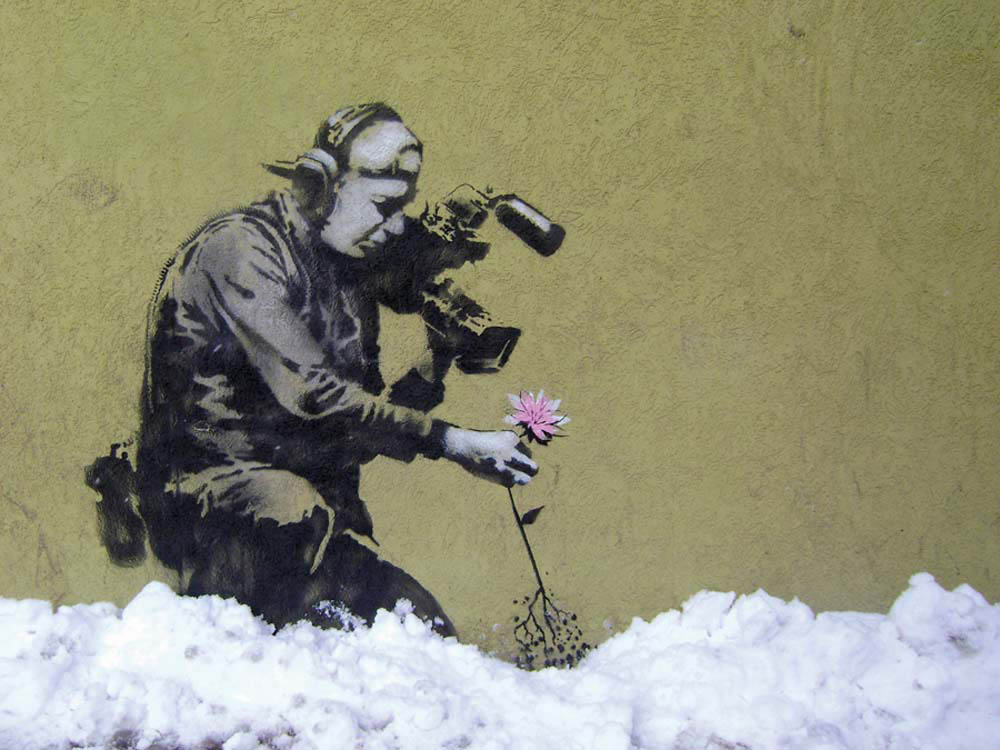
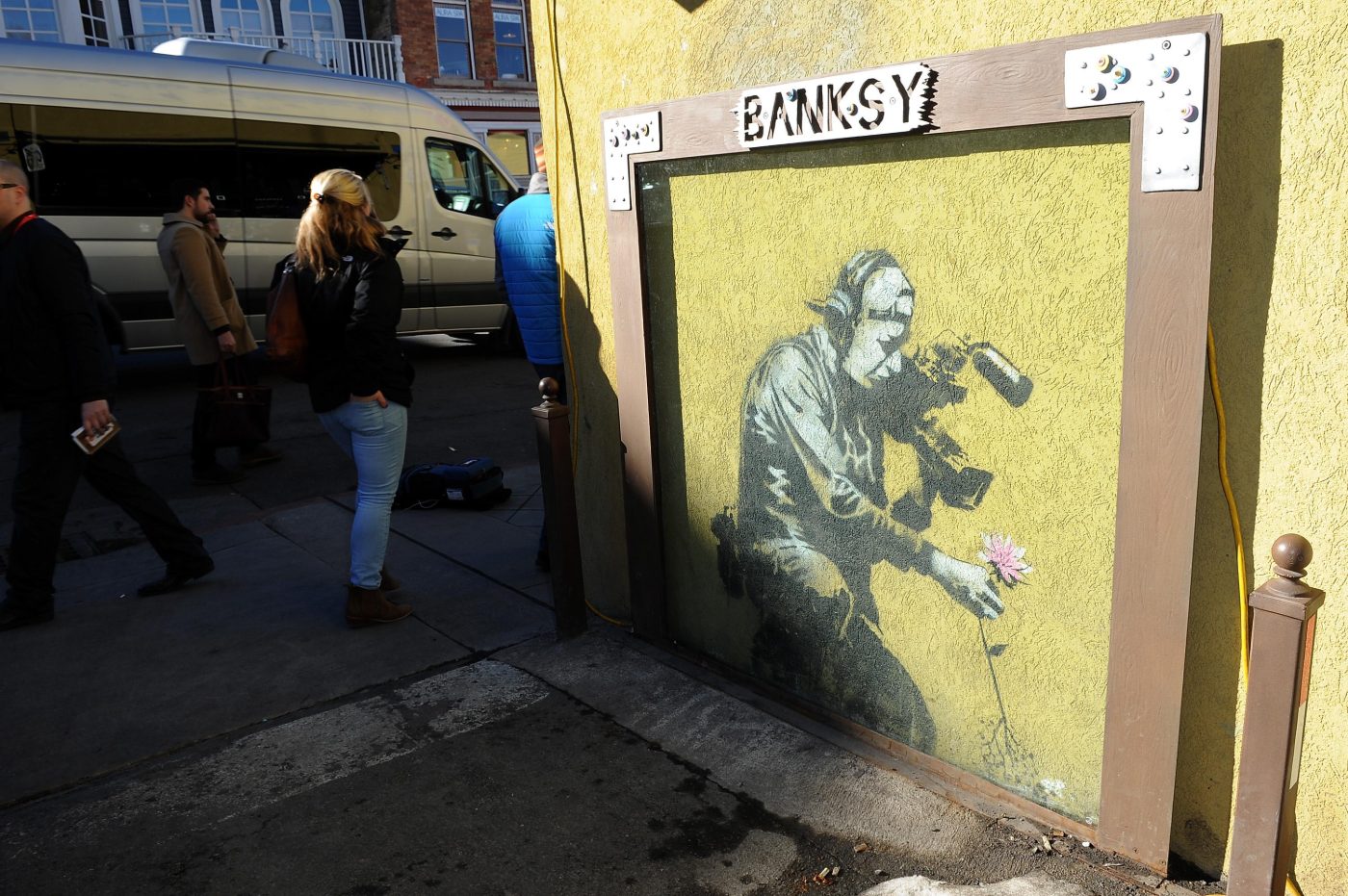
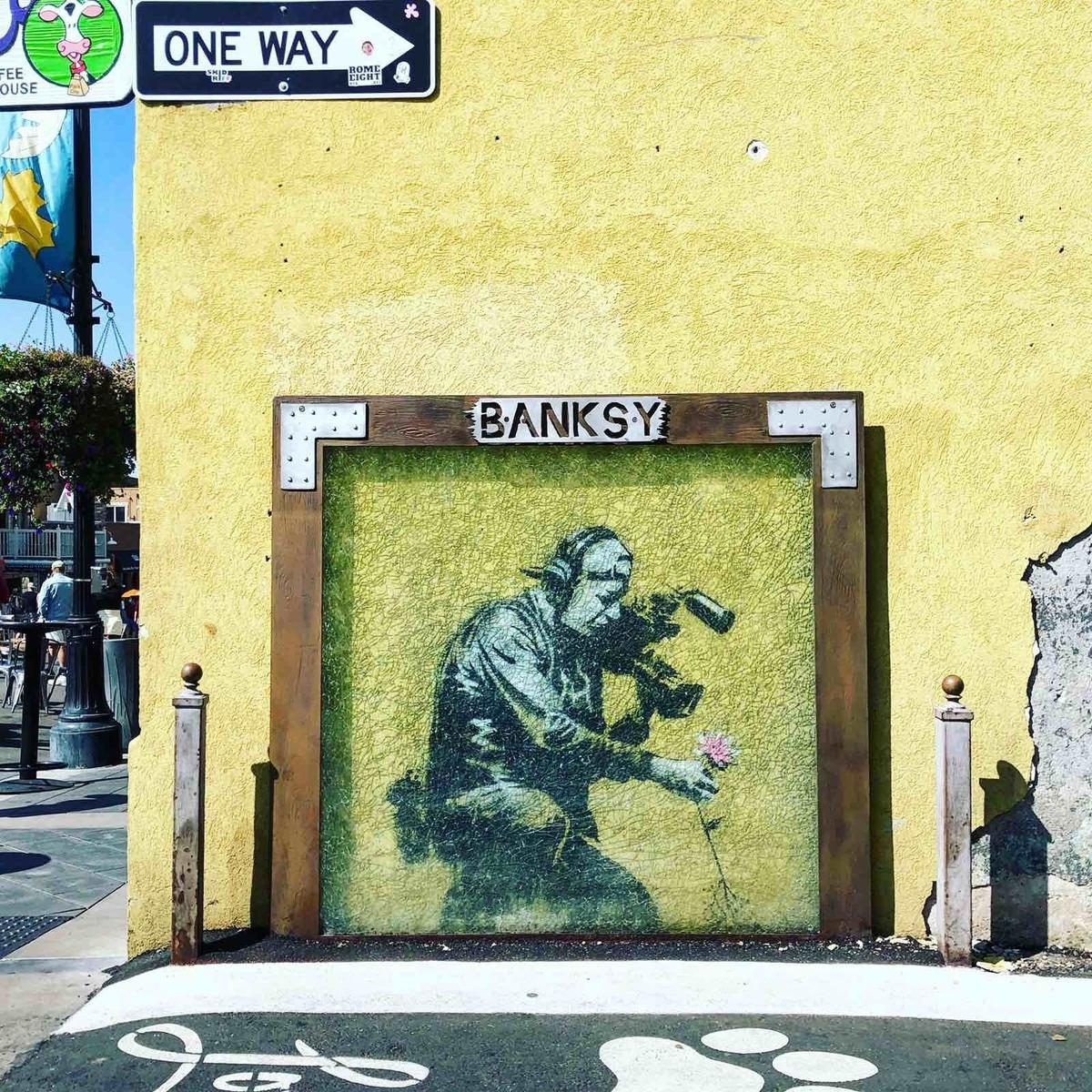
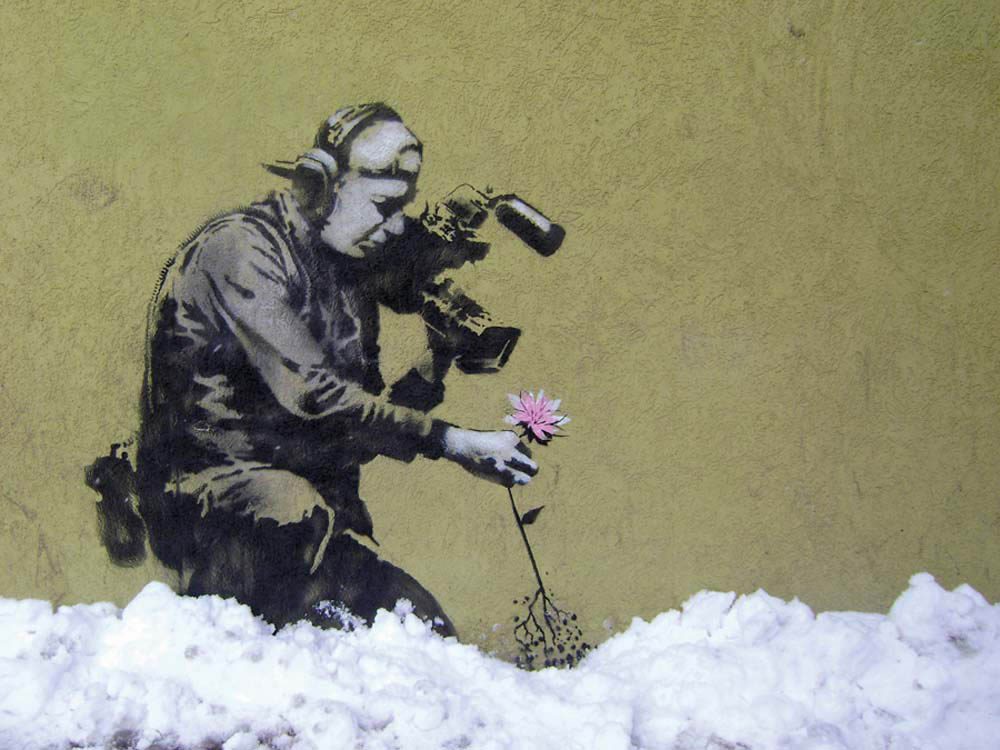
A cameraman crouches low to the ground, his eye fixed through the viewfinder of a large video camera. Before him stands a small pink flower, the only vivid color in an otherwise monochrome composition. At first glance, the scene appears gentle: a filmmaker carefully recording something fragile and beautiful. Look more closely, however, and the joke becomes apparent. In attempting to bring the flower closer to his camera, the cameraman has pulled it from the earth.
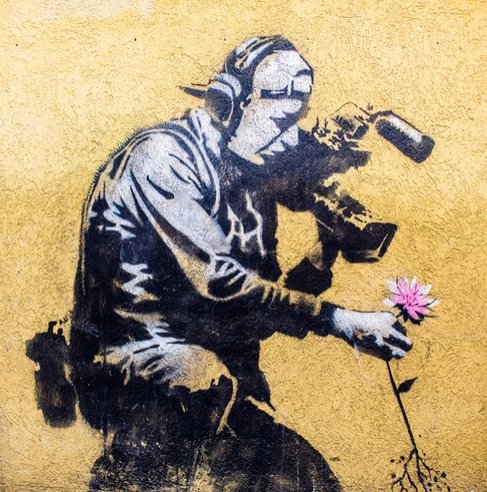
The contradiction is characteristically simple. The cameraman wants to capture the flower, but the process of capturing it destroys the very thing he finds worth recording. The verb itself becomes ambiguous: to capture an image is to preserve something visually, but to capture something can also mean to possess, remove or constrain it.
Banksy reinforces the idea through scale. The cameraman and his equipment dominate the composition while the flower is tiny and vulnerable. Technology, documentation and the desire to obtain the perfect image overwhelm their subject. Yet there is no suggestion of deliberate violence. Like the cleaner in Cave Painting Removal, the cameraman appears completely absorbed in his task. The damage is produced not by malice but by his determination to do his job.
Banksy at Sundance
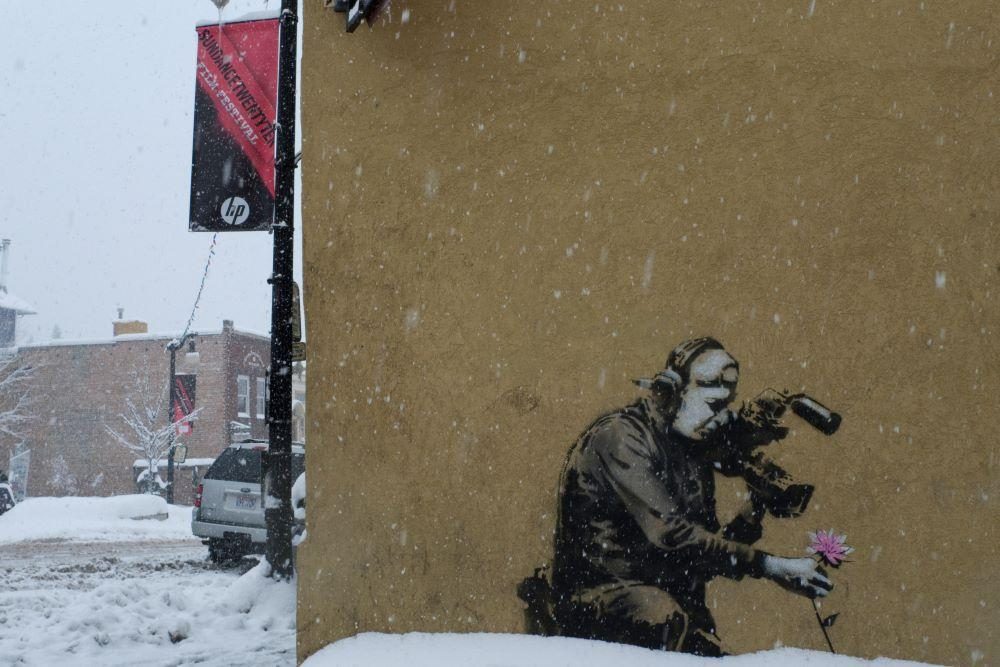
The location and date transform what might otherwise be a relatively straightforward environmental joke. Cameraman and Flower appeared in Park City immediately before the 2010 Sundance Film Festival, where Banksy's first feature film, Exit Through the Gift Shop, received its world premiere on 24 January 2010. Contemporary reporting recorded at least three Banksy-like works in Park City before the festival opened, including the cameraman on the wall of Java Cow; the Los Angeles Times subsequently reported that Banksy had left at least ten works around Park City and neighboring Salt Lake City during the week of the premiere.
That context makes the choice of a cameraman particularly significant.
Exit Through the Gift Shop is itself fundamentally concerned with the act of recording. Its central figure, Thierry Guetta, compulsively films the street-art world, accumulating thousands of hours of footage while following artists including Invader, Shepard Fairey and eventually Banksy. Banksy then turns Guetta—and his obsession with documentation—into the subject of his own film.
Placed on a wall in the city where that film was about to premiere, Cameraman and Flower therefore becomes almost impossible to separate from the questions raised by Exit Through the Gift Shop. What happens when the observer becomes more interested in recording an experience than experiencing it? And what happens to something spontaneous and ephemeral once a camera captures it?
The Camera and the Street
There is a particularly appropriate tension here for street art. Photography has always been essential to graffiti because the physical work may disappear within hours or days. Without photographs, a significant portion of Banksy's early street practice would now exist only through eyewitness accounts. The camera preserves the work after the wall has been cleaned, demolished or repainted.
But photography also changes the thing it documents. An anonymous intervention on a particular street can become an endlessly reproduced image detached from its original environment. The photograph preserves the artwork while simultaneously transforming it.
Banksy's cameraman performs a similar operation. He attempts to preserve the flower as an image while physically separating it from the ground that sustains it.
This tension is especially striking given Banksy's own sophisticated relationship with documentation. His carefully released photographs have repeatedly determined how temporary street works enter public consciousness. Cameraman and Flower does not therefore read convincingly as a simple condemnation of cameras or filmmaking. Banksy understands their necessity. The work is more interesting as an observation about the paradox inherent in documentation: the desire to preserve an experience can alter the experience itself.
From Hollywood to Park City
There is also a compelling connection with Banksy's 2008 Los Angeles mural Flower Girl. In that earlier composition, a young girl gathering flowers is confronted by the enormous lens of a surveillance camera. The camera intrudes upon an apparently innocent encounter with nature; technology watches rather than participates.
By Park City in 2010, Banksy had effectively reversed the relationship. The camera operator is now visible, and rather than merely observing the flower, he physically interferes with it in order to obtain his image. The recurring combination of camera + flower consequently develops from surveillance toward documentation and ultimately toward the destructive possibilities of obsessive image-making.
The evolution is particularly apt given what happened between the two works: Banksy had become a filmmaker.
A Work About Filming at a Film Festival
That is ultimately what makes Cameraman and Flower considerably more interesting than a generic commentary about technology destroying nature. Banksy painted a cameraman damaging his subject in Park City precisely as thousands of filmmakers, photographers, journalists and spectators descended upon the city for one of the world's most prominent film festivals—and as Banksy himself prepared to present a film constructed from another man's obsessive recording of his world.
The mural therefore operates simultaneously as visual joke, commentary on documentation and a remarkably site-specific introduction to Exit Through the Gift Shop. The cameraman wants to preserve the flower forever. To obtain the image he wants, however, he first pulls it from the ground.
Survival and Protection
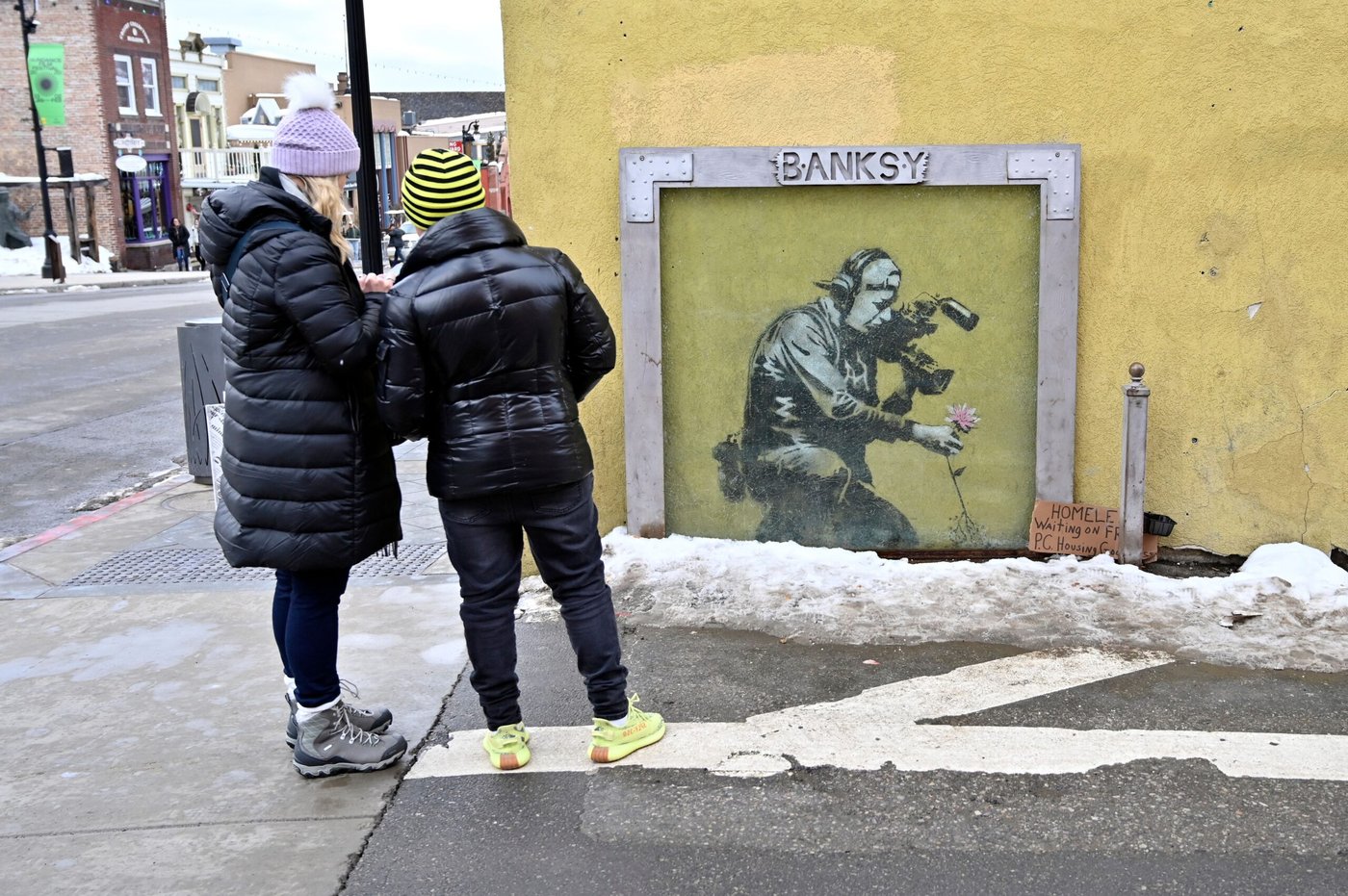
Unlike many of Banksy's American street works from this period, Cameraman and Flower survives. It remains on the exterior of Java Cow at 402 Main Street, where it has become one of Park City's best-known pieces of public art. It is now protected behind heavy glass. Park City's official tourism organization records that the protection proved necessary in 2014, when a vandal attacked the mural with a hammer.
There is a wonderful final irony in that afterlife. Banksy's image warns of the consequences of trying too hard to preserve something beautiful, while the mural itself has now been placed behind protective glass so that it can be preserved.
The flower was uprooted to save its image. The image was covered to save the Banksy.
STAY INFORMED
Receive the latest news, exhibitions, artworks and market updates on Banksy.