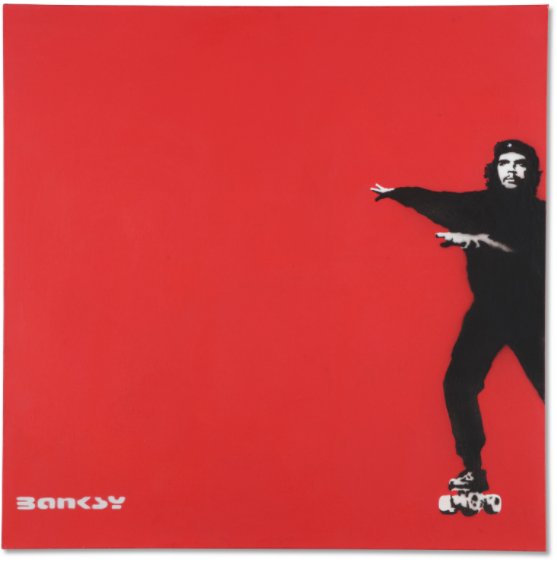
CHE GUEVARA ON SKATES, 2000
Exhibited
- Bristol, Eat the Beat Records, Come on you Reds!, 2000
Provenance
- Eat the Beat Records, Bristol
- Private collection, 2000
- Anon. sale; Bonhams, London, 17 October 2014, lot 15
- Acquired at the above sale by the present owner
Auction History
Prices are inclusive of buyer’s premium unless stated otherwise, as reported by the auction houses.
Catalogue Note
The Come on you Reds! exhibition documented the stories and accompanying photographs from Bristol’s Easton Cowboys football tour of Chiapas in Southern Mexico. The show ran from September 29th to October 30th 2000 and was held to support the Zapatista Army of National Liberation, a leftist political group based in Chiapas who were battling against the Mexican government. Banksy often played in goal for the Easton Cowboys and the photographs at Come on you Reds! were exhibited with a number of his politically charged paintings, such as the present work.
Executed in 2000, Che Guevara on Skates, encapsulates Banksy’s iconic imagery of political satire. The work, depicting Argentinian born, Marxist revolutionary Che Guevara, falls squarely into Banksy’s subversive pantheon of recognizable authority figures. The present work has another key element that too has become synonymous with the artist’s work: playfulness. Banksy’s ability to juxtapose roller skates, a totemic symbol of leisure and play, with that of Guevara, a ubiquitous counterculture icon of guerrilla warfare, is simultaneously humorous and unnerving.
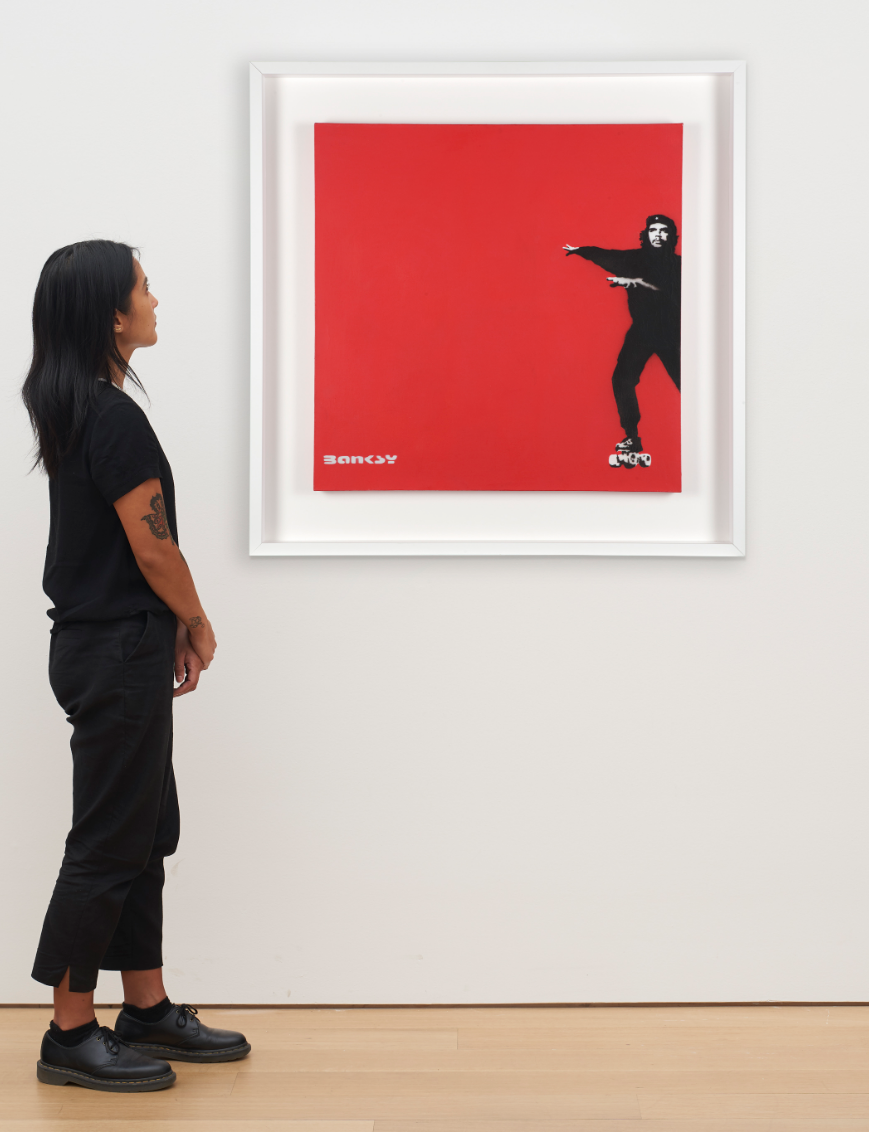
Che Guevara on Skates is made in Banksy’s characteristic method of multi-layered stencils. Inspired by a run-in with the cops at age eighteen, in which he fled the police one evening by taking cover underneath a garbage truck, Banksy began studying lettering. He quickly became immersed in the in the thriving graffiti scene of his native Bristol, England. Coming to prominence as a teenager in Bristol, in the early 1990s, Banksy began to achieve critical acclaim at the turn of the millennium through his anti-establishment wit and biting satirical images.
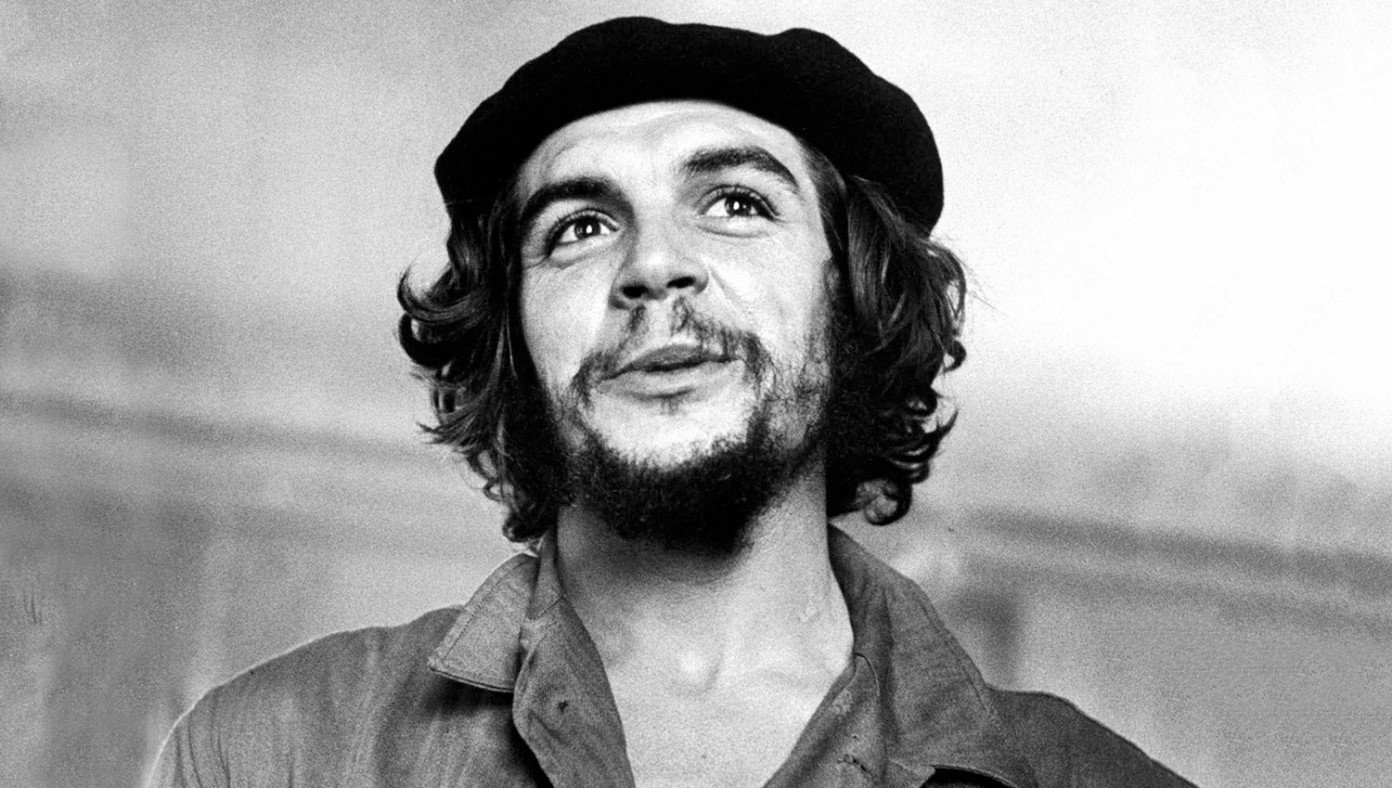
Ernesto “Che” Guevara (Spanish, 1928-1967) was an Argentine Marxist Revolutionary, physician, author, guerilla leader, diplomat, and military theorist. A major figure of the Cuban Revolution, his stylized visage has become a ubiquitous countercultural symbol of rebellion and global insignia in popular culture. As a young medical student, Guevara traveled throughout South America and was radicalized by the poverty, hunger, and disease he witnessed. His burgeoning desire to help overturn what he saw as the capitalist exploitation of Latin America by the United States prompted his involvement in Guatemala’s social reforms under President Jacobo Arbenz, whose eventual CIA-assisted overthrow solidified Guevara’s political ideology.
Guevara met Raul and Fidel Castro in Mexico City, he joined their 26th of July Movement and sailed to Cuba aboard the yacht Granma with the intention of overthrowing U.S.-backed Cuban dictator Fulgencio Batista. Guevara soon rose to prominence among the insurgents was promoted to second-in-command and played a pivotal role in the two-year guerrilla campaign that deposed the Batista regime.
Following the Cuban Revolution, Guevara performed a number of key roles in the new government. These included reviewing the appeals and firing squads for those convicted as war criminals, instituting agrarian land reform as minister of industries, helping spearhead a successful nationwide literacy campaign, serving as both national bank president and instructional director for Cuba’s armed forces, and traversing the globe as a diplomat on behalf of Cuban socialism. Such positions also allowed him to play a central role in training the militia forces who brought Soviet nuclear-armed ballistic missiles to Cuba. Additionally, Guevara was a prolific writer and diarist, composing a seminal guerilla warfare manual, along with a best-selling memoir. Guevara left Cuba in 1965 to foment continental revolutions across both Africa and South America. First unsuccessfully in Congo-Kinshasa and later in Bolivia, where he was captured by CIA-assisted Bolivian forces and summarily executed.
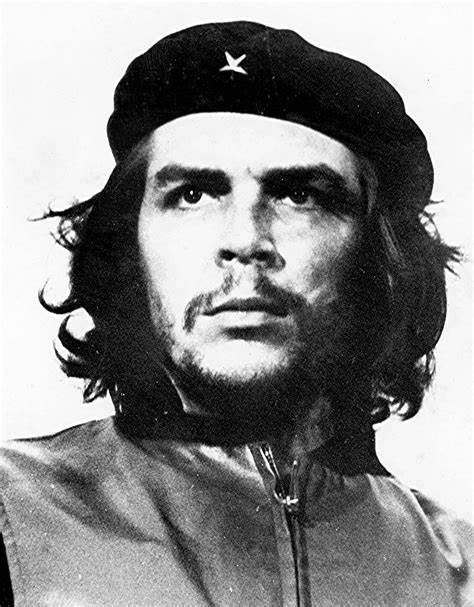
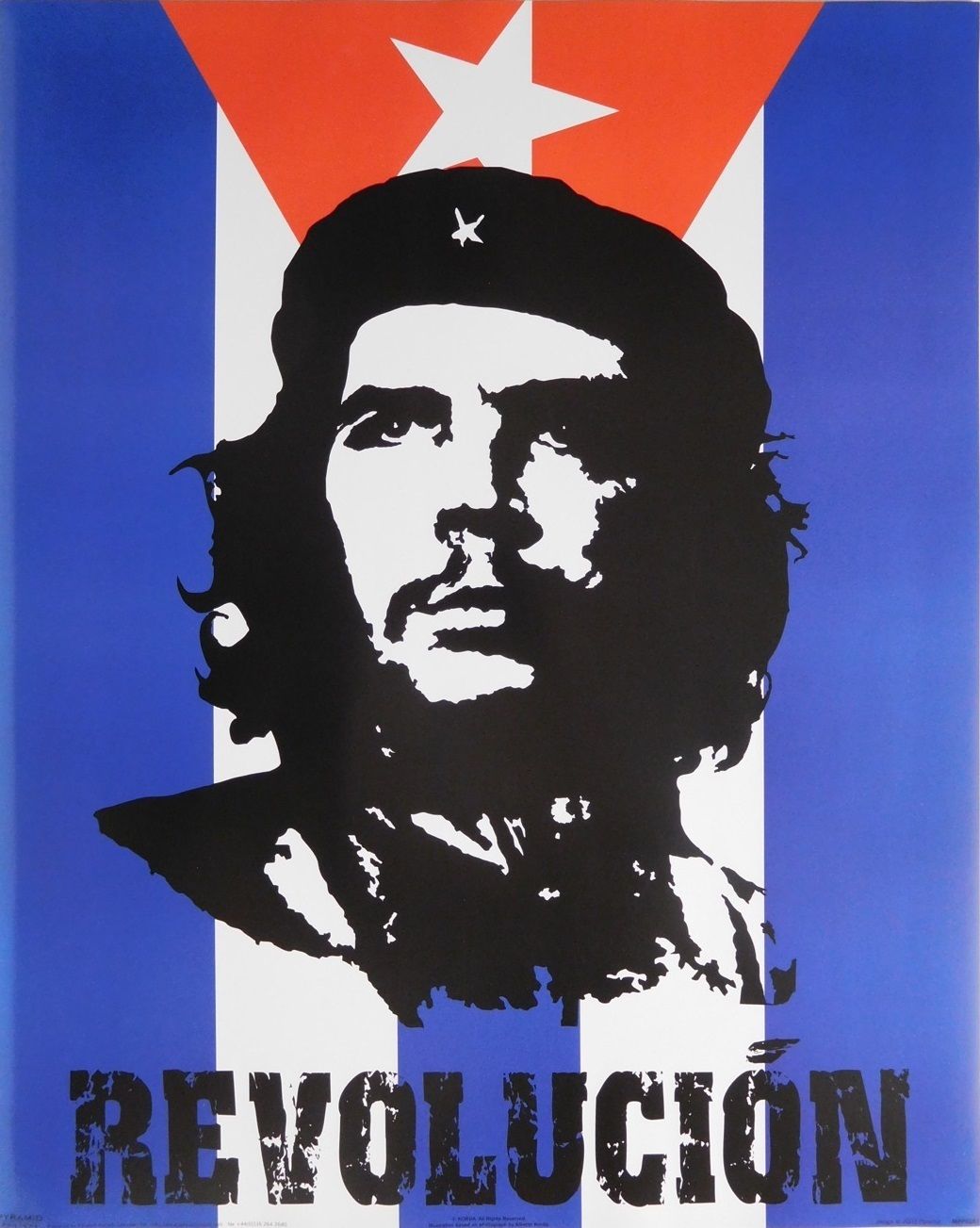
Guevara remains both a revered and reviled historical figure, polarized in the collective imagination. As a result of his perceived martyrdom, poetic invocations for class struggle and desire to create the consciousness of a “new man” driven by moral rather than material incentives, Guevara has evolved into a quintessential icon of various leftists movements. In contrast, his ideological critics on the right accuse him of promoting authoritarianism and endorsing violence against his political opponents. Despite disagreements on his legacy, Time Magazine named him one of the 100 Most Influential People of the 20th century while a photograph of him taken by Alberto Korda, titled Guerillero Heroico, was cited by the Maryland Institute College of Art as “the most famous photograph in the world”.
STAY INFORMED
Receive the latest news, exhibitions, artworks and market updates on Banksy.