ART ATTACK (CHILD THROUGH THE WALL)
Breaking Through
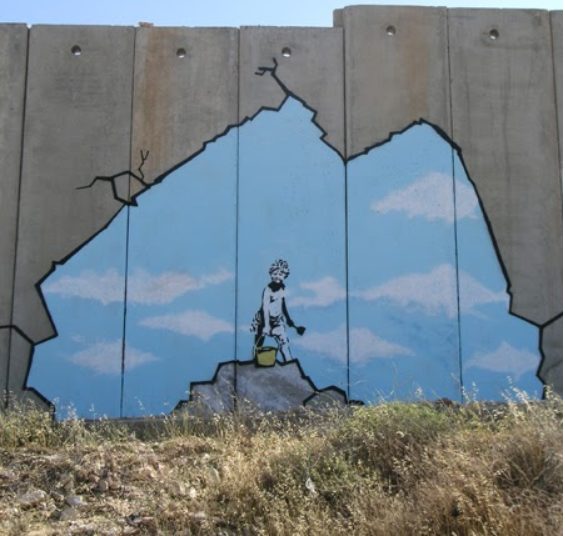
In Child Through the Wall, Banksy creates the illusion that a vast section of the concrete barrier has been violently broken open. At the center of the jagged rupture stands a small child holding a bucket and spade, while beyond him stretches an expanse of brilliant blue sky and white clouds.
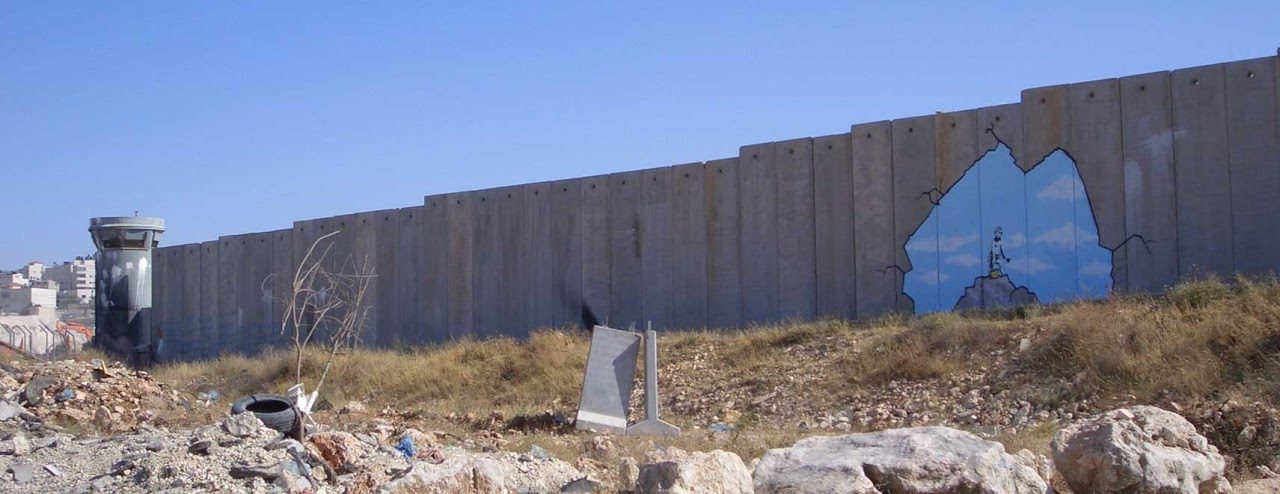
The disproportion between the child and the architecture is fundamental to the image. The figure is tiny against the monumental slabs of concrete surrounding him, yet Banksy imagines the barrier yielding precisely where the child appears. There is no machinery, no visible act of destruction and no political slogan. Instead, the impossible opening is presented with the simplicity of a child's fantasy, as though imagination alone were capable of breaking through the concrete.
The bucket and spade introduce an additional note of innocence. They belong to the vocabulary of childhood and seaside play rather than conflict or political resistance. Banksy repeatedly used children in his work to approach subjects of violence, authority and social division from a deliberately vulnerable perspective. Here, the child's ordinary presence makes the physical severity of the wall all the more conspicuous.
Beyond the Concrete
Unlike Beach Boys, where an opening in the barrier reveals an idyllic tropical beach, Child Through the Wall offers no elaborate paradise on the other side. Banksy gives the viewer something more elemental: open sky, light and apparently limitless space.
That restraint makes the work particularly powerful. The imagined alternative to confinement is not wealth, comfort or some distant utopia, but simply the absence of obstruction. The blue sky visible through the rupture contrasts sharply with the grey mass of the concrete, creating an immediate visual opposition between enclosure and openness.
Yet Banksy never allows the illusion to become an uncomplicated image of escape. The real wall remains intact. The painted breach cannot be entered, and the landscape beyond it cannot be reached. What initially appears optimistic therefore contains an unavoidable tension: the image can imagine freedom, but it cannot provide it.
The Wall as Part of the Work
Seen in its original setting, the enormous scale of the barrier becomes inseparable from the meaning of the mural. Banksy deliberately leaves most of the concrete untouched. The small painted opening is surrounded by an overwhelming expanse of blank wall, making the imagined rupture appear both miraculous and impossibly fragile.
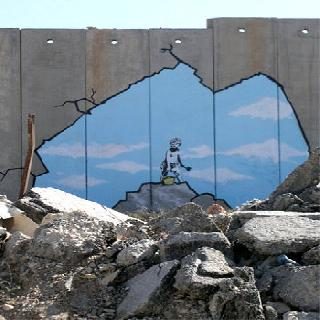
This relationship between image and architecture is central to Banksy's 2005 Palestine intervention. Rather than treating the barrier as a neutral surface on which to place independent stencils, he repeatedly responded to its physical function. Windows reveal landscapes that cannot actually be seen; openings lead toward places that cannot actually be reached; children appear to dig, climb or float beyond a structure designed to prevent passage.
Child Through the Wall is perhaps the clearest expression of that strategy. The concrete barrier is not simply the support for the artwork. Its scale, solidity and purpose are what give the painted opening its meaning.
Imagining the Wall Away
There is an important ambiguity at the heart of the image. The child may appear to have found a passage through the wall, but he remains part of an illusion painted upon it. Banksy's intervention does not pretend to alter the political or physical reality of the barrier. Instead, it momentarily asks the viewer to see that reality differently.
That distinction helps explain why Child Through the Wall stands among the defining images of the 2005 campaign. Much of Banksy's intervention was built around acts of imagined escape: looking through the wall, climbing above it, cutting it open or discovering another world behind it. Here those ideas are reduced to their simplest form. A child stands before an impossible opening, surrounded by concrete, with nothing beyond him but sky.
The wall remains. For a moment, the image allows us to imagine that it does not.
STAY INFORMED
Receive the latest news, exhibitions, artworks and market updates on Banksy.