CHOOSE YOUR WEAPON
Choose Your Weapon
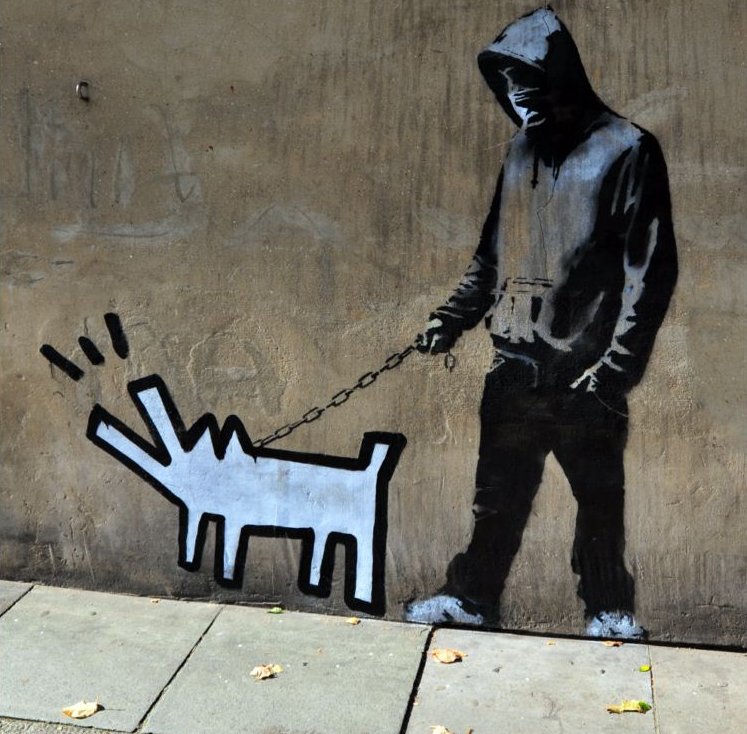
A hooded young man stands in profile, his face concealed behind a bandana. One hand remains casually buried in his pocket while the other holds a chain attached to an aggressively barking dog. The figure is rendered with Banksy's characteristic tonal stencil work, giving him a physical weight and near-photographic presence. The animal, by contrast, is reduced to an almost entirely white graphic silhouette.
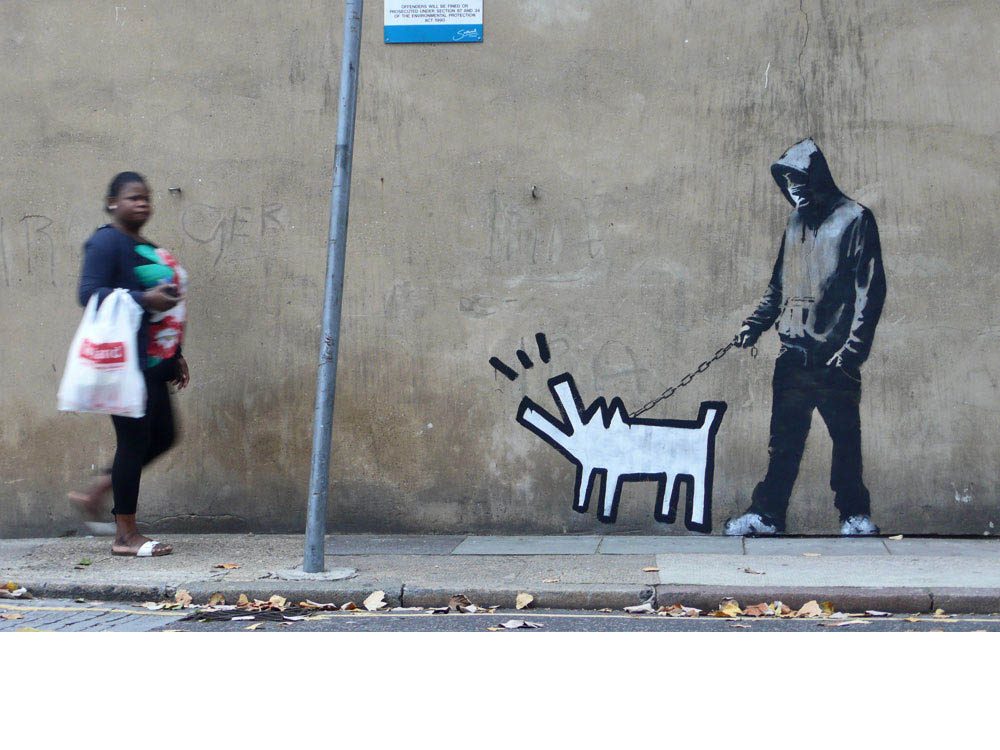
The contrast is deliberate. The man appears withdrawn and strangely passive, while the dog projects all the aggression in the composition. The chain connecting them becomes the crucial element: the animal is simultaneously companion, threat and potential weapon.
The mural appeared in October 2010 on the exterior of The Grange in Bermondsey, South London, at approximately 10 The Grange. It was initially boarded over shortly after appearing, before being uncovered and protected behind a frame and Perspex.
The Weapon
The title immediately evokes the phenomenon of so-called “weapon dogs”—dogs trained or encouraged to intimidate and attack—which had become a prominent subject in the British press during the late 2000s and early 2010s. Banksy requires no act of violence to make the point. The threat exists in reserve, held at the end of a chain.
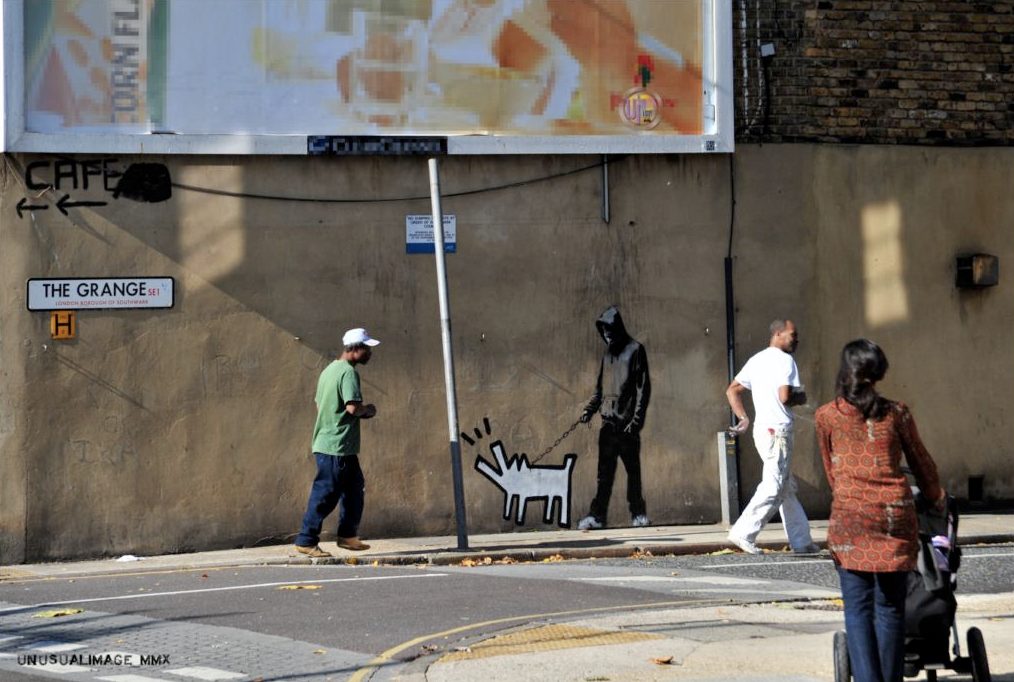
The man's posture complicates the image. He is masked and visually coded as threatening, yet he does almost nothing. His hand remains in his pocket and his body appears relaxed. It is the dog that barks, lunges and performs the aggression for him. Power has effectively been outsourced.
But the title Choose Your Weapon permits another interpretation, because this is emphatically not a naturalistic dog.
Banksy Meets Keith Haring
The animal is a direct appropriation of Keith Haring's Barking Dog, one of the most recognizable motifs to emerge from Haring's visual language in 1980s New York. Banksy preserves its flattened silhouette, emphatic outline and cartoon-like immediacy while placing it on a literal chain held by a contemporary London street figure.
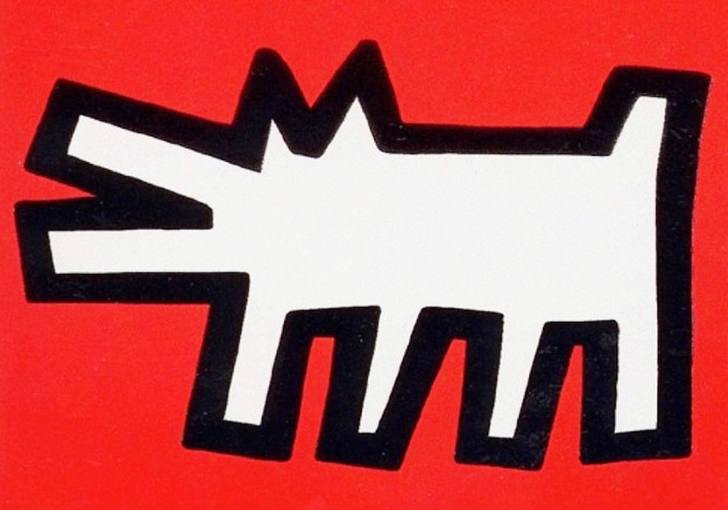
The quotation fundamentally changes the meaning of the work. Haring developed a public visual language capable of communicating outside the conventional gallery system, first drawing extensively in empty advertising panels in the New York subway. His apparently simple figures became vehicles for political activism, sexuality, social commentary and public communication.
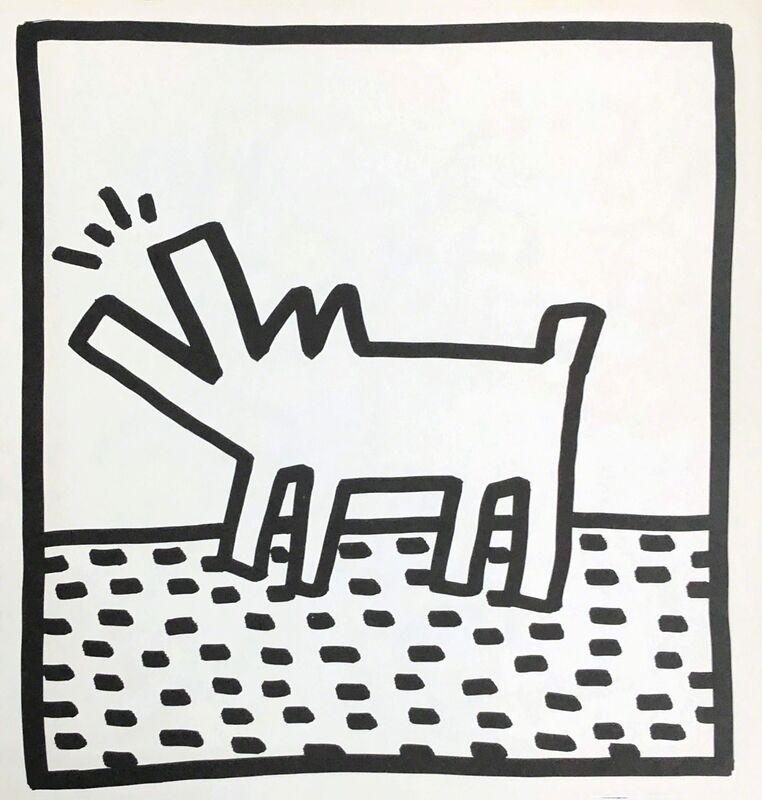
Banksy therefore places one generation of street art literally in the hands of another. The barking dog can still be read as a weapon of intimidation, but it is simultaneously an artistic weapon: an immediately recognizable image capable of occupying public space and communicating without permission.
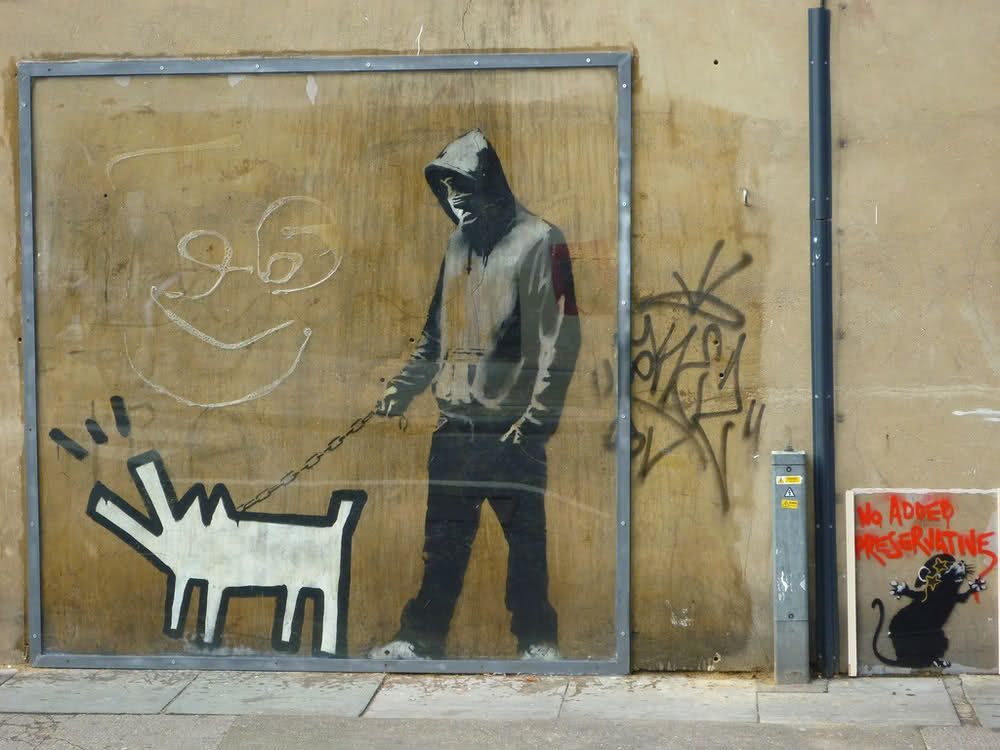
The chain joining man and dog consequently does more than connect an owner to an animal. It connects Banksy's London to Haring's New York, and two generations that understood the street itself as a place in which images could acquire power.
From the Wall to the Print
Choose Your Weapon also occupies an important position between Banksy's street and edition practices. Soon after the Bermondsey intervention, the composition was transformed into one of the artist's most elaborate print releases, published by Pictures on Walls in 2010.
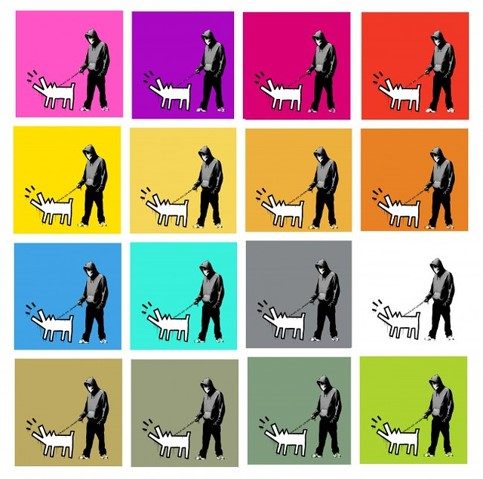
Rather than reproducing a single fixed version, Banksy issued the image in an extraordinary range of colors. The principal Cool Grey edition comprised 100 signed impressions, while numerous colored versions were produced in much smaller editions, alongside VIP and artist's proof variants. The transformation was particularly appropriate for an image already concerned with the circulation and reuse of visual language: Haring's dog had moved from the New York subway to a London wall and then into Banksy's own editions.
There is an intriguing chronology behind the image as well. Although the street mural appeared in 2010, Banksy had already produced at least one substantial studio version of Choose Your Weapon in 2009, signed and dated on the reverse. The concept therefore appears to have existed before its appearance on The Grange.
Protected, Then Lost
The reaction to the mural repeated a pattern increasingly familiar in Banksy's London work. It was first boarded over, effectively hiding an unauthorized intervention, but subsequently reappeared framed and protected behind Perspex. The gesture transformed a piece of graffiti almost immediately into something resembling an outdoor museum exhibit.
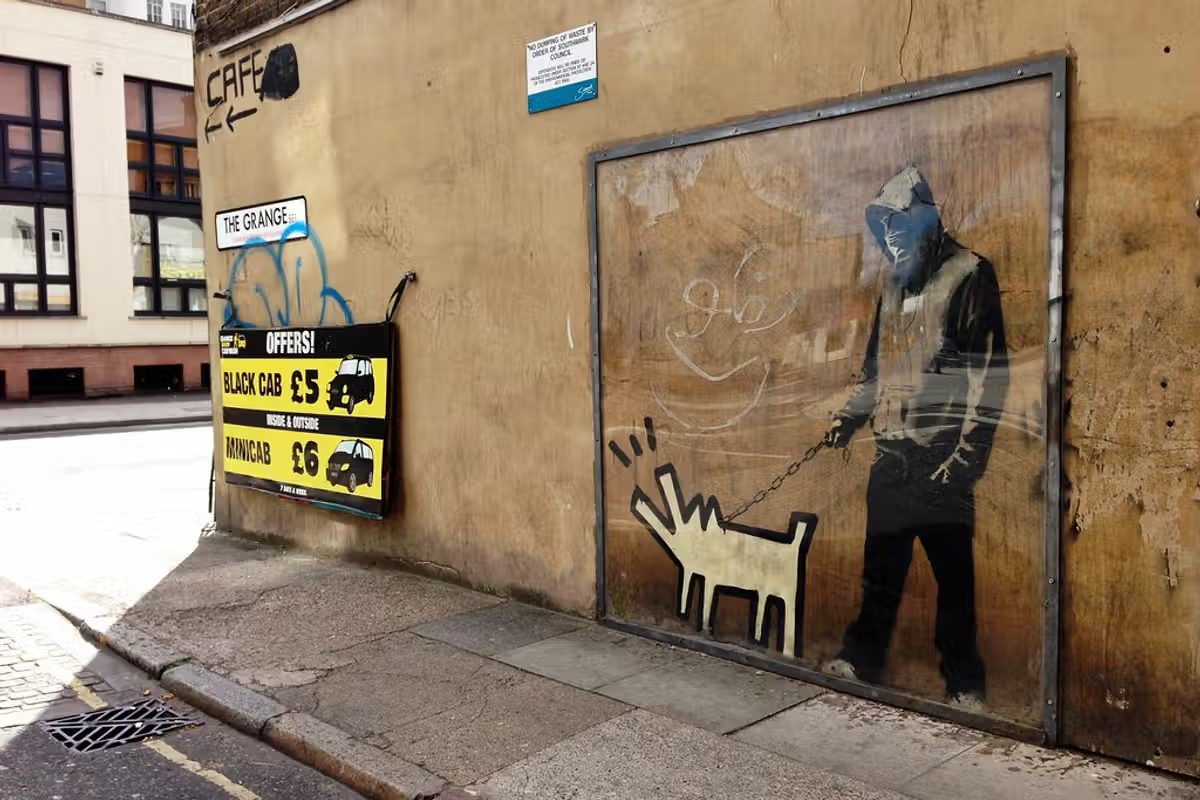
Over time, the protective surface itself accumulated posters and other material, progressively obscuring the Banksy beneath the ordinary visual activity of the street. The mural is no longer visible at its original location.
Choose Your Weapon ultimately derives its strength from the ambiguity of its title. The weapon may be the dog, the threat of violence, the image borrowed from Haring, or the spray can that placed both of them on the wall. Banksy leaves the choice unresolved. The man holds the chain, but the image holds the power.
STAY INFORMED
Receive the latest news, exhibitions, artworks and market updates on Banksy.