CLOWN, 2022
From Banksy's Early London Years
The history of Clown begins more than two decades before the production of the present screenprint. Around 2000, Banksy was still operating principally within the Bristol and emerging London street-art scenes, several years before the international recognition that followed exhibitions such as Turf War and Crude Oils. During this formative period, he became associated with Jeff Boardman and Vikas Malik, the founders of the newly established Clown Skateboards, a London-based project conceived around the intersecting cultures of skateboarding, music and street art. Clown's own account records that Boardman and Malik were involved with Banksy around his early activities on Rivington Street in Shoreditch and subsequently asked him to create the company's logo and artwork for its first skateboard designs.
The collaboration belongs to an important moment in Banksy's development. His work was beginning to move beyond Bristol while remaining closely connected to the informal networks of graffiti, skateboarding, independent music and street culture from which it had emerged. Rather than a conventional commercial commission undertaken by an established artist for a brand, the Clown project originated among figures participating in the same underground cultural environment. Boardman has subsequently confirmed that Banksy designed the Clown logo, which the company retained despite an initially mixed response from those shown the early boards.
The Gun Clown
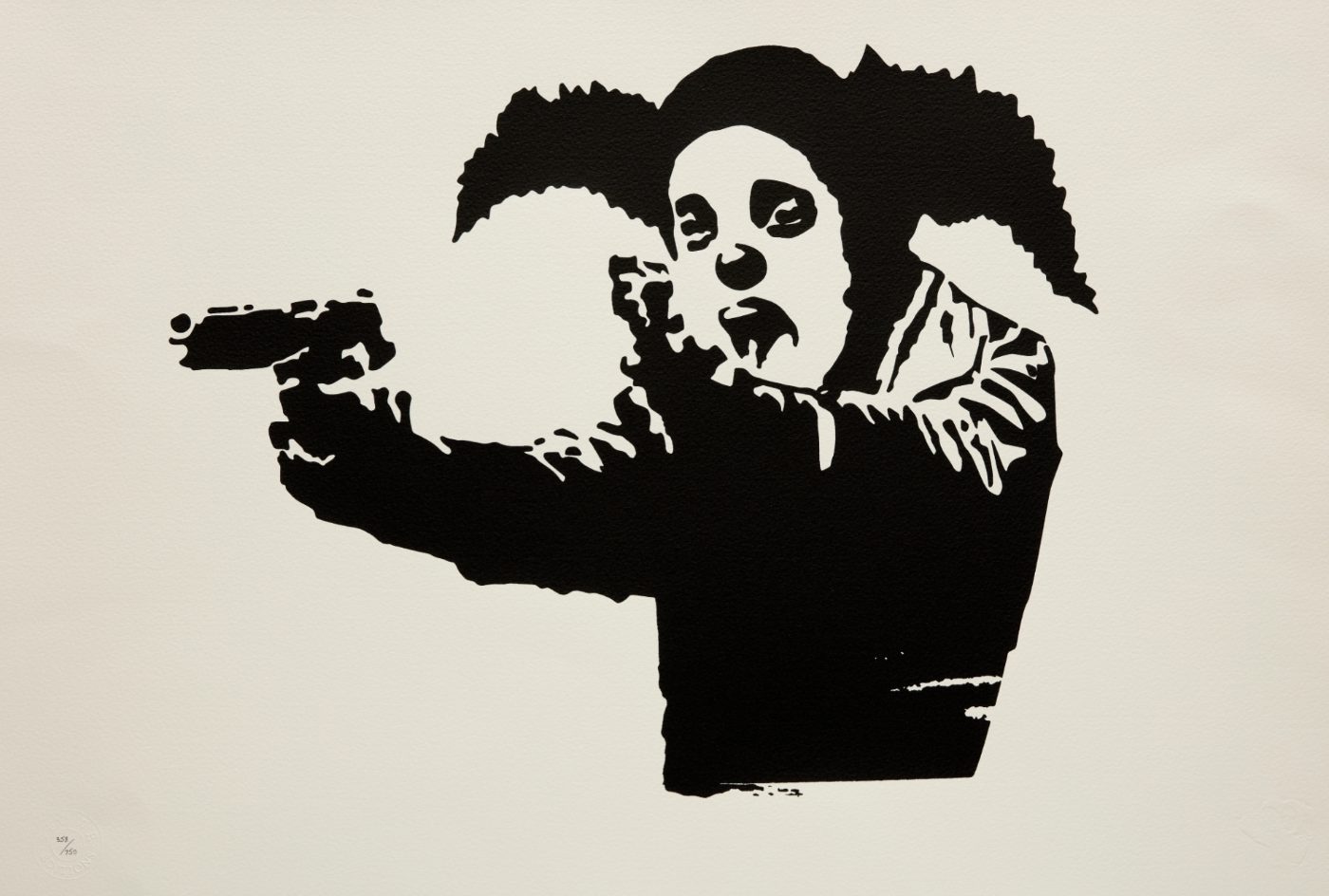
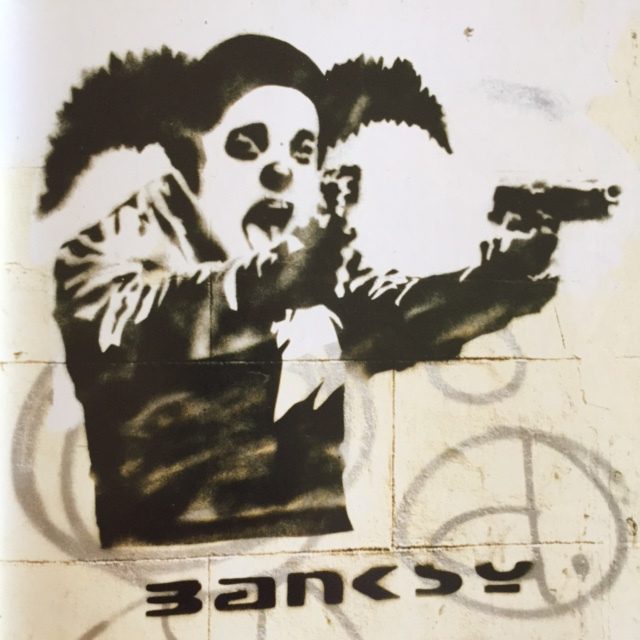
Banksy's design depicts a clown pointing a handgun toward the viewer, combining the visual language of entertainment with an unmistakable gesture of violence. The image belongs to Banksy's early fascination with destabilizing familiar figures by introducing weapons or other incongruous elements. Clowns, children, monkeys, policemen and other readily identifiable characters became vehicles through which apparently simple images could acquire more ambiguous or threatening meanings.
The motif also has a deeper place within Banksy's early iconography. Research into his earliest exhibitions identifies a gun-wielding clown in Banging Your Head Against a Brick Wall and connects the imagery to a film still from the 1995 film Dead Presidents. The same research records the motif appearing on a Bristol wall and within Banksy's work around the 2000 Urban Games. The Clown Skateboards design should therefore be understood not as an isolated graphic commission but as part of a visual vocabulary Banksy was already developing across street work, publications and related projects.
There is also an interesting relationship with Banksy's earlier Insane Clown mural in Bristol from 1998. The two are distinct compositions and should not be confused, but the recurrence of an armed clown over this short period illustrates Banksy's early attraction to the contradiction between the clown's traditional role as an entertainer and the aggressive symbolism of the firearm.
Clown Skateboards and the 2000 Test Press
Clown Skateboards launched its initial Test Press series in August 2000. According to the company's account, an initial group of twenty examples of each design was hand-printed and circulated among shops and prospective team members to gauge reaction, following a model inspired by the test-press and dubplate culture of music. Banksy had supplied the Clown logo and designs for the company's first boards, including monkey imagery.
The response was not entirely what the founders expected. The monkey design was not developed into a full production run, while the Clown logo was retained and subsequently produced in black and red. These early skateboard decks have since become documents of the period in which Banksy's imagery circulated within street culture before becoming established within the international art market.
When Clown Skateboards was revived two decades later, the company returned to this history. In 2020 it completed versions of the original Test Press project using the original acetates from 2000, presenting the new production as the completion of the editions initially envisaged with Banksy. Surviving examples and complete sets have subsequently appeared on the secondary market as Banksy × Clown Skateboards works.
The 2022 Screenprint
The present Clown screenprint was published in 2022, translating the historic Gun Clown image from its origins in Banksy's early street and skateboard culture onto paper. It was produced as a one-layer, hand-pulled gloss acrylic screenprint on textured Somerset 300 gsm paper, in a numbered edition of 750, accompanied by 75 Artist's Proofs. Examples carry the embossing of Clown Skateboards and Stowe Gallery together with a Clown blind stamp, and were issued with certificates from the publisher. Auction catalogues document both the standard edition and the separate group of 75 APs.
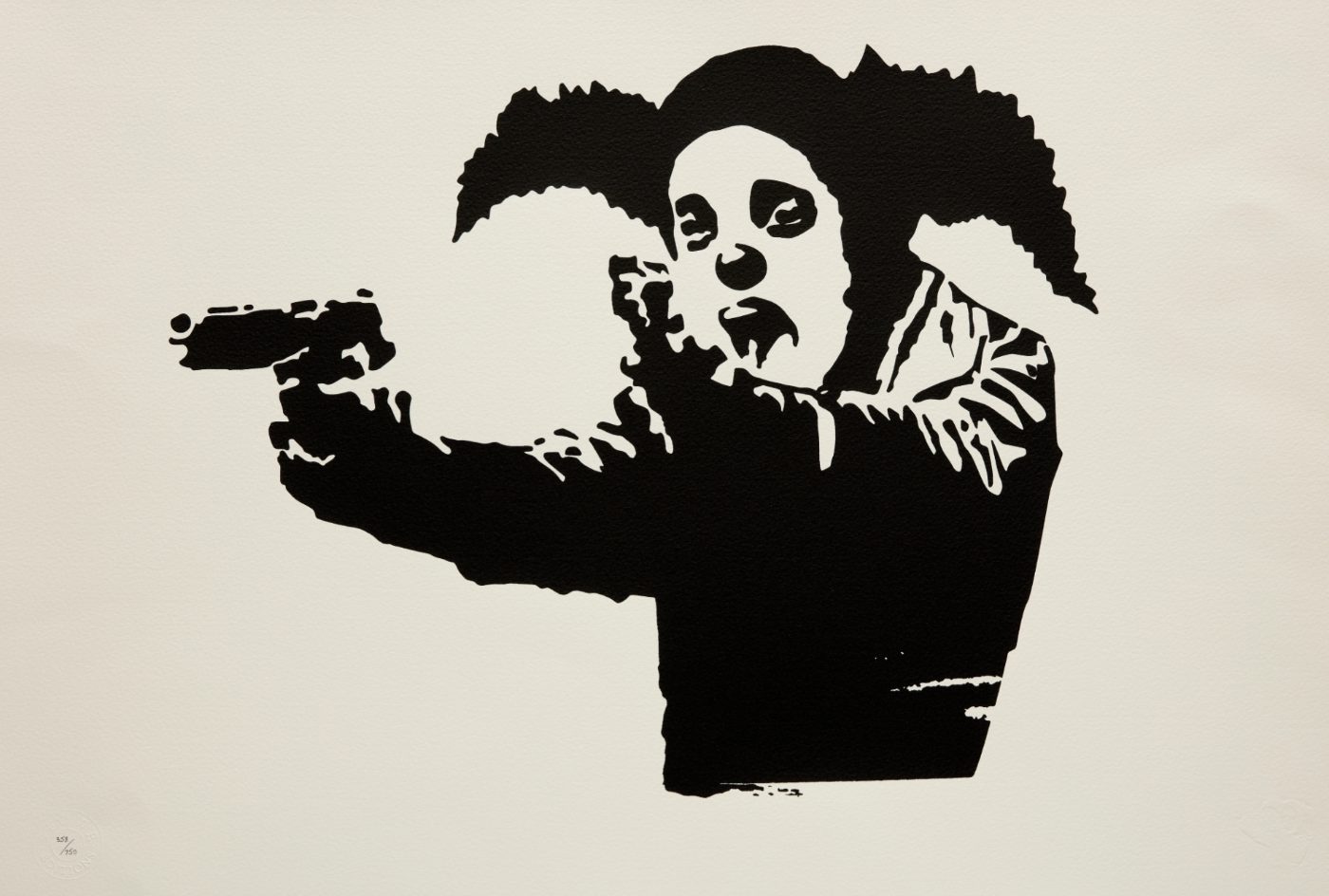
The deliberately stark black image retains the economy of Banksy's early stencil vocabulary. Against the unprinted paper, the clown's face, costume and weapon are reduced to areas of positive and negative space, giving the composition the immediate readability required of both a street stencil and a skateboard graphic. Its significance, however, lies less in the 2022 date than in the history of the image it reproduces. The print reconnects the viewer with a period when Banksy's work still circulated through small exhibitions, street interventions, inexpensive publications and collaborations within the skate and music scenes.
Status Within Banksy's Work
Clown occupies a distinct position within the wider Banksy market and should be differentiated from Banksy's canonical screenprint editions. Although the underlying image was created by Banksy and is historically associated with his collaboration with Clown Skateboards, the 2022 paper edition was published by Stowe Gallery and Clown Skateboards rather than through Banksy's original print-publishing structure. Its embossing and accompanying certificate originate from those publishers rather than from Pest Control Office. Auction catalogues accordingly describe the work as Banksy × Clown Skateboards.
For this reason, the work is best understood as a Banksy-related collectible derived from an authenticated historical collaboration, rather than being placed alongside original Banksy print editions such as Bomb Love, Rude Copper or Girl with Balloon. That distinction does not diminish its historical interest. On the contrary, its appeal lies precisely in the connection it preserves with Banksy's formative years, when the boundaries between graffiti, independent publishing, skateboarding, music and contemporary art remained deliberately fluid.
The 2022 Clown therefore functions as both a later collectible and a document of an important early relationship. Behind the relatively recent edition lies a story extending back to Banksy's emergence around 2000: an armed-clown image, the streets and railway arches of East London, an independent skateboard company and a period in which Banksy's visual language was still developing within the subcultures that first supported it.
STAY INFORMED
Receive the latest news, exhibitions, artworks and market updates on Banksy.