CRAYON HOUSE FORECLOSURE
Crayon House Foreclosure
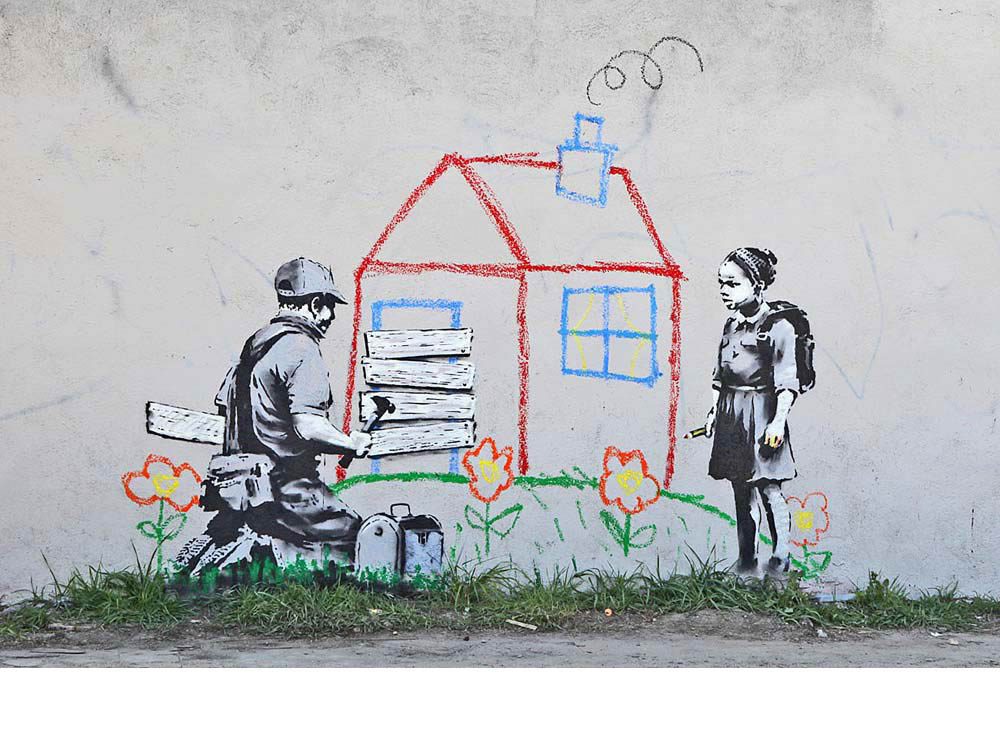
Appearing in Los Angeles in February 2011, Crayon House Foreclosure presents a poignant collision between the imaginative world of childhood and the economic realities of adulthood. The mural was located at the intersection of Washington Boulevard and Compton Avenue, just south of Downtown Los Angeles, and appeared overnight between 20 and 21 February. Banksy subsequently confirmed the work on his official website alongside several other interventions produced during his concentrated Los Angeles campaign that month.
The composition combines two deliberately incompatible visual languages. At its center stands a simple child's drawing of a house, outlined in bright red and blue crayon-like marks, complete with a smoking chimney, windows, green grass and a row of brightly colored flowers. To the right, a young girl stands holding a yellow crayon, apparently the creator of this idyllic domestic scene. Both she and the workman kneeling opposite her are rendered in Banksy's characteristic monochrome stencil technique, sharply separating the physical figures from the innocent, brightly colored world imagined between them.
The workman is methodically boarding up the entrance of the girl's house. Equipped with a hammer, timber and work bag, he belongs unmistakably to the practical adult world. His activity is almost bureaucratic in its ordinariness: he is not violently destroying the house but simply making it inaccessible. The emotional force of the image comes from the girl's passive observation of this process. Still holding the instrument with which she created her home, she watches as another person closes it to her.
The American Dream Under Foreclosure
The economic context in which Crayon House Foreclosure appeared is fundamental to its meaning. The United States was still living through the consequences of the housing collapse that had accompanied the 2008 financial crisis. California had been particularly severely affected, with foreclosures becoming a highly visible feature of communities across Southern California. Contemporary commentary immediately understood Banksy's mural in relation to that crisis.
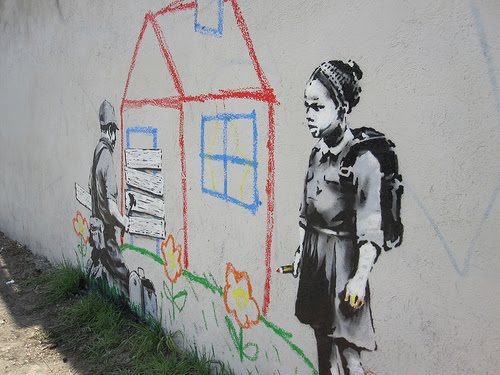
Banksy reduces this enormous economic event to its most elementary symbol: a child's picture of a home. The house contains none of the characteristics of real property. There is no architecture, mortgage, valuation or ownership document; it consists simply of four walls, a triangular roof, windows, flowers and smoke rising from the chimney. It is the archetypal home as imagined by a child, representing security and belonging before those concepts acquire their economic complications.
The intervention of the workman changes that meaning completely. By boarding up the drawn house, he introduces the language of foreclosure into a world that should theoretically be beyond it. Banksy's critique is therefore not directed simply at the loss of property. The mural exposes the distance between the cultural promise of home ownership—the American ideal of stability, family and advancement—and the financial mechanisms capable of taking that security away.
There is a particularly effective imbalance between the two protagonists. The workman appears absorbed in his task, while the girl has no means of preventing it. She can draw a house but cannot control what happens to it. The simplicity of the scene gives the financial crisis a human scale: systems that are abstract when expressed through interest rates, mortgage-backed securities and foreclosure statistics become immediately comprehensible when represented as an adult boarding up a child's home.
Crayons, Childhood and Reality
Crayon House Foreclosure was created only days after Banksy's Crayon Boy appeared in Westwood, and contemporary reporting immediately recognized the visual relationship between the two works. Both combine Banksy's monochrome stencil figures with deliberately childlike passages of intense color, but the crayon device performs a different function in each composition.
In Crayon Boy, crayons replace ammunition, redirecting the destructive potential of a weapon towards imagination and creativity. In Crayon House Foreclosure, the crayon marks construct an entire alternative world. The house, flowers, grass and smoking chimney belong to the child's imagination, while the stenciled workman belongs to a harsher external reality. Banksy therefore uses differences of medium and color to separate two ways of understanding the world within a single image.
The contrast is particularly successful because the crayon drawing is intentionally unsophisticated. The house is the kind of universal image children repeatedly draw: a square, a triangular roof, a chimney, windows and flowers. Its lack of realism is precisely what gives it meaning. The girl has drawn not a particular property but the idea of home. The adult world nevertheless manages to foreclose even that.
The flowers are equally important. Their red and yellow heads and green stems spread across the bottom of the composition, creating an almost aggressively cheerful environment around the monochrome figures. Rather than simply decorating the scene, this color intensifies its melancholy. The imagined world remains bright and optimistic even while it is being closed down.
Banksy in Los Angeles
The mural formed part of an extraordinary burst of Banksy activity in Los Angeles during the weeks preceding the 83rd Academy Awards on 27 February 2011, where Exit Through the Gift Shop had been nominated for Best Documentary Feature. Banksy produced several interventions across the city during this period, including Crayon Boy, Caution Fun! and This Looks a Bit Like an Elephant. Contemporary Los Angeles reporting followed the appearances almost day by day, and Banksy authenticated Crayon House Foreclosure through his website shortly after it was discovered.
The timing placed Banksy in an unusual position. While Hollywood was considering whether to confer one of its most prestigious awards upon a film associated with an artist who had built his reputation outside conventional cultural institutions, Banksy continued to work directly on the streets of Los Angeles. The murals became an unofficial parallel campaign, attracting substantial press attention without requiring a conventional exhibition.
Yet Crayon House Foreclosure remained firmly connected to the economic landscape beyond Hollywood. Rather than addressing celebrity culture or the Oscars directly, Banksy chose one of the defining social consequences of the preceding financial crisis. In a city built partly upon dreams of success and reinvention, the child's brightly drawn house offered a much more modest dream: simply having somewhere to live.
From Street Work to Property
The afterlife of the mural introduced an irony particularly appropriate to its subject. Within two months of its appearance, reports emerged that the wall carrying Crayon House Foreclosure was being offered for sale. In April 2011, the work was described as approximately 12 by 8 feet, “mixed media on concrete,” although—as with Banksy's street works generally—it would not receive a Pest Control certificate of authenticity. Its appearance on Banksy's official website nevertheless provided contemporary confirmation of authorship.
The episode creates an extraordinary conceptual loop around a work concerned with property and ownership. Banksy painted an image about a home being taken away; the intervention increased the value of the physical wall on which it appeared; and that wall itself subsequently became something capable of being marketed as an art object.
Crayon House Foreclosure ultimately succeeds because Banksy compresses a vast economic crisis into an image simple enough to resemble a child's drawing. The house represents security in its most innocent form, while the workman introduces the complicated adult structures of ownership, debt and dispossession. Between them stands the girl, still holding her crayon. She has imagined a home with flowers, windows and smoke rising from its chimney. The tragedy of the image is that the adult world has arrived to tell her that even an imaginary home can be taken away.
STAY INFORMED
Receive the latest news, exhibitions, artworks and market updates on Banksy.