CUT IT OUT, 2004
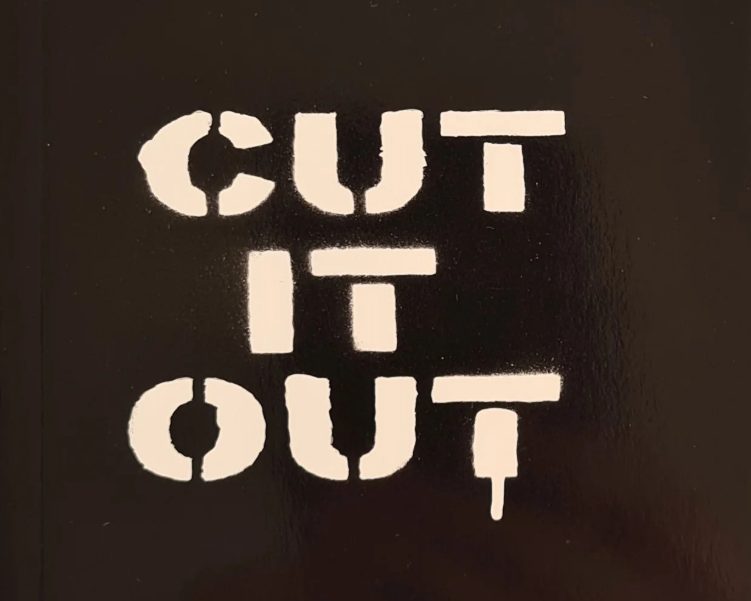
THE THIRD AND FINAL BLACK BOOK
Published in 2004, Cut It Out completed the trilogy of small-format books through which Banksy documented and interpreted his rapidly developing practice, following Banging Your Head Against a Brick Wall in 2001 and Existencilism in 2002. Like its predecessors, it occupies a territory somewhere between artist’s book, street-art archive, political pamphlet and manifesto. Yet Cut It Out feels markedly different. The first two books capture an artistic language in the process of formation and expansion; by 2004, much of the vocabulary associated with the mature Banksy is already firmly established.
The book itself confirms the deliberately independent nature of the project: its final page states simply, “Cut it out. Published by Banksy 2004,” alongside reproduction information and acknowledgements. Its pages move rapidly between photographs of street works, longer texts, newspaper extracts, interventions and increasingly ambitious conceptual projects. The geographical field has expanded as well, with works documented across London and Bristol but also Paris, Los Angeles and elsewhere. Rather than attempting to present a conventional chronological account, Banksy assembles a visual argument about the contemporary city and the forces competing to control it.
THE MATURE BANKSY
The concentration of images that would become central to Banksy’s iconography is remarkable. Girl with Balloon appears on a London wall beside the handwritten injunction “Fight the fighters not their wars,” transforming an image of apparent innocence and loss into an explicitly anti-war statement. Rats appear repeatedly; policemen, surveillance cameras and official signage are appropriated or mocked; consumer brands become targets; and familiar urban structures are turned into components of the work.
War is particularly prominent. A section entitled Unofficial war artist documents Banksy’s interventions surrounding the anti-Iraq War demonstrations, including the Wrong War placards carried through London. Elsewhere, an aircraft is transformed into a missile advertisement and the American flag becomes the backdrop to a wilting palm tree. These are not isolated political cartoons transferred onto walls. Banksy increasingly uses existing symbols, architecture, demonstrations and public behavior as raw material.
This approach is particularly visible in Pest Modernism, where a dense selection of interventions demonstrates how completely Banksy had learned to exploit the physical environment. Rats occupy utility boxes and signs; figures interact with doors and architectural features; official warnings are altered; graffiti and street furniture become inseparable. The street is no longer simply the surface upon which the artwork is painted. It has become part of the composition.
FROM STREET ART TO INTERVENTION
By Cut It Out, Banksy’s practice has also expanded decisively beyond conventional graffiti. The book documents actions in which infiltration, placement and subsequent discovery are integral to the work.
A section devoted to the Natural History Museum records Banksy’s unauthorized placement of a taxidermied rat inside the institution, complete with a museum-style label identifying it as Banksus Militus Ratus. The parody works because Banksy adopts the museum’s own mechanisms of classification and display, inserting his fiction into an institution whose authority depends upon precisely those conventions.
The following pages push the idea considerably further. Under the wonderfully appropriate heading Making an exhibition of yourself, Cut It Out documents Banksy’s clandestine insertion of his own work into established galleries. A subsequent spread records an intervention at the Louvre in Paris in 2004, where Banksy installed his own altered version of the Mona Lisa. The joke is obvious, but the mechanism is important: instead of waiting for institutional recognition, Banksy simply places himself inside the institution.
The same principle operates outdoors on a different scale. The Drinker is presented as an “illegal monument” to British drinking and vandalism—a sculptural intervention installed on a public plinth and given the appearance of civic commemoration. Here Banksy no longer merely alters an existing sign or paints an unauthorized image. He appropriates the language of public sculpture itself, manufacturing a monument without waiting for anyone to commission one.
These works point directly toward the larger interventions that would increasingly define Banksy’s practice. The artist is becoming interested not simply in making recognizable images but in manipulating the systems through which images and objects acquire legitimacy.
BRANDALISM
One of the most important texts in Cut It Out is headed Brandalism. Banksy turns his attention directly toward advertising and the unequal control of public visual space, arguing that corporations are permitted to occupy streets with messages that individuals never requested, while those same individuals are prohibited from answering back.
This provides a useful key to much of Banksy’s early practice. His objection is not simply that advertising is ugly or manipulative. It is that commercial speech has acquired a privileged right to visibility. Companies can purchase access to the shared visual environment; unauthorized individuals cannot. Graffiti consequently becomes, in Banksy’s formulation, less an intrusion into an otherwise neutral city than an unauthorized response to a city already saturated with messages.
The argument leads naturally into one of the book’s most memorable images: a repeated grid of Tesco Value Tomato Soup cans, an unmistakable appropriation of Andy Warhol’s Campbell’s Soup Cans. Banksy replaces the American emblem of post-war consumer culture with the aggressively ordinary visual identity of a British supermarket economy range. Warhol’s transformation of consumer packaging into fine art is itself recycled, downgraded and returned to the language of mass consumption.
This engagement with art history becomes increasingly important throughout the book. Banksy is no longer speaking exclusively to graffiti culture. Museums, canonical paintings, Pop Art and the conventions of the art market are becoming part of the same visual territory as police signs, advertisements and walls.
THE END OF THE BLACK BOOKS
Seen together, Banging Your Head Against a Brick Wall, Existencilism and Cut It Out constitute an extraordinary record of a remarkably compressed period of artistic development. They document Banksy before the mythology surrounding him had fully hardened, while simultaneously demonstrating that he was already actively participating in its construction.
Cut It Out is especially revealing because so many elements of the subsequent career coexist within its 38 pages. There is political protest and visual comedy; graffiti and sculpture; rats and children; attacks on advertising and appropriations of art history; clandestine museum installations and public interventions. Even the zoo strategy encountered in Existencilism returns, with animals enlisted as unwilling participants in Banksy’s continuing experiments with authorship and public communication.
The book also contains works whose subsequent importance could hardly have been predicted from their casual presentation here. Girl with Balloon sits on a wall encountered by pedestrians; the Wrong War imagery exists amid an actual demonstration; altered paintings appear as jokes about museums; and The Drinker stands temporarily in the city as an unauthorized monument. The later separation between Banksy the street artist, political commentator, institutional prankster and highly valued contemporary artist barely exists. Everything still belongs to the same practice.
That makes Cut It Out an appropriate conclusion to the black-book period. These publications had preserved ephemeral works, circulated Banksy’s images beyond the streets on which they appeared, and—crucially—allowed the artist to accompany those images with his own words. They functioned as portable exhibitions, archives and manifestos at a moment when Banksy remained largely outside the conventional structures of the art world.
The following year, Wall and Piece would bring together and substantially broaden this material for a much larger audience. The three small black books consequently belong to a distinct earlier moment: direct, independent publications produced while Banksy’s public identity and artistic language were still being established.
LEGACY
Near the end of Cut It Out, Banksy again introduces a manifesto, this time under the heading Manifesto – Fear, juxtaposed with the image of a figure beneath the words “TOURIST INFORMATION.” As elsewhere in the trilogy, humor, political anxiety and distrust of authority coexist without being resolved into a single ideology.
The importance of the three black books ultimately lies in that immediacy. They are not retrospective catalogues produced after Banksy became famous. They belong to the period they document. Their photographs preserve works that disappeared; their captions retain locations and circumstances that might otherwise have been lost; and their texts provide unusually direct evidence of the ideas Banksy chose to associate with his own work.
Cut It Out therefore closes more than a publishing trilogy. It captures the end of Banksy’s formative period at precisely the moment when the vocabulary developed on the streets of Bristol and London was becoming an international artistic language.
By 2004, very little still needed to be invented. Banksy was already there.
STAY INFORMED
Receive the latest news, exhibitions, artworks and market updates on Banksy.