EXISTENCILISM, 2002

THE SECOND BLACK BOOK
Published in 2002, Existencilism is Banksy’s second book and the second of the three small publications generally known as his early “black books,” following Banging Your Head Against a Brick Wall in 2001 and preceding Cut It Out in 2004. Pocket-sized, inexpensive and independently produced, these books occupied an unusual territory between artist’s book, street-art archive, political pamphlet and personal manifesto. They allowed Banksy to document works that were frequently ephemeral while simultaneously providing his own commentary on what they meant and why they had been made.

Existencilism retains the deliberately modest format of its predecessor but represents a noticeable editorial evolution. Color photography is used extensively; the layouts are more spacious and assured; individual works are increasingly situated within stories and sequences rather than simply reproduced as examples of graffiti. The book credits Banksy with the writing and artwork, with additional photography by Steve Lazarides, Jenny Lewis and Jimmy Pfaff, and layout by Gee Vaucher. It was published in England by Weapons of Mass Distraction and carries ISBN 0-9541704-1-5.
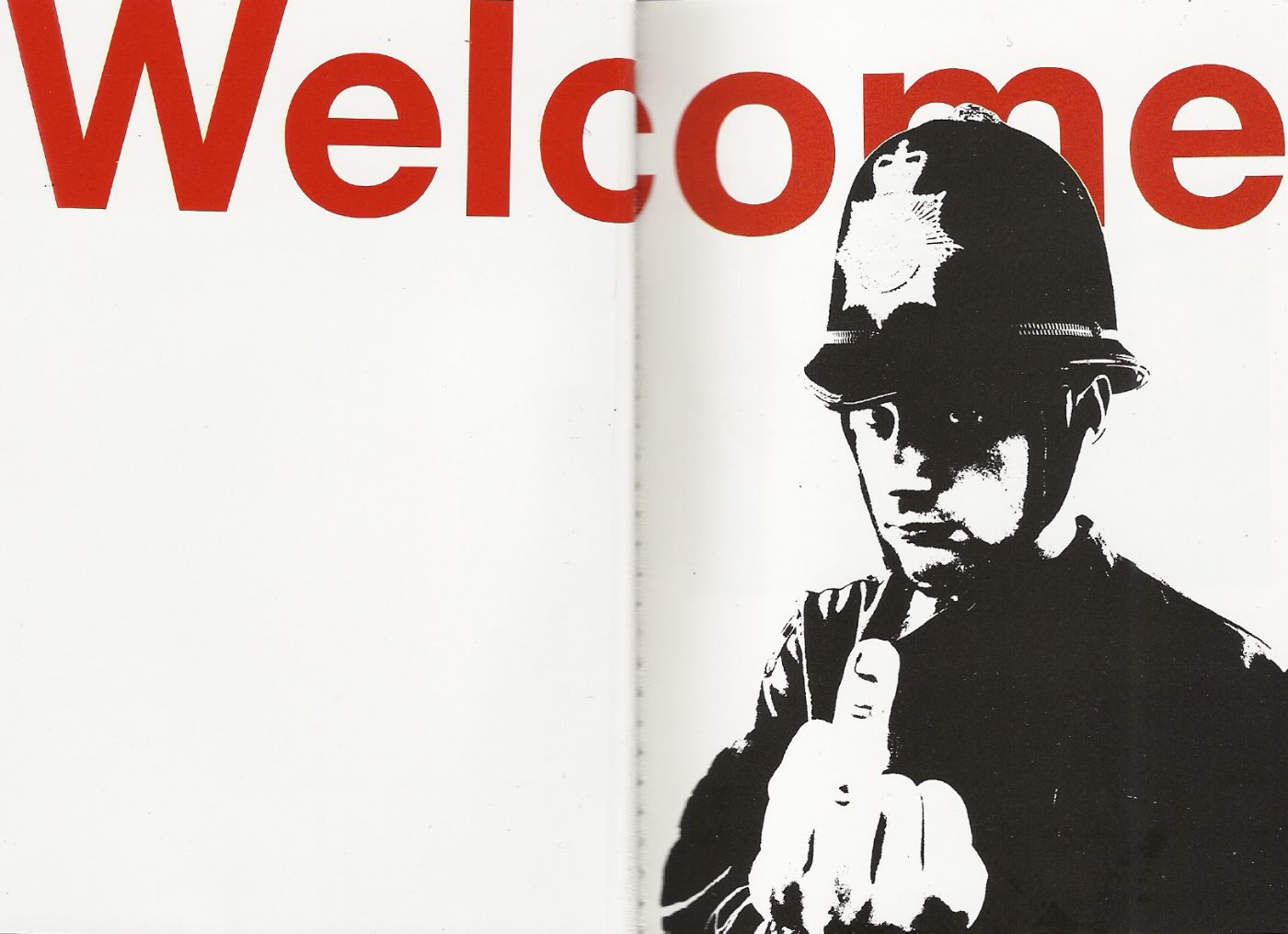
The opening spread announces the change immediately. A monumental red WELCOME stretches across the page, but the official greeting is answered by a helmeted policeman raising his middle finger toward the reader. It is a characteristically economical Banksy proposition: authority welcomes you by insulting you. The joke is immediate, but beneath it lies the contradiction that runs throughout the book—the institutions supposedly created to protect and organize public life are repeatedly presented as the very structures from which the individual needs protection.
FROM LOCAL PHENOMENON TO INTERNATIONAL PRACTICE
Perhaps the most striking development from Banging Your Head Against a Brick Wall is geographical. The first book had already documented Banksy’s movement from Bristol into London, but Existencilism reveals a practice spreading considerably further. Captions identify works in Hackney, Southbank, Bristol, Berlin and Barcelona, while subsequent pages extend the geography through Ladbroke Grove, Shoreditch, Bethnal Green, Sydney and elsewhere. Later sequences include Barcelona and numerous London locations, while a substantial passage recounts Banksy working in San Francisco.
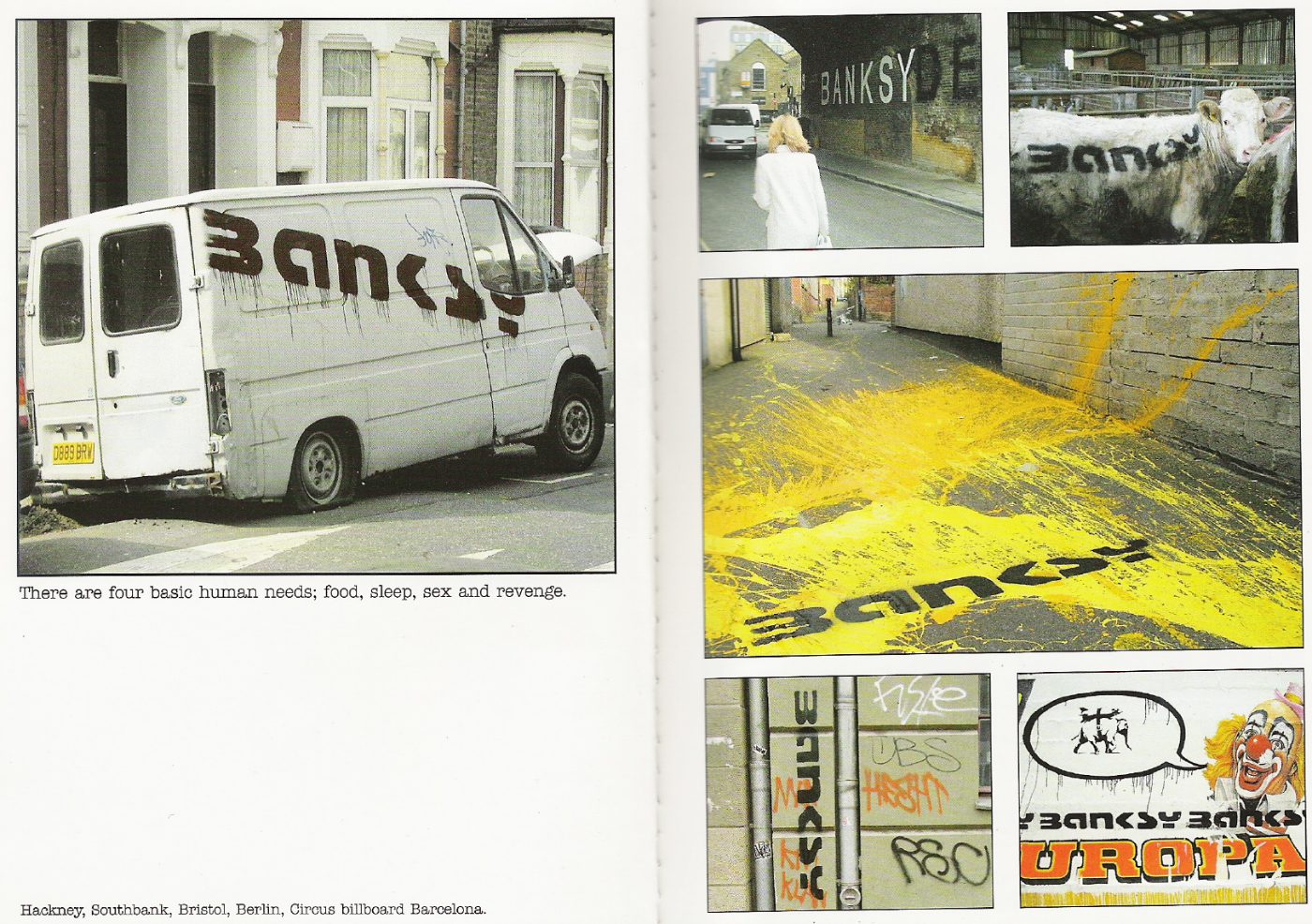
This geographical expansion matters because Banksy’s fundamental subject was becoming larger than any particular city. The architecture changes, as do the police forces, municipal signs and street furniture, but the underlying systems remain recognizable. Surveillance, advertising, property, authority and social exclusion function across borders. The city itself becomes Banksy’s medium, and increasingly the world’s cities appear to provide interchangeable stages upon which variations of the same conflicts can be exposed.
The title Existencilism captures this transition beautifully. The pun combines “stencil” with existentialism, simultaneously mocking the grand language of philosophy and making an unexpectedly serious claim for the stencil as an instrument through which questions about individual freedom, social conformity and authority can be addressed. Banksy’s stencils are becoming not simply a technique but a way of thinking.
The title would also migrate beyond the book. In July 2002, Banksy mounted his first Los Angeles exhibition, likewise entitled Existencilism, at 33⅓ Gallery. The repetition suggests that Existencilism was functioning less as the name of an individual publication than as a broader description of Banksy’s artistic position at this moment: a mixture of graffiti, political observation, absurdist humor and unauthorized intervention that was rapidly escaping its original British context.
THE CITY AS MATERIAL
Throughout Existencilism, Banksy demonstrates an increasingly sophisticated understanding that street art need not merely be an image applied to a wall. The existing environment can supply part of the work.
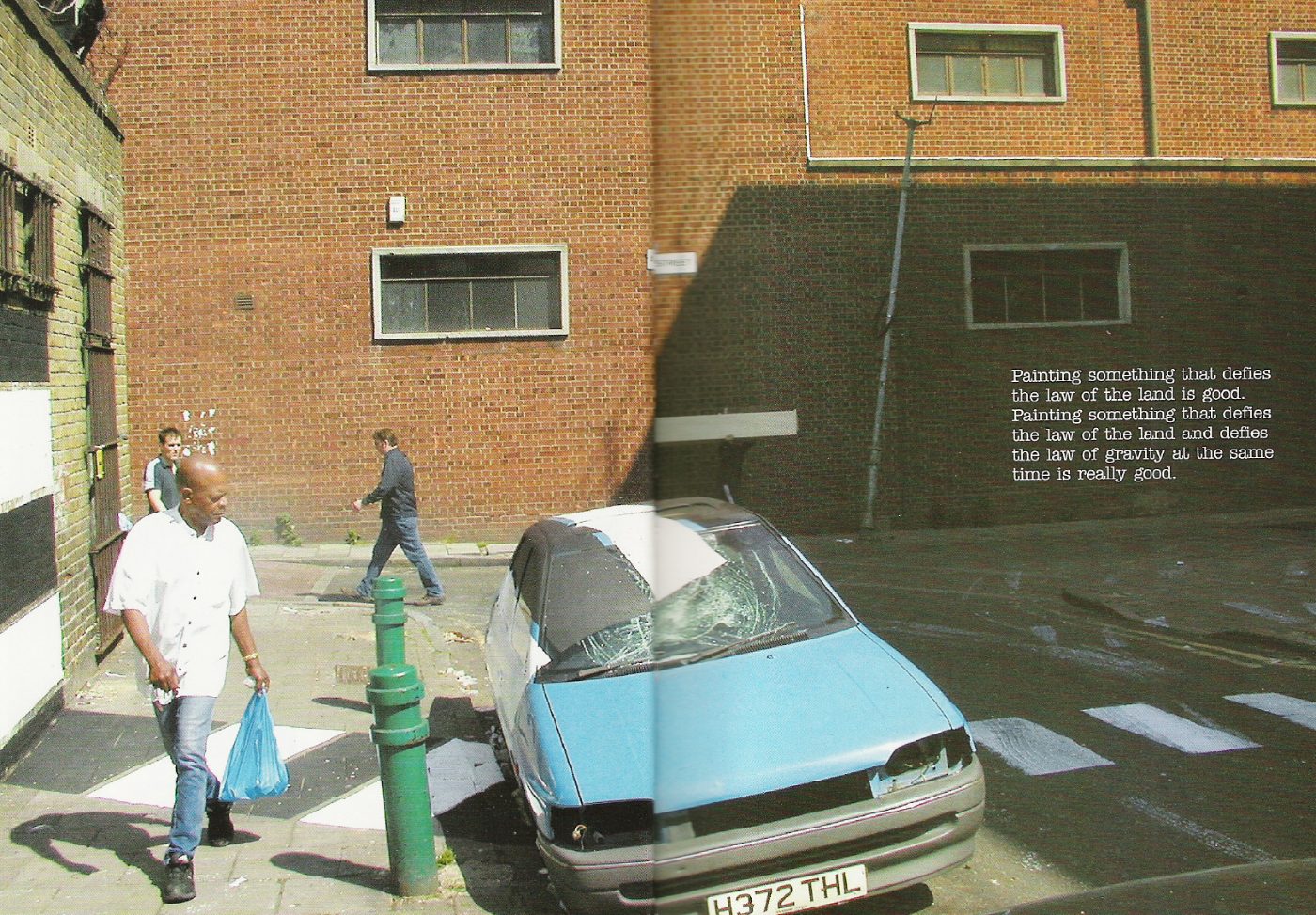
One spread records a damaged car beside the observation that painting something that defies the law of the land is good, while painting something that simultaneously defies the laws of physics and gravity is better. Elsewhere, architectural features, signs, bollards, shopfronts and street furniture become components of compositions rather than neutral backgrounds.
This distinction is fundamental to Banksy’s mature street practice. A stencil removed from its location can retain its iconography, but often loses part of its meaning. Banksy increasingly looks at a city not as a collection of blank walls but as a landscape already filled with visual information capable of being appropriated, contradicted or completed.
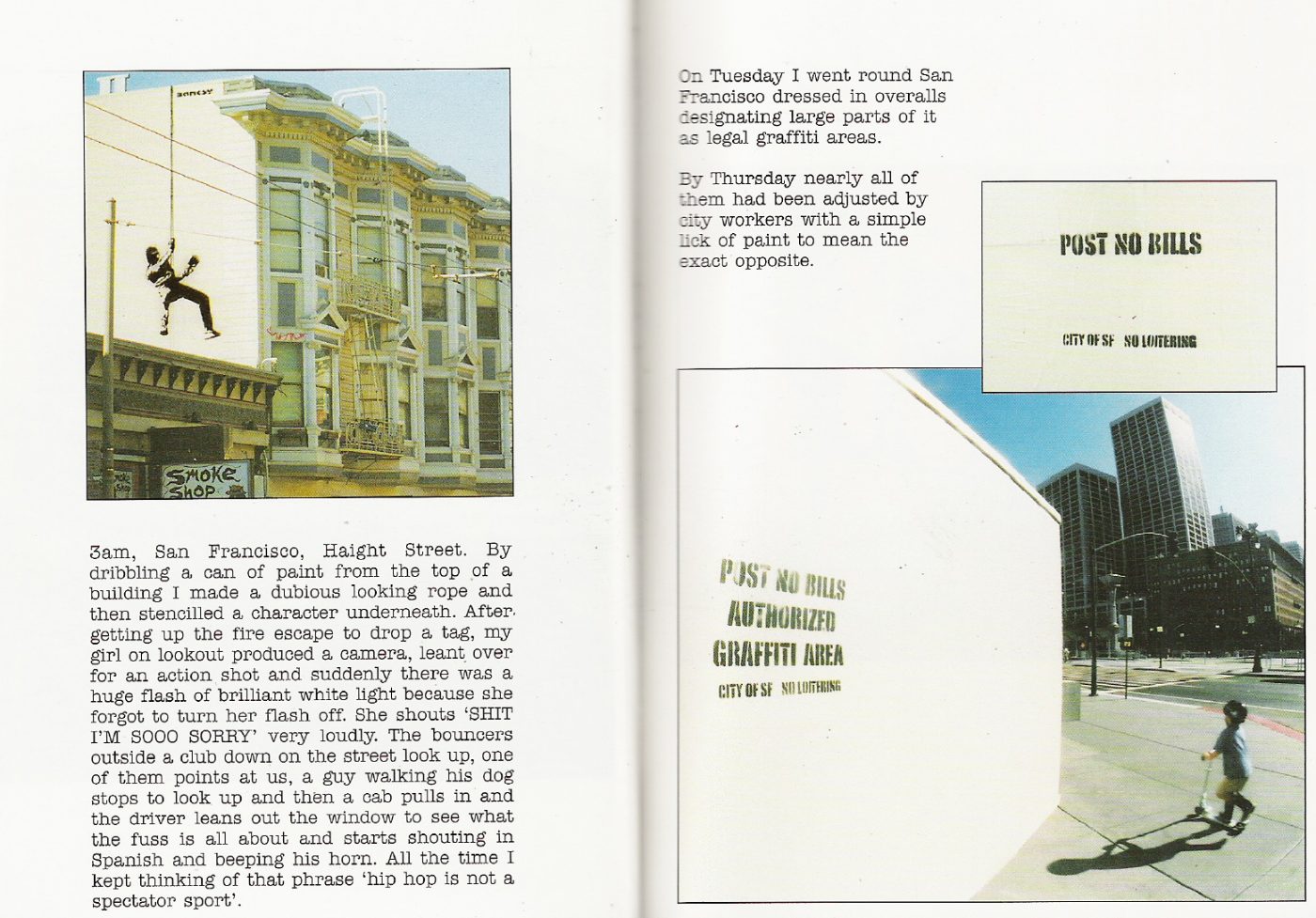
The strategy is particularly clear in the San Francisco sequence. Banksy describes encountering municipal signage prohibiting fly-posting and manipulating the language of civic authority to create what appears to be an officially sanctioned graffiti area. The intervention works because the typography and institutional appearance of the sign carry authority independently of what the words actually say. Banksy does not simply disobey the rule; he borrows the visual language of the people who make the rules and uses it against them.
This fascination with false authorization had already appeared in the first black book and would become one of the recurring mechanisms of Banksy’s career. Official signs, museum labels, police uniforms, barriers and institutional conventions all derive power from collective agreement. Banksy repeatedly discovers that by imitating their appearance closely enough, an unauthorized artist can temporarily borrow that power.
KEEPING IT REAL
One of the most revealing pages in the book is headed Keeping it real. Beside a small figure carrying a placard bearing those words, Banksy tells a parable about a celebrated painter commissioned by a king. The painter works obsessively to produce what he believes to be a masterpiece, only for the king to remain dissatisfied.
The story operates as a compact meditation on artistic integrity and patronage. The artist can seek approval from authority or remain faithful to his own judgment, but the two objectives are not necessarily compatible. Coming from Banksy in 2002, the subject is particularly revealing. His audience was expanding, exhibitions were appearing and the mechanisms through which street art might become commercially successful were beginning to develop around him.
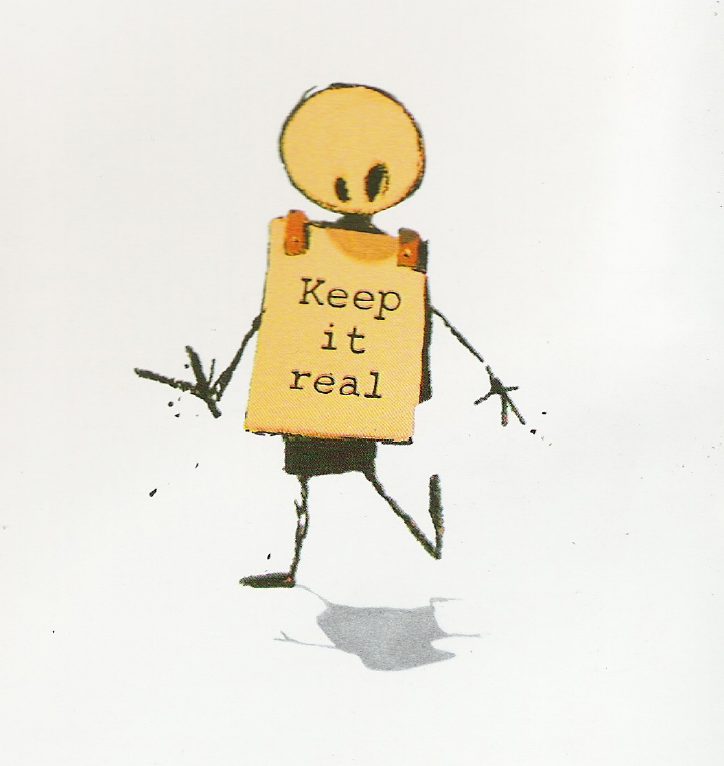
The phrase “keep it real” consequently carries more weight than its apparently casual language suggests. Banksy had constructed a practice around working without authorization and outside conventional systems of cultural approval. Success inevitably threatened to introduce precisely the patrons, markets and expectations from which that independence had emerged.
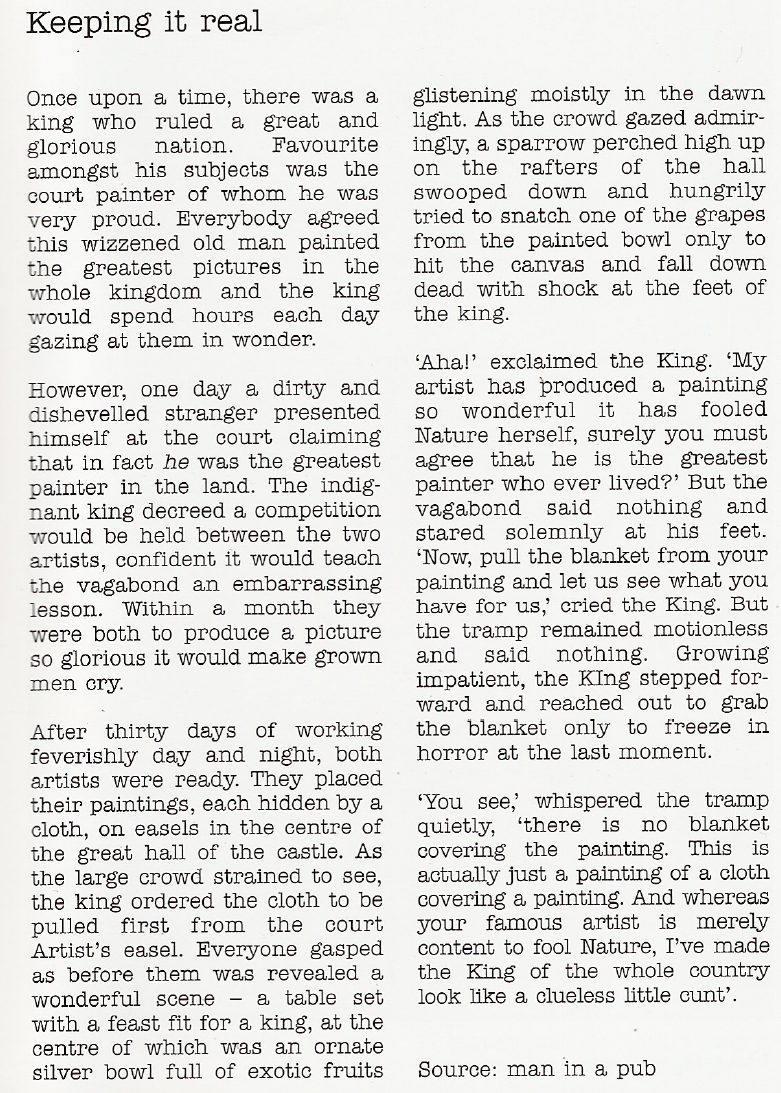
The contradiction would become increasingly important as Banksy moved from underground recognition toward international fame. Existencilism shows that the problem was already understood remarkably early.
THE RAT PACK
The rats occupy a particularly important place in Existencilism. By 2002 they were no longer merely recurrent stencil characters but had become something approaching an alternative population inhabiting Banksy’s cities.
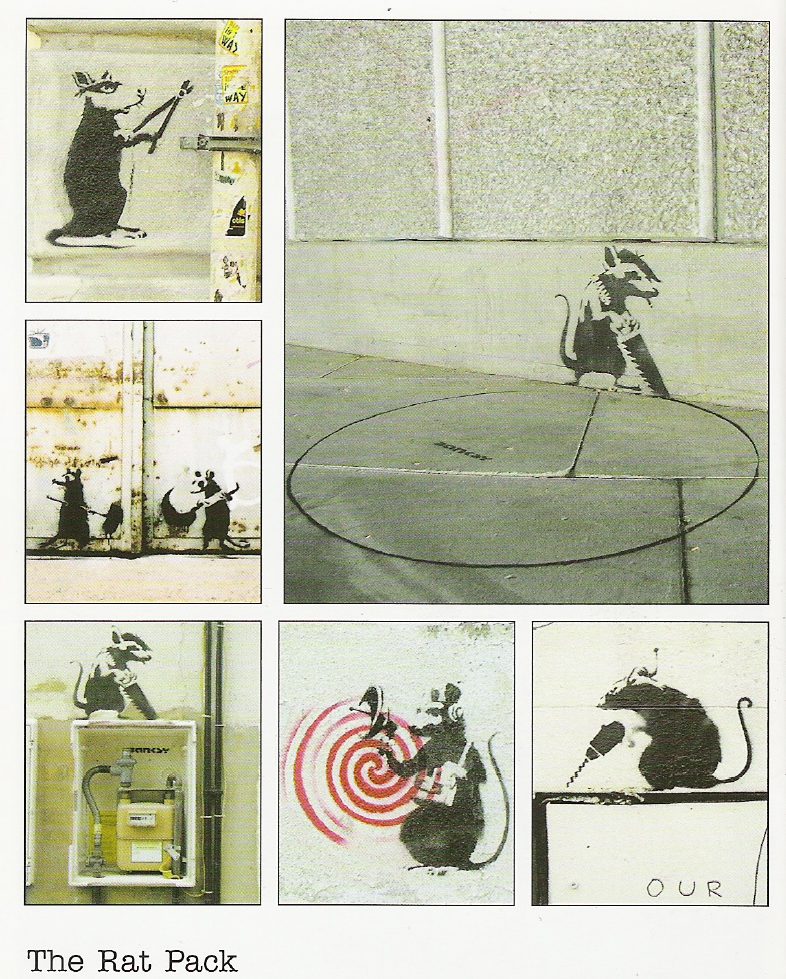
Under the heading The Rat Pack, Banksy explicitly imagines the apparently powerless joining together, acquiring the means to resist and allowing what exists underground to emerge into the overground. On the following spread, rats appear against London’s architecture and transport infrastructure, including a small armed figure positioned against the monumental backdrop of Westminster.
The metaphor is unusually transparent. Rats live alongside human society while remaining unwanted by it. They survive in tunnels, sewers, railway systems and neglected spaces; attempts to eradicate them rarely succeed. Their existence depends upon adaptability rather than permission. As such, they provide Banksy with an almost perfect surrogate for the graffiti writer.
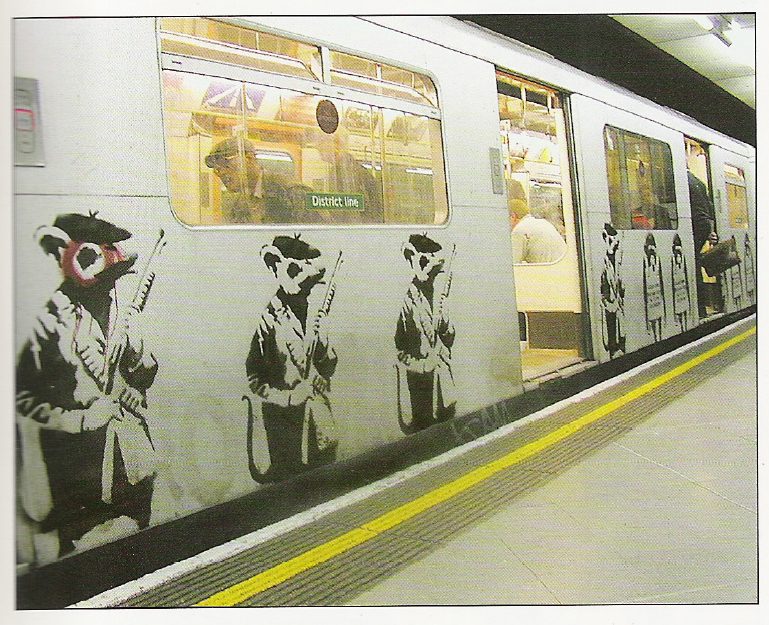
Yet the rats are not simply heroic outsiders. They can be violent, opportunistic, antisocial and absurd. That ambiguity is essential. Banksy does not turn them into conventional political symbols. Their power comes from their refusal to behave respectably.
The book is therefore an important primary document for understanding the subsequent proliferation of rats throughout Banksy’s work. The motif is already being articulated as a philosophy of survival: the unwanted inhabit the same city as everyone else, whether the authorities approve of their presence or not.
INTERVENTION RATHER THAN IMAGE
One of the major developments visible in Existencilism is Banksy’s increasing interest in creating events rather than simply images.
The extraordinary section entitled The Zoo recounts an unauthorized intervention inside an animal enclosure. Banksy describes entering the zoo with stencils and materials concealed about his person, navigating security and eventually placing his mark inside the enclosure. The account stretches across several pages and combines documentary photographs with an extended first-person narrative.
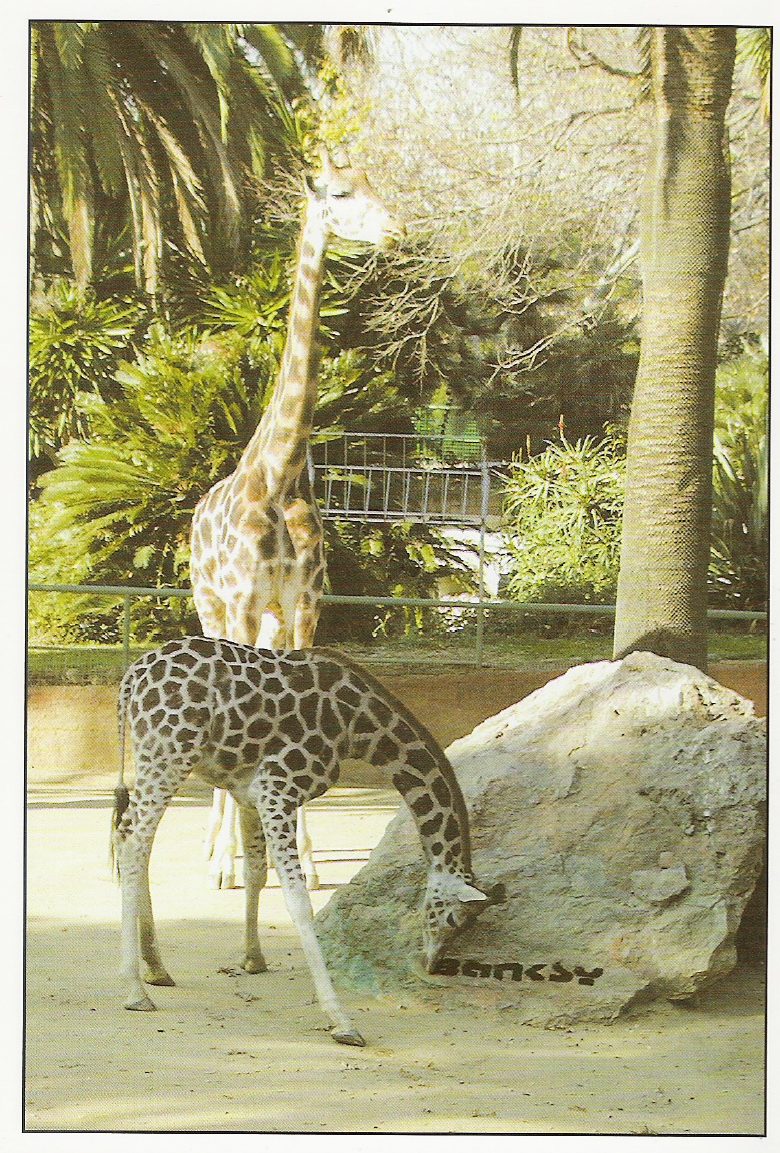
What matters here is the shift in artistic form. The finished stencil is only one component of the work. The infiltration, risk, location, story and subsequent documentation are equally important. The artwork increasingly becomes something Banksy does, rather than simply something Banksy paints.
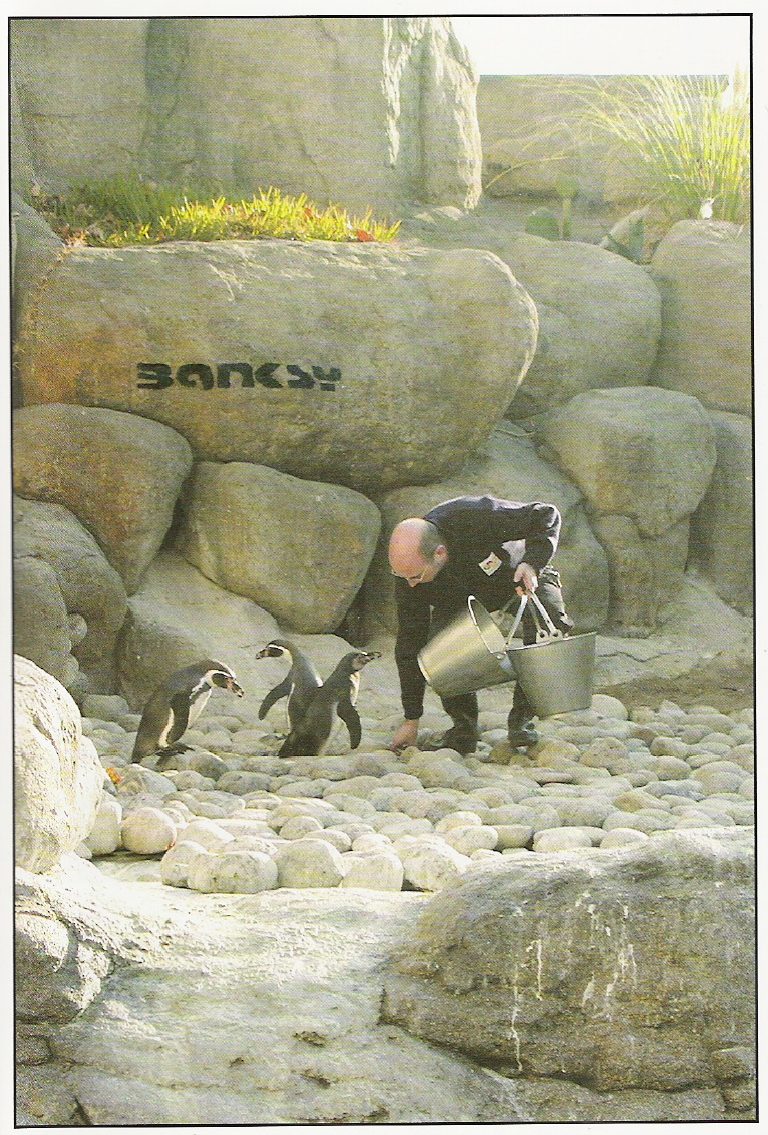
This structure anticipates many of the interventions that would define his subsequent career: unauthorized installations in museums, manipulated public signage, elaborate street actions, the intervention at Disneyland, the Village Pet Store, Dismaland and eventually the spectacular theatre surrounding works such as Love is in the Bin. The mechanism changes in scale, but its foundations are already visible. Banksy understands that an artwork can be simultaneously an object, an action and the story generated by that action.
AUTHORITY, UNIFORMS AND THE PERFORMANCE OF POWER
Police officers, guards and other uniformed figures recur throughout the publication. Banksy observes the psychological power conferred by uniforms, describing how policemen and security guards can appear physically larger and more intimidating simply because of what they wear.
Banksy repeatedly attacks that authority by making its representatives behave incorrectly. A guardsman paints an anarchist symbol. Another apparently official figure becomes implicated in an absurd or subversive act. The familiar visual language of authority remains intact, but its expected behavior has been replaced.
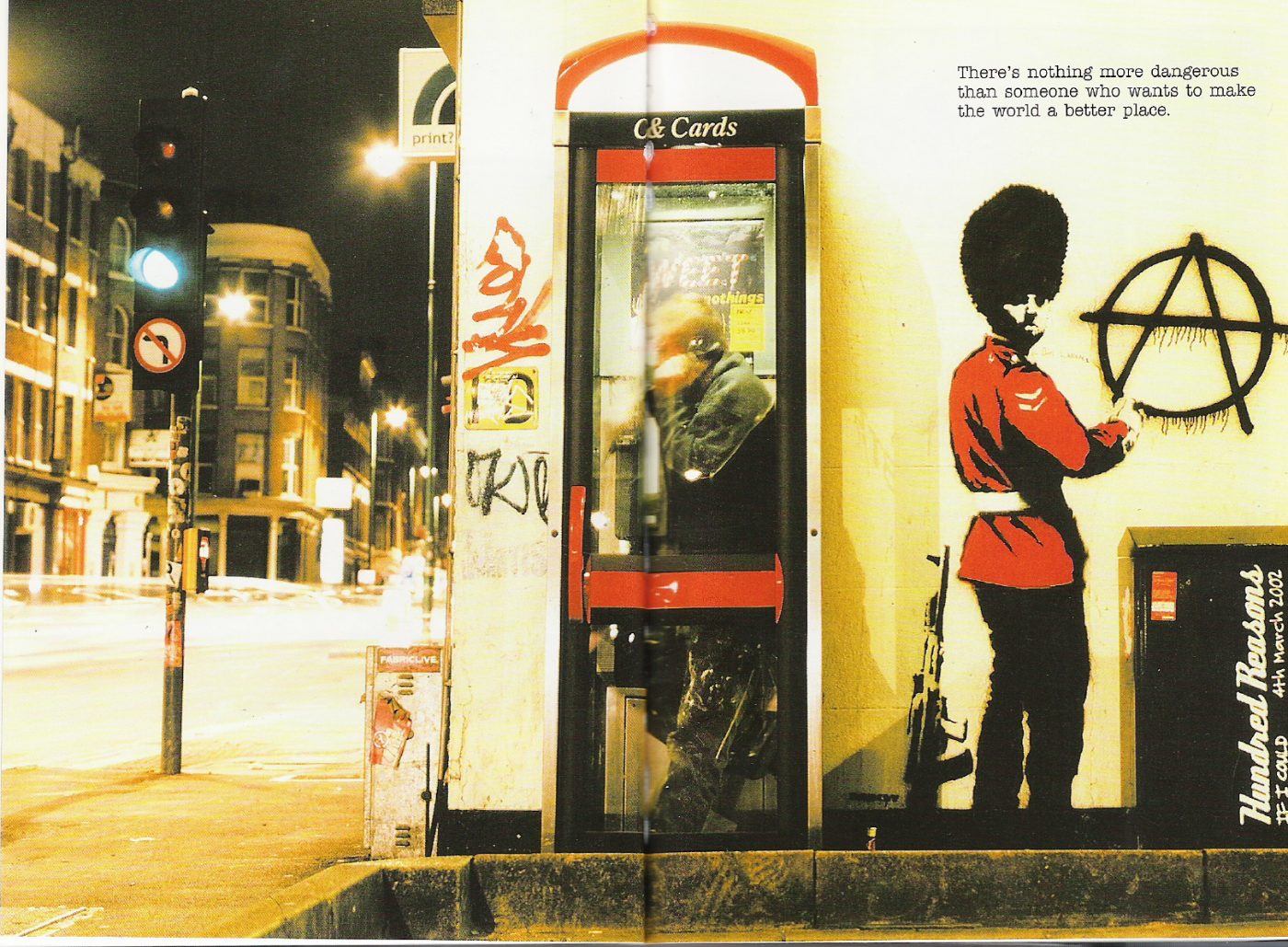
The celebrated guardsman painting the anarchist symbol is particularly effective because Banksy does not need to explain the contradiction. The guardian of established order becomes the author of its most recognizable symbol of rejection. Nearby, other guardsmen appear beneath the phrase “God save the Queen,” while the accompanying text dryly imagines that perhaps everything will be fine and there will not be a war.
The joke conceals a serious proposition. Authority is partly theatrical. Uniforms, symbols, signs and rituals tell citizens whom to obey. If those visual codes can be appropriated, their apparent solidity begins to dissolve.
VANDALS AND THE OWNERSHIP OF PUBLIC SPACE
Toward the end of the book, Vandals develops one of the central arguments running through Banksy’s early writing: who possesses the right to determine what the city looks like?
Banksy contrasts graffiti writers with the institutions, property interests and planning authorities that regulate public space. The conventional distinction appears straightforward: the owner or authority is legitimate; the graffiti writer is a vandal. Banksy’s work repeatedly complicates that distinction by asking why ownership should automatically confer moral authority over the visual environment experienced by everyone.
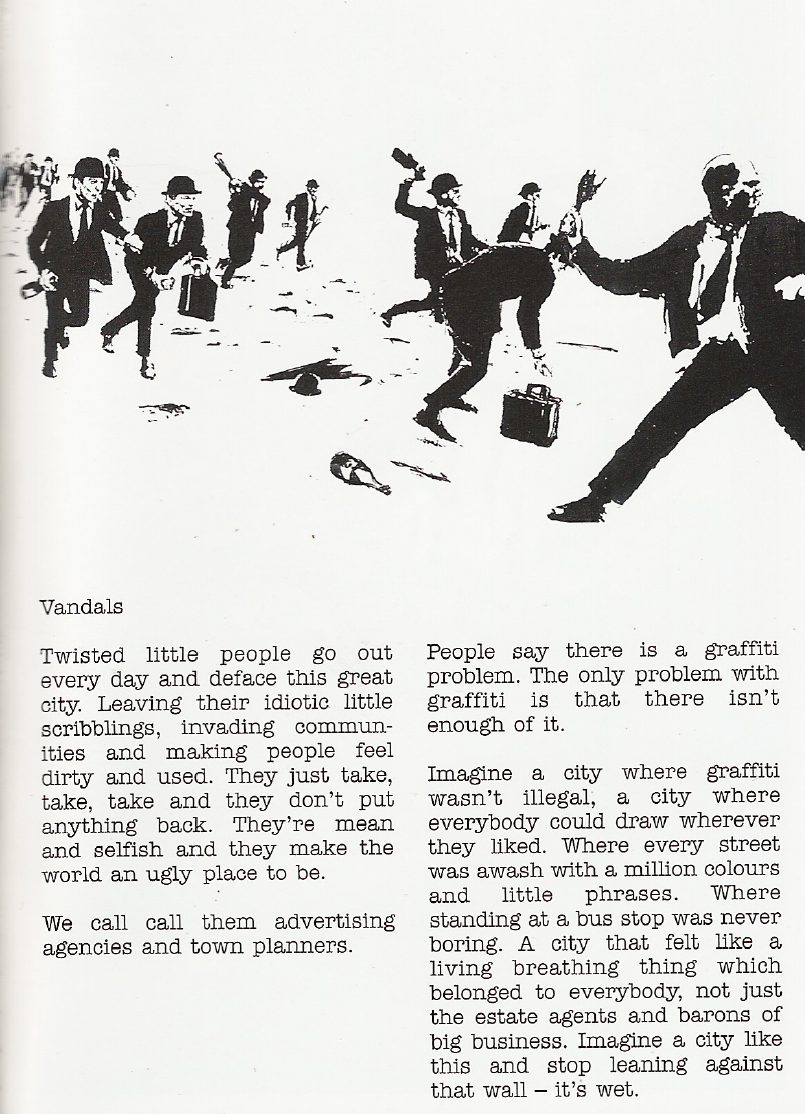
Advertising is particularly vulnerable to this argument. Commercial imagery can occupy enormous portions of public space because somebody has paid for permission, while an individual painting a small unauthorized image can be prosecuted for vandalism. Legality and visual intrusion therefore cease to correspond neatly.
Banksy does not construct a systematic political theory from this observation. He does something more effective for his purposes: he makes the contradiction visible. The city is already covered in messages telling people what to buy, where to walk, what not to do and whom to obey. Graffiti becomes another participant in an argument that was taking place long before the graffiti writer arrived.
ART, INSTITUTIONS AND “PHOTO OPPORTUNITIES”
Banksy’s relationship with the established art world also becomes increasingly visible. One of the most memorable late spreads juxtaposes the monumental façade of Tate Britain with a street intervention reading This is not a photo opportunity positioned within the tourist landscape around Westminster.
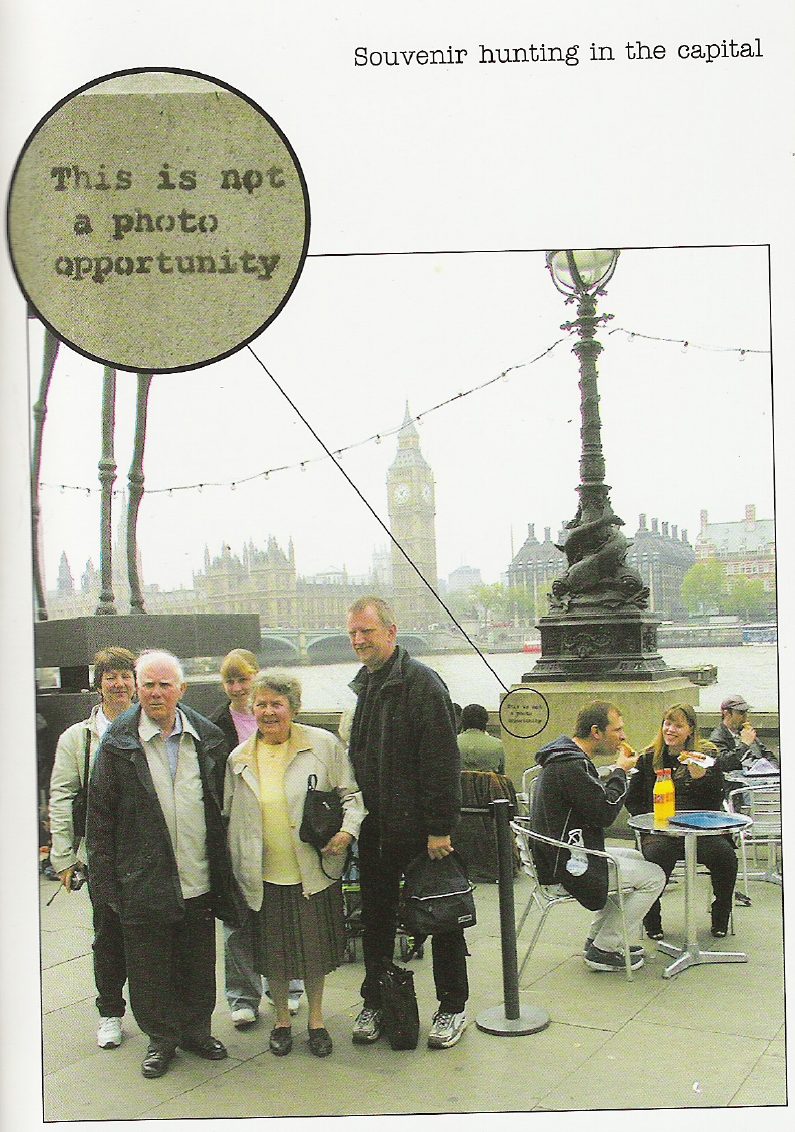
The juxtaposition is characteristically economical. Museums, monuments and tourist landmarks are institutions through which culture tells people what deserves attention. The phrase This is not a photo opportunity simultaneously refuses and creates the photograph: once the instruction exists, photographing it becomes almost irresistible.
This tension between cultural authority and unauthorized artistic action would soon become literal. Banksy would begin clandestinely installing his own works inside major museums, bypassing the curatorial mechanisms that determine what is admitted into cultural history. Existencilism shows the intellectual groundwork already in place. The question is no longer simply whether graffiti belongs in a museum. Banksy is beginning to ask who gets to decide what belongs there in the first place.
CAMP
The book’s final major sequence changes tone dramatically.
A stark black spread introduces the single word Camp beside an image of concentration-camp prisoners behind barbed wire. It is followed by Manifesto: Camp, in which Banksy recounts visiting Bergen-Belsen and encountering the physical and psychological traces of the Holocaust.
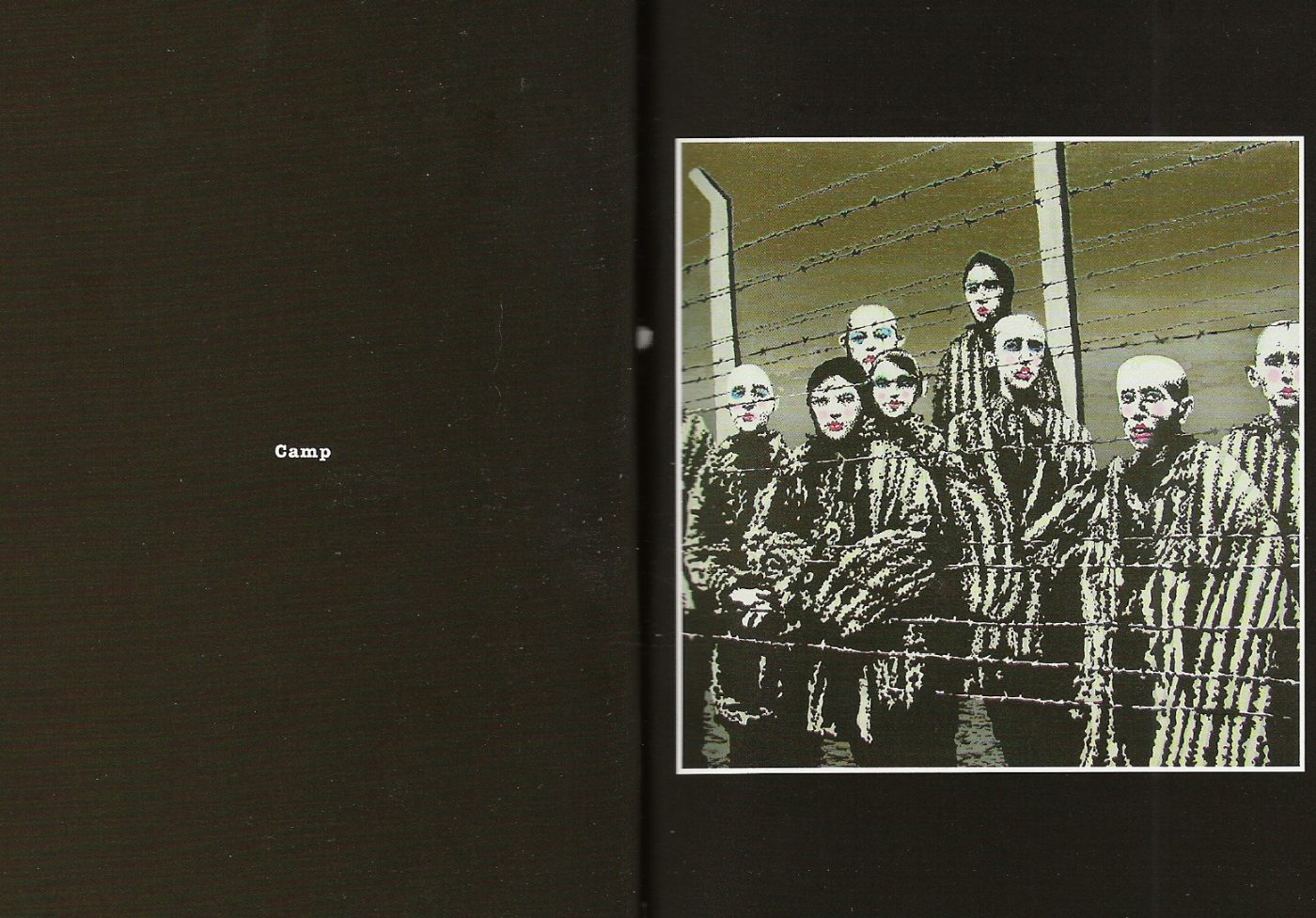
After the visual jokes, irreverent policemen, rats, graffiti adventures and acts of trespass that dominate much of the book, the shift is deliberately uncomfortable. The comic mechanism disappears. Banksy writes instead about historical memory, suffering and the inadequacy of encountering such events only through books before confronting the place in which they occurred.
Its position close to the end of Existencilism is significant. Banksy’s anti-authoritarianism is sometimes mistaken for indiscriminate cynicism—the assumption that because institutions are mocked, nothing is ultimately taken seriously. Camp demonstrates otherwise. Beneath the humor lies a moral hierarchy. Power, violence and the treatment of vulnerable populations matter precisely because Banksy does not regard everything as equivalent.
The passage also helps explain something fundamental about his later work. Banksy frequently uses humor not because his subjects are trivial but because humor provides a route into subjects that are not. War, refugees, political violence, surveillance and inequality can coexist with visual jokes because the joke is a delivery mechanism rather than necessarily the conclusion.
BUILDING BANKSY
Like Banging Your Head Against a Brick Wall, Existencilism is also an exercise in self-documentation. Banksy photographs works that may disappear, records their locations, tells stories about their creation and provides his own interpretation before critics, dealers or historians can do so for him.
But the second book feels more consciously authored.

The photographic credits themselves are revealing. Steve Lazarides, who would become crucial to the documentation and development of Banksy’s early career, appears alongside Jenny Lewis and Jimmy Pfaff. Banksy writes the texts and produces the artwork, while Gee Vaucher is credited with the layout. The apparently spontaneous underground booklet is therefore the product of increasingly deliberate visual and editorial construction.
The black books are consequently not neutral archives of Banksy’s early career. They are among the instruments through which “Banksy” was created.
This matters enormously to the formation of Banksy’s identity. An anonymous artist cannot build a conventional public biography. There are no studio portraits, society photographs or authorized accounts of childhood and artistic training through which an audience can construct the person behind the work. Instead, Banksy constructs a persona through images, stories, jokes, opinions and selected fragments of autobiography.
PUBLICATION AND DISTRIBUTION
Existencilism was published in England in 2002 by Weapons of Mass Distraction, with Banksy credited for writing and artwork. The book itself gives the early banksy.co.uk address and acknowledges the network of photographers and collaborators involved in its production. Bibliographic records confirm the publication and ISBN 0-9541704-1-5. WorldCat bibliographic record
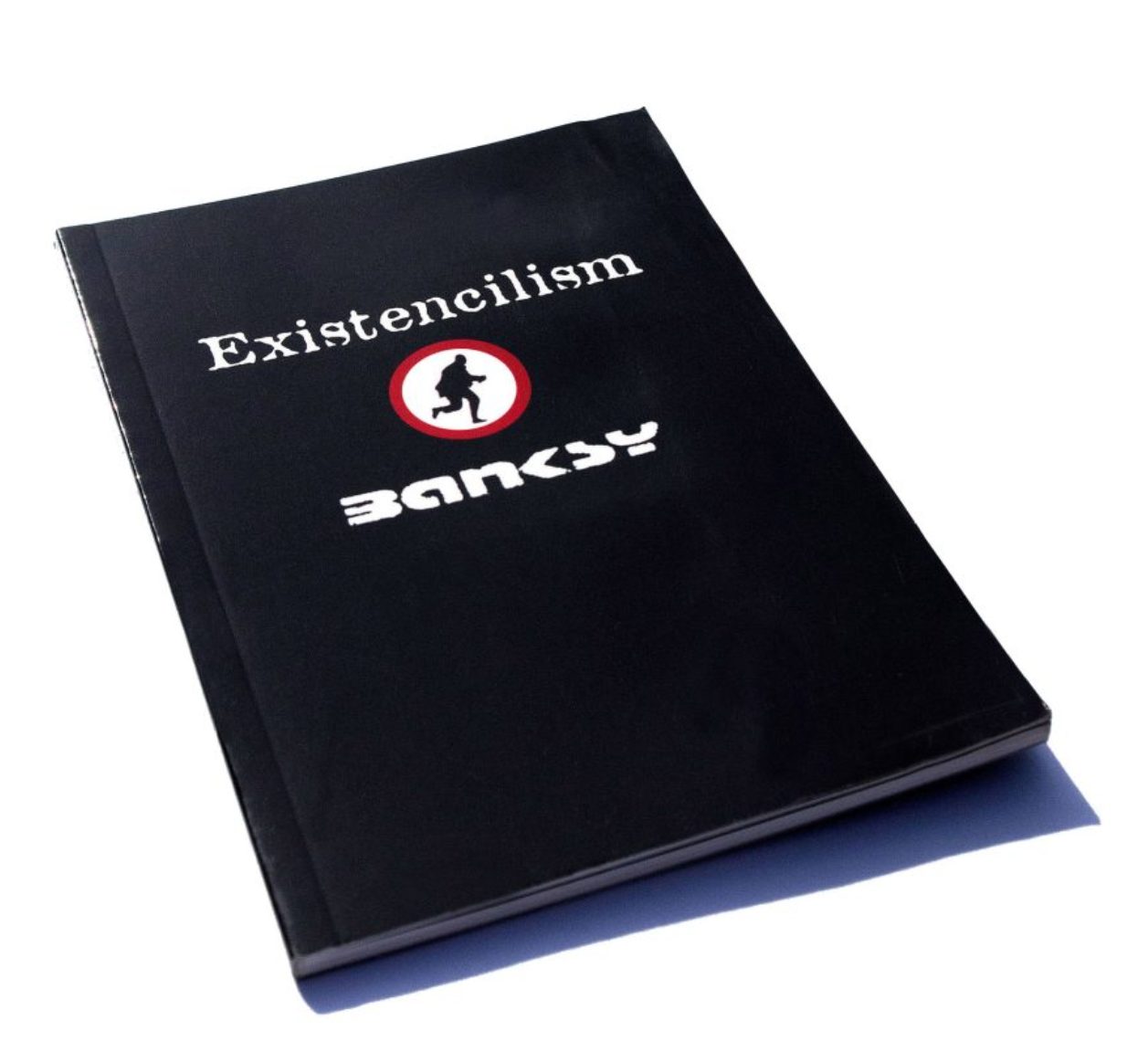
As with Banging Your Head Against a Brick Wall, the exact history of the earliest printings is less securely documented than later market descriptions sometimes suggest. Multiple impressions are known, and differences exist between copies. Claims that the original printing consisted of precisely 1,000 copies circulate widely in the secondary market but should not be treated as firmly established without primary documentation.
What is clearer is the philosophy of distribution. These were not conceived as luxurious livres d’artiste. They were relatively inexpensive, compact publications designed to circulate. Later bookseller records indicate that the black books were distributed through independent shops and other alternative channels, with sets at one stage reportedly offered through record stores. Their physical accessibility was consistent with Banksy’s broader argument that art should not depend upon conventional institutional gateways.
This makes the books conceptually connected to the street works they reproduce. A mural encountered without buying a museum ticket and a small book available inexpensively through an independent shop belong to the same attempt to place imagery directly in front of an audience.
FROM BANGING YOUR HEAD TO EXISTENCILISM
Read beside Banging Your Head Against a Brick Wall, Existencilism demonstrates how quickly Banksy’s practice was developing.
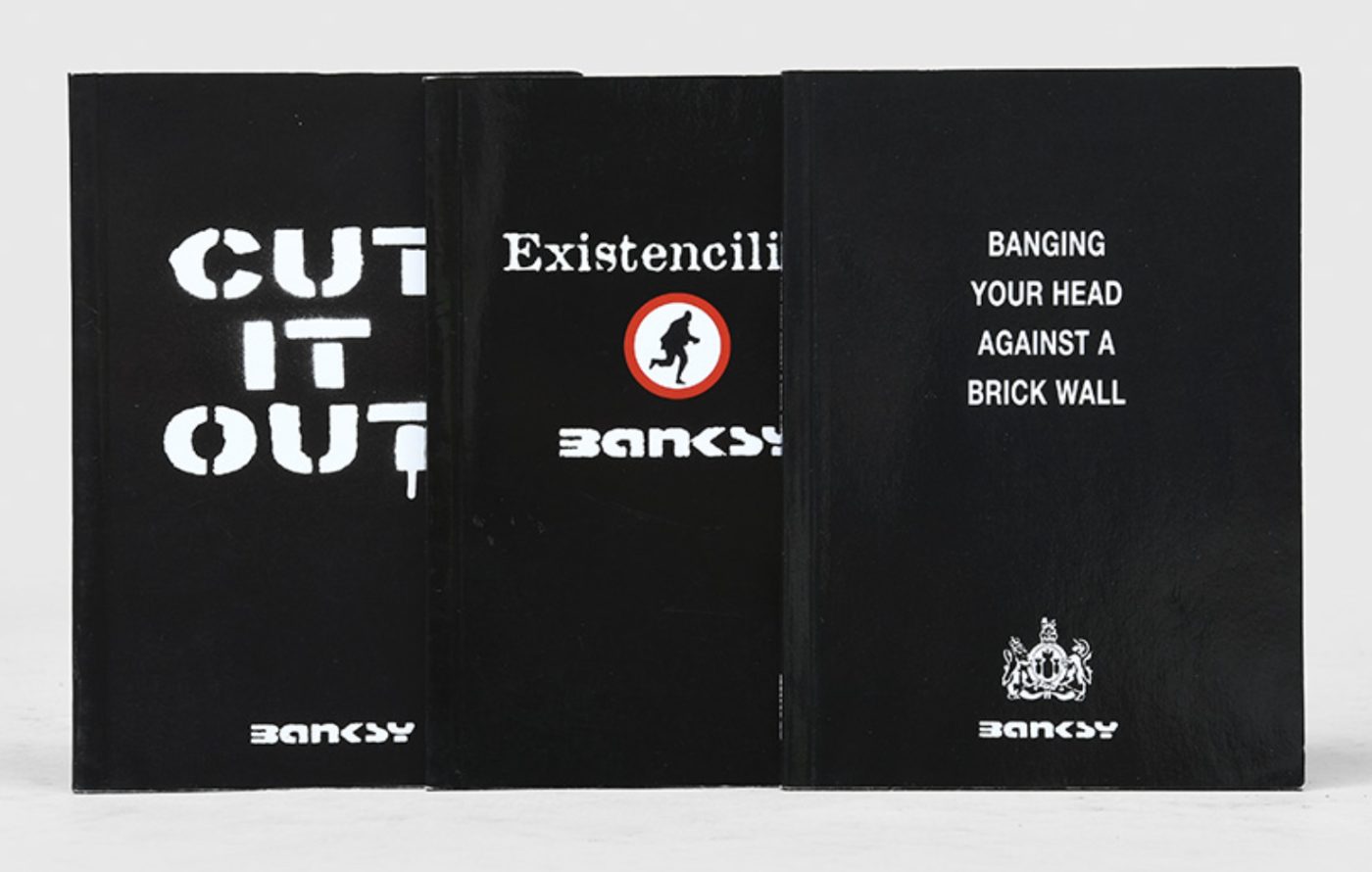
The essential vocabulary remains. Rats, policemen, guards, political slogans, anti-war imagery, manipulation of official signs, jokes about property and authority, and the appropriation of urban infrastructure were already established in 2001. What changes is scale, confidence and narrative complexity.
Banksy is travelling further. The photographs range across Britain, continental Europe and the United States. He is increasingly interested in interventions whose meaning depends upon their location and execution rather than simply upon the stencil itself. He is writing longer narratives. He is developing arguments about the ownership of public space. And he is beginning consciously to document the mythology of his own activities.
The book therefore captures a crucial transitional moment. Banksy has not yet become the international phenomenon of the middle and later 2000s, but the practice is no longer geographically or conceptually confined to the environment from which it emerged.
LEGACY — FROM STENCIL TO WORLDVIEW
The enduring importance of Existencilism lies in precisely what its title proposes. By 2002, the stencil has become more than Banksy’s preferred technique. It has become an instrument for looking at the world.
The rat reveals the politics of exclusion. The policeman exposes the theatricality of authority. The altered municipal sign demonstrates that legitimacy can be manufactured through typography. The zoo intervention turns trespass into performance. The Tate and Westminster images question who determines cultural value. Camp reveals the moral seriousness beneath the jokes. And the stories surrounding these works demonstrate that the act of making them can be as important as the resulting image.
Even the contradictions are becoming productive. Banksy opposes institutional control while carefully constructing his own public identity. He celebrates ephemeral street art while preserving it in books. He attacks commercial visual culture while developing images of extraordinary reproducibility. He remains anonymous while becoming increasingly recognizable.
The book closes with an Evening Standard assessment reproduced on the black rear cover:
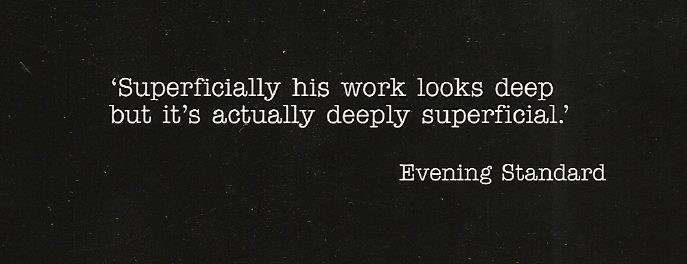
Banksy appropriates the criticism and turns it into part of the work. The insult becomes advertising; criticism becomes authorship; the institution attempting to define Banksy finds itself reproduced inside a publication controlled by Banksy.
If Banging Your Head Against a Brick Wall revealed that the essential Banksy was already remarkably complete by 2001, Existencilism documents the next decisive development. The vocabulary is no longer merely established; Banksy is discovering how far it can travel, how many forms it can assume and how effectively an anonymous graffiti artist can control the narrative surrounding his own work.
The stencil was becoming a philosophy. And Banksy was becoming international.
STAY INFORMED
Receive the latest news, exhibitions, artworks and market updates on Banksy.