FALLING SHOPPER (SHOP TILL YOU DROP)
Falling Shopper
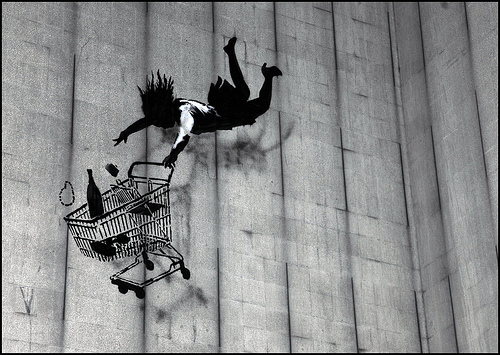
Painted high above Bruton Lane in London's Mayfair district in November 2011, Falling Shopper, also widely known as Shop Till You Drop, depicted a woman and her shopping trolley in free fall. Her body is pitched headfirst towards the ground, her hair and clothing thrown upwards by the descent, while immediately beneath her a heavily laden trolley falls at a similar angle. Despite the apparent imminence of disaster, the woman's arms remain extended towards the trolley, as though retaining possession of her purchases were still an urgent concern. Contemporary photographs reveal recognizable luxury or leisure goods among its contents, including a bottle of wine and what appears to be a necklace.
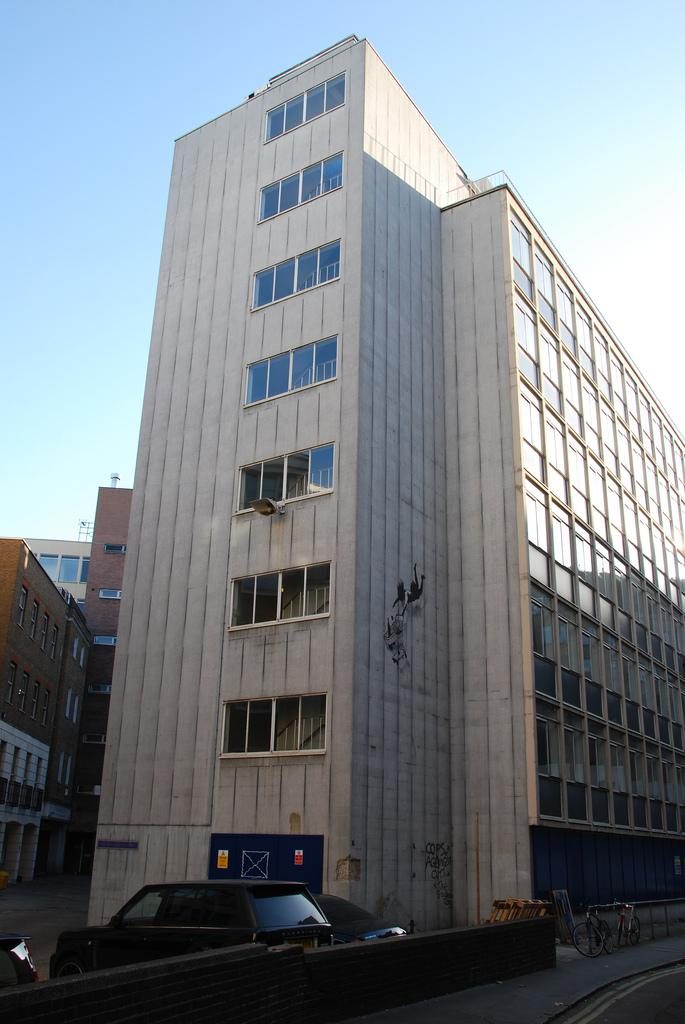
The exceptional effectiveness of the mural depended upon its location. Banksy placed the composition approximately seven metres above street level on the sheer façade of a tall office building, allowing the considerable expanse of masonry beneath the figures to function as pictorial space. Unlike a conventional image of falling, in which movement must be represented entirely within the composition, Falling Shopper borrowed the actual height of the architecture to create its illusion. The restrained shadowing around the woman and trolley further separated them visually from the wall, producing the impression that both had momentarily detached themselves from the building and were descending through space.
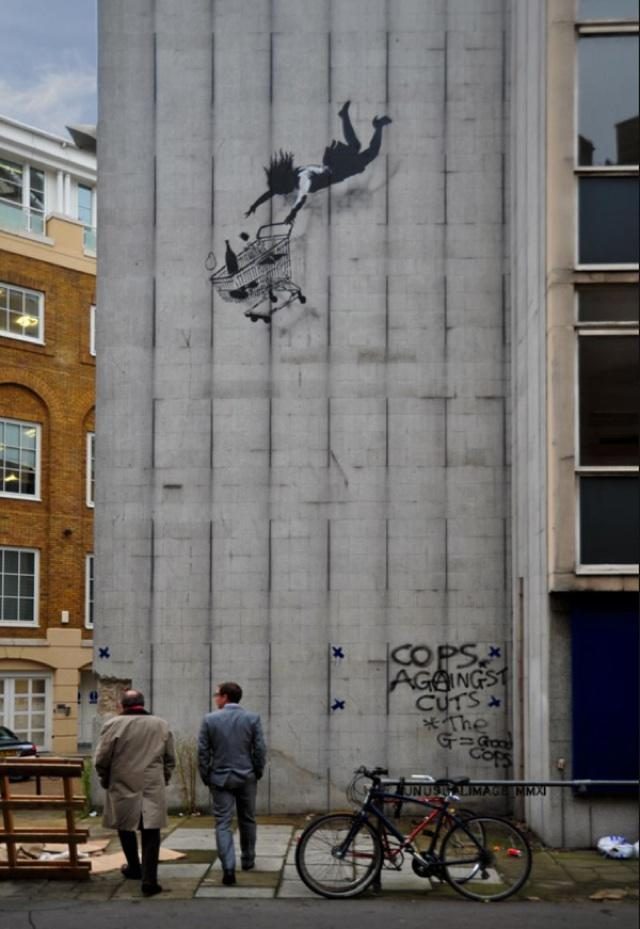
The location in Mayfair adds another important dimension. Bruton Lane lies within one of London's most affluent districts, surrounded by luxury retail, galleries, restaurants and some of the capital's most expensive property. Banksy's falling shopper therefore appeared not on the periphery of consumer culture but within one of its most concentrated environments. The choice of site allowed the physical act of falling to operate metaphorically: consumption has ceased to support the figure and instead accompanies her descent.
Shopping as Free Fall
Consumerism had long been a recurrent subject in Banksy's work. Sale Ends Today, Very Little Helps and the Trolleys compositions similarly examine the rituals and assumptions of contemporary consumption, often by presenting familiar commercial behavior as though it were irrational or quasi-religious. Falling Shopper approaches the subject with particular economy. There are no logos, slogans or explanatory text; the relationship between the woman and the trolley is sufficient to establish the argument.
The gesture of the falling figure is central to the work. Her arms remain directed towards the trolley even though both she and her possessions are apparently heading towards destruction. This produces the mural's characteristic mixture of humor and unease. The shopping cart, an ordinary instrument of consumption, becomes something she seems unable or unwilling to relinquish even when self-preservation should logically take precedence. Banksy's criticism is therefore directed not simply at shopping but at the extent to which possession can become inseparable from identity and desire.
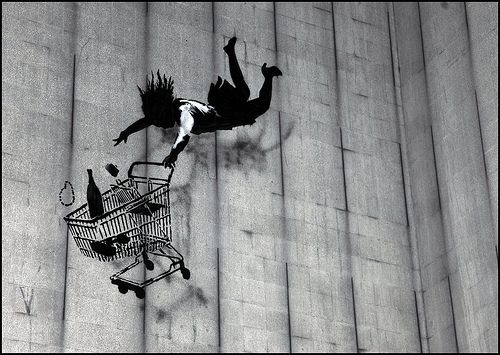
The contents of the trolley reinforce this interpretation. They do not appear to represent basic necessities but rather the accessories of comfortable consumption. This distinction is particularly pertinent in Mayfair, where shopping is frequently associated less with material need than with status, taste and social distinction. Banksy turns that relationship into a physical image: consumer and commodities descend together, with the woman apparently more concerned with recovering the trolley than arresting her own fall.
There is also an effective reversal of the traditional visual language of aspiration. Commercial advertising commonly associates consumption with upward mobility, improvement and fulfillment. Banksy's shopper moves emphatically in the opposite direction. The image converts the promise that material acquisition will elevate the individual into the spectacle of an individual literally falling under the weight of consumption.
A Carefully Staged Street Intervention
The circumstances in which the mural was produced are themselves noteworthy. Contemporary accounts place its appearance in late November 2011 and report that the work was executed in daylight using scaffolding concealed behind tarpaulin, an ingenious method that allowed a substantial intervention to be completed on a conspicuous central London building without revealing the identity of those responsible. The mural's position several storeys above the street would in any event have required equipment of this kind.
This method illustrates an important evolution in Banksy's street practice. The popular conception of graffiti imagines an artist working rapidly and clandestinely at ground level, whereas increasingly ambitious Banksy murals required careful planning, access and temporary control of architectural space. The apparent spontaneity of the finished image concealed a considerably more organized production process.
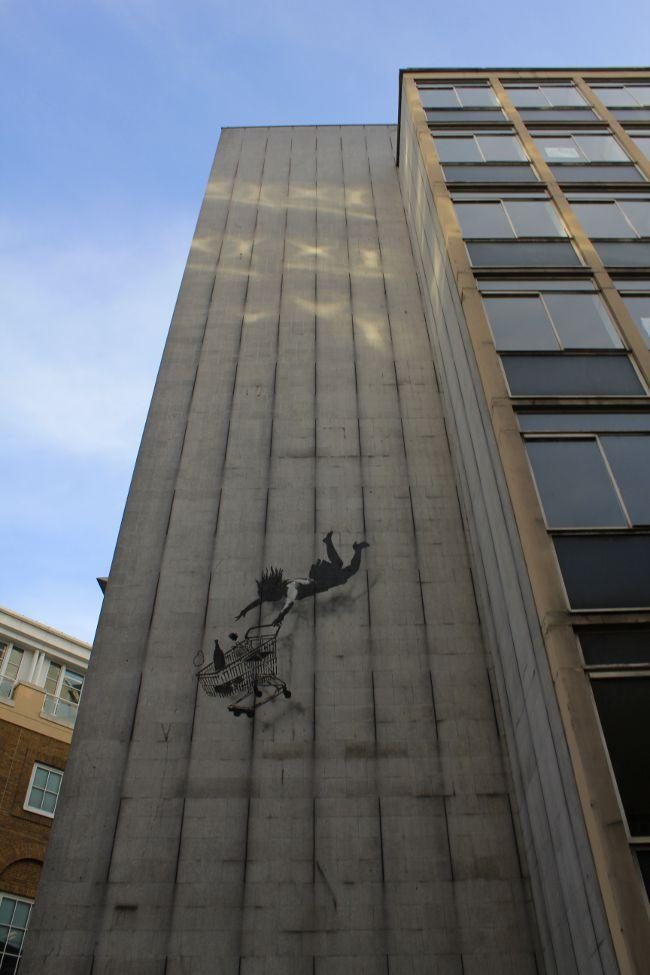
Its height subsequently contributed to the work's longevity. While numerous London Banksys were tagged, painted over or otherwise damaged, Falling Shopper remained comparatively intact for more than a decade because it was difficult to reach. For many years it was consequently regarded as one of the better-preserved examples of Banksy's London street work.
Demolition and Disappearance
That description on the present Banksy Explained page is now outdated. The building carrying Falling Shopper was demolished in 2023, and Art of the State, which has documented Banksy's London street works extensively, now records the mural as lost. Later London guides likewise record the demolition of the Bruton Lane building during 2023.
This disappearance is particularly interesting in relation to the work's earlier survival. The height that protected Falling Shopper from casual vandalism could not protect it from redevelopment. Its fate illustrates the fundamental dependence of street art upon architecture: however culturally or financially valuable an image may become, a mural remains physically attached to a building whose economic life is governed by entirely different considerations.
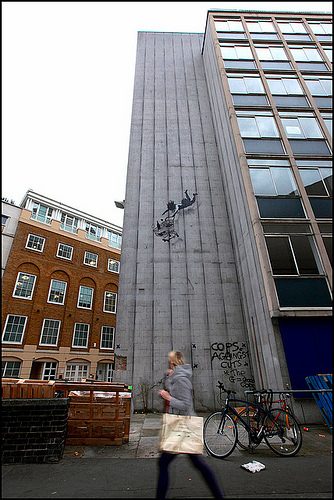
The loss also changes the way the work must now be understood. Photographs that include the full height of the Bruton Lane façade are particularly important because a tightly cropped reproduction preserves the figures but removes much of the original intervention. The large expanse of wall beneath the shopper was effectively part of Banksy's composition, providing the distance through which the viewer imagined her falling.
Takeaways
Falling Shopper is among Banksy's more formally accomplished critiques of consumer culture because the argument is carried almost entirely by composition and location. The woman, trolley and commodities are immediately recognizable, but their placement high above a Mayfair street transforms an ordinary act of shopping into an image of uncontrolled descent. Banksy does not need to identify a particular corporation or accompany the work with a slogan; the absurd determination of the figure to retain her purchases provides the necessary commentary.
The mural can also be situated within a broader group of Banksy works in which familiar objects associated with contemporary consumption are made strange through displacement. Shopping trolleys become primitive hunting targets in Trolleys; children pledge allegiance to a Tesco carrier bag in Very Little Helps; sale signs become objects of quasi-religious devotion in Sale Ends Today. In each case, Banksy isolates an everyday ritual of consumer society and presents it from a sufficient distance for its underlying absurdity to become visible.
What distinguished Falling Shopper was the unusually complete integration of that critique with the architecture on which it appeared. The vertical wall provided both the pictorial space and the metaphor. Consumer culture promises acquisition as a form of advancement; Banksy's shopper, surrounded by one of London's wealthiest retail districts, travels decisively in the opposite direction.
STAY INFORMED
Receive the latest news, exhibitions, artworks and market updates on Banksy.