FOLLOW YOUR DREAMS – CANCELLED
Follow Your Dreams
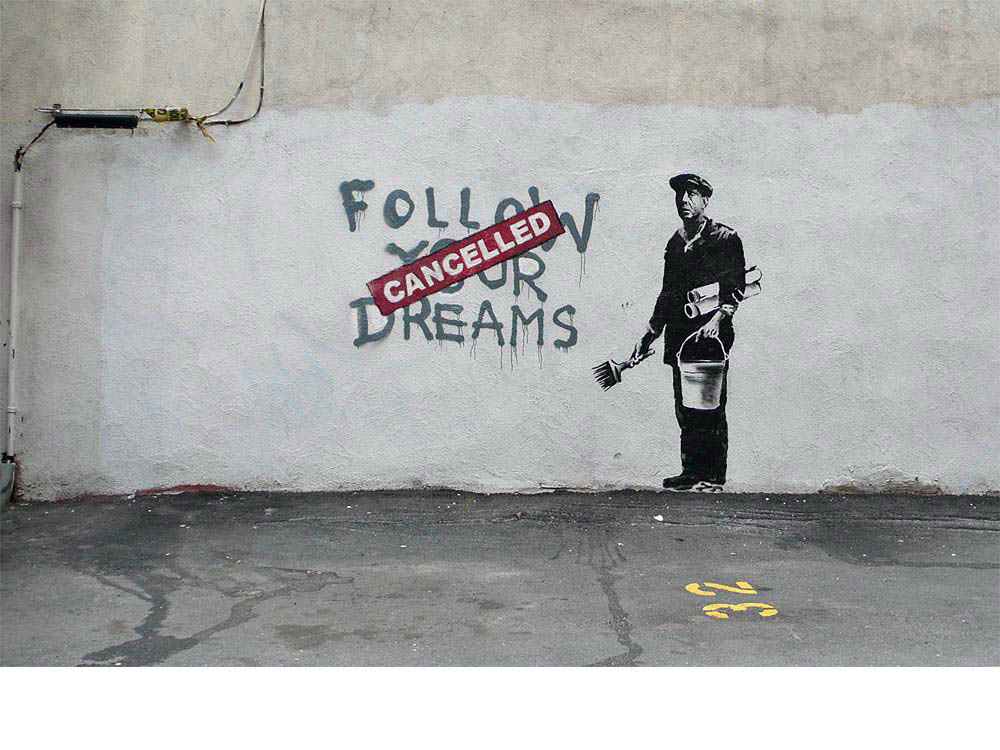
In May 2010, Banksy appeared in Boston with one of the simplest and most immediately legible works of his American campaign. On a wall on Essex Street in Chinatown, a weary-looking painter stands beside the enormous handwritten instruction FOLLOW YOUR DREAMS. Across those reassuring words Banksy places a bright red bureaucratic stamp: CANCELLED.
The figure carries a bucket and brush and appears almost resigned to the verdict beside him. His clothes, equipment and stooped posture identify him not as the beneficiary of some glamorous American success story, but as someone engaged in ordinary physical work. The large grey slogan appears loose and handmade; the red CANCELLED box, by contrast, is rigid, official and impersonal.
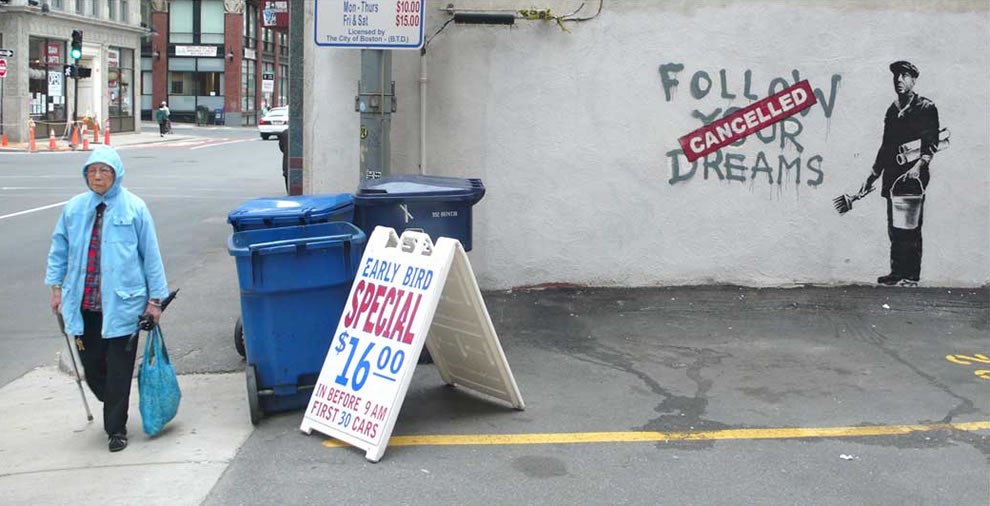
That distinction is fundamental to the composition. The dream is written by hand. Its cancellation comes as a stamp.
The American Dream
Placed in an American city, the phrase inevitably evokes the mythology of the American Dream: the belief that ambition, determination and hard work allow individuals to improve their circumstances. Banksy reverses that optimistic proposition with a single word.
The humor is characteristically economical. He does not replace FOLLOW YOUR DREAMS with a competing political slogan. The aspiration remains completely visible. It has simply been overruled.
This makes the work more nuanced than a statement that dreams are impossible. The red stamp introduces an unseen authority into the composition. Someone—or something—has decided that this particular dream cannot proceed. The viewer is left to decide who issued the cancellation: government, economics, social class, capitalism, circumstance, or simply reality itself.
The timing is relevant. The work appeared in 2010, in the aftermath of the 2008 financial crisis and Great Recession, when unemployment remained elevated and the promises associated with economic mobility had been badly shaken in the United States. That context makes Banksy's intervention particularly resonant, although it would be too restrictive to claim that the mural refers exclusively to the financial crisis.
The image survives because its argument is broader. Societies encourage people to aspire while simultaneously constructing obstacles that determine whose aspirations are realistically achievable.
A Battle Between Grey and Red
Formally, Follow Your Dreams – Cancelled is an excellent example of Banksy's ability to make color carry the argument.
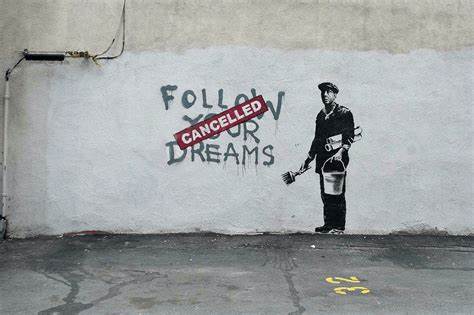
Almost everything is grey or black: the painter, his tools and the motivational slogan itself. The only emphatic color is the red CANCELLED stamp, which slices diagonally across the words. The red therefore does more than attract attention. It represents interruption.
Banksy has frequently used red this way. In Girl with Balloon, the red balloon concentrates hope and desire within an otherwise monochrome composition. In Love Is in the Air, flowers provide the eruption of color against the black-and-white protester. Here red performs almost the opposite function. Instead of offering possibility, it closes it down.
The composition is also unusually dependent upon typography. Remove the figure and the piece could almost function as a conceptual text work; remove the words and the exhausted painter becomes ambiguous. Banksy brings the two together so that the figure appears to have encountered the sentence almost as a physical obstacle.
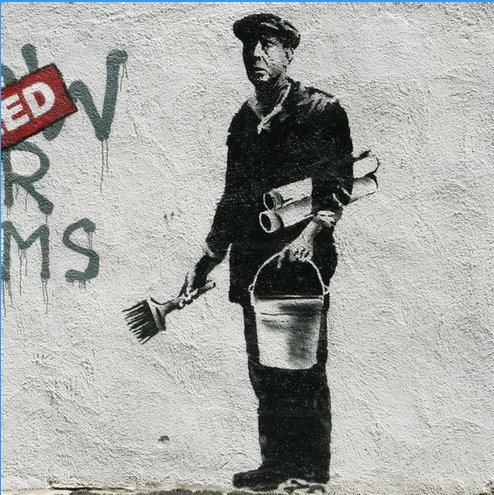
The figure is sometimes described as a painter, decorator or chimney sweep, and the latter nickname appears in contemporary photographic documentation. Photographs taken on Essex Street in May 2010 preserve the work in relatively fresh condition.
He is precisely the kind of person who normally disappears into the background of the city. Banksy makes him the protagonist.
Banksy Comes to Boston
The mural formed part of Banksy's extraordinary sequence of American interventions during the spring of 2010, coinciding with the American release and promotion of Exit Through the Gift Shop. Works had already appeared in Park City and Salt Lake City around Sundance, followed by interventions in San Francisco and Los Angeles.
By 13 May 2010, local observers were reporting new Banksy works in Boston and neighboring Cambridge. Contemporary documentation places Follow Your Dreams – Cancelled on Essex Street in Chinatown.
Interestingly, another Banksy appeared on an Essex Street across the Charles River in Cambridge: the deliberately misspelled NO LOITRIN rat. Later photographers noticed the coincidence, although there is no firm evidence that the repetition of the street name carried a deliberate meaning.
Follow Your Dreams – Cancelled is quintessential Banksy because almost nothing in it is superfluous. A laborer. A bucket. A brush. Four optimistic words. One pessimistic stamp.
Banksy takes one of the most familiar pieces of motivational advice in modern culture and subjects it to the language of administration. The opposition is not really between optimism and pessimism; it is between individual aspiration and external authority. You may follow your dreams—but someone else apparently retains the power to cancel them.
And yet there is a small contradiction hidden inside the image that makes it less hopeless than it first appears. The words FOLLOW YOUR DREAMS remain visible. The red stamp crosses them but does not erase them. The dream has been cancelled. Nobody said you had to accept the cancellation.
STAY INFORMED
Receive the latest news, exhibitions, artworks and market updates on Banksy.