GHETTO BOY
CHILDHOOD ON THE STREET
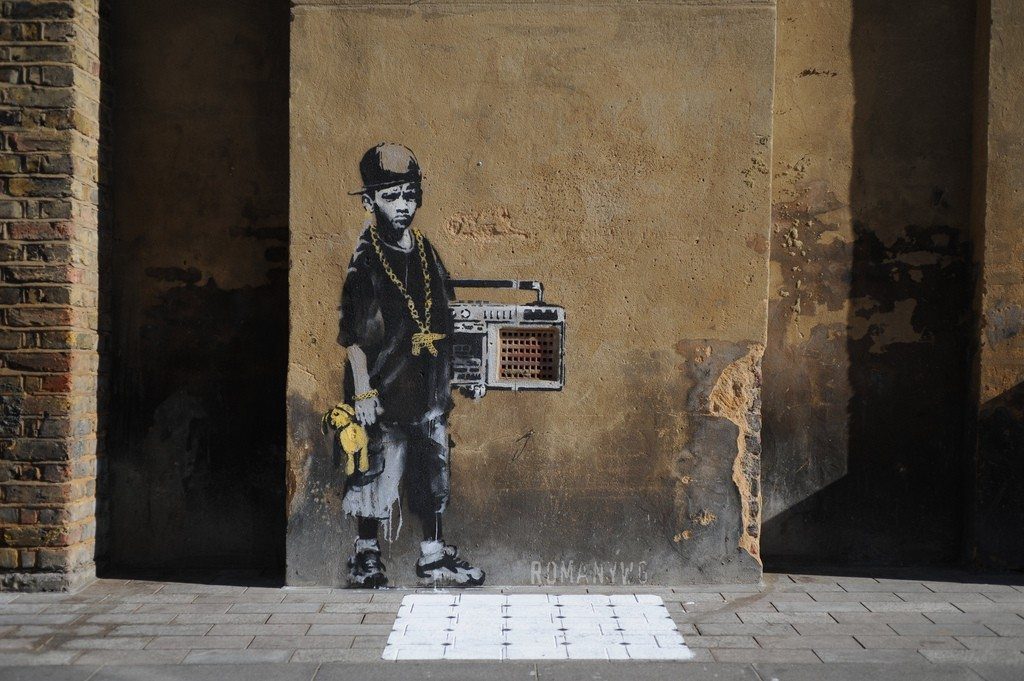
Appearing in Gillett Square, Dalston, in February 2009, Ghetto Boy depicts a young boy dressed in the exaggerated visual language of hip-hop culture. Wearing an oversized T-shirt, baggy shorts, trainers and a baseball cap, he carries a large ghetto blaster beneath one arm while holding a teddy bear in the other. Banksy introduced selective touches of gold to the otherwise monochrome stencil, highlighting the boy's jewellery and the conspicuous chain around his neck, from which hangs a gun-shaped pendant. Contemporary photographs documented the work shortly after its appearance, while Art of the State recorded it in situ in 2009.
The contradictions within the figure are carefully constructed. The teddy bear belongs unmistakably to childhood, while the oversized jewellery, firearm pendant and stylized clothing belong to an adult image of toughness and status. Banksy does not simply portray a child participating in street culture; he compresses competing ideas of innocence, aspiration, consumerism and violence into a single character. The gold details are particularly effective, drawing the eye toward the objects through which identity and status are being performed, while the child's expression remains notably serious and detached.
THE WALL BECOMES PART OF THE IMAGE
As with many of Banksy's strongest street works, the architecture is not merely a surface on which the stencil happens to have been painted. An existing rectangular ventilation grille in the wall was incorporated into the boy's ghetto blaster, functioning visually as one of its speakers. Banksy constructed the radio around an object that was already present, allowing the physical fabric of Gillett Square to complete the image.
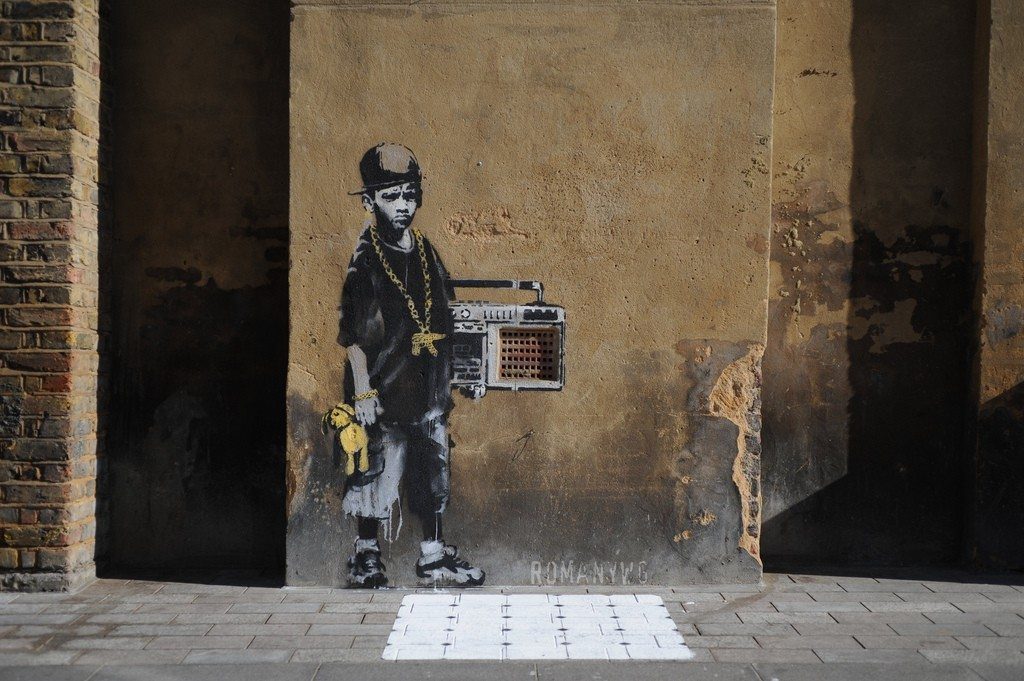
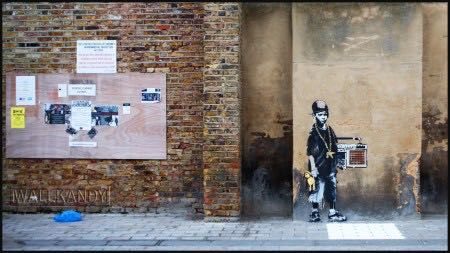
The intervention continued onto the pavement. Directly in front of the figure, Banksy painted a large white grid resembling a dance mat, extending the composition from the vertical wall into the pedestrian space of the square. The wider contemporary photographs are therefore particularly important: when the boy is isolated in a cropped image, much of the work's site-specific character disappears. Seen in its original setting, the wall, ventilation grille and pavement operate together as a single composition, transforming an unremarkable architectural corner into a small urban stage.
GHETTO BOY
The work appeared at a moment when debates surrounding youth violence, gang culture and the representation of young people were particularly visible in British public life. Banksy's image, however, is more ambiguous than a straightforward commentary on juvenile crime. The child seems less threatening than costumed in the signs through which toughness has been culturally represented and commercially packaged. His enormous chain and gun pendant border on caricature, while the teddy bear quietly undermines the adult persona he has adopted.
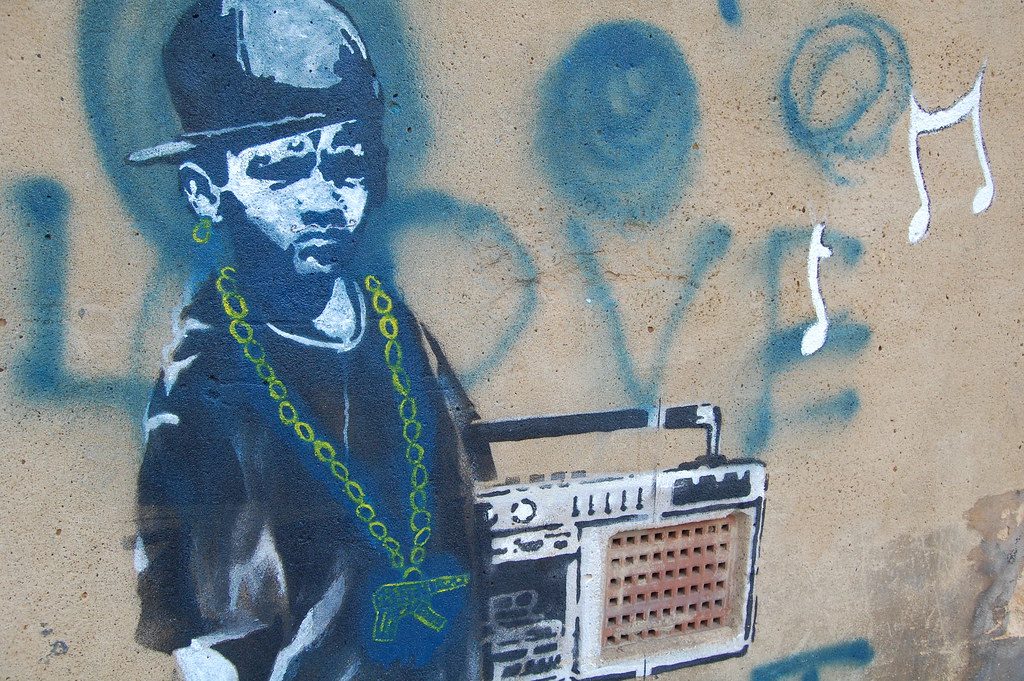
The ghetto blaster introduces another layer to the image. Once a powerful emblem of hip-hop's emergence from public space, the portable radio evokes music, dancing and the occupation of the street as a cultural arena. By combining it with the painted dance mat, Banksy creates an image that is playful as well as critical. The boy belongs simultaneously to the worlds of childhood play and constructed street identity, and the tension between them prevents the work from settling into a simple moral judgment.
A LOST LONDON BANKSY
The mural became known variously as Ghetto Boy, Kid with Ghetto Blaster and Boy with Dance Mat. Contemporary reporting from early 2009 documented its appearance in Gillett Square, while Art of the State subsequently recorded the work as completely gone.
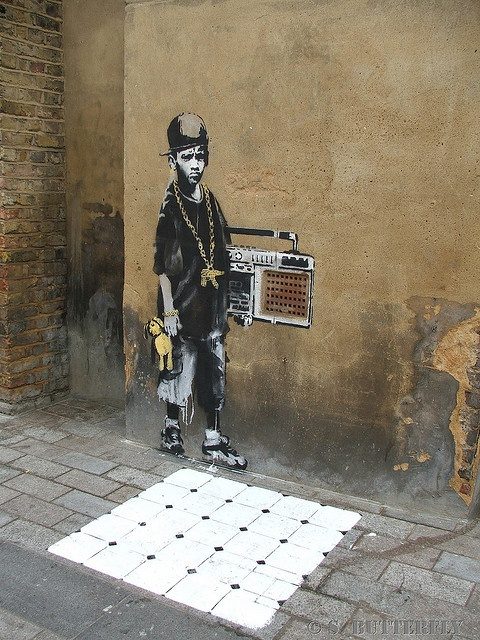
Its disappearance makes the surviving contextual photographs especially valuable. Ghetto Boy was not simply an image capable of being detached from its surroundings: its boombox depended upon an actual ventilation grille and its dance floor occupied the pavement immediately in front of it. Like many of Banksy's most successful street interventions, the work temporarily reorganized existing architecture through a minimal addition, turning the ordinary features of the city into indispensable elements of the artwork itself.
STAY INFORMED
Receive the latest news, exhibitions, artworks and market updates on Banksy.