GHETTO FOR LIFE
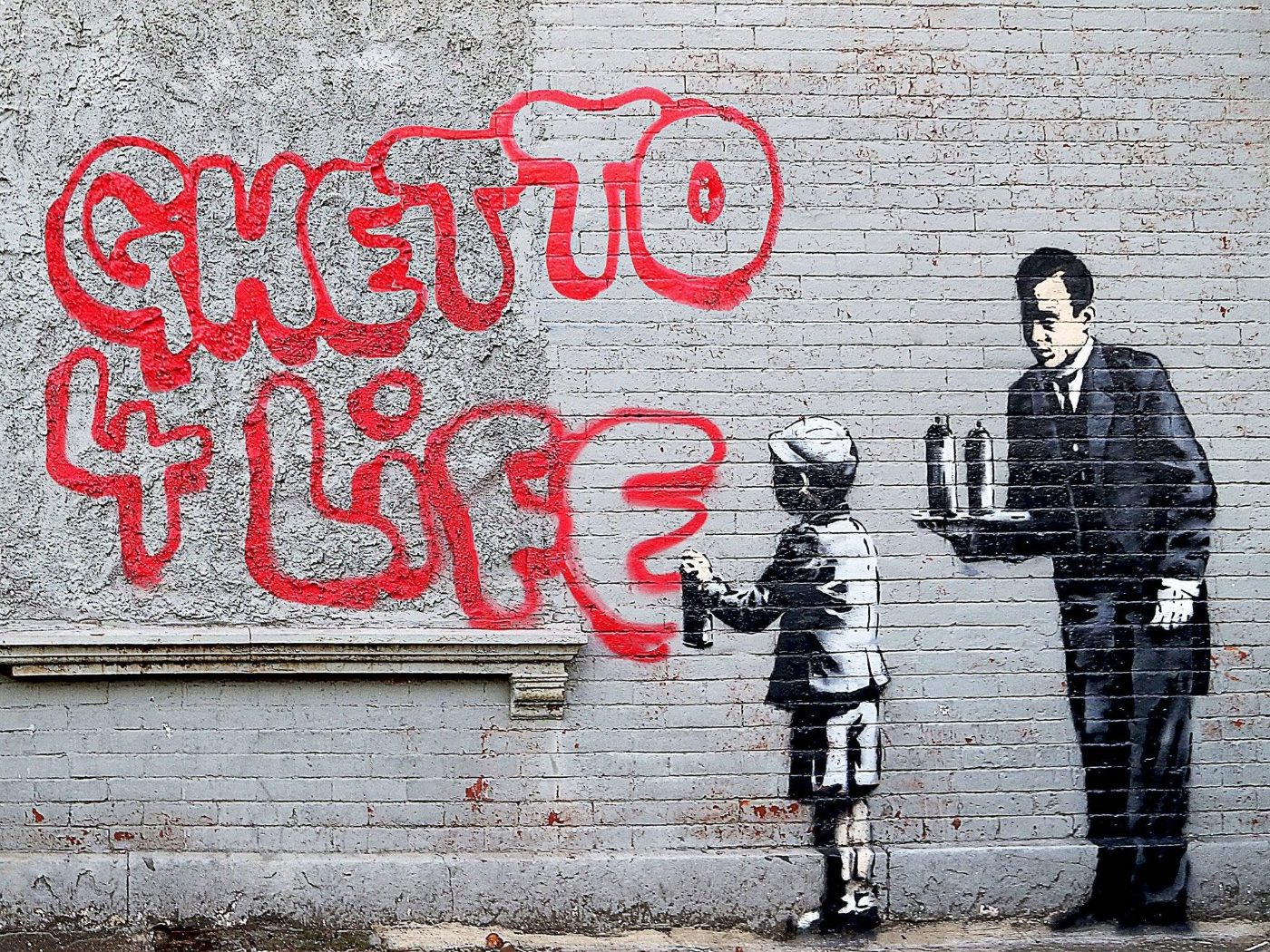
Ghetto 4 Life
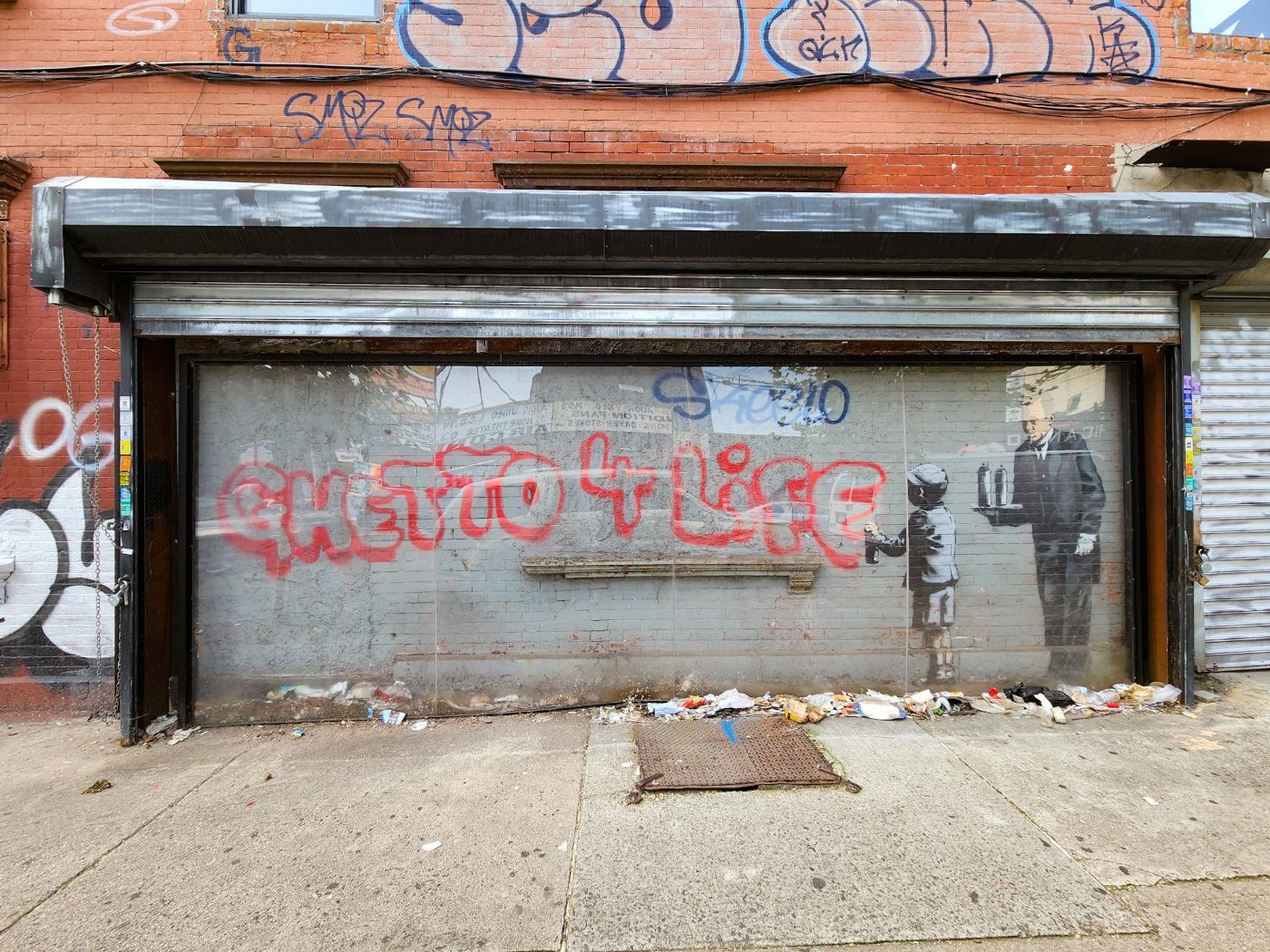
On 24 October 2013, during his month-long New York residency Better Out Than In, Banksy travelled to the South Bronx and created one of the project's most provocative interventions. The mural depicted a young boy, dressed casually in a T-shirt, jeans and baseball cap, standing beside an elegantly dressed butler. The servant bends forward holding a silver platter upon which the child is spray-painting the words: GHETTO 4 LIFE
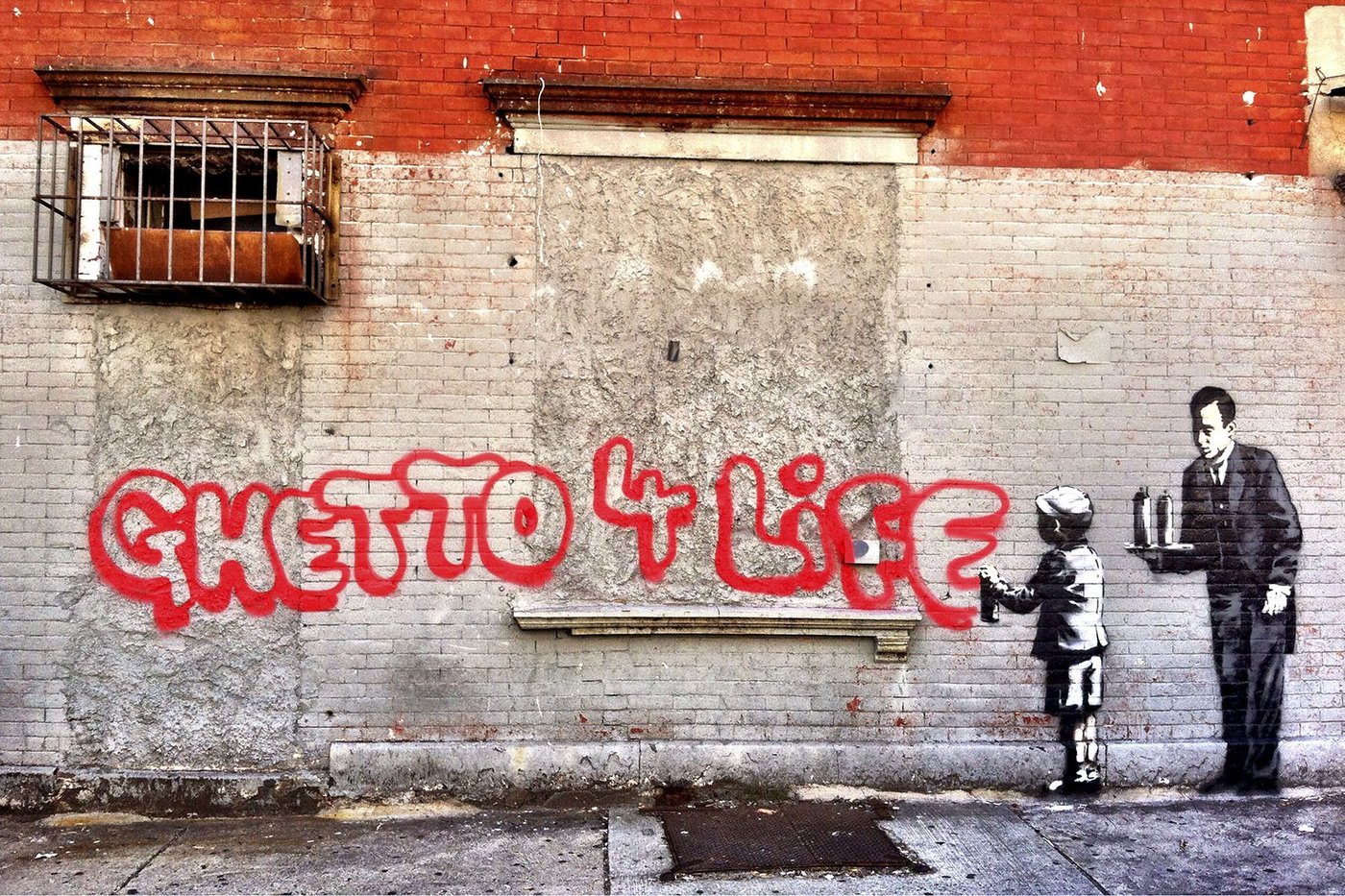
The inversion is immediate. The visual language of wealth and domestic service—a uniformed butler presenting a tray to his privileged young master—is transplanted into the South Bronx. Instead of being served food or champagne, the boy is being served a surface upon which to write graffiti.
Banksy announced the work on his website simply as “Bronx”, accompanied by his customary audio guide. The location was not incidental. The Bronx occupies a foundational place in the history of graffiti and hip-hop, but it has also been repeatedly transformed into a cultural shorthand for urban poverty, crime and the American “ghetto.” Banksy's mural deliberately stepped into that history.
Who Gets to Romanticize the Ghetto?
The humour depends upon a contradiction. The boy is presented almost as an aristocrat, attended by a servant who facilitates his act of graffiti. Poverty and marginality have been converted into privilege; the word ghetto itself becomes something that can be performed, displayed and perhaps consumed.
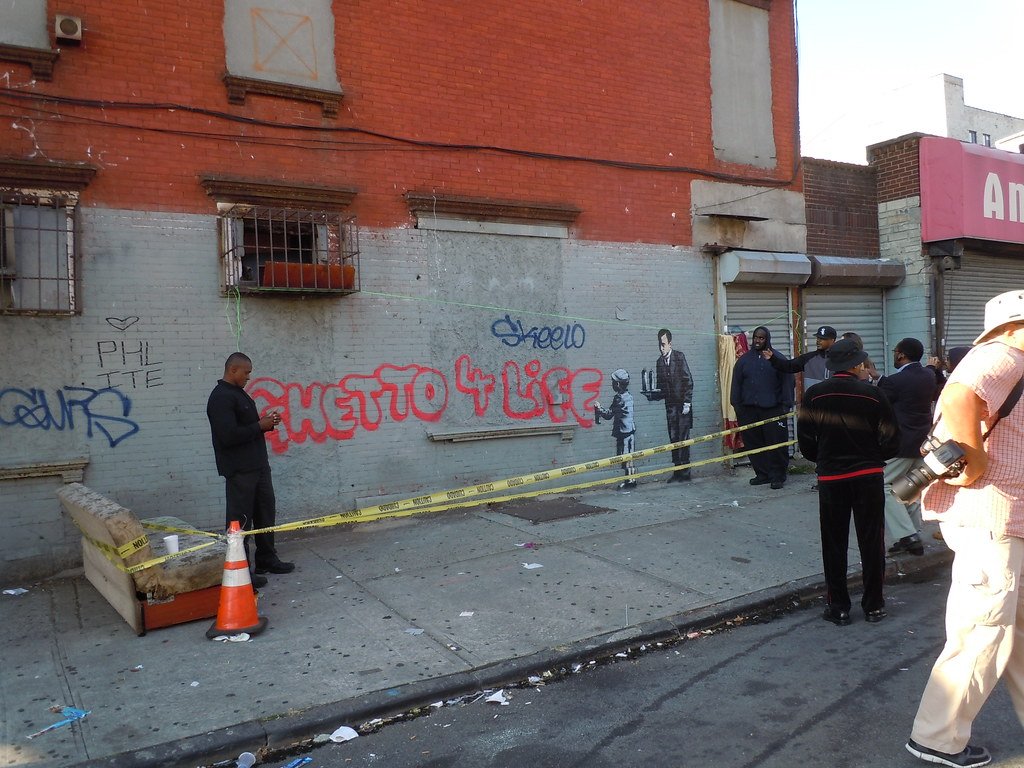
The mural can therefore be read as a satire of the romanticization and commercialization of “ghetto” identity. Cultural forms born from economically marginalized communities—graffiti among them—had long since travelled into advertising, fashion, galleries and the international art market. By 2013, Banksy himself was perhaps the most famous example of that transformation: an anonymous British street artist whose works were already commanding enormous prices.
That makes Ghetto 4 Life unusually self-reflexive. Banksy arrives in the Bronx, one of the historical homes of graffiti culture, and produces a Banksy about graffiti. Within hours, photographs of it circulate internationally precisely because of the identity and market value of the artist who painted it.
The work consequently raises an uncomfortable question: who has the privilege of turning the ghetto into an aesthetic?
The Bronx Responds
That question quickly escaped Banksy's control.
The mural provoked criticism from some local residents and commentators who regarded the image as patronizing or insulting to the South Bronx. The very word Banksy had chosen—ghetto—carried a different weight when painted by a wealthy and internationally celebrated British artist onto a wall in a predominantly Black and Latino neighborhood.
The response is important because it complicates any straightforward interpretation of the mural as social criticism. Banksy may have intended to satirize stereotypes of the Bronx rather than endorse them, but public art does not operate only according to the intentions of its author. Once placed in the neighborhood, the work entered an existing history of representation, inequality and cultural appropriation.
Banksy's Better Out Than In residency repeatedly depended upon this loss of control. Works were altered, tagged, protected, removed, sold and argued over almost as soon as they appeared. In the Bronx, the debate over Ghetto 4 Life effectively became part of the work.
Banksy and the Birthplace of Graffiti
The location also placed Banksy in dialogue with the history from which much of contemporary street art emerged. New York graffiti developed during the late 1960s and 1970s through writers who transformed subway cars, walls and infrastructure into an alternative system of visibility. The Bronx played a central role in the broader culture of hip-hop within which graffiti became internationally influential.
Banksy's own practice came from a different lineage—Bristol's graffiti and underground culture, combined with the rapid reproducibility of stencil—but his international success was inseparable from the history established by earlier graffiti writers.
Ghetto 4 Life therefore contains an uneasy reversal. A British artist whose work had entered museums, auction houses and wealthy collections returns to one of graffiti culture's foundational territories and depicts a child being assisted in making graffiti as though he were a privileged heir.
Whether Banksy intended admiration, parody, self-criticism or all three, the contradiction is difficult to escape.
Better Out Than In
The mural appeared on Day 24 of Better Out Than In, Banksy's extraordinary October 2013 residency across New York. During the month, the artist treated the city as an enormous temporary exhibition, producing new works almost daily across Manhattan, Brooklyn, Queens, Staten Island and the Bronx.
The residency repeatedly questioned the relationship between street art and value. A stall in Central Park secretly sold authentic Banksy canvases for $60 each; a slaughterhouse delivery truck filled with squealing stuffed animals travelled through Manhattan; paintings purchased from thrift stores were altered and returned to the charity system; murals were immediately covered, guarded or removed once their authorship became known.
Ghetto 4 Life belongs directly within that investigation. Graffiti associated with marginalized communities had historically been treated as vandalism. A Banksy appearing on the same kind of wall could instantly become a valuable cultural object.
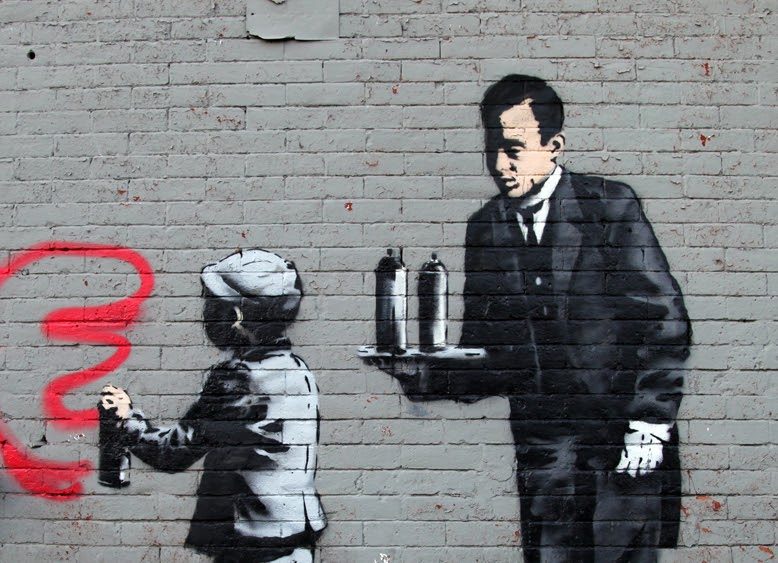
The butler holding the tray may therefore be serving more than the child. He is serving graffiti itself back to the culture that created it—now transformed by fame, privilege and the art market.
An Uncomfortable Work
Ghetto 4 Life remains deliberately difficult to resolve. Read one way, it mocks outsiders who consume romantic ideas of poverty and street credibility. Read another, it risks participating in precisely the stereotyping it seeks to criticize. The controversy that followed its appearance demonstrates how narrow the distance can be between exposing a stereotype and reproducing it.
That ambiguity makes the mural more interesting rather than less. Banksy's strongest public works frequently depend upon the context into which they are inserted, and sometimes that context pushes back. In the South Bronx, the wall did exactly that.
Banksy came to the birthplace of a culture that had helped make his career possible. The question Ghetto 4 Life left behind was whether he had come to celebrate it, criticize its commercialization—or become part of the problem himself.
STAY INFORMED
Receive the latest news, exhibitions, artworks and market updates on Banksy.