GIRL WITH BALLOON
From a London Wall to a Universal Image
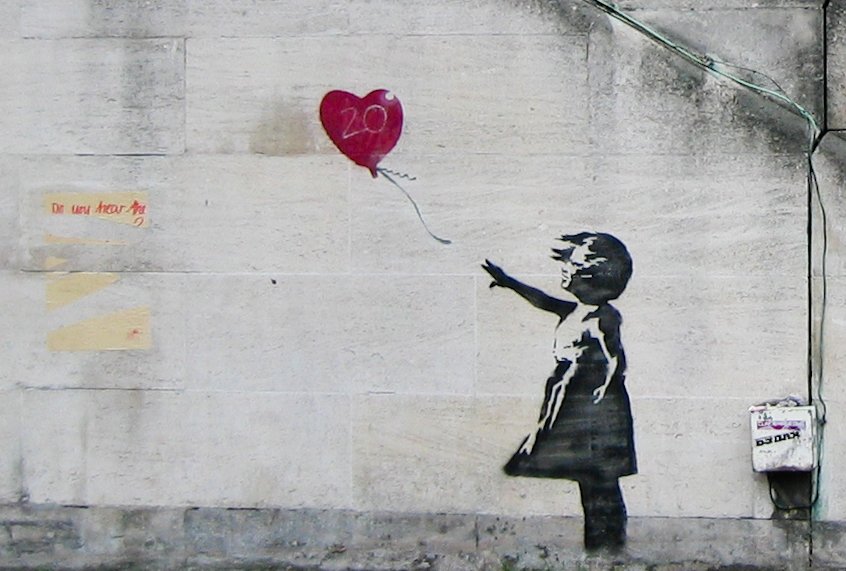
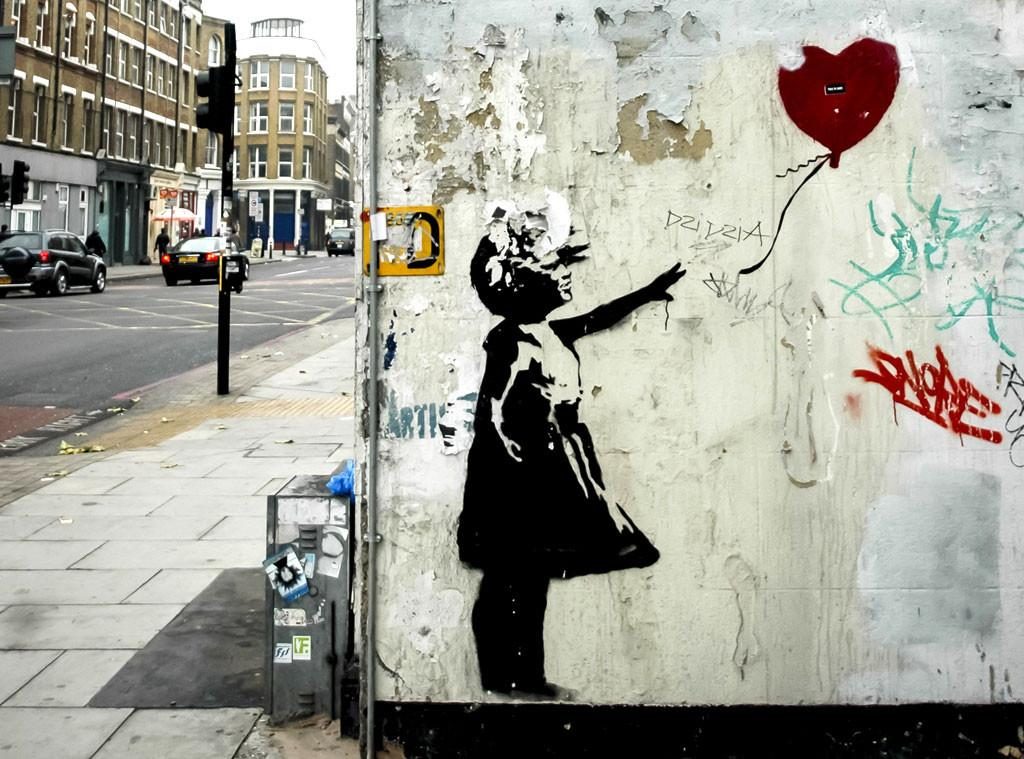
A little girl stands almost completely alone against a bare wall. Her dress and hair appear to be caught by the wind as she stretches one arm toward a red, heart-shaped balloon floating beyond her reach. Banksy reduces the composition to almost nothing: a black stencil, a single area of brilliant red and the empty wall separating them. Yet from those few elements came what would become arguably his most recognizable image.
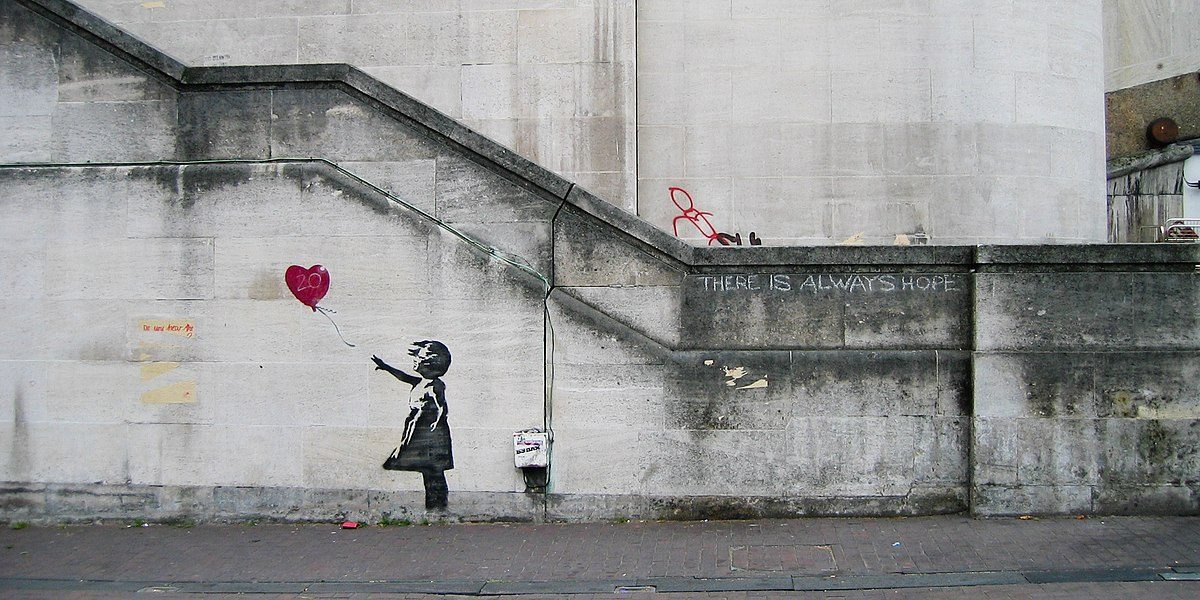
The ambiguity is fundamental. Has the girl accidentally lost the balloon, or has she deliberately released it? Is she reaching desperately for something disappearing, or watching something she loves travel freely into the world? Banksy never resolves the movement. Loss and hope therefore occupy the same image. The phrase “There is always hope,” associated with the South Bank version, pushes the interpretation toward optimism without eliminating its melancholy.
The Importance of Empty Space
What makes the original mural particularly powerful is the amount of wall Banksy leaves untouched. Girl and balloon are physically separated by empty space, and that distance is really the subject of the composition. The girl's body leans forward; her arm and fingers extend the movement; the balloon continues upward and away. Our eye instinctively attempts to close the gap even though the image never does.
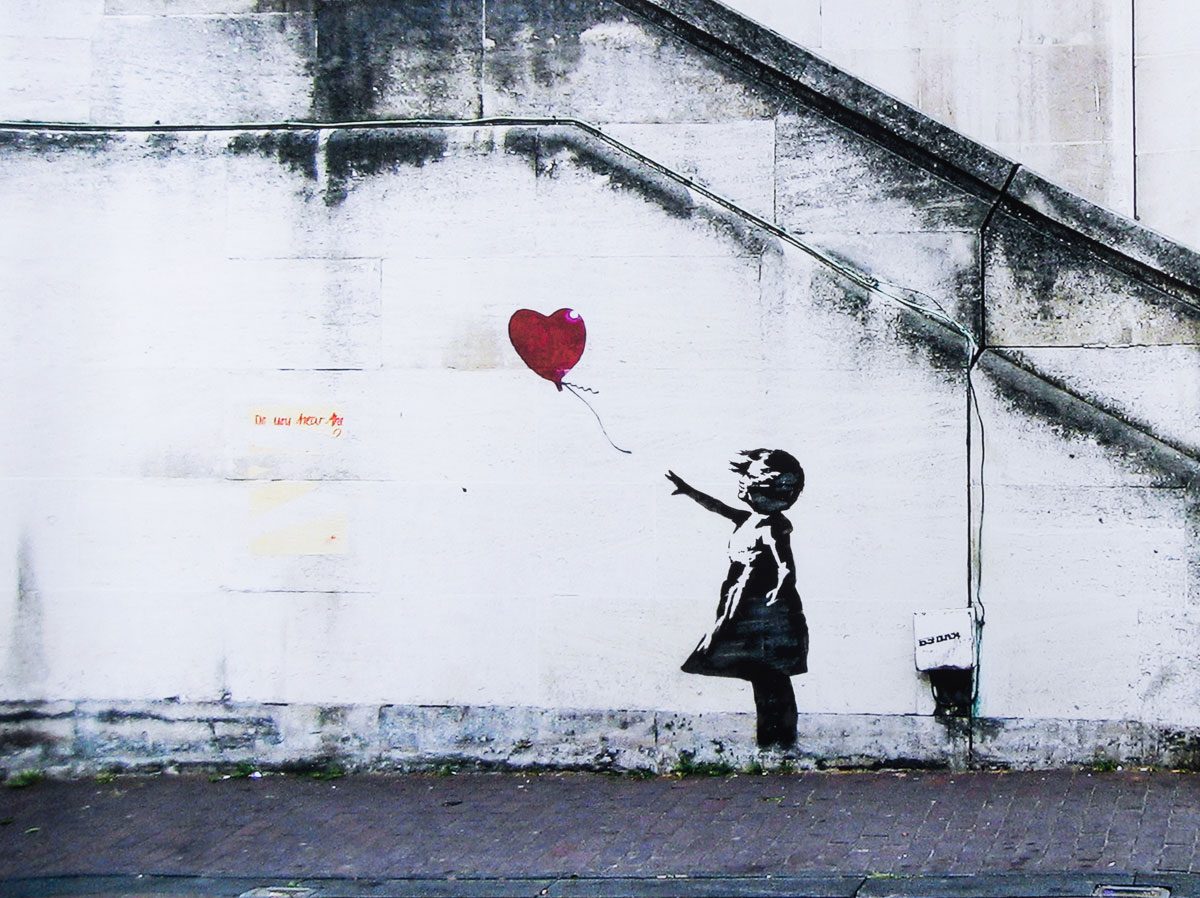
The red is equally important. Banksy had already demonstrated how effectively a single color could activate an otherwise monochromatic stencil, but here red carries almost the entire emotional weight of the image. The balloon is at once a child's toy, a heart, an object of desire and something inherently fragile. The image requires no particular political knowledge, language or cultural sophistication to understand it. That extraordinary accessibility helps explain why Girl with Balloon travelled further than almost any other Banksy motif.
Shoreditch and South Bank
The photographs are also important because they document different early versions. The South Bank example was integrated into the pale stone architecture near Waterloo Bridge; another famous version occupied the rough, deteriorating wall at King John Court in Shoreditch. In the latter, peeling plaster, electrical fittings, graffiti and the ordinary disorder of the street surrounded the immaculate little visual fable.
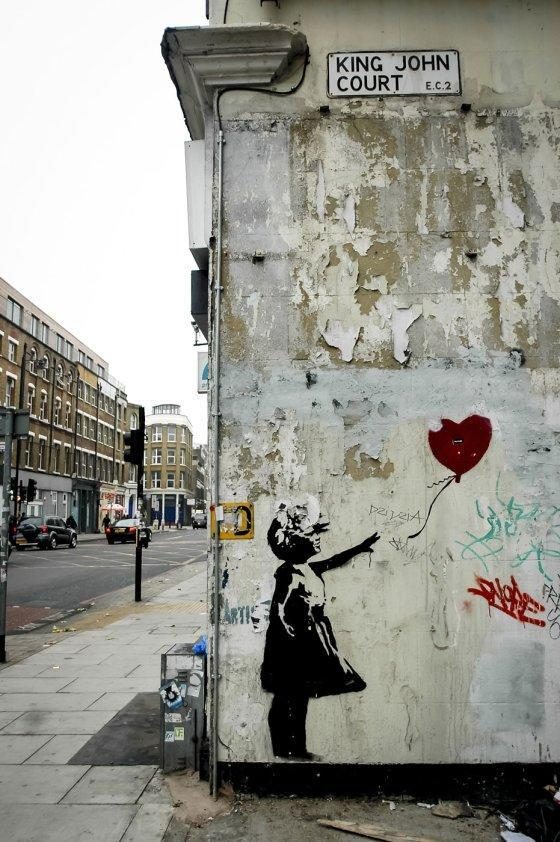
Both environments mattered. A reproduction of Girl with Balloon against a white gallery wall inevitably turns it into an image. On the street, however, the empty architectural space surrounding the girl becomes part of the composition. She does not simply lose her balloon; she loses it into the city.
Neither of the original London murals survives. The South Bank work was eventually painted over, while the Shoreditch example also disappeared from its original setting. The image nevertheless escaped the fate of the walls themselves through photographs, prints and Banksy's subsequent reinterpretations.
An Image Banksy Never Really Left Behind
Its subsequent history is exceptional. Banksy returned to the basic language of the balloon repeatedly: in Palestine, in humanitarian and political interventions, and ultimately in the extraordinary 2018 Sotheby's event when a framed Girl with Balloon partially shredded itself immediately after being auctioned and became Love Is in the Bin. The transformation from illegal stencil to coveted market object—and then to an artwork attacking its own status as an object—makes Girl with Balloon almost a compressed history of Banksy's career.
Its cultural reach is equally remarkable. In 2017, a British public poll selected Girl with Balloon as the nation's favorite artwork, ahead of works deeply embedded in the history of British art.
There are more political Banksys, more complex Banksys and certainly more elaborate Banksys. Few are as perfectly resolved. The genius of Girl with Balloon lies in what Banksy removes. There is no setting, narrative explanation or punchline. A child wants something that is moving away from her. Almost everyone understands that feeling.
Perhaps that is why an image painted illegally on a London wall survived long after the wall itself had forgotten it. The balloon escaped first. Eventually, the image did too.
STAY INFORMED
Receive the latest news, exhibitions, artworks and market updates on Banksy.