MIGRANT CHILD (GIRL WITH RELIEF TORCH)
The Venice Intervention
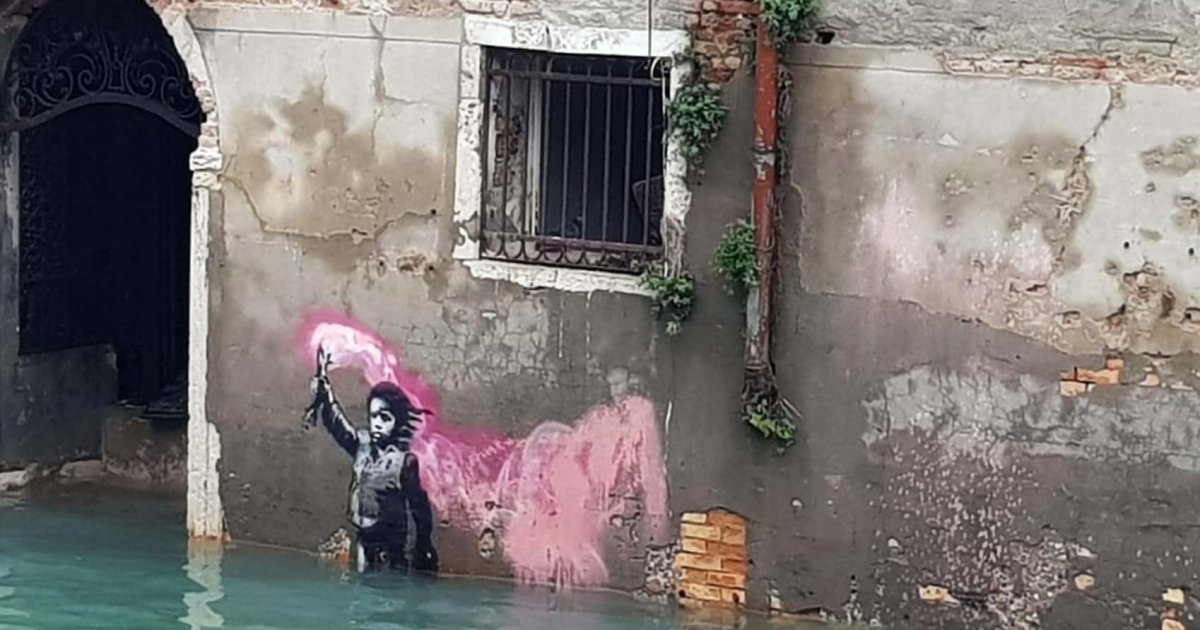
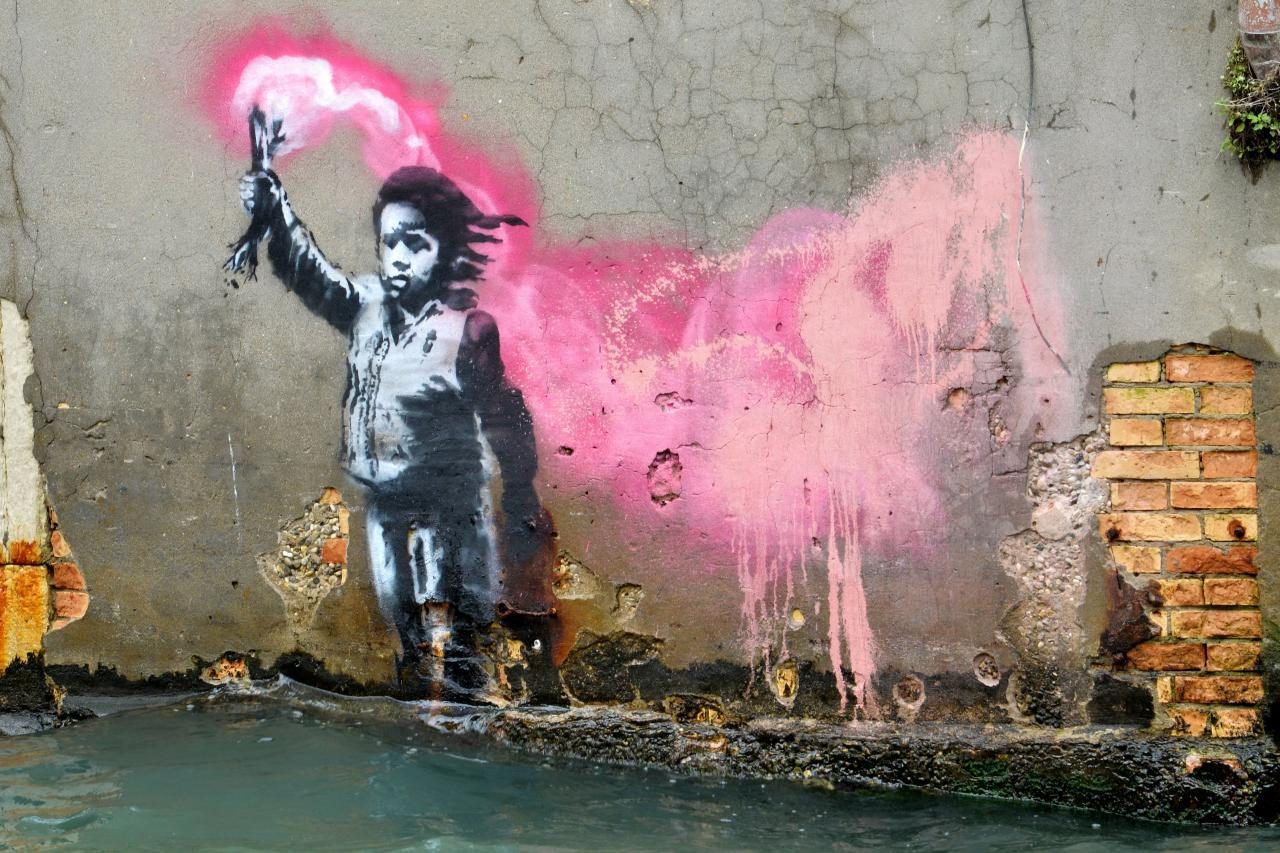
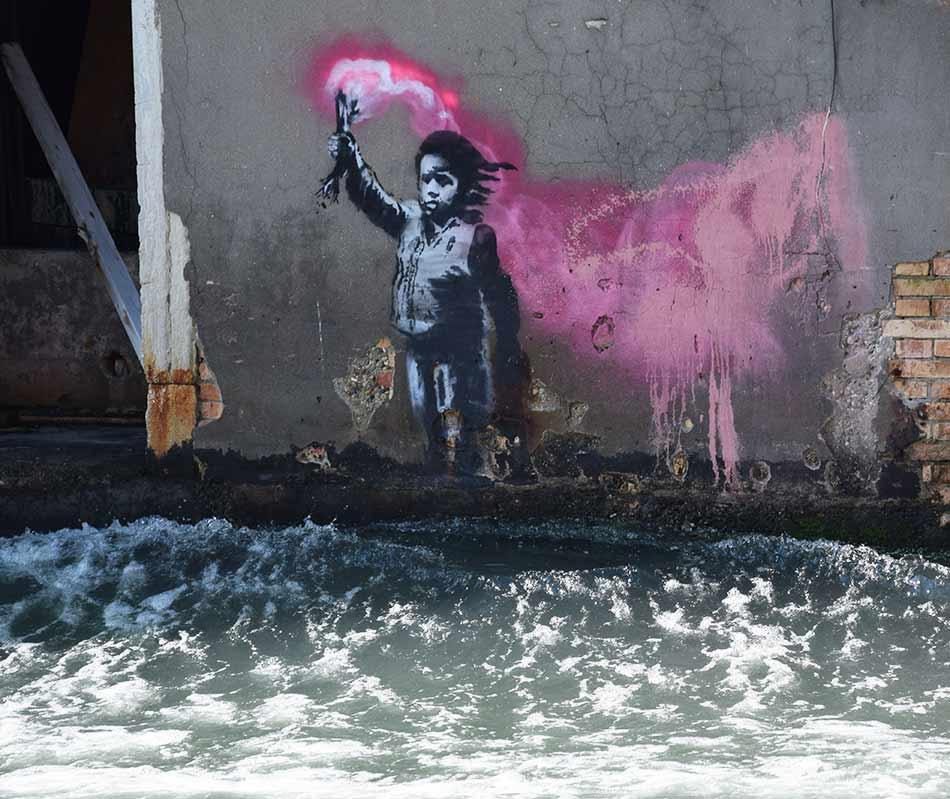
Migrant Child, also known as Girl With Relief Torch, appeared during the night of 8–9 May 2019 on the canal-facing façade of Palazzo San Pantalon in Venice, coinciding with the opening days of the 58th Venice Biennale. The mural depicts a young child wearing a life jacket and holding a distress flare above her head. Executed predominantly in black and white, the figure is dramatically punctuated by the vivid pink smoke emitted from the flare, which spreads laterally across the weathered surface of the building. Current conservation documentation identifies the work as one of only two Banksy interventions in Italy officially acknowledged by the artist.
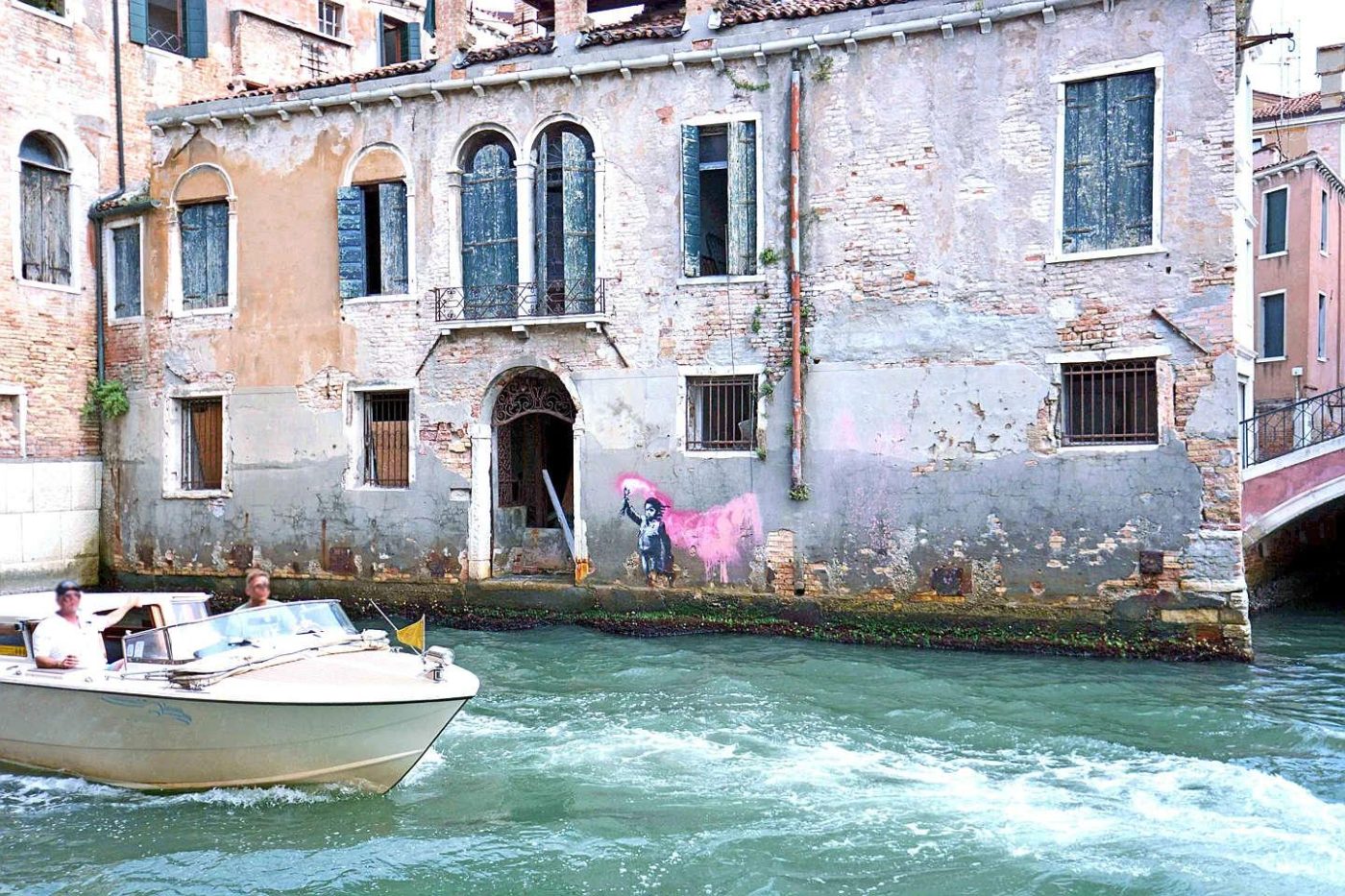
The work is an especially accomplished example of Banksy's use of existing architecture and urban geography as integral components of an image. The child was positioned immediately above the canal, close enough to the waterline for the fluctuating Venetian tide to alter the visual relationship between figure and environment. The water was therefore not simply a picturesque background but an essential part of the composition. At high tide, and particularly during the exceptional acqua alta that affected Venice in November 2019, the lower part of the figure appeared threatened by the rising water. The mural consequently acquired a physical vulnerability that reinforced its subject: a child exposed to the dangers of a maritime crossing.
The architecture contributed equally to this effect. Banksy did not place the image on a pristine surface but on the visibly deteriorating lower façade of Palazzo San Pantalon, where cracked plaster, exposed masonry, humidity and discoloration already recorded the building's prolonged exposure to the lagoon. The material fragility of the wall became inseparable from the vulnerability of the child depicted upon it. This relationship between image, substrate and environment would become increasingly important as the mural itself began to deteriorate.
Migration, Visibility and the Mediterranean
The iconography clearly belongs to Banksy's sustained engagement with migration and displacement. The life jacket immediately identifies the child with the dangerous maritime journeys undertaken by migrants and refugees attempting to reach Europe across the Mediterranean. The flare adds a further dimension. It is not merely an accessory or symbolic source of light, but an emergency device whose purpose is to make an endangered person visible to potential rescuers.
The work therefore concerns not only migration but also the politics of visibility. Banksy places an individual child at the centre of a crisis more commonly represented through statistics, boats and anonymous crowds. The absence of other figures intensifies this effect. There is no vessel, rescue ship, border guard or coastline; the entire humanitarian narrative is concentrated into the isolated figure and the signal raised above her head.
The use of pink is particularly effective. Banksy frequently employs a single area of saturated color to organize otherwise monochromatic compositions, as in the red balloon of Girl with Balloon or the flowers in Love Is in the Air. Here, however, color performs a specific narrative function. The flare is simultaneously the brightest and most urgent element of the composition, drawing the spectator's attention in much the same way that an actual distress signal is intended to attract the attention of a rescuer. Form and meaning therefore coincide with unusual precision.
The Venetian location gives the subject additional resonance. Venice is a city whose history, economy and cultural identity have always been inseparable from maritime movement. It is also one of the world's most intensively visited tourist destinations, receiving enormous numbers of international visitors who cross borders under circumstances radically different from those experienced by refugees attempting to enter Europe by sea. Banksy's intervention quietly introduces this contrast into the city's celebrated relationship with travel. The same waters that signify leisure, beauty and cultural pilgrimage for one population can signify displacement, danger and survival for another.
An Unofficial Intervention at the Venice Biennale
The timing of the work was significant. Banksy was not an official participant in the 2019 Venice Biennale, yet his presence in the city became one of the event's most widely discussed unofficial interventions. The appearance of Migrant Child coincided with a Biennale already confronting the politics of migration through Christoph Büchel's controversial Barca Nostra, the wreck of a fishing vessel that had sunk between Libya and Lampedusa in April 2015 with the loss of hundreds of migrants. The simultaneous presence of the wreck inside the institutional framework of the Biennale and Banksy's vulnerable child on an exterior Venetian wall created an unavoidable dialogue between official contemporary art and unauthorized intervention.
Banksy reinforced his unofficial participation through Venice in Oil, an installation staged near Piazza San Marco in which a series of traditionally framed paintings assembled into the image of an enormous cruise liner overwhelming the Venetian cityscape. The artist subsequently released a video of the intervention under the caption “Setting out my stall at the Venice Biennale.” Although formally independent, Venice in Oil and Migrant Child can productively be considered together. Both concern movement through Venice and the unequal conditions under which different populations arrive there: mass tourism on the one hand and precarious migration on the other.
This juxtaposition is characteristic of Banksy's method. Rather than construct an elaborate political argument, he brings two familiar realities into proximity and allows their contradiction to become visible. Venice's dependence upon international tourism, its contentious relationship with cruise ships and its geographical position within the broader Mediterranean context provided an unusually rich environment for such an intervention.
The Water as Part of the Work
The subsequent history of Migrant Child raises an important question concerning the conservation of street art. Its position only inches above a Venetian canal made deterioration inevitable. Humidity, salt, tidal fluctuations and repeated exposure to acqua alta progressively damaged both the painted surface and the historic masonry supporting it. By 2025, approximately 30% of the work was reported to have deteriorated.
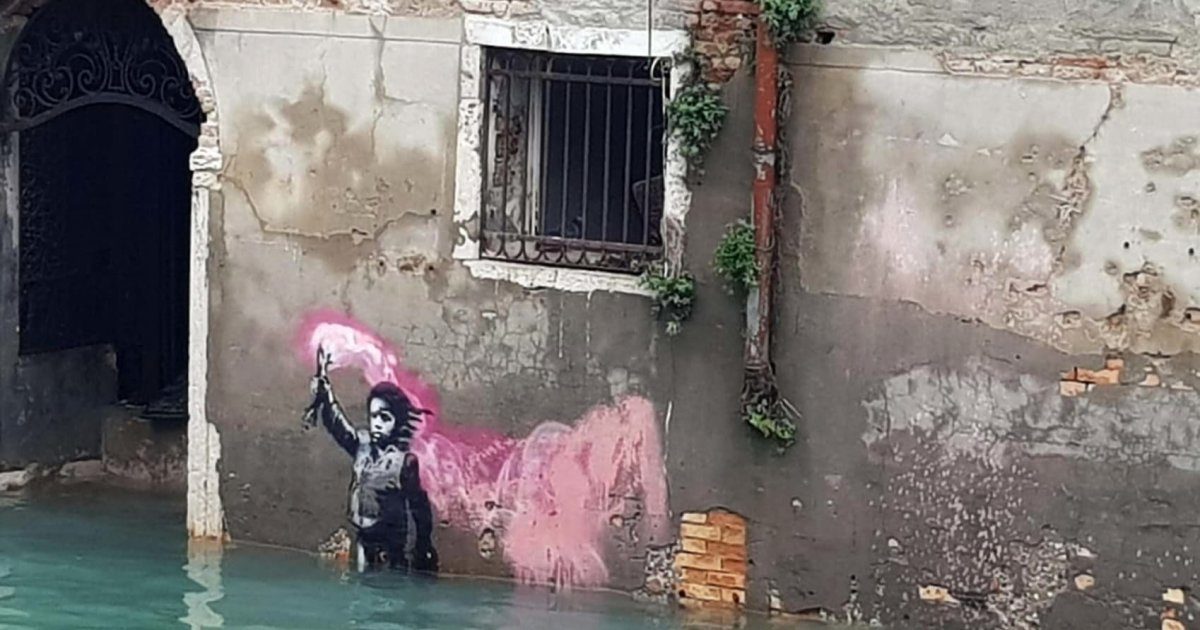
Yet these same environmental conditions were fundamental to the mural's meaning. The proximity of the water gave the child its precarious position and transformed the canal into an implicit Mediterranean crossing. Conservation therefore presented an unusual conceptual problem. Protecting the physical image required separating it, at least temporarily, from the environment that had made the image so effective.
This dilemma extends beyond Migrant Child. Street art is inherently vulnerable to alteration, weathering, demolition and overpainting, and Banksy's murals have repeatedly forced owners, municipalities and conservators to decide whether the material instability of a street work should be accepted or arrested. In Venice the question became particularly acute because deterioration was not incidental to the location: it resulted directly from the same lagoon that gave the composition much of its significance.
Removal and Conservation, 2025–2026
Concern about the condition of the mural eventually prompted a major conservation initiative. Banca Ifis, which acquired Palazzo San Pantalon, responded to an appeal involving the Italian Ministry of Culture, the Municipality of Venice and the Veneto Region and initiated a program intended both to preserve the Banksy and restore the historic building.
Conservation work under restorer Federico Borgogni began on 3 June 2025. The initial treatment involved dust removal, surface and deep consolidation, cleaning and stabilization of the relationship between the plaster and masonry. Conventional conservation methods used for frescoes and other wall paintings were considered unsuitable because of Banksy's technique and the characteristics of the historic substrate. The project consequently adopted the considerably more radical solution of removing the section of wall carrying the image.
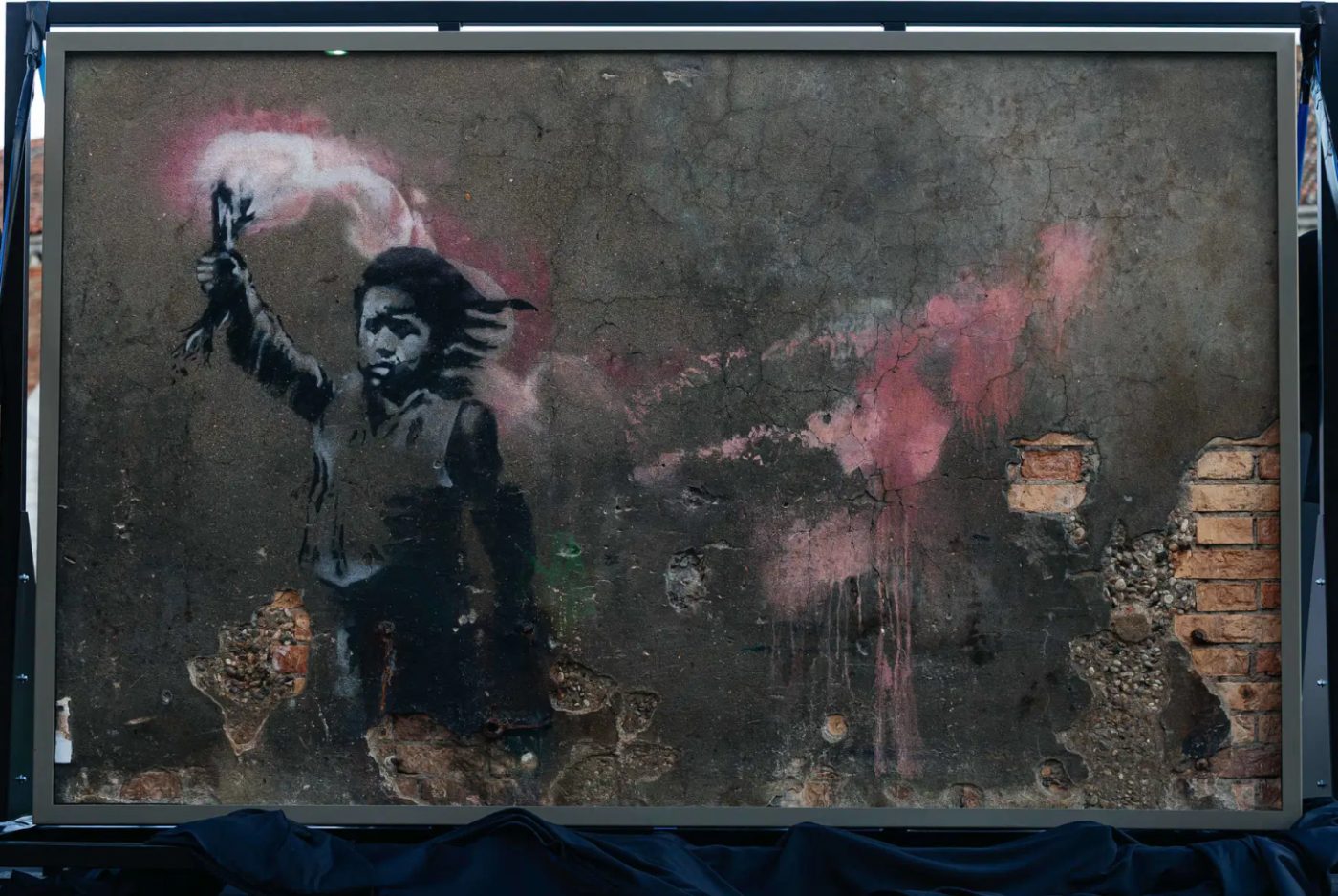
During the night of 23–24 July 2025, the relevant portion of the façade was detached from Palazzo San Pantalon. Banca Ifis described the operation as an innovative approach to wall conservation in Italy, undertaken after six years of deterioration had caused substantial losses to the work. The removal preserved not merely the painted layer but a section of the original architectural support, thereby retaining some of the material relationship between Banksy's intervention and the Venetian building on which it had been executed.
Following conservation, Migrant Child was publicly presented again in Venice in May 2026, in conjunction with the opening period of the Venice Biennale. Banca Ifis records the work as having been exhibited at Tesa 113 in the Arsenale and has connected its conservation with a broader educational initiative developed with Treccani concerning art, citizenship and children's rights.
The restoration of Palazzo San Pantalon forms part of the same project, with plans to transform the building into an exhibition space. The intervention therefore represents an unusual evolution in the history of a Banksy mural: an unauthorized street work became sufficiently culturally significant to influence the conservation and future function of the architecture upon which it had originally appeared.
Takeaways
Migrant Child should be considered among Banksy's most accomplished site-specific interventions of the later 2010s. Its visual vocabulary is characteristically economical, but its effectiveness depends upon a sophisticated relationship between figure, architecture, water and urban context. The life jacket establishes the subject of maritime migration; the flare introduces both urgency and visibility; the Venetian canal transforms the wall into the edge of an imagined crossing; and the deteriorated façade gives material form to the vulnerability already present within the image.
The work also extends several concerns that had occupied Banksy for many years. Children repeatedly function within his imagery as figures through whom the consequences of adult political decisions become visible, from Bomb Hugger and the Palestine interventions to the refugee works in Calais. In Migrant Child, however, the child is neither merely victim nor passive symbol. The raised flare constitutes an active appeal for recognition, making the act of looking ethically significant: once the distress signal has been seen, the spectator can no longer claim not to know that it exists.
Its later conservation history has added a further, unintended dimension. The mural itself became vulnerable to the environment in which Banksy had placed it, requiring physical intervention to prevent its disappearance. The removal of the wall in 2025 undoubtedly protected the surviving material, but it also altered the work's relationship with the site. This tension between preservation and context is fundamental to the conservation of street art and is particularly pronounced here, because the canal was never merely adjacent to Migrant Child. It was one of the elements through which the mural acquired its meaning.
The challenge facing its eventual presentation at Palazzo San Pantalon will therefore be more complex than simply reinstalling a conserved Banksy. To understand the work fully, the viewer must still be able to perceive the relationship that existed in 2019 between the isolated child, the deteriorating Venetian wall and the water immediately beneath her.
STAY INFORMED
Receive the latest news, exhibitions, artworks and market updates on Banksy.