GORILLA IN A PINK MASK
Behind the Mask
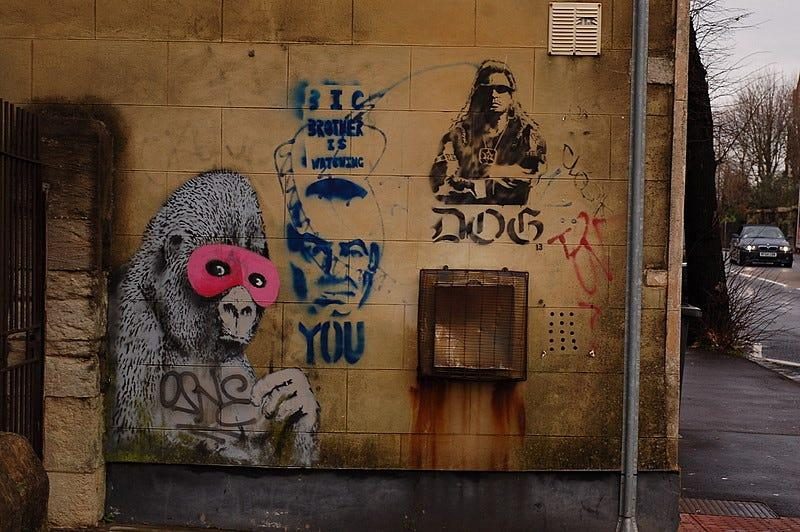
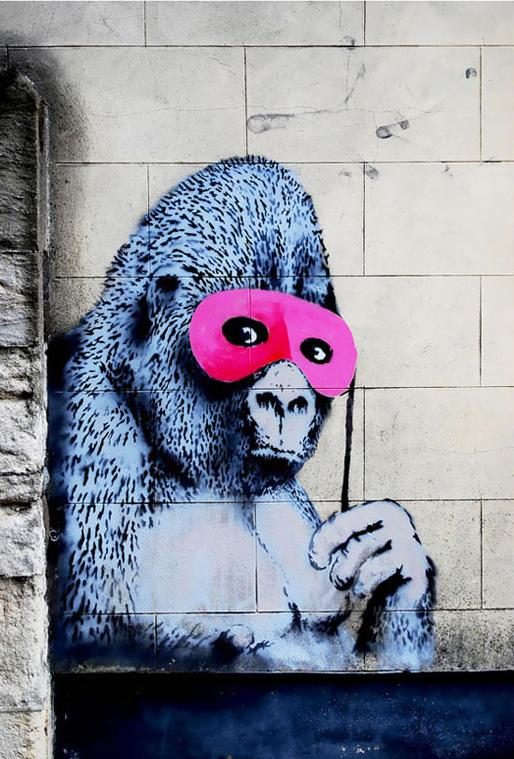
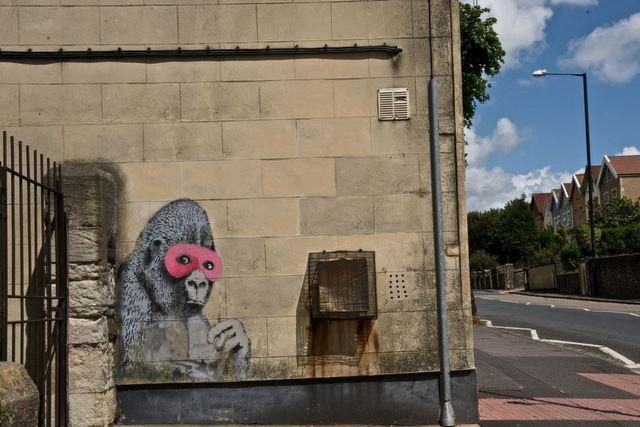
A large gorilla emerges from the edge of a Bristol wall, one enormous hand resting beneath its face. Rendered predominantly in black, white and grey, the animal wears an incongruously delicate bright pink masquerade mask. The intense color provides the composition's single emphatic accent, immediately drawing attention toward the gorilla's eyes.
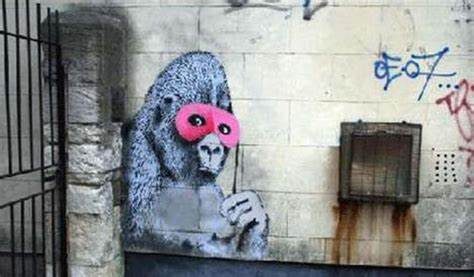
The contrast is both visual and psychological. Banksy takes an animal conventionally associated with physical strength and masculine aggression and gives it an accessory associated with disguise, performance and play. Yet the gorilla does not appear particularly threatening. Its hunched posture and sideways glance give it an almost hesitant presence, as though the mask allows this imposing creature to adopt another identity.
The image belongs to the period in which monkeys and apes were becoming central characters in Banksy's visual vocabulary. They allowed him to collapse distinctions between supposedly civilized human behavior and the animal world, a strategy that would soon produce works such as Laugh Now and Monkey Queen. Here, however, the satire is gentler. Rather than impersonating a politician, worker or member of the establishment, the gorilla simply hides behind a mask.
An Early Bristol Landmark
Gorilla in a Pink Mask appeared in 2001 on the exterior wall of the former North Bristol Social Club on Fishponds Road in Eastville. It remained there for approximately a decade and became a familiar neighborhood landmark. Contemporary reporting following its later destruction described residents who had grown accustomed to passing the image as part of their daily lives.
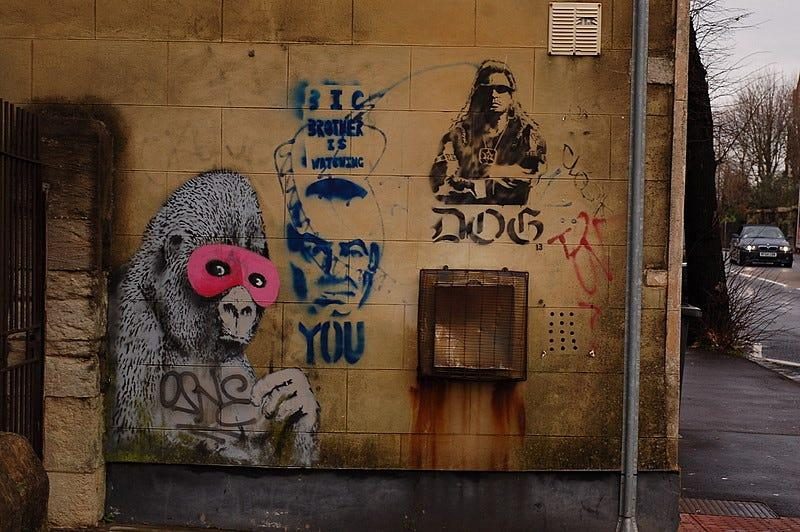
The setting visible in surviving photographs is important to the work's original character. Banksy's gorilla was not isolated on a pristine surface. It occupied the lower corner of an ordinary, weathered urban wall alongside ventilation equipment, stains, tags and subsequently other stencil graffiti. As the surrounding surface accumulated new marks, the gorilla became one element within a changing street environment.
The two surviving photographs are particularly revealing in this respect. The earlier view preserves the relative clarity of Banksy's original composition; the wider photograph records what happened afterwards, as other writers and stencil artists progressively occupied the same wall. The masked gorilla remained recognizable but increasingly embedded within the visual disorder around it.
Painted Over
In July 2011, the building had become the Jalalabad Islamic Centre and was being renovated by its new owner, Saeed Ahmed. Unaware that the gorilla was a Banksy, Ahmed had the graffiti-covered exterior wall painted over with emulsion.
His explanation was remarkably straightforward: he had regarded the image as worthless graffiti and had simply wanted to clean the building. Once informed of its authorship and significance, he apologized and explored whether it could be recovered.
The episode unintentionally recreated one of the central contradictions surrounding Banksy's career. A stencil originally placed on somebody else's building without permission had acquired sufficient cultural and financial value that the perfectly ordinary act of repainting the wall was suddenly treated as the destruction of an artwork.
Conservator Richard Pelter of International Fine Art Conservation Studios examined the surface and concluded that the upper paint could potentially be removed, although doing so would be slow and technically difficult. Restoration work subsequently recovered much of the composition, but not its original clarity. By October 2011 it was being described as partially restored.
The result was the ghostly version of Gorilla in a Pink Mask that remained visible for the following years: unmistakably the same image, but scarred by the attempt to erase and recover it.
Removed from the Street
In September 2020, nearly two decades after its creation, the section of masonry containing the mural was physically removed from the Jalalabad Islamic Centre. The operation was undertaken by street-art conservation company Exposed Walls, which said the deteriorating building and condition of the work made removal necessary for its preservation. The mural underwent further restoration after being detached.
It was subsequently announced for auction in November 2020, with proceeds intended in part to benefit the local community, but the planned sale was withdrawn. Later local reporting states that its current whereabouts are unclear. The original Fishponds Road wall no longer contains the Banksy.
The history of Gorilla in a Pink Mask charts an extraordinary transformation in the status of Banksy's street work. In 2001, someone could stencil a masked ape onto the side of a Bristol social club. Ten years later, someone else could innocently mistake it for ordinary graffiti and paint it out. Another decade later, the wall itself would be cut apart to save what remained.
The gorilla survived, but the wall on which Banksy intended it to live did not.
STAY INFORMED
Receive the latest news, exhibitions, artworks and market updates on Banksy.