GRAFFITI REMOVAL HOTLINE
Graffiti Removal Hotline
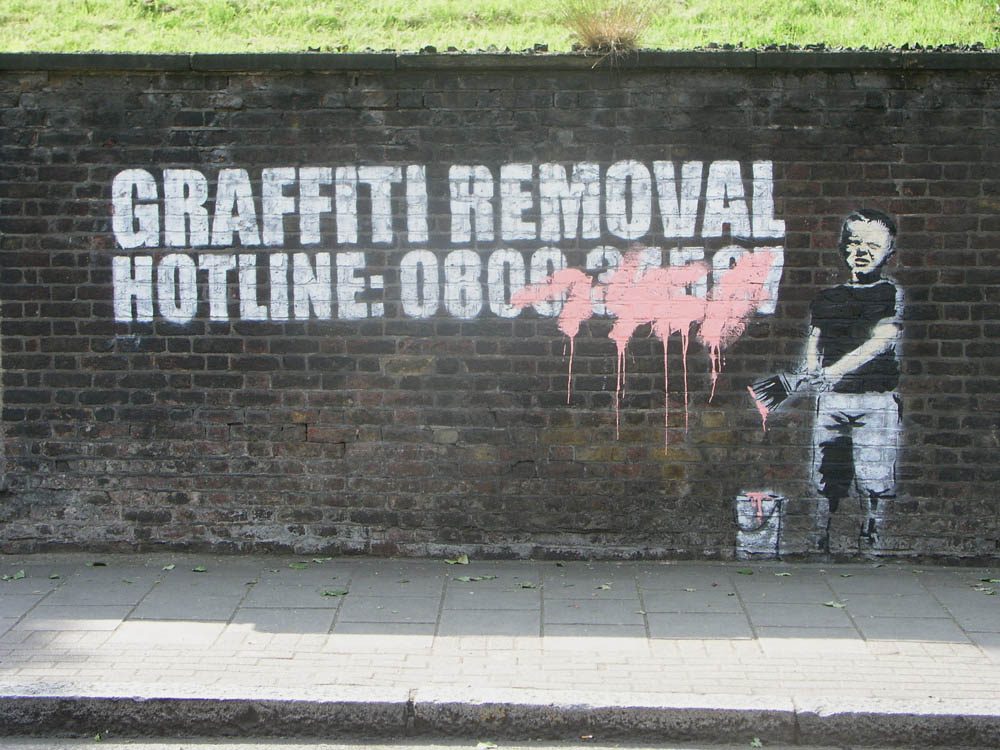
In May 2006, Banksy transformed a brick wall on Pentonville Road in Islington into an enormous parody of an official public notice. In large white capitals, the wall announces: GRAFFITI REMOVAL HOTLINE: 0800…
Beside the lettering stands a young boy holding a paintbrush and bucket. He has covered the telephone number with thick, dripping pink paint, making the supposed graffiti-removal service impossible to contact.
The composition is characteristically economical. The institutional lettering resembles the sort of municipal signage designed to regulate public space, while the small monochrome child quietly undermines it. The only strong color comes from the act of vandalism itself: the vivid pink paint spreading across the supposedly official message.
Removing the Removal Service
The joke operates as a perfect circle. Banksy creates graffiti advertising a service for removing graffiti, then depicts a child vandalizing the information required to report it. The act of attempting to erase the message creates another layer of graffiti.
The work belongs to Banksy's recurring fascination with the bureaucracy surrounding public space and the unstable distinction between vandalism and legitimate urban maintenance. A council worker painting over graffiti and a graffiti artist painting over a council notice may perform almost identical physical actions; what changes is simply who has been given permission to hold the brush.
The mural had an appropriately brief existence. Contemporary documentation records the Islington work being removed by the authorities in early June 2006, only weeks after it appeared. The council therefore completed the sequence Banksy had begun: graffiti about graffiti removal was ultimately removed as graffiti.
The Earlier West Kensington Version
Earlier that same month, Banksy had tested the idea in West Kensington in a markedly different form. Against a white wall, the words GRAFFITI REMOVAL HOTLINE appeared in large red lettering, while a deliberately crude stick-figure painter covered part of the telephone number with dripping blue paint. The figure itself looks almost like an amateur piece of graffiti, sharpening the joke by setting an apparently official public notice against the most rudimentary form of unauthorized drawing.
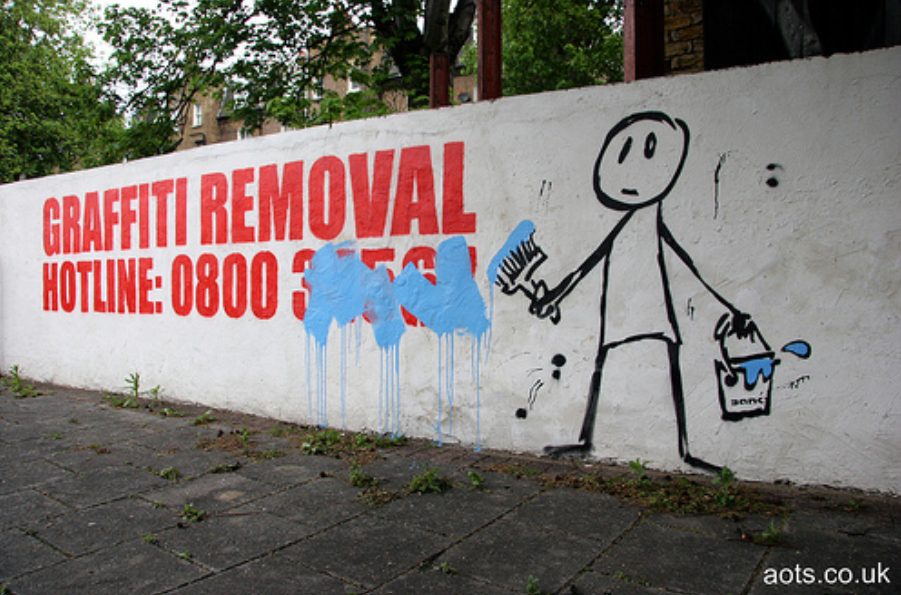
The West Kensington work was subsequently obliterated with black paint. Banksy then returned to the concept on Pentonville Road in Islington, replacing the stick figure with the far more accomplished stencilled boy and reversing the visual scheme to white lettering on dark brick with pink paint. That second execution became the definitive and better-known version of Graffiti Removal Hotline.
STAY INFORMED
Receive the latest news, exhibitions, artworks and market updates on Banksy.