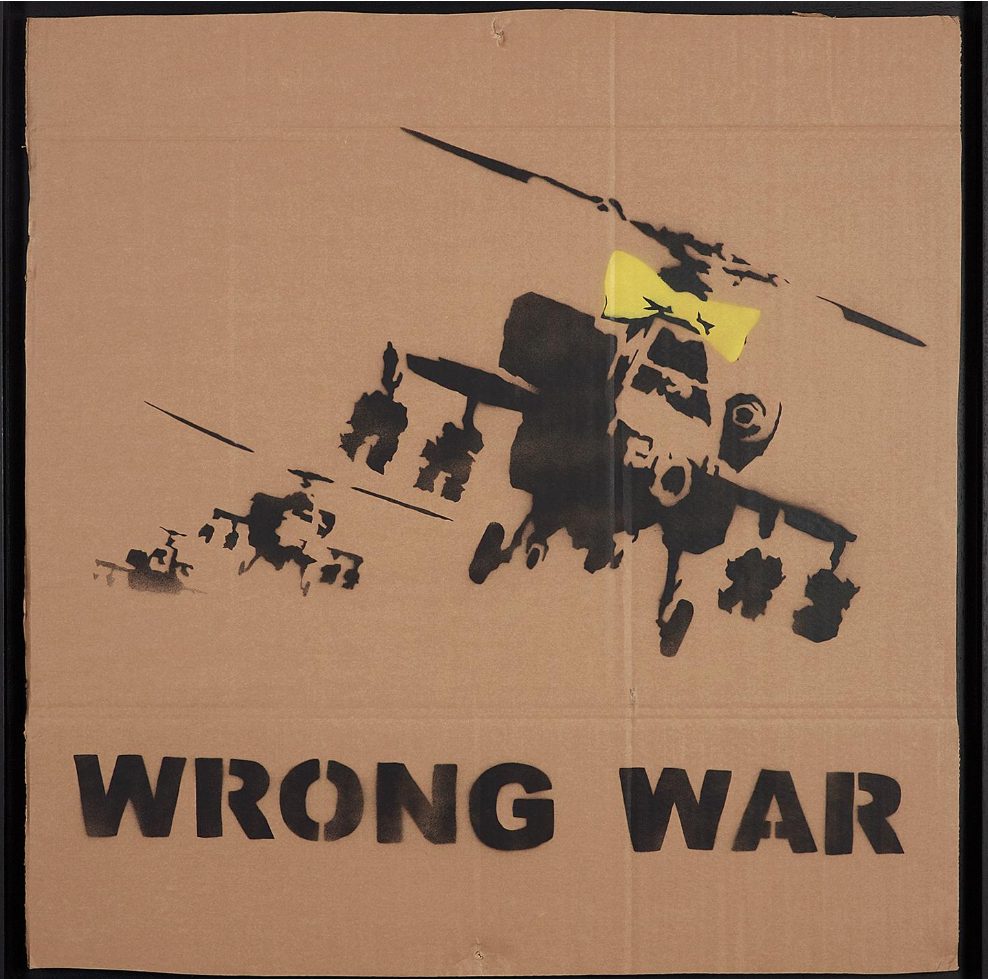
HAPPY CHOPPERS WRONG WAR PLACARDS, 2003
Exhibited
- Miami, Art Miami, Art in the Game, 2017
- Miami, The Sagamore Hotel, Urban Legends, 2018
Auction History
Prices are inclusive of buyer’s premium unless stated otherwise, as reported by the auction houses.
This work belongs to a group of protest placards produced in connection with the demonstrations against the Iraq War in London in 2003. Those works are considered street works, and are not eligible for the issuance of a Pest Control certificate.
Art Made to Be Carried
Wrong War (Happy Choppers) occupies a particularly unusual position within Banksy’s oeuvre. It was neither conceived as a conventional painting nor executed on a permanent urban wall. Instead, it belongs to a group of hand-sprayed cardboard placards associated with the enormous anti-Iraq War demonstrations that took place in London in 2003. Made to be carried through the streets rather than hung in a gallery, these objects represent one of the most direct intersections between Banksy’s art and political action.
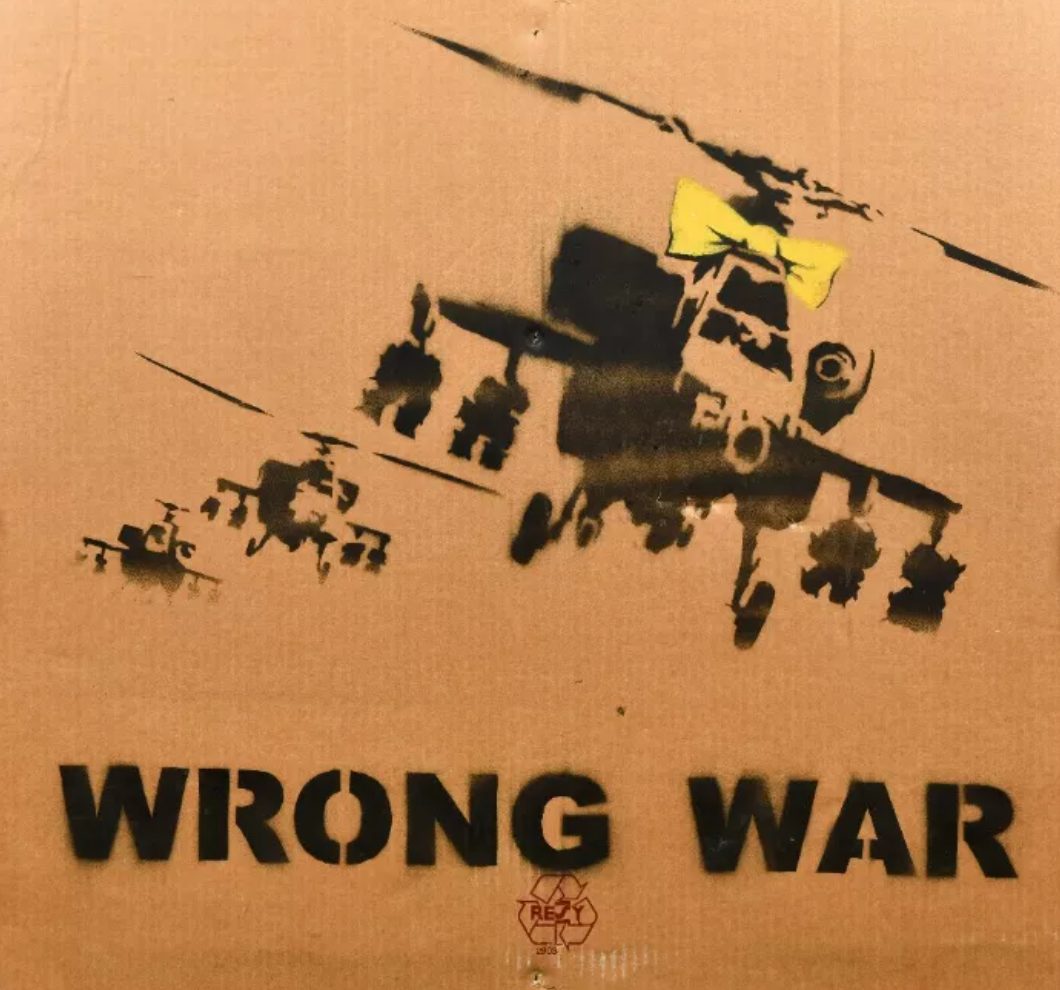
The distinction is important because it changes the nature of the object. A painting waits for its audience, while a protest placard travels through the city in search of one. Carried above a crowd, it becomes simultaneously an artwork, a political message and a piece of street theatre. The person carrying it temporarily becomes part of its presentation, while photographs, television cameras and the movement of the demonstration allow the image to circulate far beyond the physical object itself. In this sense, Banksy transformed the humble protest sign into another vehicle for the fundamental purpose of street art: placing an image directly into public space without waiting for permission.
London and the Iraq War
The historical context gives the work much of its significance. On 15 February 2003, London witnessed one of the largest political demonstrations in modern British history as protesters gathered against the impending invasion of Iraq. Similar demonstrations took place around the world, creating an extraordinary international moment of coordinated opposition to the war. Banksy’s contribution was characteristically economical: rather than construct an elaborate political argument, he produced images capable of communicating almost instantaneously within the noise, movement and visual confusion of a mass demonstration.
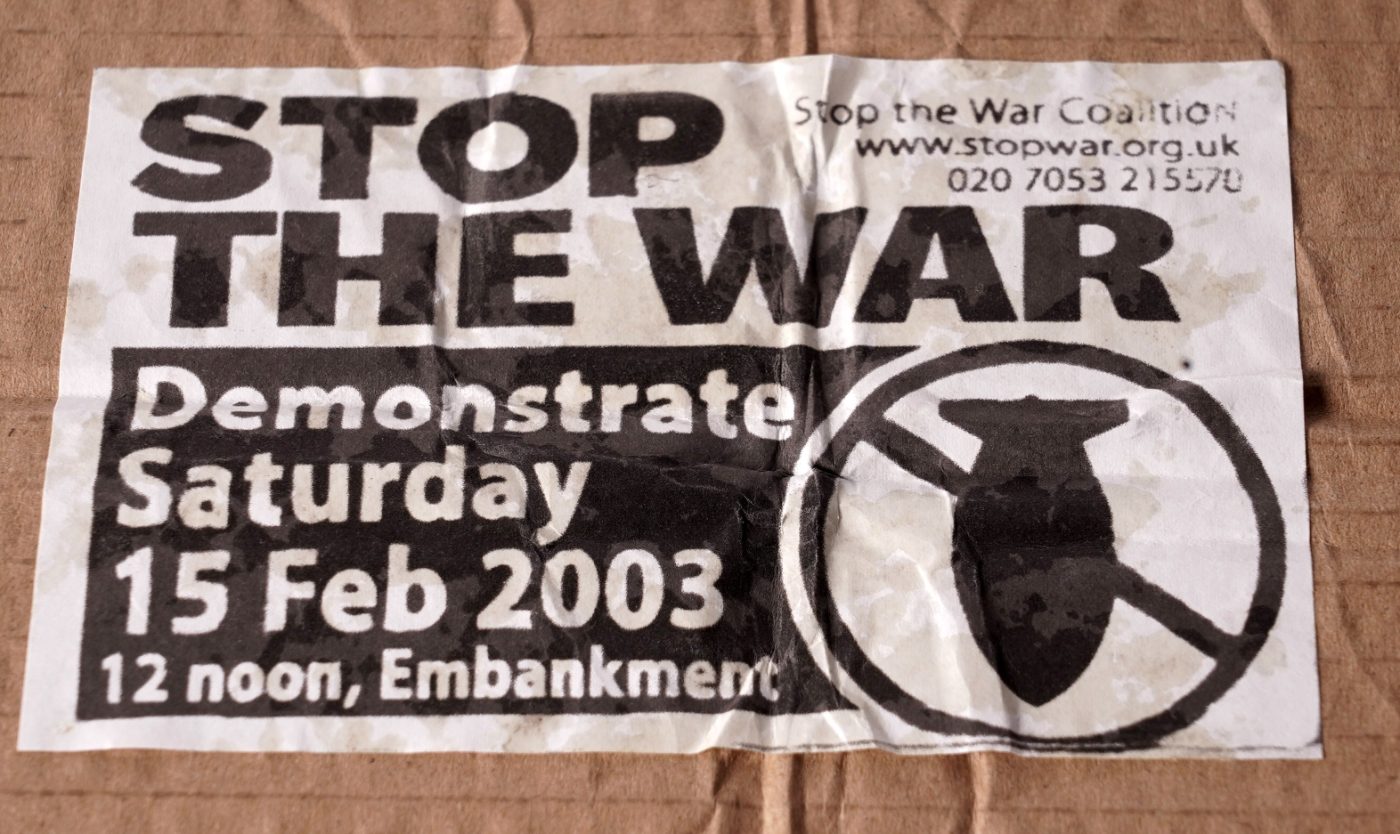
The materials were perfectly suited to that purpose. Spray paint, stencil and inexpensive cardboard belonged to the practical vocabulary of protest rather than the traditional materials of fine art. These placards were meant to be carried, handled and exposed to the street. They could be bent, damaged, abandoned or simply discarded when the demonstration ended. Their apparent disposability is consequently an essential part of their meaning, and the survival of examples such as Wrong War (Happy Choppers) gives them the character of historical documents as much as artworks.
Happy Choppers
The upper part of the placard is dominated by one of Banksy’s most recognizable early anti-war images. A formation of military attack helicopters moves diagonally across the cardboard, led by a larger aircraft whose rotor has been decorated with a conspicuous yellow bow. Banksy had already employed the Happy Choppers motif before the 2003 demonstration, and it would subsequently become one of the recurring images through which he explored warfare, militarism and the strange visual seductions of military power.
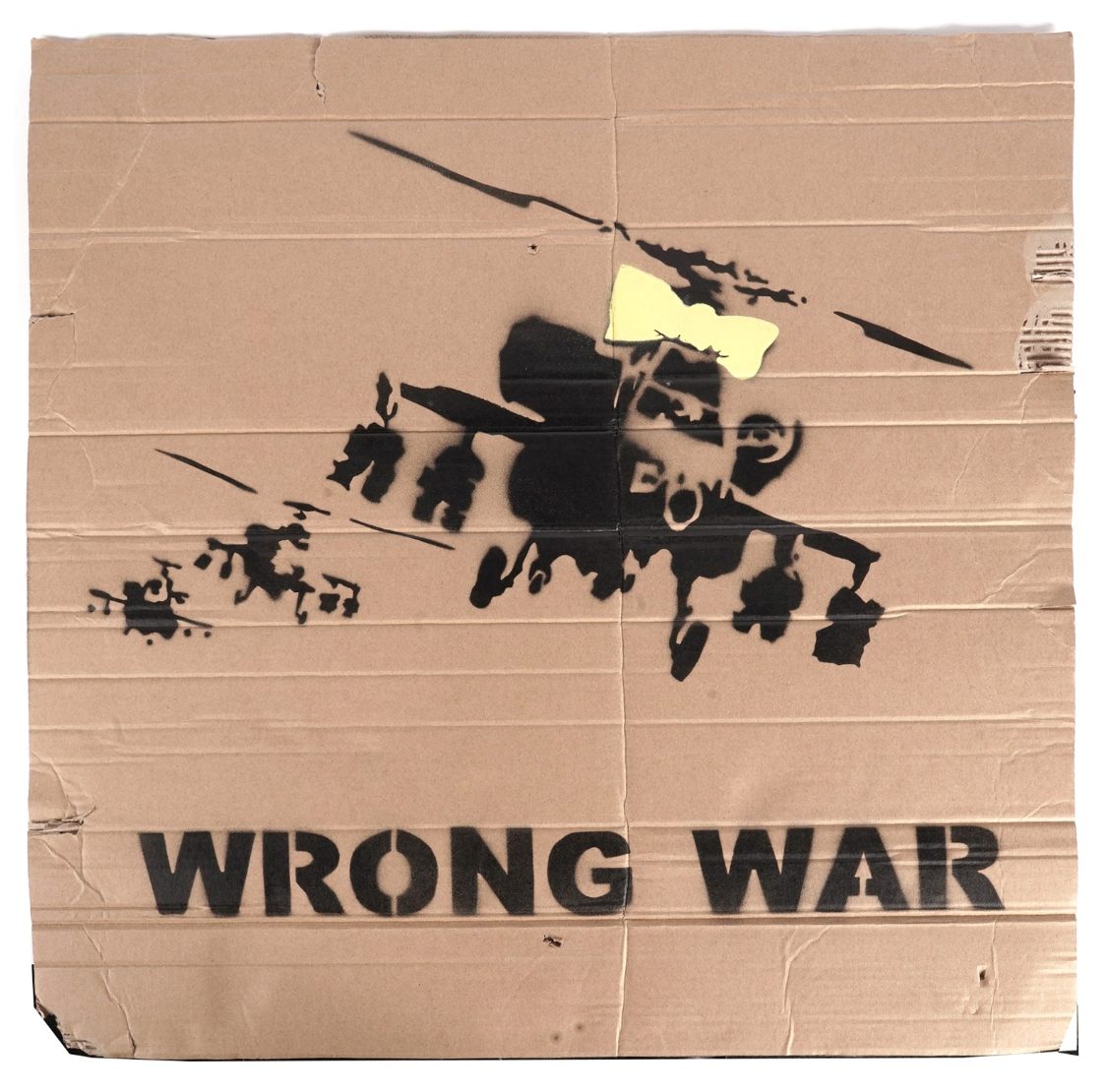
The conceptual mechanism is extraordinarily simple. Banksy takes an object engineered for violence and attaches to it a symbol associated with gifts, childhood and celebration. Neither element changes, yet their juxtaposition makes both suddenly absurd. The helicopter remains threatening and the bow remains cheerful, but together they create an image in which violence has effectively been gift-wrapped. The bright yellow accent is particularly important against the otherwise austere black stencil and untreated brown cardboard. It attracts the eye immediately, transforming a tiny decorative detail into the conceptual centre of the composition.
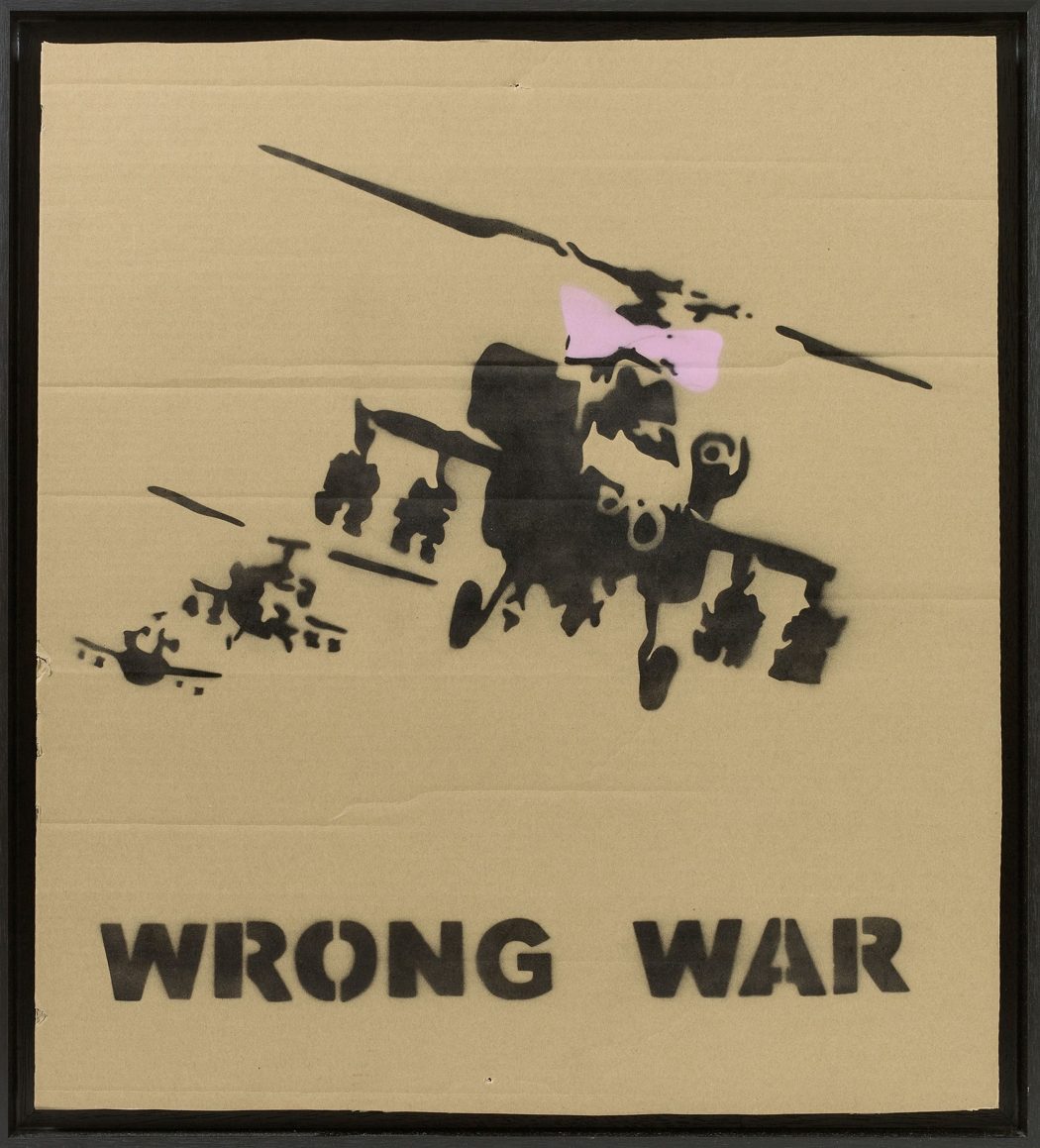
There is also considerable economy in the arrangement of the aircraft. The helicopters diminish toward the left, establishing depth and suggesting an approaching formation rather than a static military emblem. Banksy needs almost nothing to create the sensation of movement: a handful of black shapes, a diagonal trajectory and the smallest flash of yellow. The image demonstrates the efficiency that would become one of the defining characteristics of his mature visual language.
WRONG WAR
Beneath the helicopters, the words WRONG WAR occupy almost the entire lower portion of the placard. Here Banksy abandons the ambiguity that often characterizes his gallery works. The message is deliberately blunt because a protest placard operates under different conditions from a painting: it needs to be understood from a distance, above people's heads and often in a matter of seconds. Image and language therefore work together with the efficiency of political advertising.
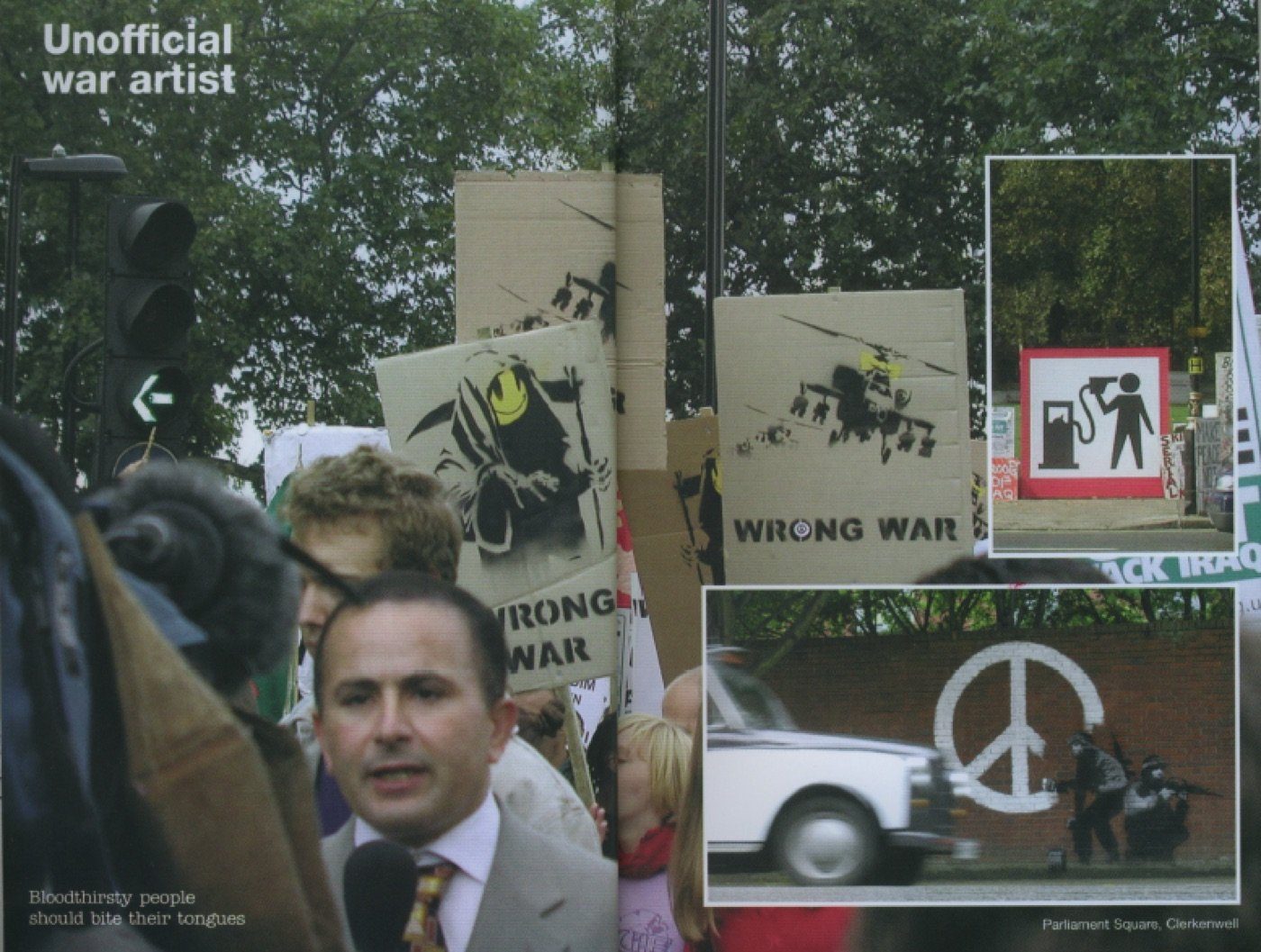
The relationship between the two is nevertheless more sophisticated than the slogan initially suggests. The words state the political position, while the Happy Choppers image provides the memorable visual contradiction. Banksy understood that political arguments may be complex, but political images need not be. The helicopter with a yellow bow turns an abstract debate about warfare into an immediately recognizable absurdity, allowing humour to perform much of the rhetorical work.
A Street Work Without a Wall
This is also what makes Wrong War (Happy Choppers) particularly interesting within the Street Works catalogue. Its connection with the street does not depend upon architecture. Unlike a mural subsequently removed from a building, there is no original wall whose location has been lost. Instead, the work belongs to the street through its intended use. It was conceived as an object capable of moving through public space and participating directly in a political event.
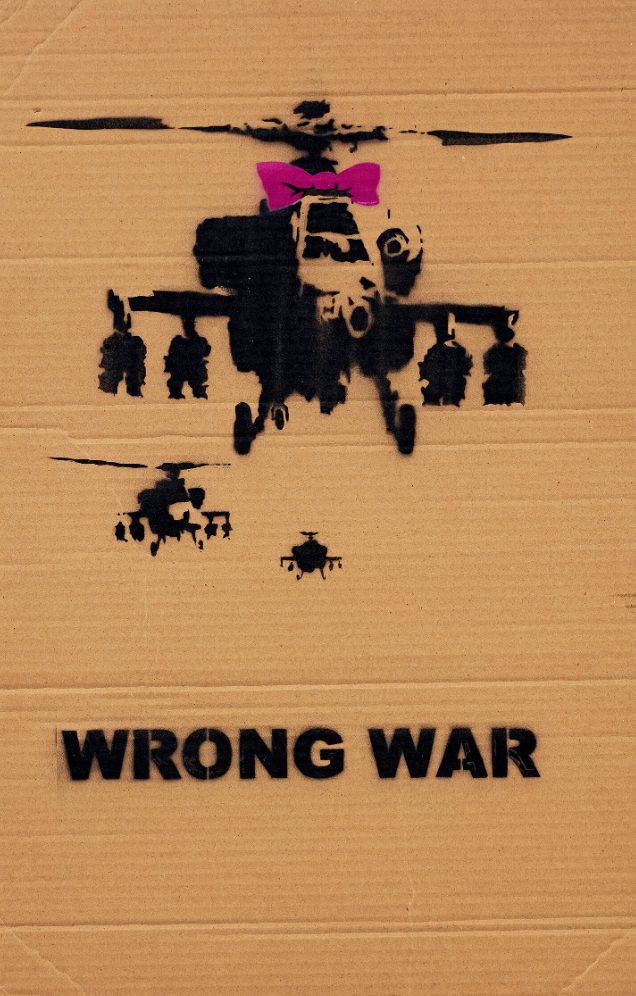
The cardboard itself therefore deserves to be treated as part of the work rather than merely as an inexpensive support. Its folds, imperfections and fragile surface preserve the material vocabulary of protest. These were not standardized fine-art editions carefully produced on archival paper, and surviving placards appear in different dimensions and configurations. They are better understood as pieces of political ephemera produced within a specific intervention, which helps explain both their unusual status and their rarity today.
From Protest to Collectible
The subsequent life of the work introduces one of the great contradictions surrounding Banksy’s street practice. An inexpensive piece of cardboard made to protest against a war survives its original moment, is preserved, framed, exhibited and eventually enters the art market. An object whose initial value depended upon being visible in a crowd gradually acquires another kind of value based upon authorship, rarity, provenance and survival.
That transformation does not necessarily diminish the work. On the contrary, the physical fragility of the cardboard makes its survival especially evocative. Unlike a conventional painting created with posterity in mind, a protest placard was never guaranteed a future. Every crease and irregularity reminds us that this was originally an active object rather than a precious one. What is now protected and exhibited was once intended to be held above somebody’s head on a crowded London street.
An Important Document of Banksy’s Political Practice
Wrong War (Happy Choppers) is therefore more than an early appearance of an image that would become familiar within Banksy’s iconography. It documents a moment when the artist’s imagery was being actively deployed within political protest. The work existed not simply to represent opposition but to participate in it, moving among demonstrators and competing for attention within one of the defining public debates of the period.
That distinction gives the surviving placards a special place within Banksy’s oeuvre. They sit somewhere between artwork, protest sign, street intervention and historical document, while embodying his longstanding determination to communicate beyond the conventional spaces of art. A mural makes use of the wall on which it appears; these works dispensed even with that necessity. The street remained the exhibition space, but the artwork itself could move through it.
Variations Sold at Auction
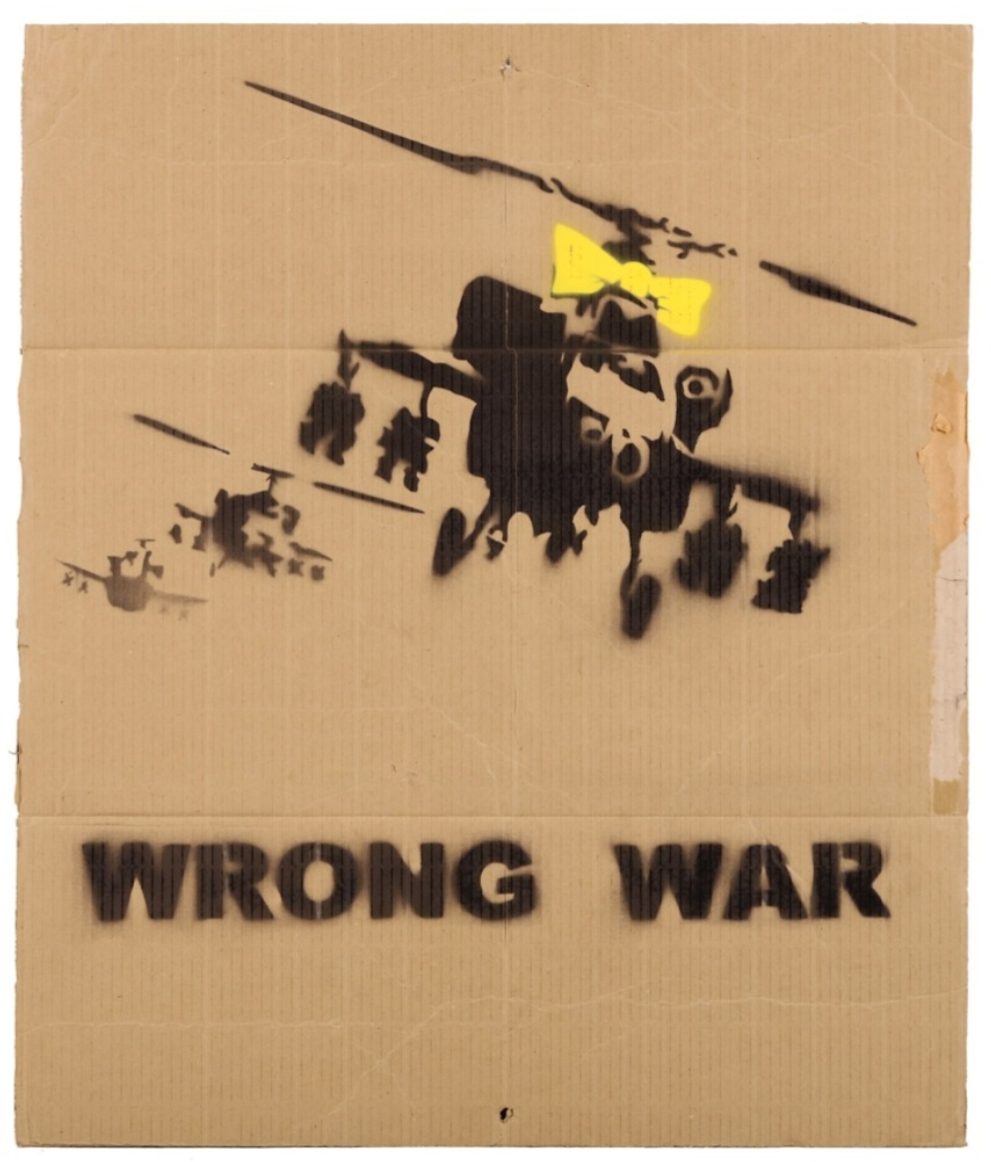
- Wrong War (Yellow Chopper), 2003
- Stencil and spraypaint on cardboard placard
- 73 x 61.5 cm (28 3/4 x 24 1/8 inches)
Prices are inclusive of buyer’s premium unless stated otherwise, as reported by the auction houses.
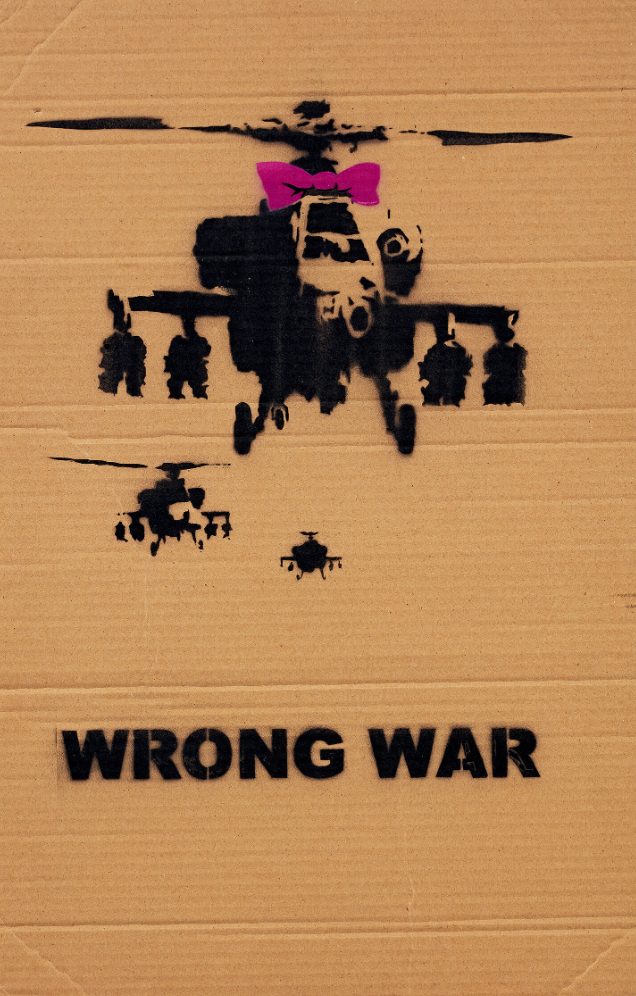
- Wrong War, 2003
- Spraypaint on cardboard placard
- 58x37 cm (22 7/8 x 14 5/8 inches)
Prices are inclusive of buyer’s premium unless stated otherwise, as reported by the auction houses.
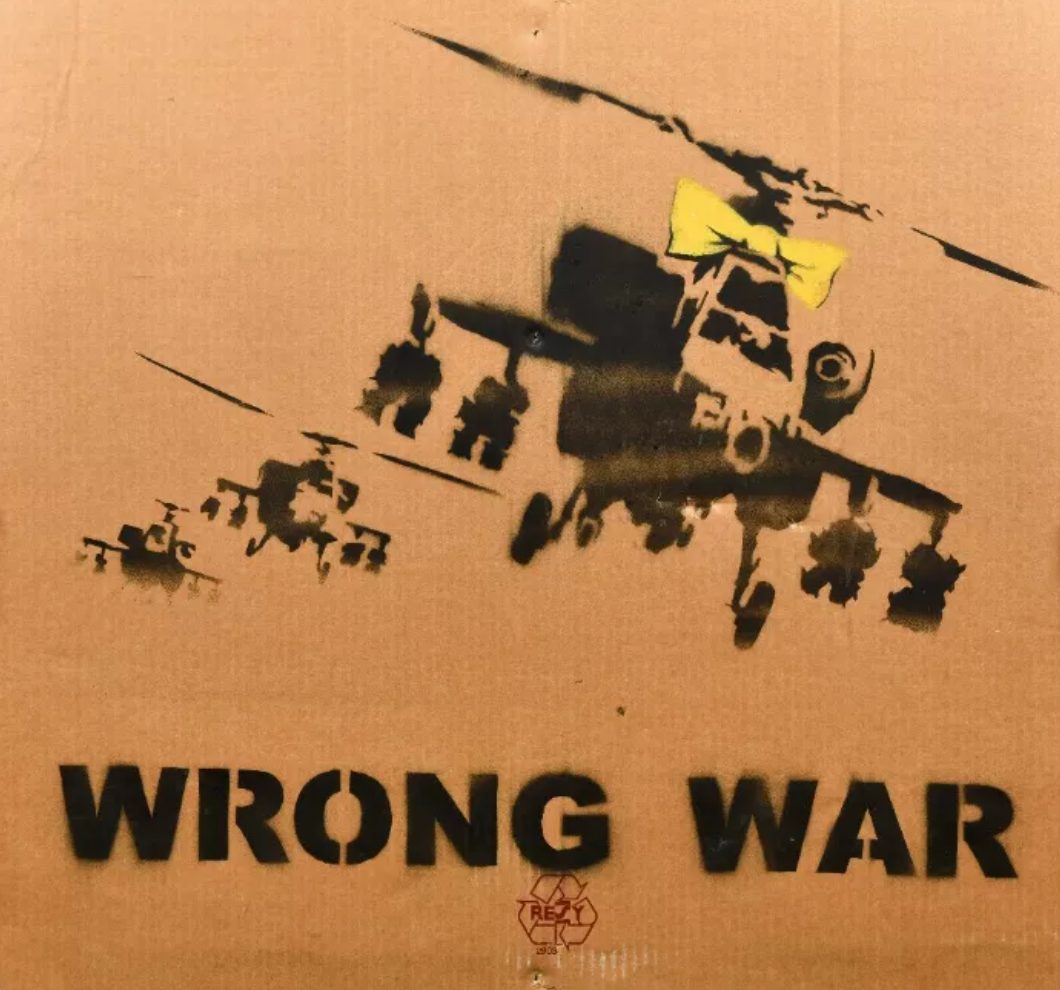
- Happy Choppers Wrong War, 2003
- Aerosol stencil on cardboard
- 79x78 cm (31 x 30 3/4 inches)
Prices are inclusive of buyer’s premium unless stated otherwise, as reported by the auction houses.
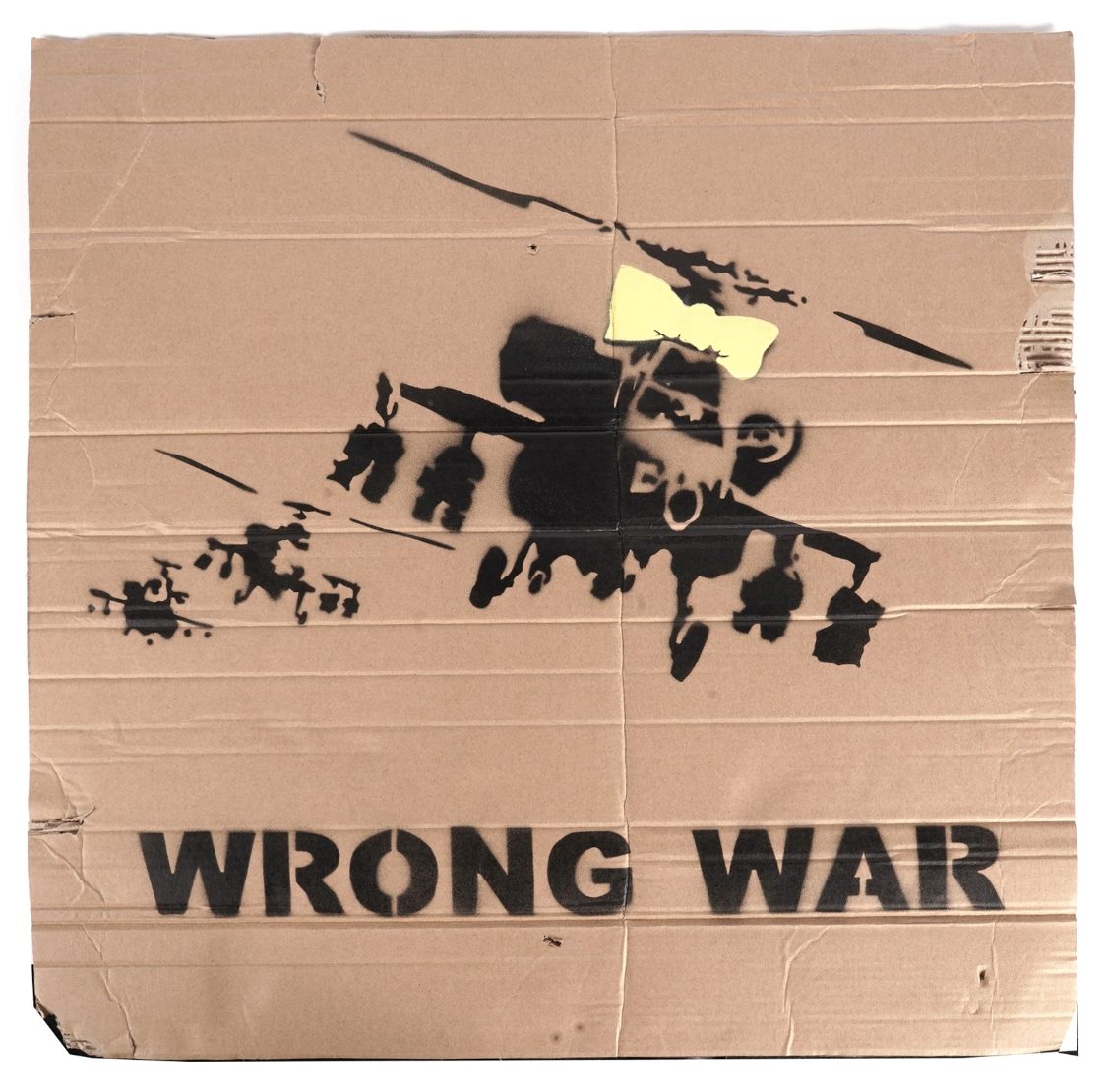
- Happy Choppers (Wrong War), 2003
- Spray paint on cardboard
- 74x74 cm (29x29 inches)
Prices are inclusive of buyer’s premium unless stated otherwise, as reported by the auction houses.
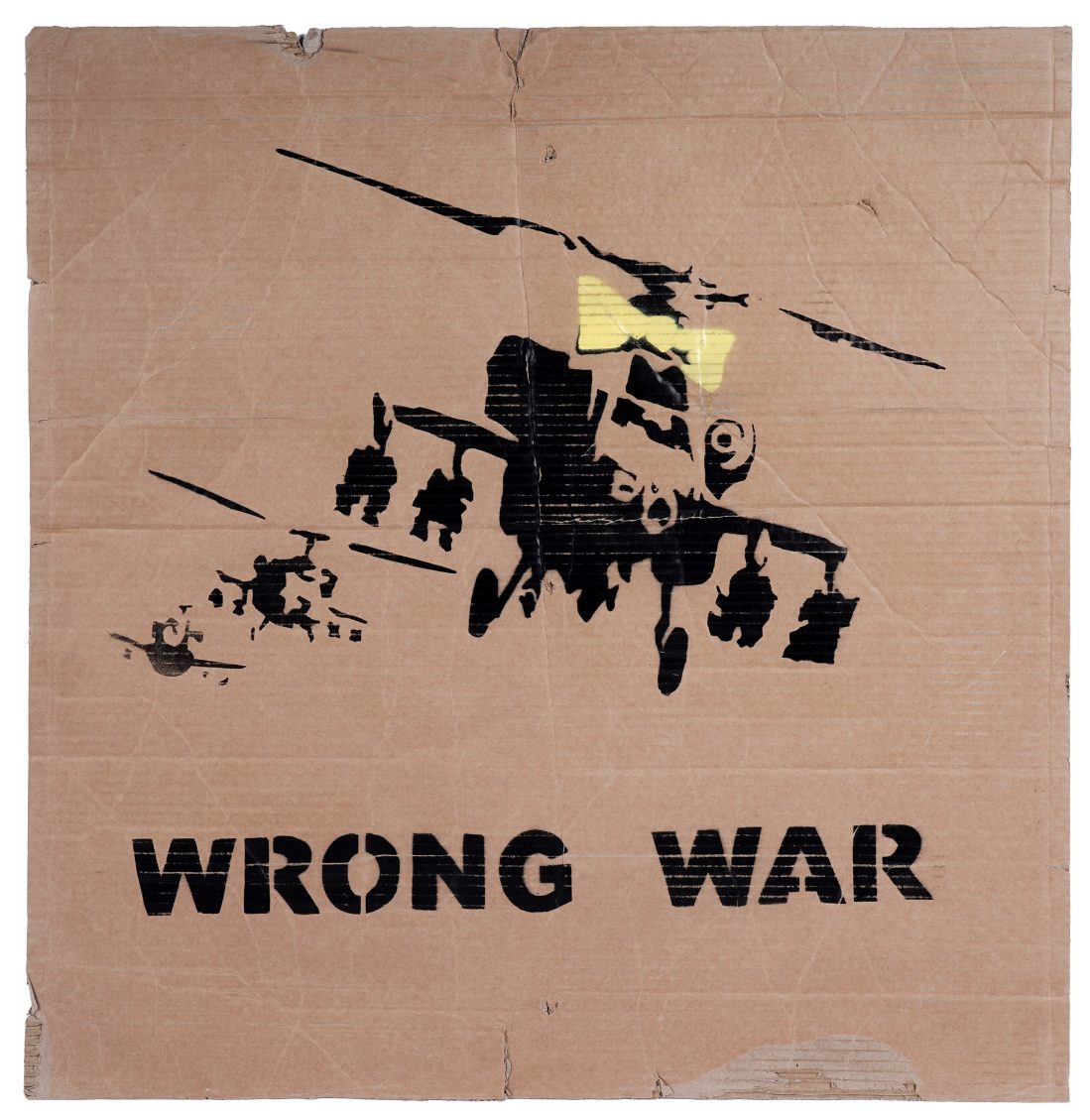
- Happy Choppers (Wrong War), 2003
- Spray paint on cardboard
- 74x74 cm (29x29 inches)
Prices are inclusive of buyer’s premium unless stated otherwise, as reported by the auction houses.
STAY INFORMED
Receive the latest news, exhibitions, artworks and market updates on Banksy.