HIS MASTER'S VOICE
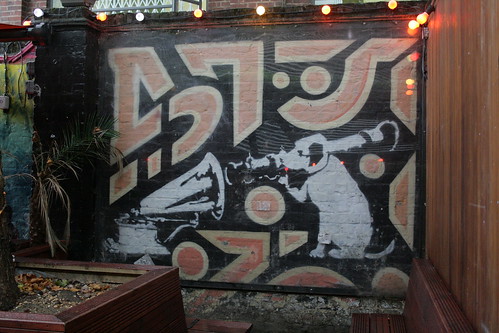
The mural is conventionally dated 2003, although recent academic research places the Cargo stencil in 2001.
Cargo, a well-known venue on Rivington Street in the middle of Shoreditch, in London, is built inside an old railway tunnel showcasing murals from many urban artists. Acclaimed as a local masterpiece, Banksy's work has been protected by perspex for about 15 years now and crowds still gather to see it.
Don't Listen to His Master's Voice
A small white dog sits obediently before an old-fashioned gramophone. The image is instantly familiar: it appropriates His Master's Voice, Francis Barraud's famous late nineteenth-century image of the terrier Nipper listening attentively to the recorded voice of his dead master, subsequently transformed into one of the most recognizable trademarks in the history of recorded music.
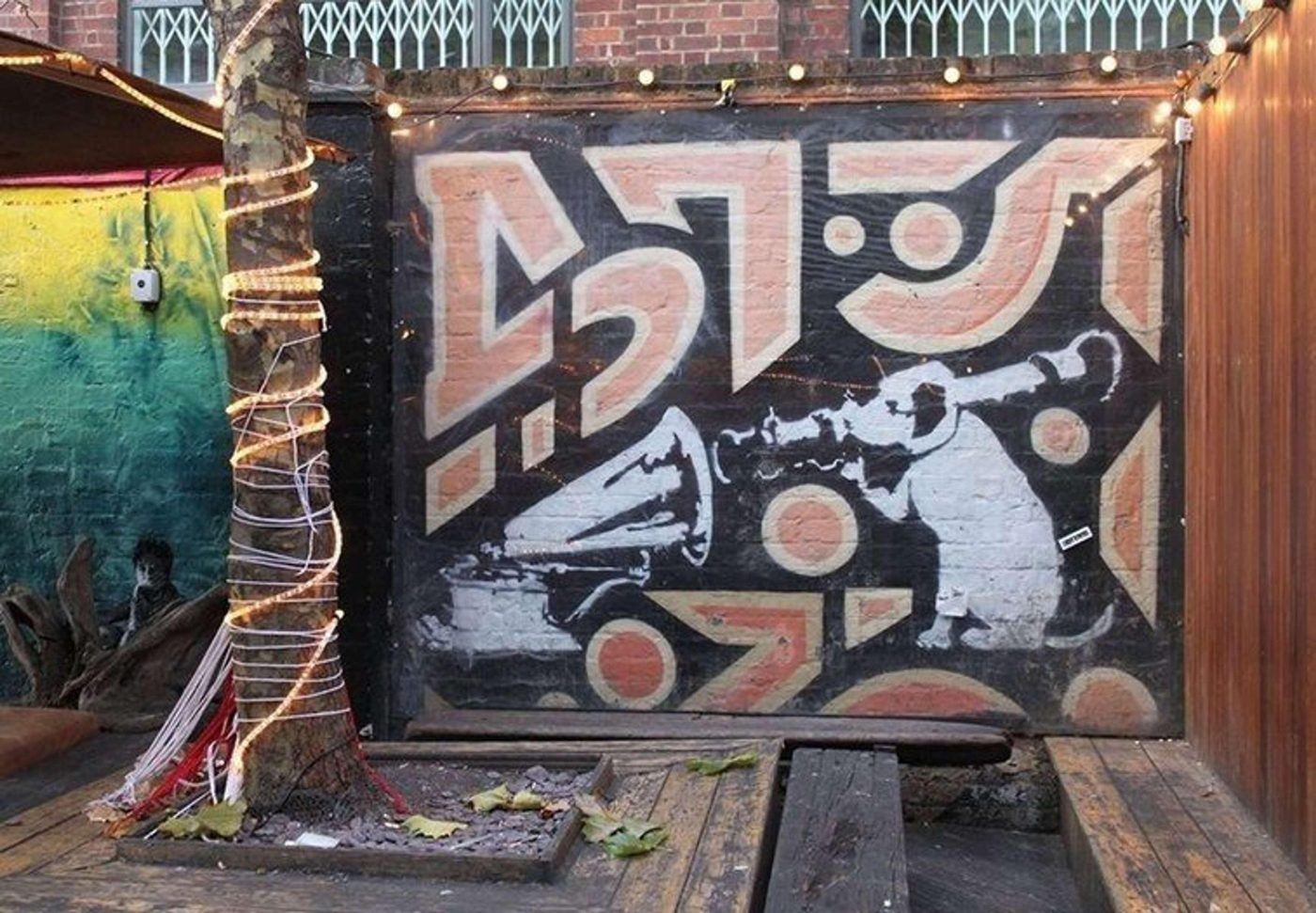
Banksy changes one thing, and everything changes. His dog is no longer listening. It is pointing a bazooka directly into the gramophone.
The reversal is wonderfully economical. Obedience becomes insurrection; the faithful consumer becomes the attacker; the master's voice is no longer something to be listened to but something to be silenced. Banksy takes an image built around loyalty to authority and turns it into an image of revolt against it.
Music, Authority and Rebellion
The choice of HMV was particularly resonant in early-2000s Britain. HMV was not an obscure historical reference but an enormously visible presence on British high streets and one of the dominant retailers through which recorded music was consumed. Banksy's dog therefore appears to attack several “masters” simultaneously: tradition, the established music business, corporate distribution and, more broadly, the expectation that audiences should simply consume what they are given.
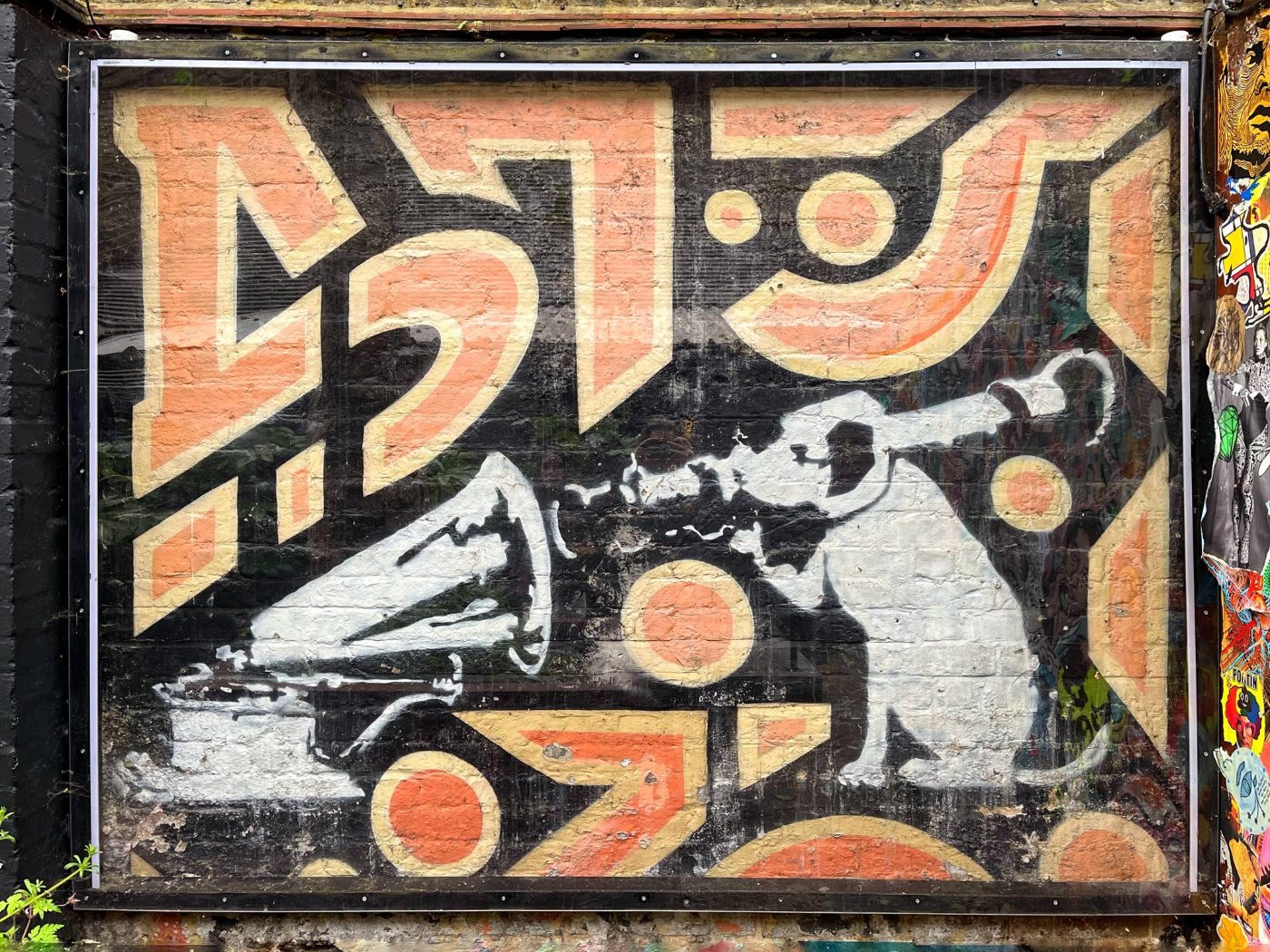
There is also a pleasing generational contradiction within the image. The gramophone belongs to the technological past; the rocket launcher belongs to modern warfare. Yet the animal caught between them remains the same obedient little dog. Banksy turns that obedience into refusal.
I would avoid claiming that the mural specifically predicts the death of physical music through digital technology. That has become a popular retrospective interpretation, but it is more precise to understand the image within Banksy's broader suspicion of authority and commercial culture. The fundamental proposition is simpler: stop listening to your master's voice.
A Banksy Inside a Graffiti Collaboration
The Cargo mural is particularly interesting because the Banksy we see today is not purely a Banksy composition. His monochrome dog and gramophone sit within a much larger field of angular orange, red and black lettering associated with the French graffiti writer Stylo. Academic research notes Stylo's signature on early photographs and concludes that the surrounding work was probably added shortly after Banksy's stencil.
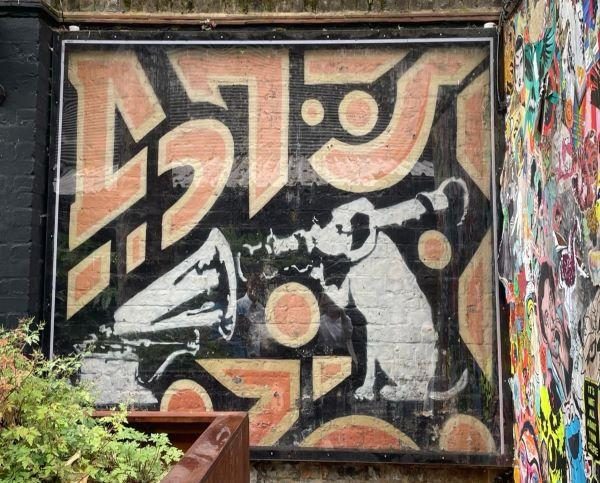
That distinction matters. Later reproductions of HMV—particularly the famous 2003 screenprint—strip everything away and leave dog, weapon and gramophone isolated against black. On Rivington Street, however, the image belongs unmistakably to graffiti culture. Banksy's crisp figurative stencil and Stylo's energetic letter forms occupy the same brick surface.
It is therefore a particularly valuable survivor from the period before Banksy's imagery became detached from the streets and endlessly reproduced as autonomous icons.
Still There
Unlike Girl with Balloon and Pulp Fiction, this early London Banksy still survives in its original location in the courtyard associated with Cargo at 83 Rivington Street, Shoreditch. It has long been protected behind transparent Perspex, although the work and its surroundings have inevitably aged. Recent documentation continues to record it at the site.
That makes His Master's Voice unusually important for Banksy Explained. We are not reconstructing a vanished mural from photographs. Visitors can still stand in front of essentially the same brick wall Banksy stencilled more than two decades ago.
His Master's Voice contains one of the clearest examples of Banksy's early visual method: appropriate an image everybody already understands, preserve almost everything about it, and alter one element so radically that the original meaning collapses. Nipper spent a century listening faithfully to his master's voice. Banksy gave him a bazooka.
Further reading: Art of the State is one of the longest-running independent archives documenting London street art and graffiti, with extensive first-hand photographic records of Banksy’s early works in situ. Their page on the surviving Cargo yard murals provides valuable historical context and images of HMV in its original Shoreditch setting.

STAY INFORMED
Receive the latest news, exhibitions, artworks and market updates on Banksy.