HOOLA-HOOP GIRL
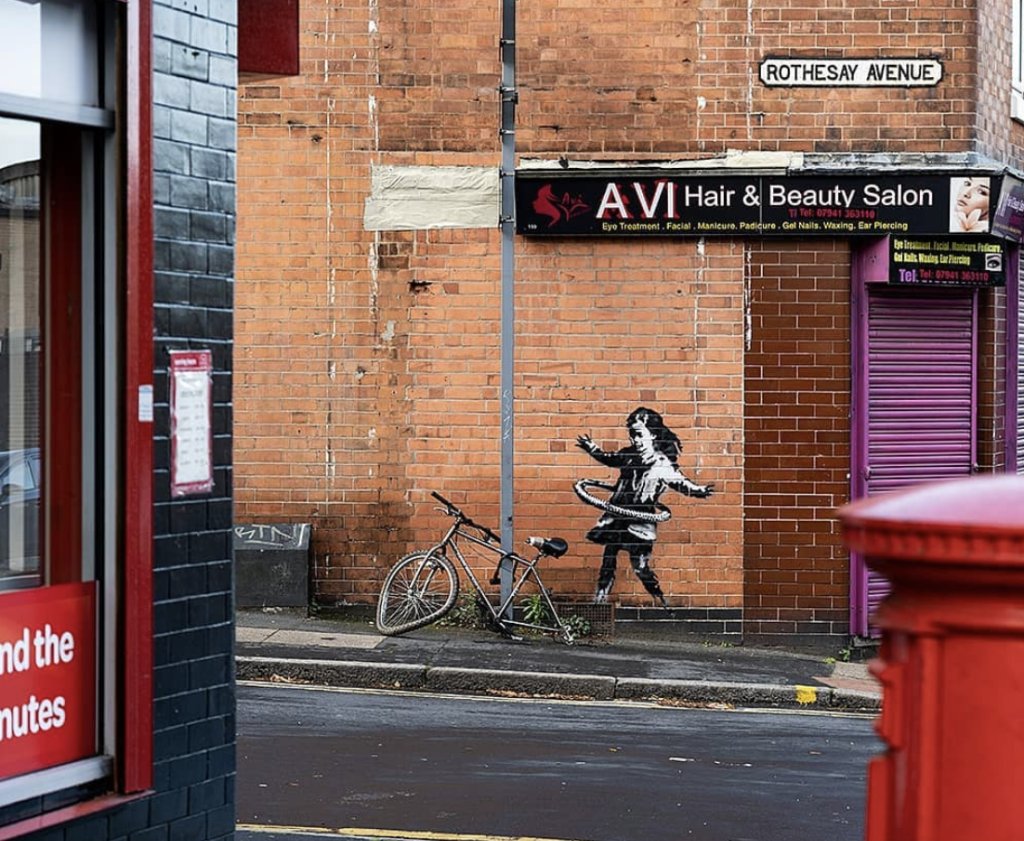
Hula-Hooping Girl
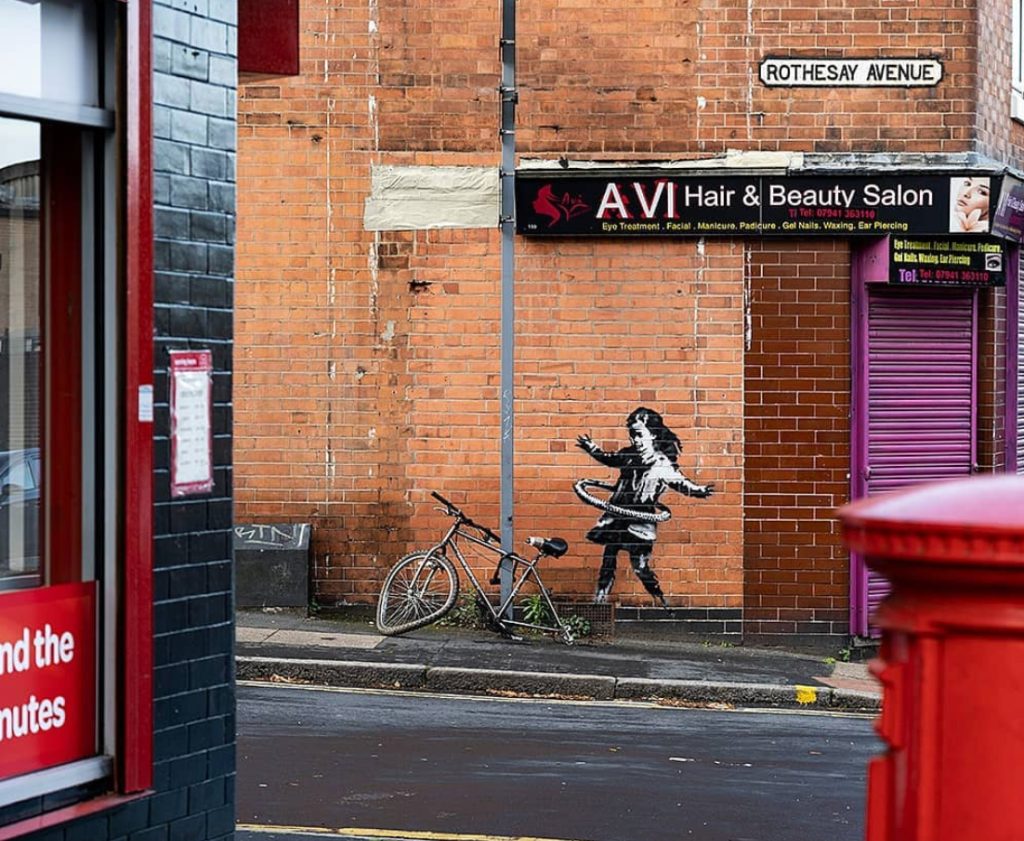
Appearing on the side of a building at the junction of Rothesay Avenue and Ilkeston Road in Nottingham on 13 October 2020, Hula-Hooping Girl depicts a young girl playing with a bicycle tire. Immediately beside the mural, a battered bicycle missing its rear wheel had been chained to a lamppost. Local residents reported that the bicycle appeared at approximately the same time as the painting, making the physical object an integral part of the original intervention rather than merely an accidental feature of its surroundings. After several days of speculation about the work's authorship, Banksy confirmed it on 17 October by publishing a photograph on his official Instagram account.
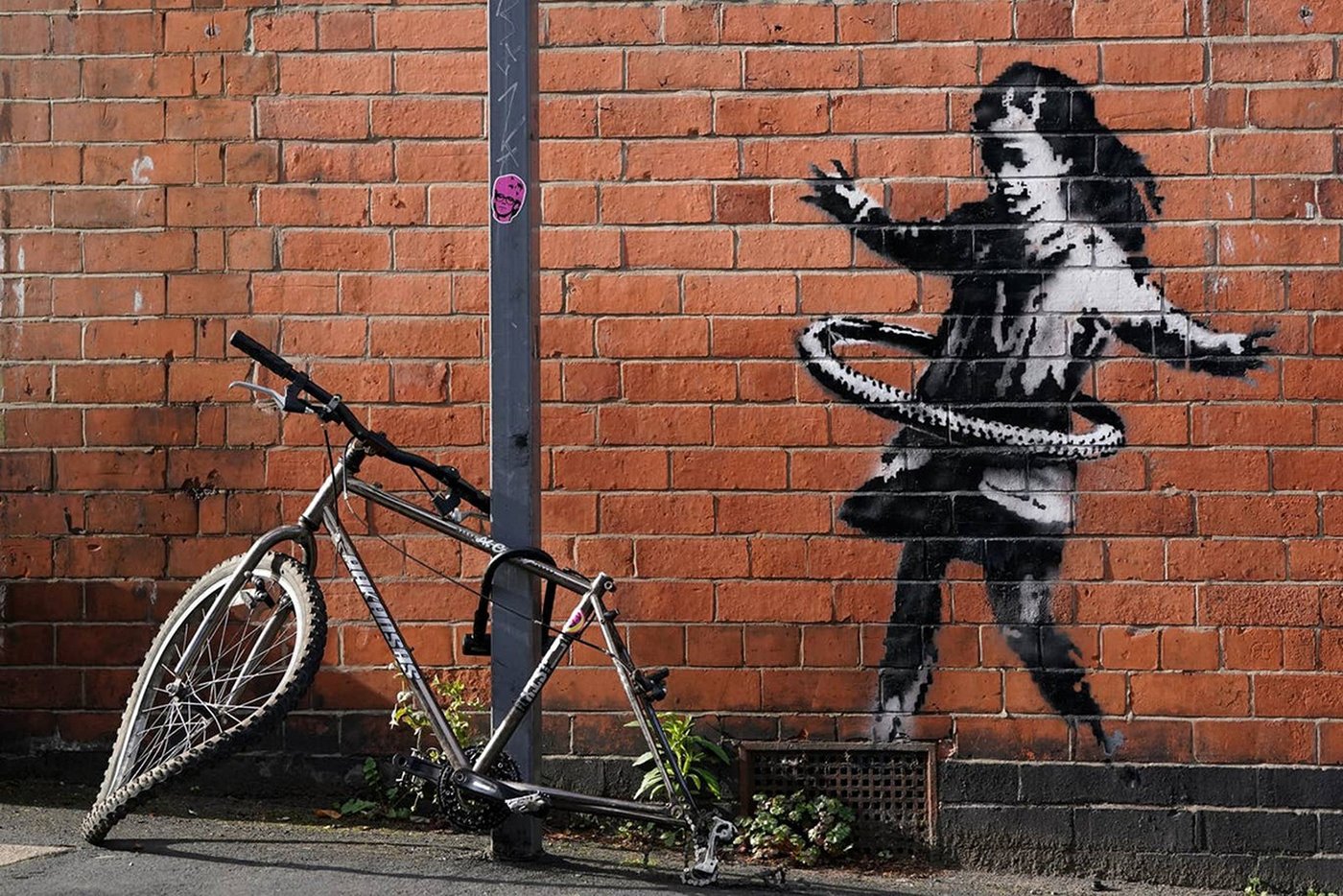
The image itself is exceptionally economical. The girl is rendered entirely in black and white, bending slightly forward as she guides the imaginary movement of the tyre around her waist. Banksy uses almost nothing beyond the figure and the adjacent bicycle to establish the narrative. The missing wheel appears to have crossed the boundary between the real world and the painted one: what is absent from the bicycle has seemingly been appropriated by the child on the wall.
This interaction between stencil and physical environment is central to the work. As in Spy Booth, where a real telephone box completes the scene, Banksy uses an existing—or deliberately introduced—three-dimensional object to extend the image beyond the painted surface. The bicycle, lamppost, pavement and mural functioned together as a small installation. Seen without the bicycle, the girl remains perfectly comprehensible, but the visual joke and much of the work's site-specific character are lost.
Play, Improvisation and the Pandemic
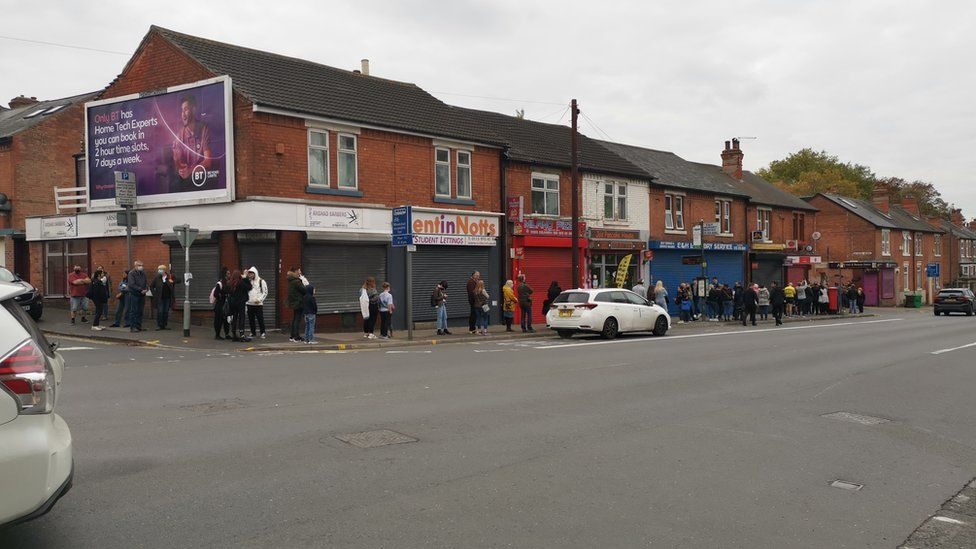
The work appeared during an exceptionally difficult moment for Nottingham. In October 2020, the city was experiencing some of the highest Covid-19 infection rates in England, with restrictions on everyday life tightening once again. Contemporary local commentary immediately interpreted the unexpected appearance of the mural as a welcome moment of optimism during the pandemic.
That context helps explain the work's emotional resonance, although it should not be turned into a definitive statement of Banksy's intention. Unlike the explicitly pandemic-related works Banksy produced earlier in 2020—such as his bathroom rats and If You Don't Mask – You Don't Get on the London Underground—Hula-Hooping Girl contains no direct reference to Covid-19. Its imagery is broader and more durable. A discarded or damaged object is transformed through imagination into a source of amusement; what appears useless to one person becomes valuable to another.
The work consequently belongs to a longstanding group of Banksy images in which children demonstrate an ability to reinterpret the adult environment. There is an obvious affinity with No Ball Games: in both compositions, a young figure converts an object that was never intended as a toy into an instrument of play. Yet the Nottingham work is gentler. There is no prohibition to overcome and no authority against which the child needs to rebel. The transformation occurs entirely through imagination.
Nottingham and the Bicycle
The choice of a bicycle also acquired particular resonance in Nottingham. The city has a profound historical association with Raleigh, one of Britain's most important bicycle manufacturers, whose vast Nottingham factory complex once employed thousands of workers. Local observers immediately wondered whether Banksy's image deliberately referred to that history.
There is no evidence that Banksy confirmed such an interpretation, so it should remain a contextual possibility rather than a statement of fact. Nevertheless, the association adds a distinctly local dimension to an otherwise universal image. A broken bicycle in a city historically synonymous with bicycle manufacturing becomes the raw material from which a child creates something new.
The mural's location outside an ordinary neighborhood business is equally important. Like many of Banksy's strongest street interventions, Hula-Hooping Girl did not require a monumental architectural setting. Its success depended instead upon the precise relationship between a small painted figure, a real bicycle and the pavement on which viewers stood. The work was immediately accessible, and crowds began gathering within days of its appearance. Nottingham City Council quickly installed transparent protection over the mural, which itself was soon targeted with spray paint.
The Disappearing Bicycle
The precarious relationship between the painted and physical components soon became evident. In November 2020, the original bicycle disappeared, initially prompting speculation that it had been stolen. Nottingham City Council subsequently explained that the building's owner had removed it for safekeeping. Another bicycle was soon placed at the site, restoring something resembling the original composition but inevitably altering Banksy's intervention.
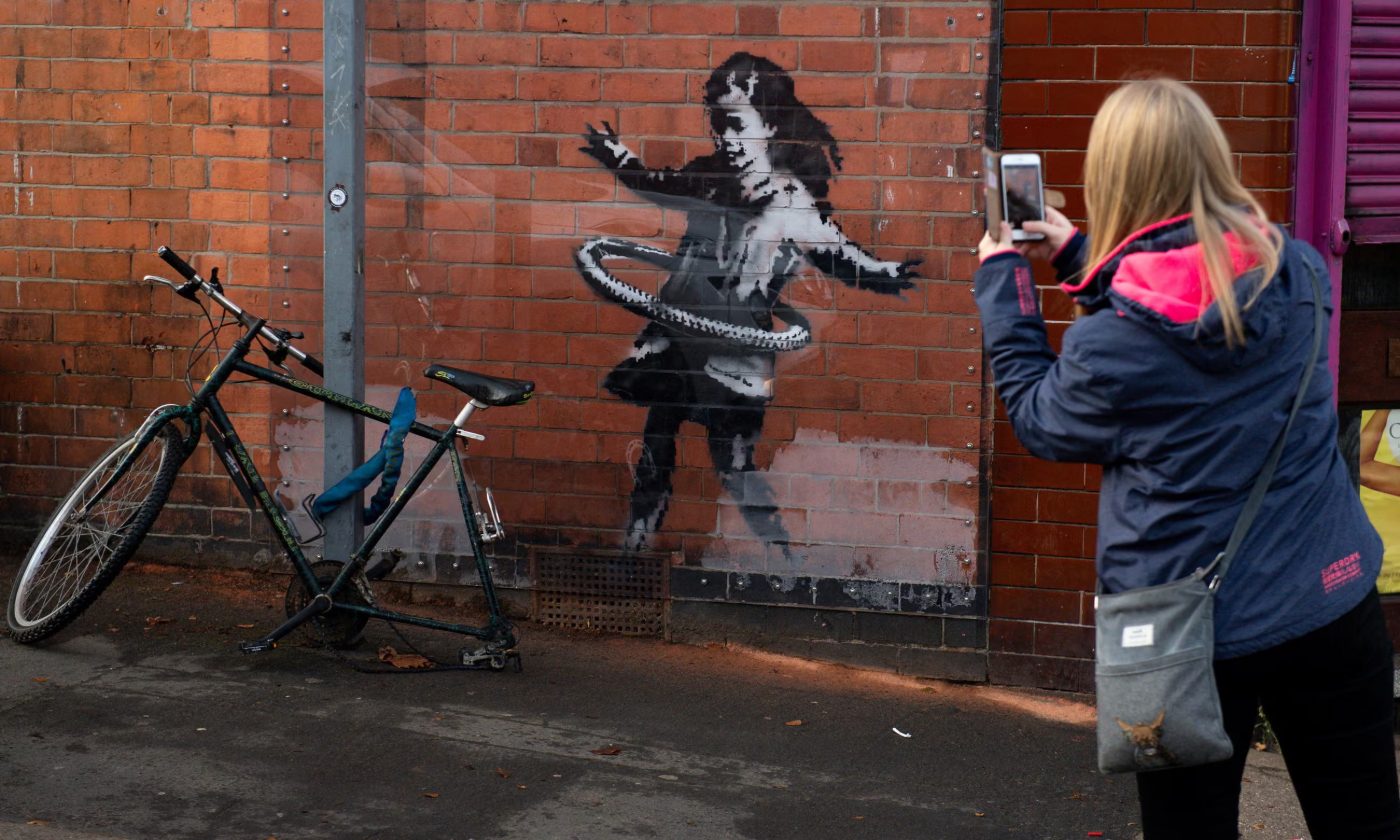
The episode raises an interesting question about where Hula-Hooping Girl actually begins and ends. If the bicycle was deliberately placed by Banksy or his collaborators—as its simultaneous appearance strongly suggests—then it was not simply contextual scenery but part of the work. Replacing it with another bicycle could recreate the visual joke, but not the original object.
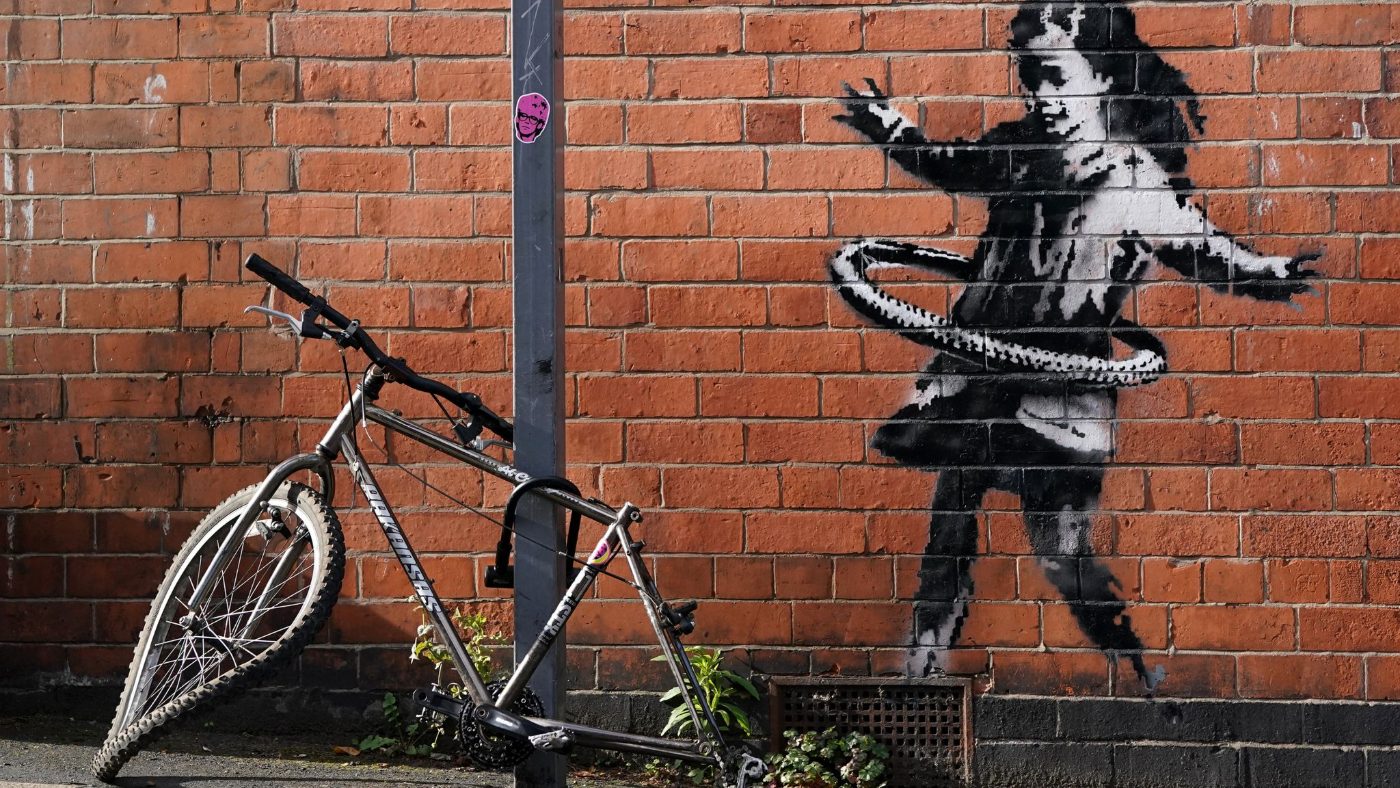
This distinction is particularly important for Banksy's site-specific works. Their identity can reside as much in temporary relationships between objects and architecture as in the stencil itself. Preserving the painted figure does not necessarily preserve the complete intervention.
Removal from Nottingham
The work's existence in its original location was remarkably brief. On 17 February 2021, only four months after it appeared, sections of the wall containing the mural were physically removed from the building. The work had been purchased by John Brandler of Brandler Galleries in Brentwood, Essex, for an undisclosed six-figure sum. Brandler argued that removal was necessary because moisture was developing behind the protective covering and threatened the mural's survival.
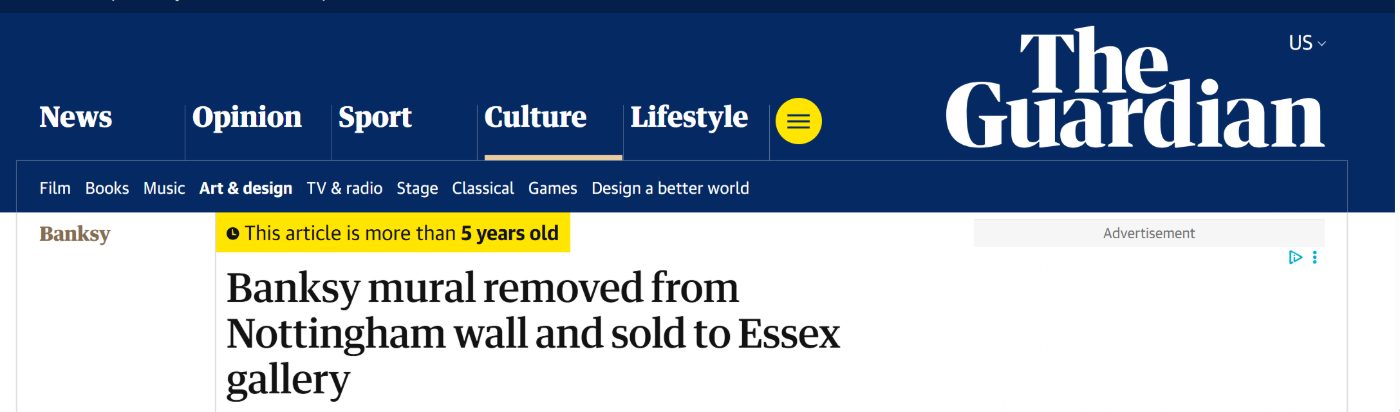
The decision disappointed many local residents who had hoped the work would remain in Nottingham. Its removal once again exposed the unresolved tension surrounding Banksy's street art: an image may be given freely to the public realm, but the physical wall generally belongs to someone else. Once the cultural and financial value of the image becomes apparent, the wall itself can effectively become an art object.
The case is particularly revealing because Hula-Hooping Girl depended so heavily upon its surroundings. Removing the painted section could preserve Banksy's stencil, but it could not preserve the original relationship between girl, bicycle, lamppost, pavement and neighborhood. Conservation of the physical image therefore involved the loss of part of the work's original meaning.
Takeaways
Hula-Hooping Girl is one of Banksy's quieter street works, and its strength lies precisely in that restraint. There is no slogan, explicit political target or elaborate narrative. A broken bicycle and a painted child are sufficient. Through their juxtaposition, an object defined by what it has lost becomes the source of something playful.
The mural also illustrates Banksy's continuing interest in collapsing the boundary between representation and reality. The wheel apparently migrates from the physical bicycle into the pictorial world of the girl, connecting three-dimensional street furniture with the flat surface of the wall. That simple device turns the surrounding street into part of the composition.
Its subsequent removal makes this relationship especially important. The stencil could be cut from the Nottingham wall, conserved and displayed elsewhere, but the original intervention could not travel with it. Like Spy Booth, No Ball Games and several other Banksy murals that have entered private ownership, Hula-Hooping Girl poses a fundamental question about site-specific street art: when the image survives but the place is removed from it, how much of the original work remains?
STAY INFORMED
Receive the latest news, exhibitions, artworks and market updates on Banksy.