KEEP BRITAIN TIDY
The Perfect Vandal
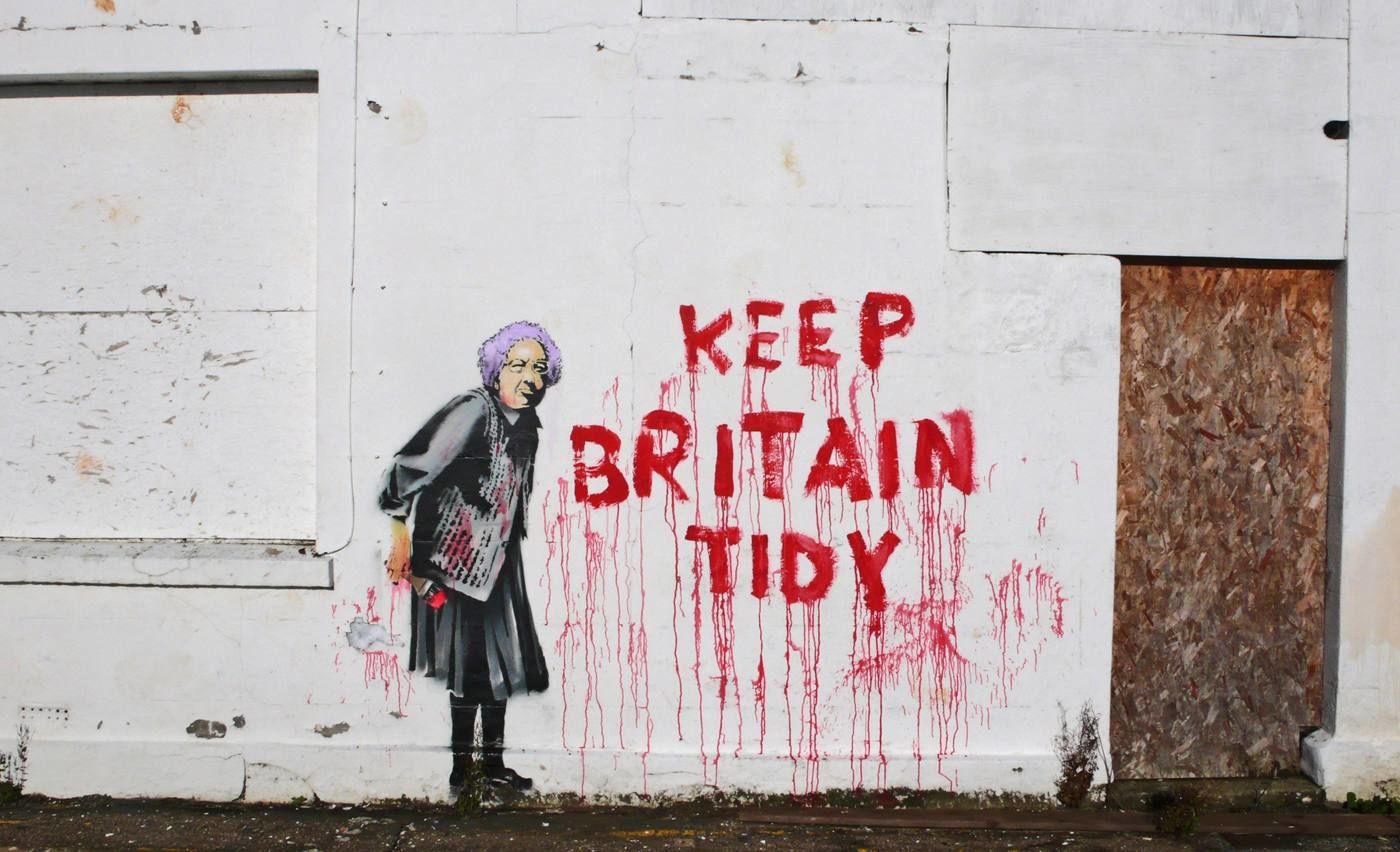
Appearing on a boarded-up building on Lift Road in Shanklin on the Isle of Wight in October 2010, Keep Britain Tidy presents one of Banksy's characteristic inversions of social expectation. An elderly woman, conservatively dressed in a dark skirt, cardigan and sensible shoes, stands beside the enormous words KEEP BRITAIN TIDY, freshly sprayed in dripping red paint. Her lilac hair and almost grandmotherly appearance make her an improbable graffiti writer, yet the spray can in her hand leaves little doubt as to who has just vandalized the wall.
The contradiction is beautifully economical. “Keep Britain Tidy” belongs to the language of civic responsibility, public-information campaigns and respectable behaviour, yet Banksy delivers the instruction through precisely the activity normally condemned as making Britain untidy. The lettering is deliberately uncontrolled: red paint runs down the wall in long drips, splashes surround the woman's feet, and the supposedly responsible message becomes the most visually disorderly element in the composition.
Banksy and Keep Britain Tidy
There is a particularly good historical joke behind the choice of slogan. Keep Britain Tidy had publicly criticized Banksy's work as vandalism. In 2007, The Guardian reported the organization's description of his work as “pure vandalism,” while an earlier profile quoted a spokesman asking how Banksy would feel if somebody sprayed graffiti over his own house.
Seen against that background, Keep Britain Tidy becomes more pointed than a generic joke about cleanliness. Banksy effectively appropriates the language of an organization that had condemned the very activity through which he became famous. The elderly woman further complicates the argument by separating vandalism from the stereotype of the vandal. She looks like precisely the person one might expect to complain about graffiti rather than produce it.
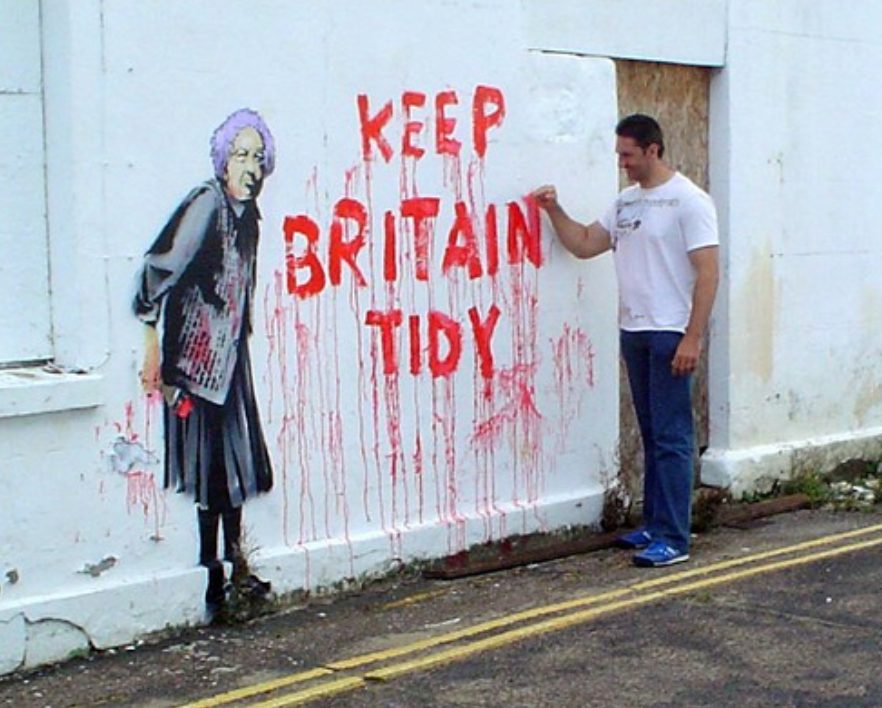
The work therefore asks a familiar Banksy question: does our judgment depend upon the act itself, or upon who we imagine performing it? The respectable pensioner and the illegal graffiti writer become the same person, while an instruction promoting civic order becomes an act of civic disorder.
A Very Short Life
The mural had an appropriately Banksy-like afterlife. Local authorities apparently treated it as exactly what its fictional author had produced: graffiti. It was painted over shortly after appearing, and the work no longer survives. The building remained boarded and painted white; later documentation of the site records a metal fence standing in front of it.
That destruction adds an unintended final layer to the work. Banksy painted a mural mocking the distinction between cleanliness and vandalism; the authorities then restored “tidiness” by erasing it. In doing so, they effectively completed the argument contained within the image.
Keep Britain Tidy is a relatively simple Banksy mural, but an exceptionally efficient one. The elderly vandal, the violently dripping lettering and the history of criticism from Keep Britain Tidy allow Banksy to compress a larger debate about graffiti and public space into a single comic scene. Who decides what belongs on a wall? When does an intervention constitute vandalism, and when does it become something worth preserving?
Shanklin answered those questions rather quickly. The wall was cleaned, the Banksy disappeared, and Britain was tidy again. Which, of course, was the joke.
STAY INFORMED
Receive the latest news, exhibitions, artworks and market updates on Banksy.