INSANE CLOWN
Catalogue Note
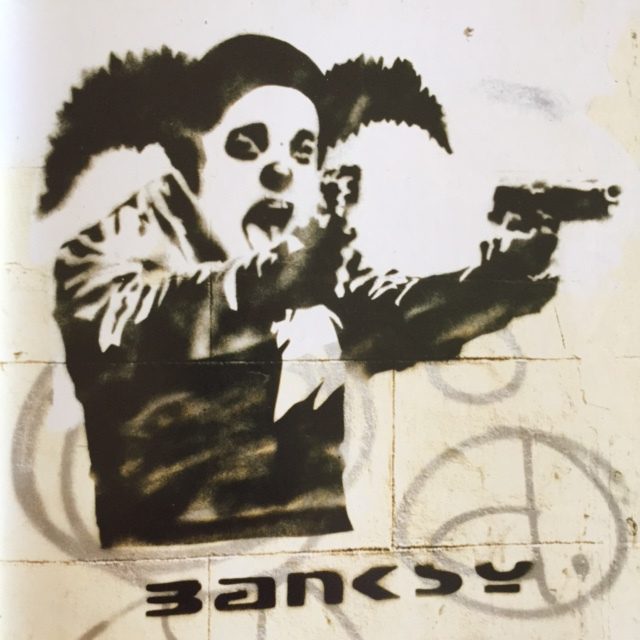
Insane Clown belongs to the small group of murals Banksy produced in Bristol during 1998, when he was still developing the visual language that would define his mature work. The image depicts a clown holding a firearm, bringing together two immediately recognizable but fundamentally incompatible symbols: the clown as a figure of entertainment, humor and childhood, and the weapon as an instrument of violence and intimidation. The contradiction is simple, but it already demonstrates Banksy's ability to construct an image around a visual collision that can be understood almost instantaneously.
The work is particularly interesting in retrospect because this juxtaposition of innocence and violence would become one of the recurring structures of Banksy's imagery. Children carry weapons, embrace bombs or encounter soldiers; familiar characters from popular culture are placed in threatening circumstances; symbols normally associated with happiness or reassurance are made deliberately unstable. In Armed Clown, the transformation is achieved with remarkable economy. Banksy does not need to explain why the figure is armed: the incongruity itself creates the tension, while the absurdity prevents the image from becoming straightforward political propaganda.
The mural also belongs to an important transitional period in Banksy's technique. During the late 1990s he was increasingly adopting stencils as a means of producing more complex images rapidly in the street, although his early works could still combine stencil, freehand painting and existing graffiti practices. Armed Clown already reveals the advantages that would make the stencil central to his practice: a recognizable figure can be reduced to strong contrasts, reproduced quickly and read immediately from a distance.
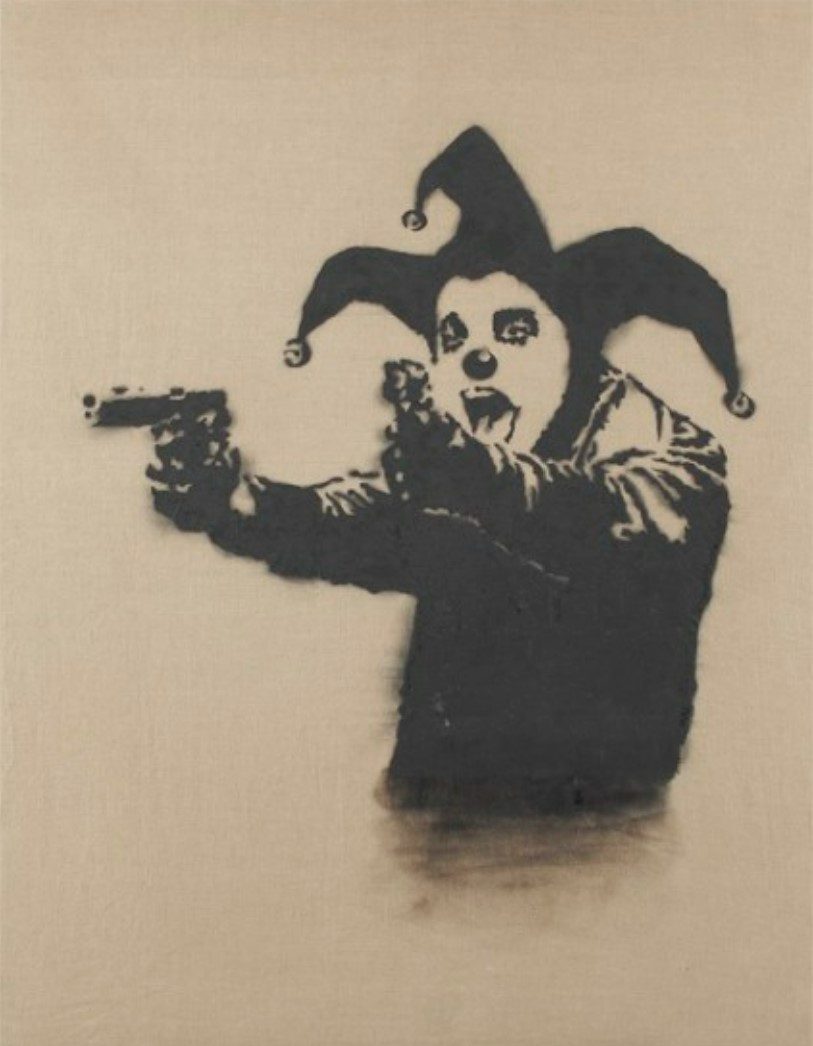
Seen alongside the other Bristol works of 1998 and 1999, Insane Clown provides an early indication of how quickly Banksy's vocabulary was taking shape. Weapons, political figures, police, surveillance, animals and black humor all begin to appear during these years. The individual murals were often temporary and many have subsequently disappeared, but collectively they document the emergence of an approach in which a familiar image is altered by one carefully chosen contradiction, allowing humor to become the vehicle for a more unsettling observation.
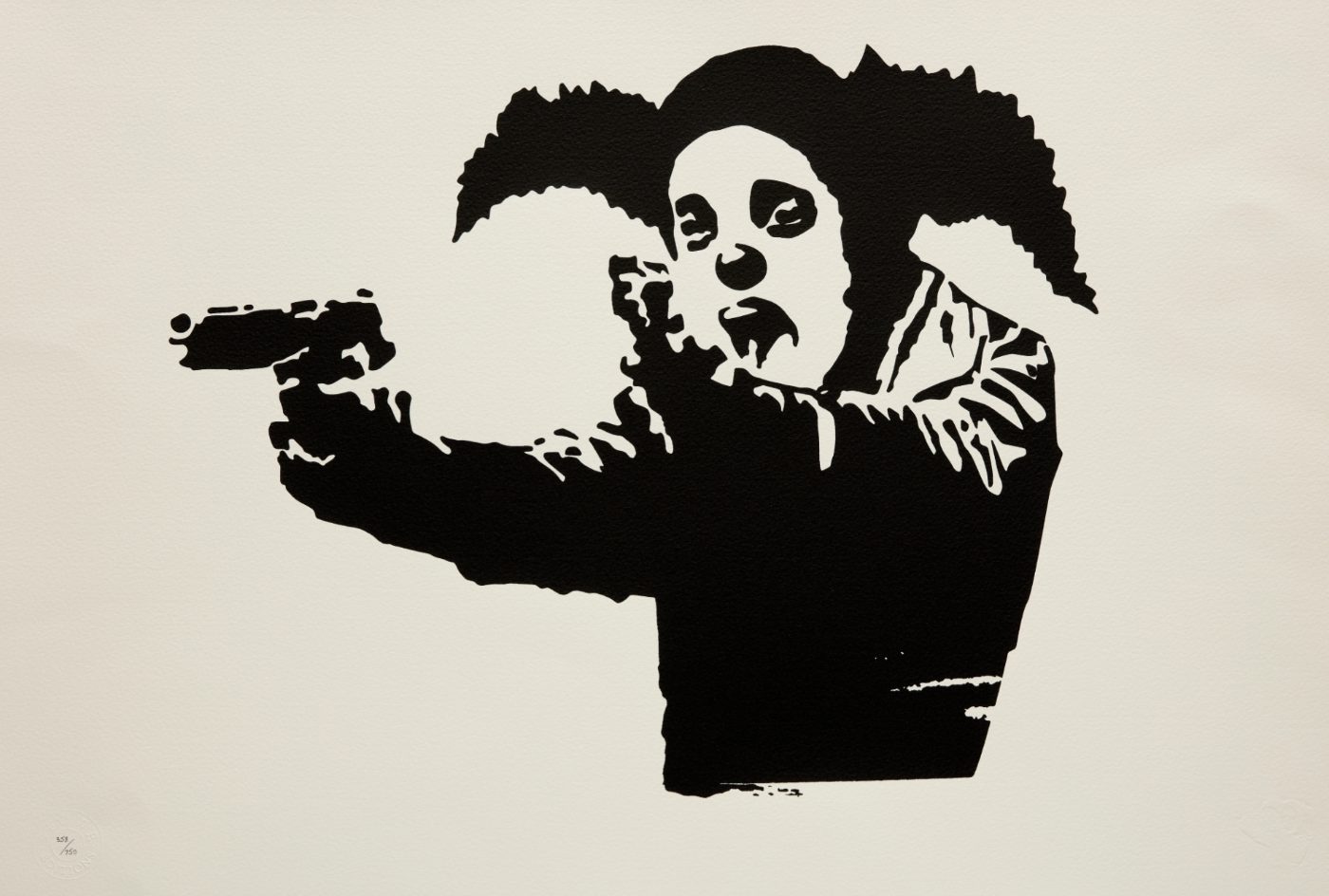
The armed-clown motif did not disappear with Banksy's early Bristol street work. In 2000, during his association with the newly established Clown Skateboards, Banksy created another gun-wielding clown image that became closely associated with the company. Clown's founders, Jeff Boardman and Vikas Malik, had been involved with Banksy around his early Rivington Street activities in London and subsequently asked him to produce artwork for their new skateboard brand. Banksy's Gun Clown, a different composition from the 1998 Bristol mural, was used on the company's early boards and became one of the enduring images associated with Clown Skateboards. More than two decades later, the design was revisited in officially licensed skateboard releases and, in 2022, as a limited screenprint published by Stowe Gallery.
STAY INFORMED
Receive the latest news, exhibitions, artworks and market updates on Banksy.