JAIL BREAK
An Impossible Escape
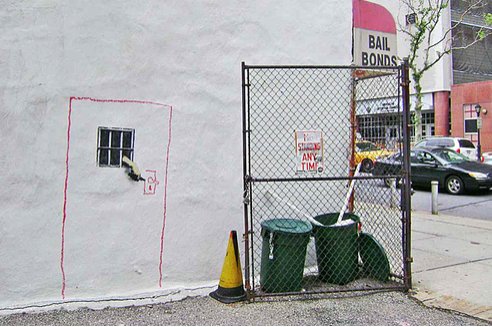
A solitary arm reaches through the bars of what appears to be a prison window. In its hand is a piece of chalk or drawing implement with which the unseen prisoner is sketching the outline of a door handle onto the wall beside the cell. There is no real door and therefore no conventional means of escape. The prisoner simply draws one.
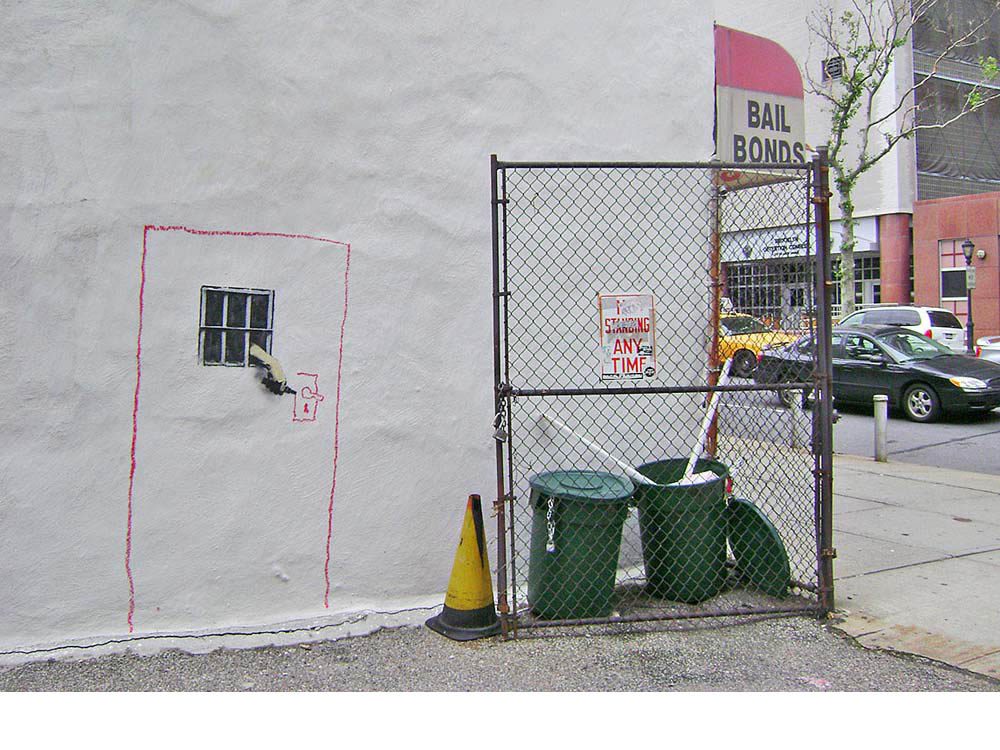
Jail Break is one of Banksy's most economical images of freedom. The physical architecture represents confinement—bars, masonry and an inaccessible exterior—while the tiny drawn handle proposes an escape based entirely upon imagination. Rather than breaking through the wall, the prisoner attempts to redraw the conditions imposed upon him.
The Bail Bonds Building
The stencil appeared in New York in 2010 on the exterior of a bail bonds business, positioned where a secondary door might naturally have existed. This location was fundamental to the work. Contemporary descriptions of the mural and the later Bonhams catalogue for Banksy's studio version both identify the original site as a bail bonds building.
That context turns a simple visual joke into something sharper. A bail bonds office exists precisely at the intersection between incarceration and temporary freedom: it facilitates release from custody, but only through a financial transaction. Banksy's imaginary door handle therefore appears on a building whose business is, quite literally, helping people get out of jail.
The precise street address and execution date do not appear to be securely documented in the reliable contemporary material I can find, so 2010 / New York City remains the most defensible catalogue dating and location rather than assigning a more precise date without evidence.
Drawing a Way Out
The work belongs to a recurring Banksy theme in which apparently immovable structures of authority are defeated through small acts of ingenuity. There is no spectacular prison break here. Almost nothing is visible of the prisoner himself. Instead, Banksy reduces the idea of liberation to an arm, a few bars and the outline of a handle.
The contrast between the solidity of the wall and the fragility of the drawing is what gives the image its force. A prison is among the most literal manifestations of institutional power: its purpose is to determine where a body can and cannot go. Banksy's prisoner responds by treating that supposedly fixed architecture as though it were merely another surface capable of being altered.
There is also an obvious parallel with graffiti itself. A graffiti artist cannot physically reconstruct the city, but can temporarily transform its meaning by drawing upon it. In Jail Break, Banksy makes that principle literal: if the architecture does not provide an exit, draw one.
From the Street to the Studio
The image did not remain confined to the New York wall. Banksy produced two unique gallery works incorporating variations of the same motif in 2010, demonstrating that Jail Break was conceived as more than a single street intervention.
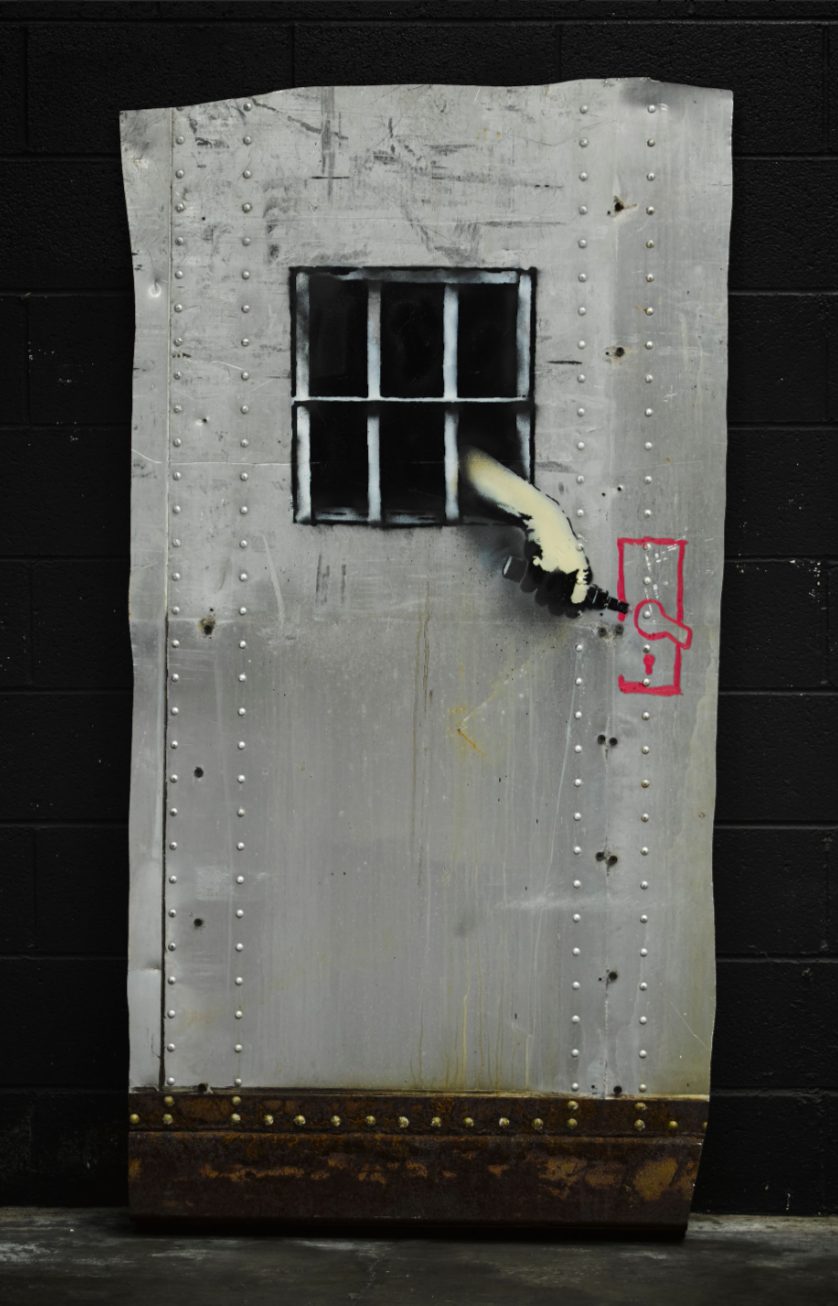
The best documented example was executed in stencil spray paint and household gloss directly onto a large found metal prison door. It was acquired directly from Banksy in 2012 and subsequently belonged to snowboarder Shaun White. It sold at Bonhams London on 8 March 2017 for £185,000.
The material transformation is particularly effective. On the New York wall Banksy created the illusion of imprisonment; in the studio work he appropriated the physical architecture of confinement itself. The rusted steel, rivets and barred opening are no longer represented—they are real. Against that uncompromising material weight, the prisoner's modest drawn handle becomes even more improbable.
Jail Break ultimately reduces one of Banksy's recurring ideas to its simplest possible form: authority builds the wall; imagination draws the way through it.
STAY INFORMED
Receive the latest news, exhibitions, artworks and market updates on Banksy.