KEEP OU T, 2019
Provenance
- Private Collection (acquired directly from the artist in 2019)
- Acquired from the above by the present owner
Auction History
Prices are inclusive of buyer’s premium unless stated otherwise, as reported by the auction houses.
Catalogue Note
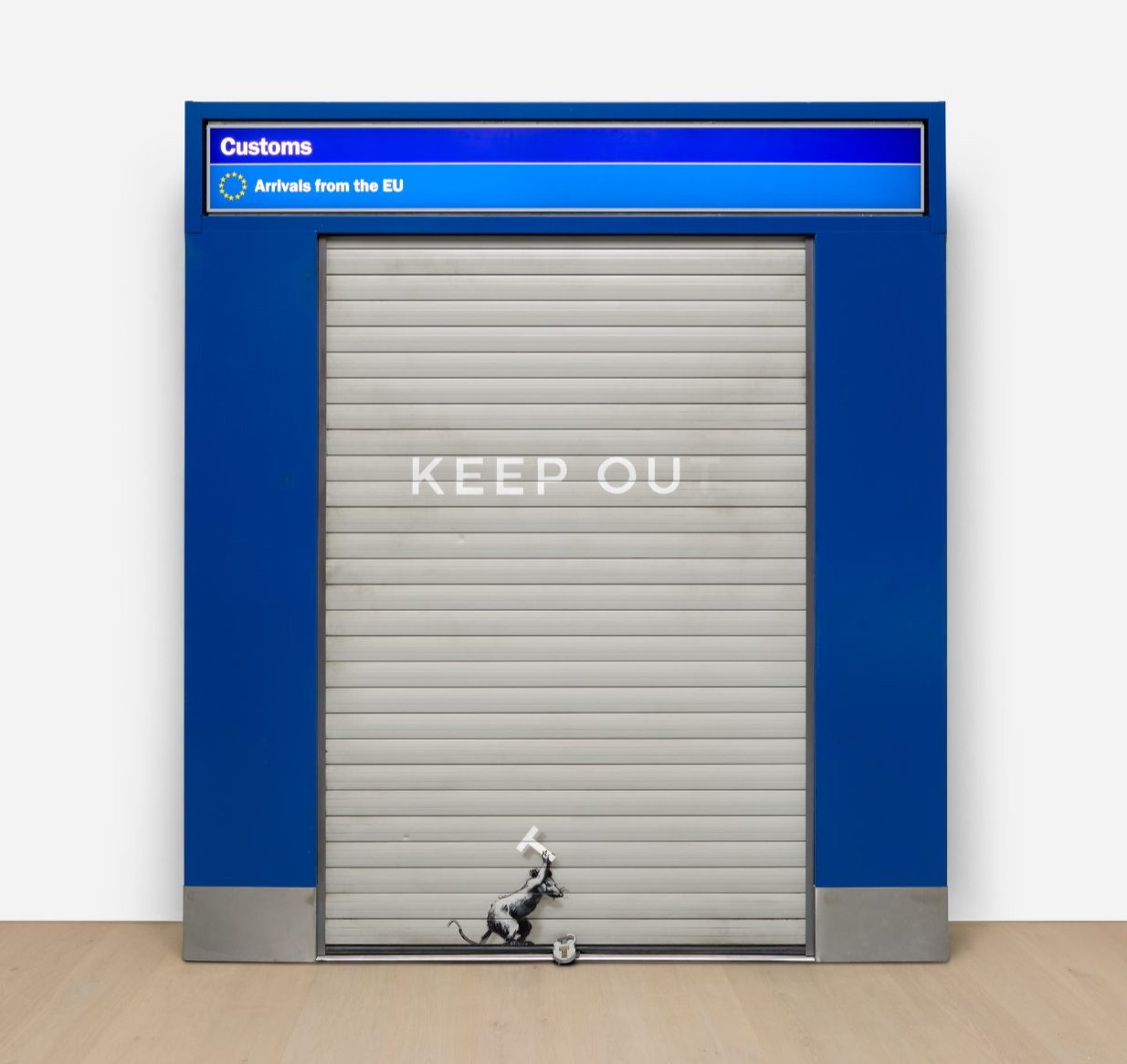
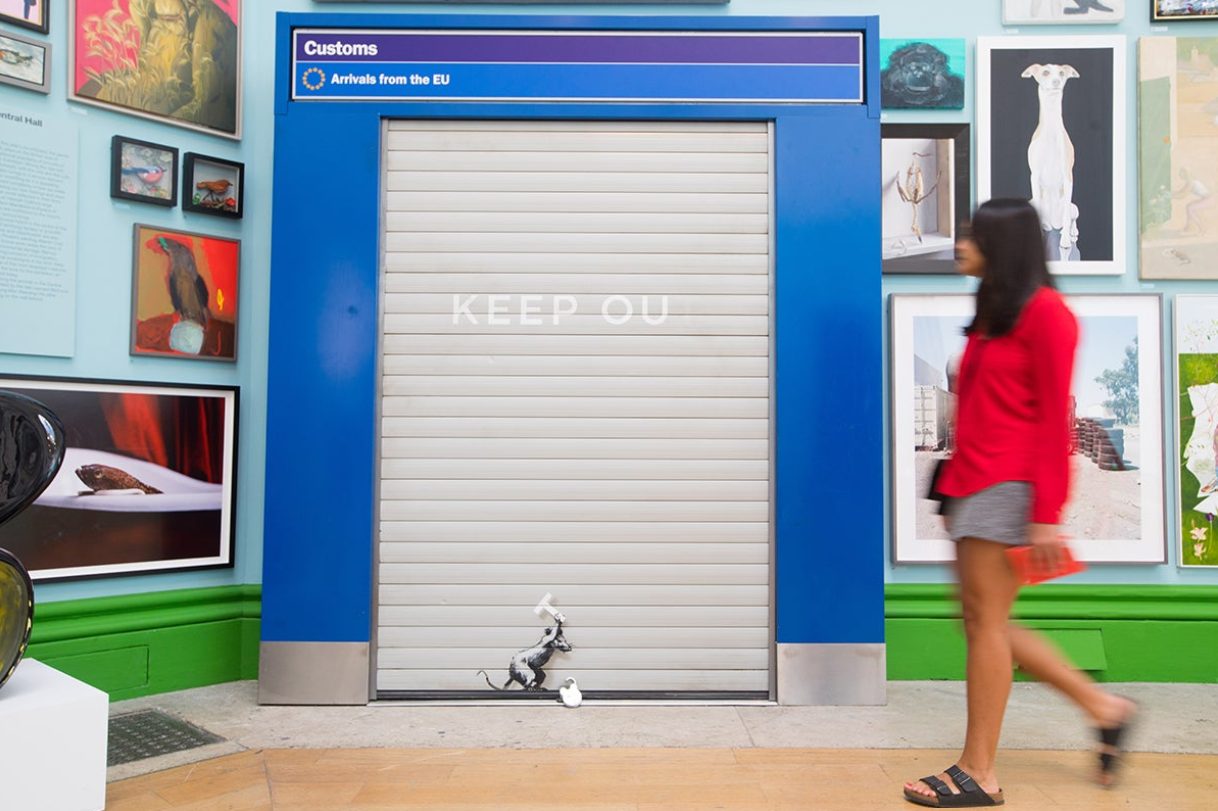
Across the ages, there are singular figures whose use of visual culture uncompromisingly addresses contemporary life — as a means of rousing discourse and looking within society. Characterizing this insistence on sharp and shrewd critique, Keep Ou T fully embodies Banksy’s playful, satirizing commentary. Taking on one of the most landmark and polarising British referendums of the twenty-first century, Keep Ou T first publicly debuted to the excitement of the British media at the Royal Academy of Arts Summer Exhibition in 2019 and is offered for the first time at auction.
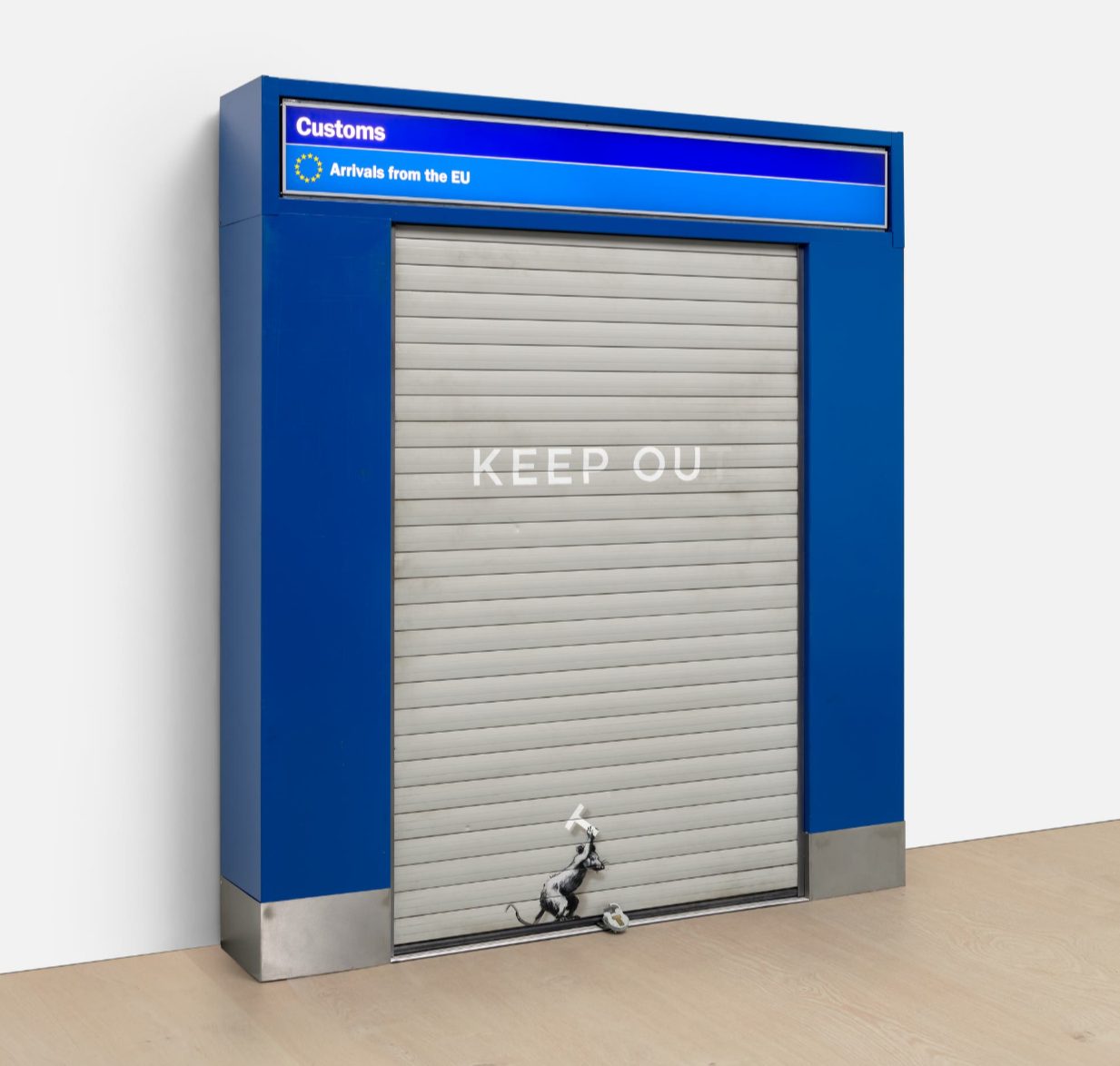
Reported on as it was unveiled in the Guardian, the Independent and Sky News among other publications, Keep Ou T is one of only two instances that the artist has participated in the esteemed show and features some of Banksy’s most recognized themes and motifs, utilizing jest, controversy and direct imagery to capture the attention of a splintered audience.
The Brexit Referendum
Executed in 2019, Keep Ou T belongs to a cycle of works that Banksy created in response to the British vote to leave the European Union in June 2016.
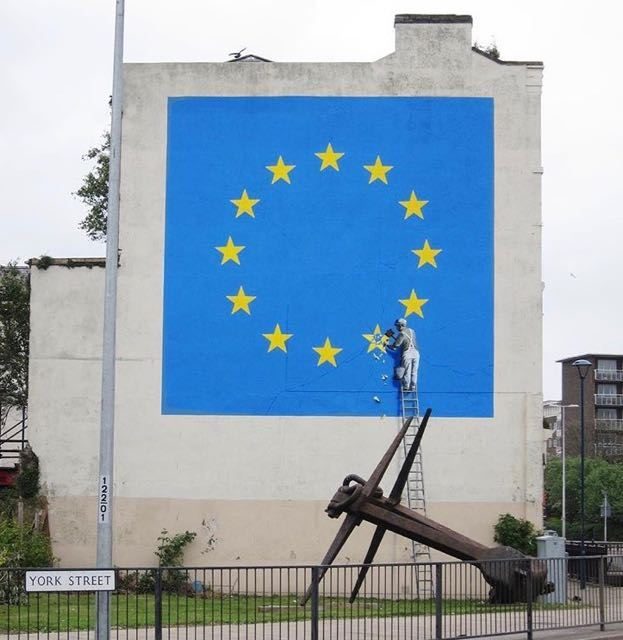
Simultaneous to the debate that divided public opinion and descended into acrimonious conflict far beyond the referendum, Banksy produced the major mural in Dover of a workman chiseling away at the European Union flag in 2017.
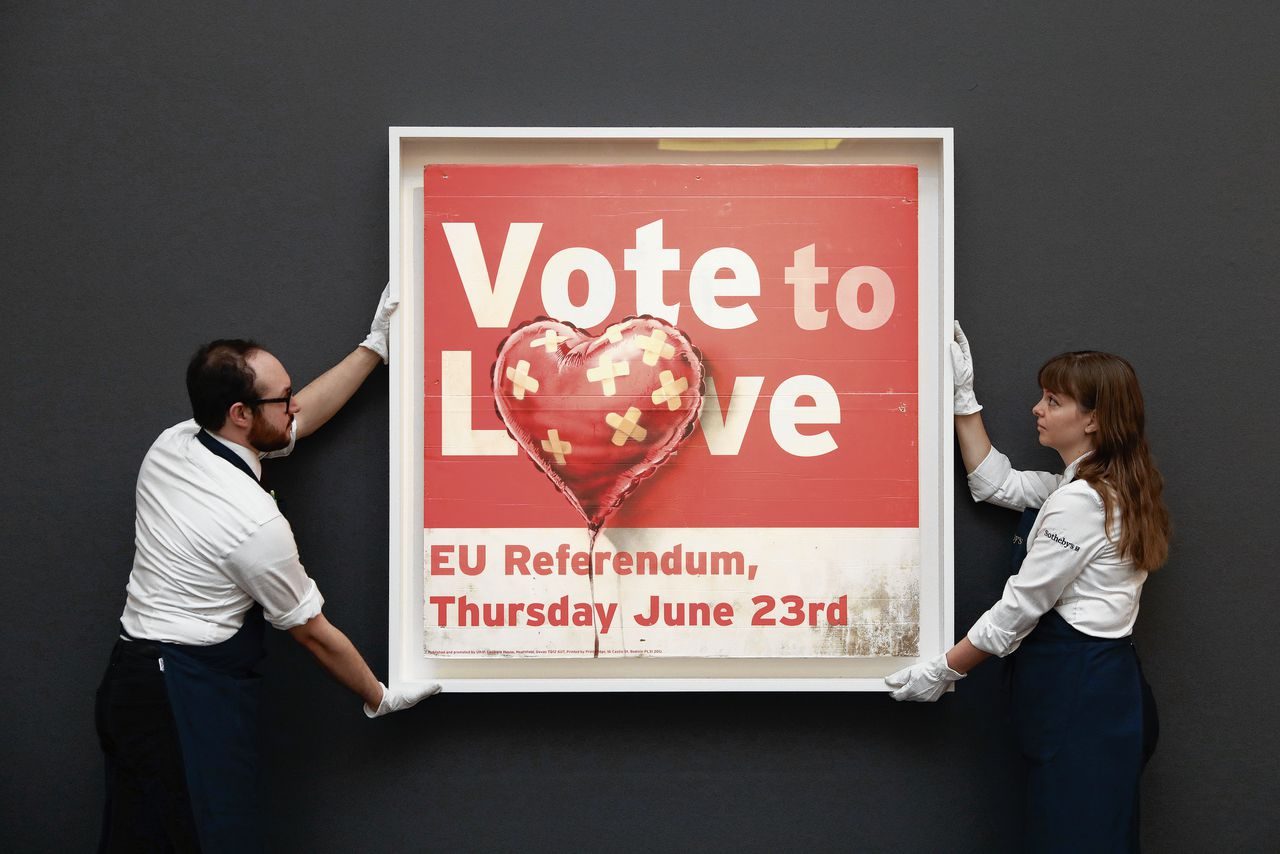
Followed in close sequence to Banksy’s Brexit-themed painting Vote to Love debuted at the artist’s inaugural Summer Exhibition at the Royal Academy of Arts in 2018, Keep Ou T was realized the following year. Signaling the second and final appearance of Banksy to date in the annual presentation at the Royal Academy, for Keep Ou T the artist once again utilized a stencil technique. Sharing the wit and ingenuity of Marcel Duchamp who through his readymades legitimized the ability of the everyday object to become a work of art, centring conceptual value over pure technical accomplishment, Banksy continues to summon Duchamp’s irreverence through contemporary popular culture.
Using an arch from customs purported to have been salvaged from London’s Heathrow airport, across its shutters a stenciled rat brazenly wields the letter ‘T’ from the phrase ‘KEEP OU’ to break open the padlock. Alluding to the discourse on immigration and freedom of movement that dominated the political campaign, Keep Ou T is a chilling prompt and prescient mirror to our own times.
Banksy's Rats
Standing as a provocateur, a cunning foil to the establishment and invoking the very essence of Banksy’s renegade spirit, the rat in Keep Ou T is one of the artist’s most enduring and immediately recognizable symbols. Long associated with squalor, disease, harbingers of doom or synonymous with the Black Death, for Banksy the rodent becomes an antihero, endearing in their mischief and artifice. In spite of their modest size, the rat is proven capable of invoking maximum impact.
“They exist without permission. They are hated, hunted, and persecuted. They live in quiet desperation amongst the filth. And yet they are capable of bringing entire civilizations to their knees. If you are dirty, insignificant and unloved then rats are the ultimate role model.”
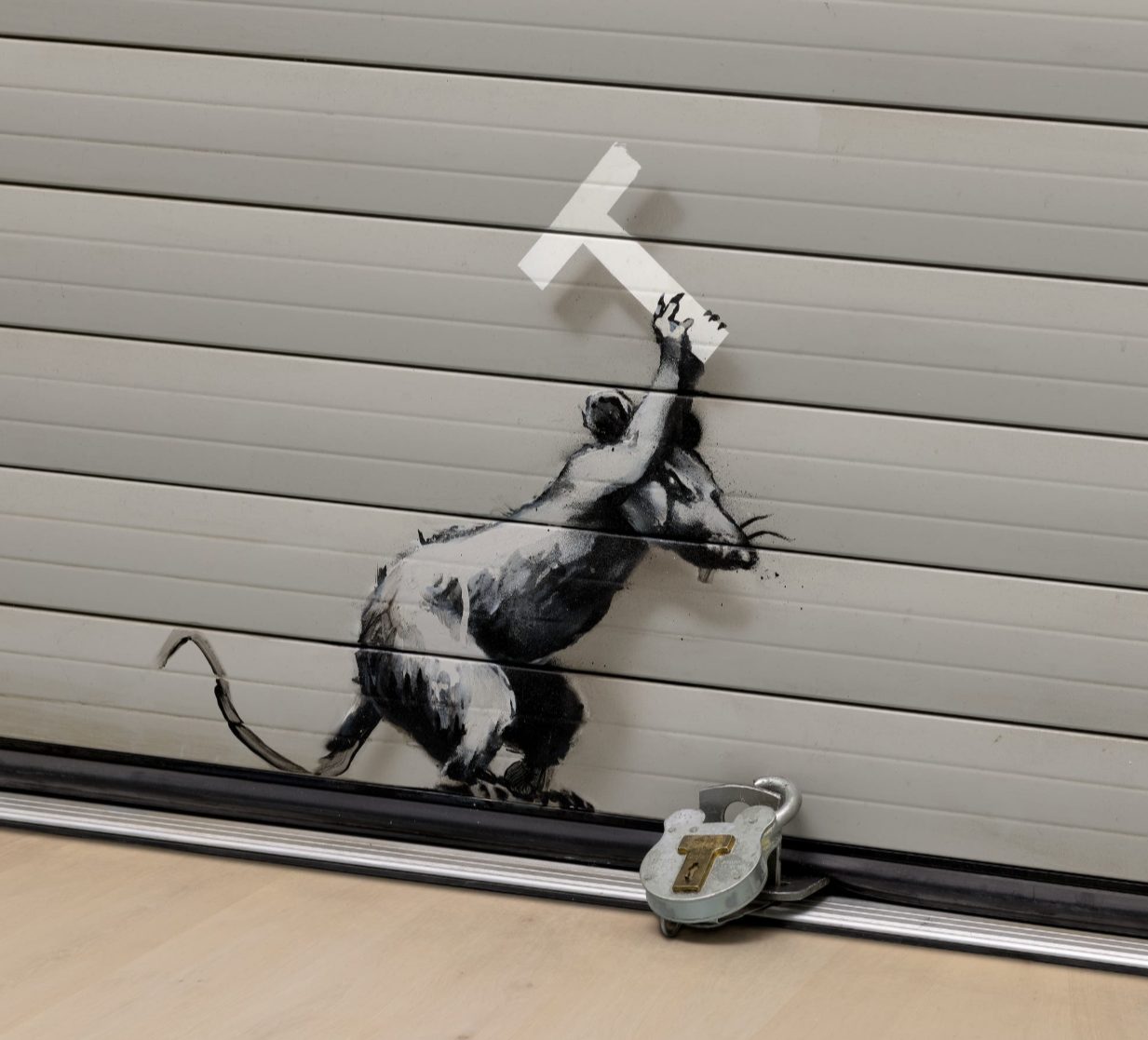
Bestowed with human characteristics, Banksy’s rodents inhabit a world of comedic trickery and bad behavior from spilling chemical waste, parachuting, vandalizing to cracking safes, doors and padlocks as in Keep Ou T. Accentuating the dialogue between the three-dimensional object and the two-dimensional painted surface, Banksy dramatically brings the rat to life with a physical lock laying broken at its hinge as if the viewer has just missed the act having occurred. An anagram of ‘art’, the rat manifests the role of Banksy alongside the broader ideology of street artists and their aversion of established order. Like the sly accomplice of the rat, Banksy moves at pace — invisible and unseen — to elude authority’s grasp.
“I’d been painting rats for three years before someone said ‘that’s a clever anagram of art’ and I had to pretend I’d known that all along.”
Contrasting the stenciled rat with the prescription and formula of airport paraphernalia, Keep Ou T points to the fundamental act of graffiti as transcending official boundaries — duplicitous activities that shaped Banksy’s early background. Remaining anonymous and coining the now infamous pseudonym to avoid discovery, Banksy came of age during the counter-cultural and political shifts of the late 1980s and 1990s in Britain. First known to have been active in Bristol during the thriving, rebellious youth culture of this period and rise in graffiti, police crackdowns and arrests like Operation Anderson in 1989 responding to graffiti’s increase impacted the artist’s relationship with the government and surveillance.
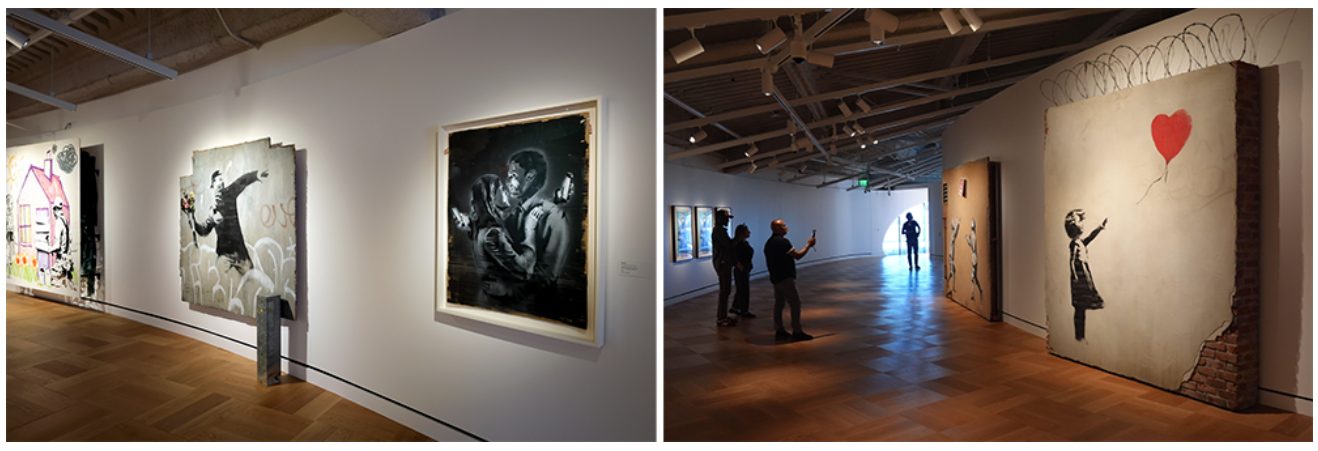
It was allegedly during a similar confrontation at eighteen with the British transport police that the artist developed the use of the stencil. Laboriously painting ‘LATE AGAIN’ on the exterior of a passenger train at night, the artist was discovered and chased down by the police, hiding beneath ‘a dumper truck’ to avoid capture.i Within breathing distance of authorities, Banksy then understood ‘I had to cut my painting time in half or give it up altogether’ and in the period of ‘staring straight up at the stencilled plate on the bottom of a fuel tank’ the artist ‘realised I could just copy that style’.ii Bringing forward these experiences of the street, in dialogue with Banksy’s most consequential large-format works, including those exhibited this year at the newly inaugurated Lucas Museum of Narrative Art in Los Angeles, Banksy addresses some of the most pressing issues of the time, teasing the line in Keep Ou T between sheer ridicule and socio-political commentary.
STAY INFORMED
Receive the latest news, exhibitions, artworks and market updates on Banksy.