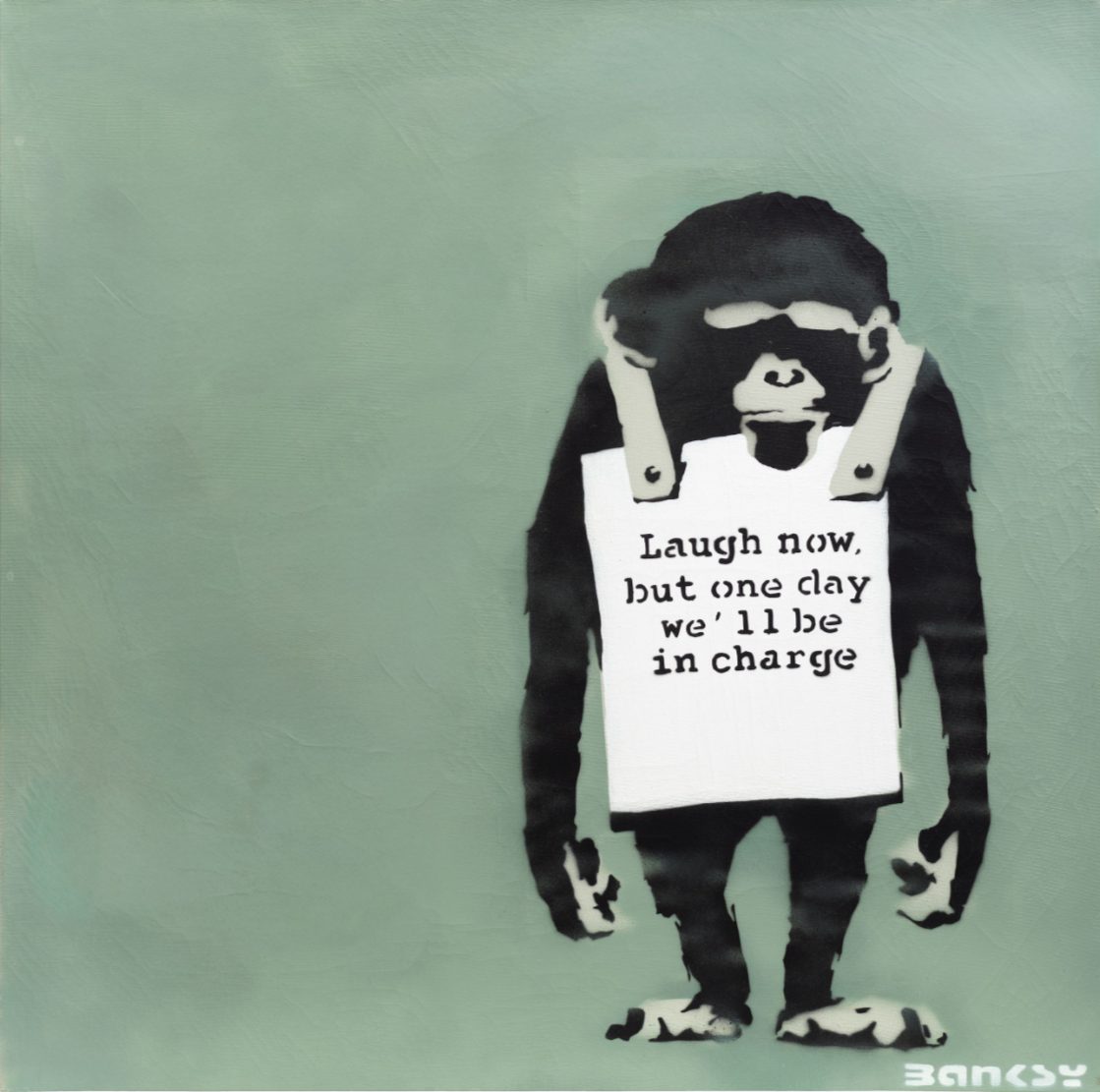
LAUGH NOW, 2001
Provenance
- Acquired from the artist by the present owner in 2001
Auction History
Prices are inclusive of buyer’s premium unless stated otherwise, as reported by the auction houses.
AN ICON BEFORE THE ICON
Painted in 2001, this early Laugh Now belongs to the formative years in which Banksy was developing a visual vocabulary that would soon become internationally recognizable. The solitary chimpanzee stands with shoulders lowered and head bowed, burdened by the sandwich board hanging from its body. It is an image of apparent submission, yet the figure would become associated with one of Banksy’s most defiant declarations: “Laugh now, but one day we’ll be in charge.”
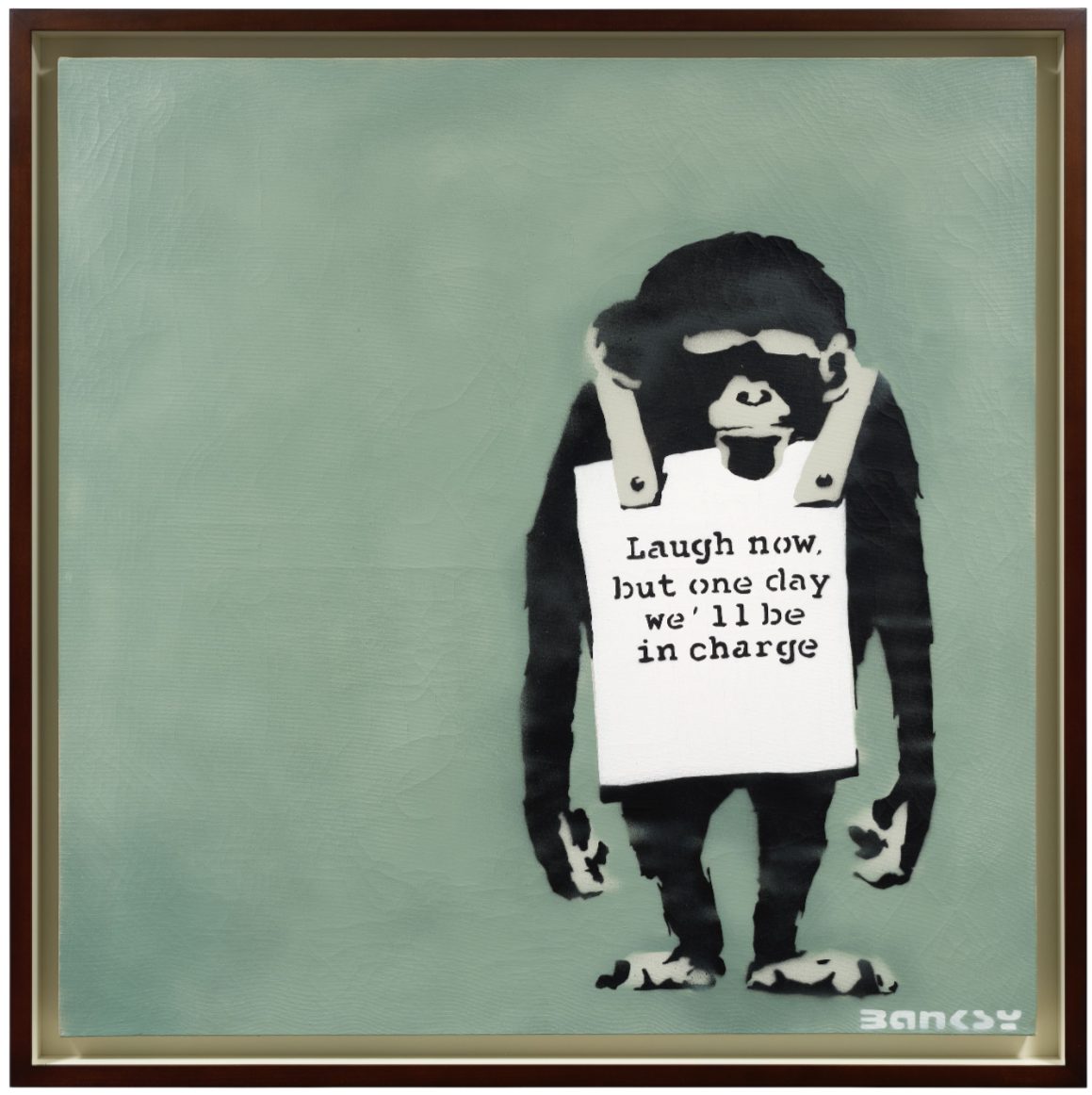
The date is significant. Laugh Now is frequently described as originating with the celebrated mural commissioned for the Ocean Rooms nightclub in Brighton, where a procession of monkeys stretched approximately six metres behind the bar. That commission, however, dates from 2002. Earlier surviving works demonstrate that Banksy had already been developing the motif before then: Banksy Explained documents examples from 1998 and 2000, while research into Banksy’s early exhibitions records a grey-background Laugh Now Monkey among the works associated with his 2001 practice. Banksy Explained The present 2001 painting therefore belongs not to the later dissemination of a successful image, but to its early evolution.
THE MONKEY AS HUMAN MIRROR
Monkeys occupy a privileged position within Banksy’s iconography. Like his rats, they permit the artist to discuss human behavior at one remove. They can appear primitive, obedient or ridiculous while simultaneously exposing those characteristics in the society observing them. In Laugh Now, that ambiguity is particularly acute.
The chimpanzee's posture suggests exhaustion or defeat. Its arms hang heavily beside its body; the shoulders slump forward and the eyes are lowered. The sandwich board reinforces the impression of servitude, recalling the anonymous figure employed to carry an advertisement through the street. Yet the message historically associated with the image reverses this apparent hierarchy. The supposedly inferior creature is not accepting its position at all. It is waiting.
Banksy thus constructs the work around a contradiction between appearance and prophecy. The monkey looks powerless, but its message anticipates a future reversal of power. What initially appears comic gradually becomes unsettling: the viewer is implicitly placed among those doing the laughing.
There is an obvious echo of Planet of the Apes, although it is better understood as a cultural resonance than a documented source. More broadly, Banksy exploits the long history of humans using primates as caricatures of themselves. The monkey is funny because it resembles us; it becomes disturbing for exactly the same reason.
BRISTOL, LONDON AND THE MAKING OF BANKSY
The year 2001 occupies an important position in Banksy’s development. His work was moving beyond Bristol into a wider British street and club culture, while his first self-published book, Banging Your Head Against a Brick Wall, helped codify the combination of stencils, aphorisms, political satire and black humor that would define his public identity. Contemporary documentation also places Banksy at Electric Stew events in Manchester, Brighton and London during this period, showing how closely his early work circulated through music and alternative cultural networks rather than the conventional gallery system.
That context is particularly relevant to Laugh Now. The motif did not emerge as a polished contemporary-art brand. It developed within the same environment as Banksy’s early rats, policemen, monkeys, military imagery and interventions on urban walls. Its visual economy reflects those origins: a monochrome stencil, an instantly recognizable silhouette and an idea that can be understood before the viewer has time to walk past it.
By the following year, Banksy would expand the solitary figure into the monumental procession created for Brighton’s Ocean Rooms. Ten monkeys stood side by side across a work measuring more than six metres, repeatedly carrying the warning that one day they would be in charge. That original mural was subsequently removed and sold at Bonhams in 2008 for £228,000, before selling at Phillips New York in 2013 for $485,000. The 2001 work belongs to the moment immediately before that expansion—from individual character to public procession, and ultimately from early Banksy motif to cultural icon.
FROM OUTSIDER TO EMBLEM
Banksy continued to develop Laugh Now throughout the following years. The composition appeared in paintings of different scales and formats before being translated into the well-known screenprint edition. The motif consequently offers an unusually clear example of how Banksy moved images between street, studio, exhibition and edition, altering their context while preserving their essential visual language.
Its later history also makes the early date of the present painting particularly compelling. Laugh Now would eventually become one of Banksy’s most commercially recognizable compositions, reproduced and collected around the world. Yet its subject remains an explicitly marginalized figure carrying a promise that existing hierarchies will not last.
That contradiction has only grown sharper with time. The downtrodden monkey conceived during Banksy’s emergence from Bristol's underground culture has itself entered the canon of contemporary art. Works from the series have subsequently achieved seven-figure prices: a 2002 Laugh Now But One Day We'll Be In Charge sold at Christie’s New York in 2021 for $2.07 million, while the motif’s monumental Ocean Rooms manifestation has become a key document of Banksy’s early career. In retrospect, the famous warning carried by Banksy’s chimpanzee appears almost uncomfortably prescient. The outsider did indeed enter the establishment—although perhaps not quite in the way the monkey had in mind.
STAY INFORMED
Receive the latest news, exhibitions, artworks and market updates on Banksy.