LAUGH NOW (OCEANS ROOM), 2002
Provenance
- Commissioned for the interior of the Ocean Rooms Night Club, Brighton
- Bonhams, London, Urban Art, February 5, 2008, lot 10
- Artificial Gallery, London
- Acquired from the above by the present owner
Auction History
Prices are inclusive of buyer’s premium unless stated otherwise, as reported by the auction houses.
FROM A SOLITARY MONKEY TO AN ARMY
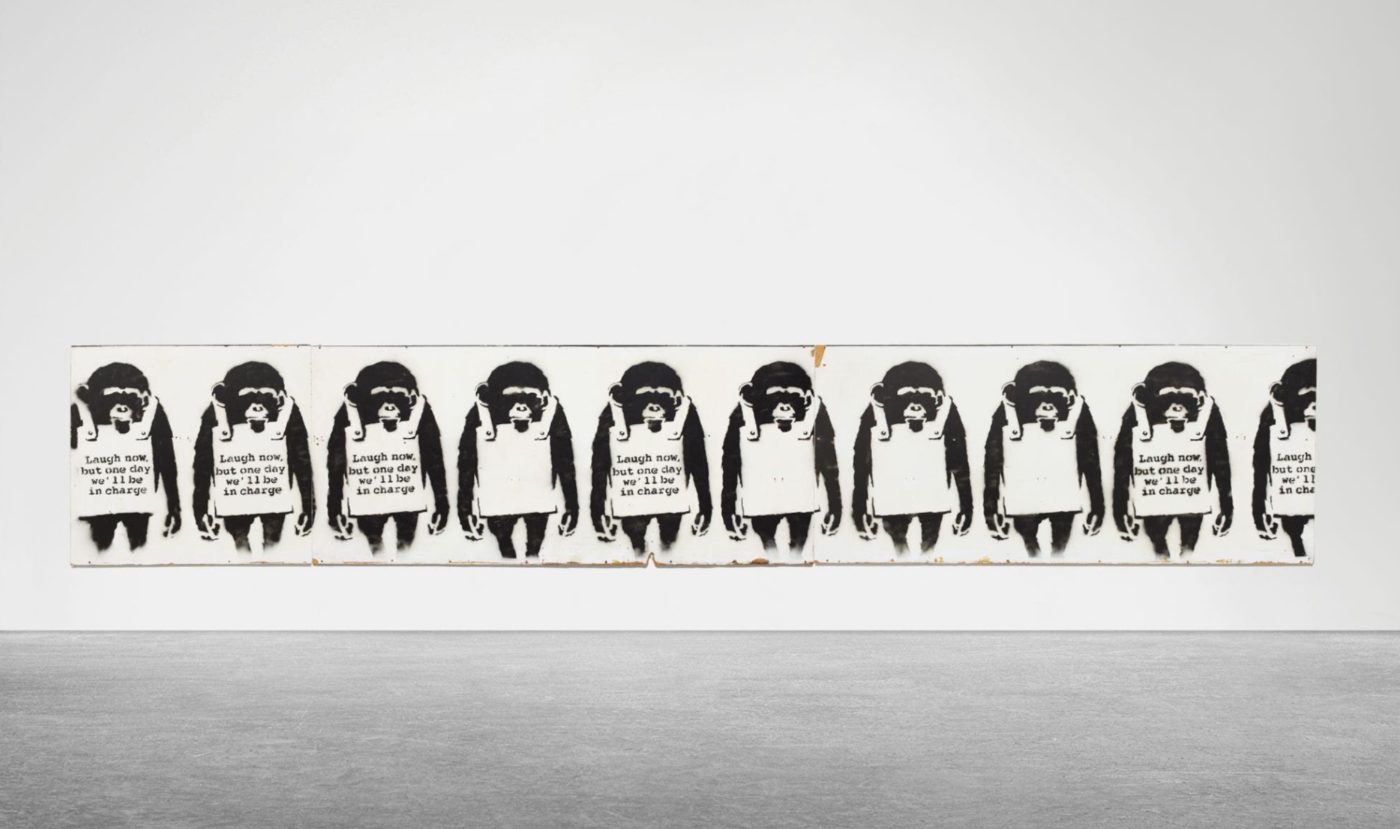
Created for the Ocean Rooms nightclub in Brighton in 2002, this monumental Laugh Now occupies a decisive position in the evolution of one of Banksy's most enduring images. Extending more than six metres across three painted boards, the work presents a procession of ten downcast chimpanzees standing shoulder to shoulder, sandwich boards suspended heavily from their bodies. Some are left blank; others carry the warning that would become inseparable from the motif: “Laugh now, but one day we'll be in charge.”

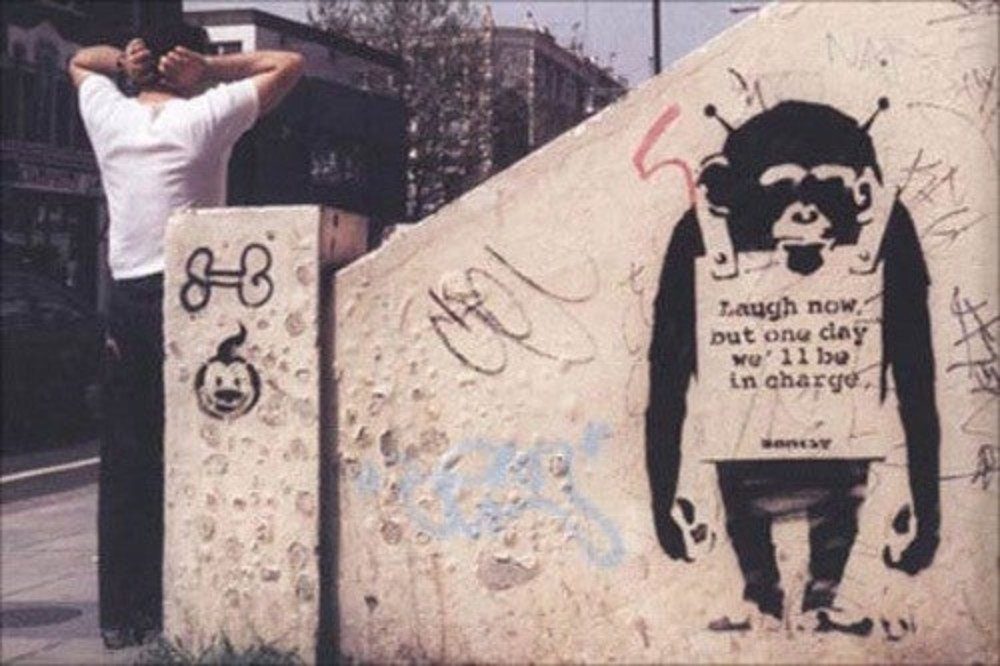
For many years, the Ocean Rooms commission was routinely described as the origin of Laugh Now. The surviving evidence now establishes a more complex chronology. Banksy was already developing the chimpanzee and placard motif before 2002: an Untitled (Laugh Now…) work dated 1998 survives with provenance directly from the artist; another multi-monkey composition was commissioned for a hip-hop club in 2000; and a solitary Laugh Now monkey was present on a wall in Ladbroke Grove by late November of that year.
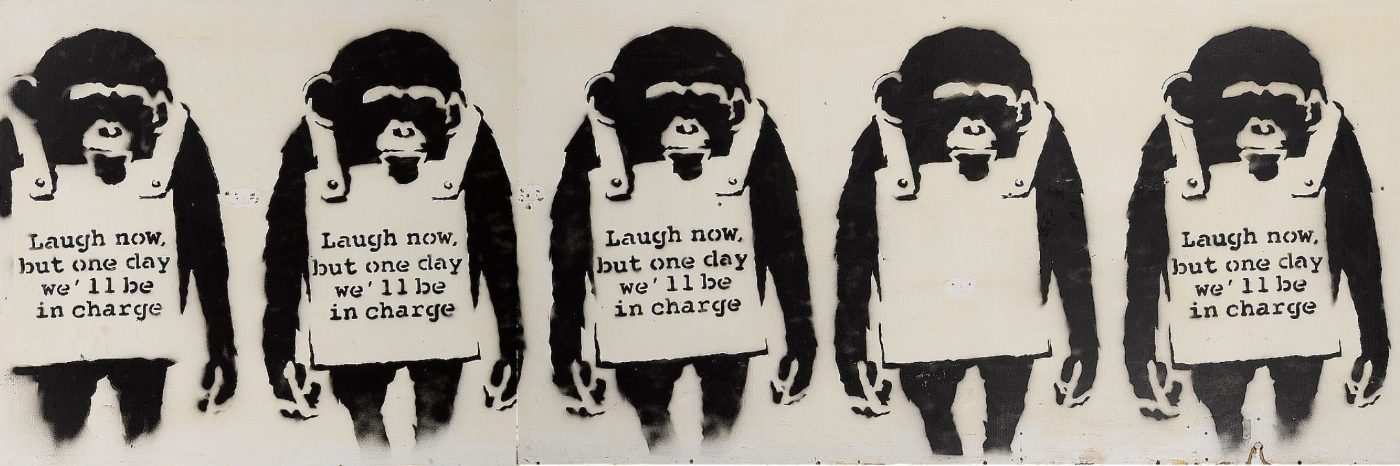
The significance of Ocean Rooms therefore lies not in the invention of the character, but in its transformation. What had existed as an isolated outsider became a collective presence. Banksy repeated the same apparently powerless figure until it formed a line stretching across the architecture of the nightclub. The prophecy embedded in the slogan suddenly acquired physical credibility: one monkey might be dismissed; ten begin to resemble an uprising.
LAUGH NOW, BUT ONE DAY WE'LL BE IN CHARGE
The brilliance of Laugh Now rests upon the contradiction between the chimpanzee's body and the message it carries. Everything about the animal suggests submission. Its shoulders slump forward, its arms hang heavily and its head appears bowed beneath the sandwich board. The pose recalls both a protester and the anonymous street workers historically employed to carry advertisements through commercial districts.
The text reverses that apparent hierarchy. The creature being observed, controlled and laughed at predicts that the balance of power will eventually change. Banksy never identifies precisely who “we” are. The pronoun might refer to animals, the socially excluded, the working class, graffiti artists, political outsiders—or simply everyone denied authority by those currently possessing it. That openness is central to the image's longevity.
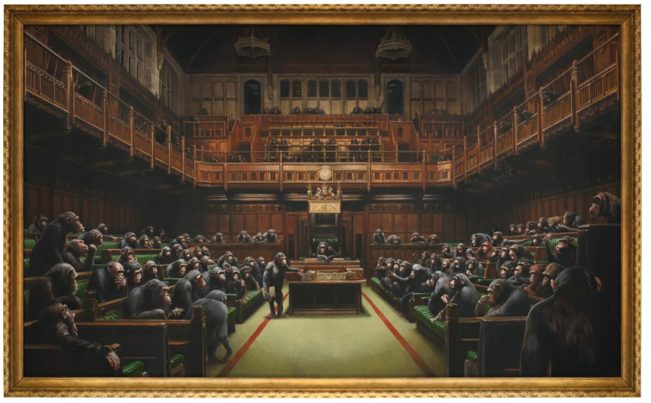
The chimpanzee also belongs to the much older satirical tradition of using monkeys to expose human vanity and pretensions. Banksy would repeatedly exploit the animal's uncomfortable proximity to humanity, eventually placing chimpanzees directly inside the institutions of power in works such as Devolved Parliament. Read retrospectively, the trajectory is almost narrative: the early monkey announces that one day it will be in charge; years later, Banksy seats the monkeys in the House of Commons. The joke has become prophecy.
THE OCEAN ROOMS: AN ICON AT MONUMENTAL SCALE
The Ocean Rooms commission nevertheless changed the character of the image profoundly. At 604.5 centimetres wide, repetition becomes the work's dominant formal device. The chimpanzees cease to function simply as individual characters and become a rhythm—a regimented sequence of identical bodies extending laterally across the wall. That repetition introduces another ambiguity. The monkeys appear united, yet they are also standardized. They can be read as an emerging collective preparing to overturn the existing hierarchy, but equally as individuals reduced to interchangeable units. Banksy's procession hovers between solidarity and conformity, revolution and obedience.
The nightclub setting was also characteristic of the cultural environment in which Banksy's early work developed. Before international galleries and evening auctions became central to his market, his imagery circulated through streets, music venues, clubs and alternative cultural spaces. Ocean Rooms was not a museum exhibition. The mural functioned as part of the architecture of a working Brighton nightclub—an unlikely environment in which one of the defining images of Banksy's career would receive its first monumental treatment. The work was subsequently removed from the venue, transforming an architectural installation into a transportable object.
FROM BRIGHTON TO AN ICON
Following Ocean Rooms, Banksy returned repeatedly to the chimpanzee. During 2002 he produced Laugh Now paintings on canvas, paperboard, drywall and other supports, varying the scale and presentation while preserving the essential relationship between the bowed animal and its provocative message. The composition subsequently entered Banksy's print practice, allowing the image to circulate far beyond the locations in which its early versions had appeared.
Ocean Rooms should therefore be understood as a turning point rather than a beginning. The monkey had already existed; the idea had already been tested. What happened in Brighton was an extraordinary act of amplification. Banksy took a marginal, solitary figure and multiplied it until the outsider became a crowd. That distinction actually makes the work more interesting. The evolution from the early individual monkey to the ten-figure Ocean Rooms procession demonstrates something fundamental about Banksy's method. His iconic images rarely emerged as immutable designs. They migrated between walls, commissions, boards and canvases, changing scale and context as their meanings developed.
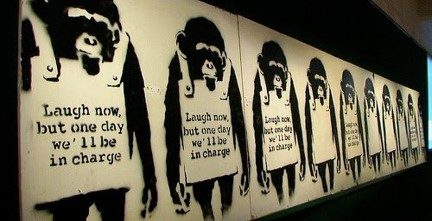
In Laugh Now, that development is unusually visible. The bowed chimpanzee begins as an apparently powerless individual. At Ocean Rooms, it finds others like itself. The warning remains the same, but the balance of power has already begun to shift. One monkey could be laughed at. Ten made the promise harder to ignore.
STAY INFORMED
Receive the latest news, exhibitions, artworks and market updates on Banksy.