LOVE IS IN THE AIR
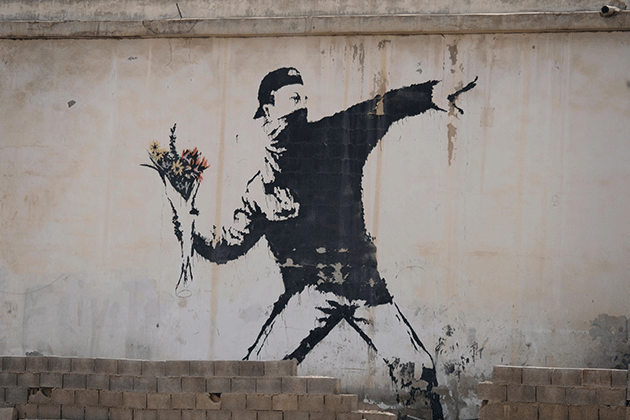
Throw Flowers, Not Stones
A masked protester is captured at the precise instant before throwing something. His legs are spread, his torso twists backward and one arm extends forward to establish the direction of his attack. Almost every element of his appearance belongs to the visual vocabulary of confrontation: the baseball cap, the bandana concealing his face and the explosive physical gesture immediately suggest a rioter preparing to throw a stone or Molotov cocktail.
Except that Banksy replaces the expected weapon with a bouquet of flowers.
It is one of the simplest substitutions in Banksy’s work and one of his most powerful. The aggression of the body remains completely intact; only the object has changed. Violence is not erased but redirected. The protester throws flowers with exactly the same commitment and physical force with which another man might throw a weapon.
The bouquet provides the composition’s crucial chromatic interruption. Against the largely monochrome figure, the flowers introduce flashes of red, yellow and green, appearing almost unnaturally alive in the hands of the masked protester. Banksy makes the eye travel immediately toward the one element that does not belong within the familiar imagery of street confrontation, and that contradiction carries the entire composition.
Love and Rage
The alternative title Flower Thrower describes what we see, but Love Is in the Air changes how we understand it. Banksy does not transform the protester into a passive pacifist. He remains masked, angry and physically committed to his action. The image therefore proposes something more interesting than a sentimental plea for peace: what if the energy of resistance could remain intact while its weapon was changed?
That distinction helps explain the extraordinary endurance of the image. The protester does not retreat, surrender or abandon his anger. Banksy preserves the aesthetics and physical intensity of rebellion while replacing its instrument of destruction with something fragile, beautiful and temporary. Flowers become ammunition, but the force behind the throw remains unchanged.
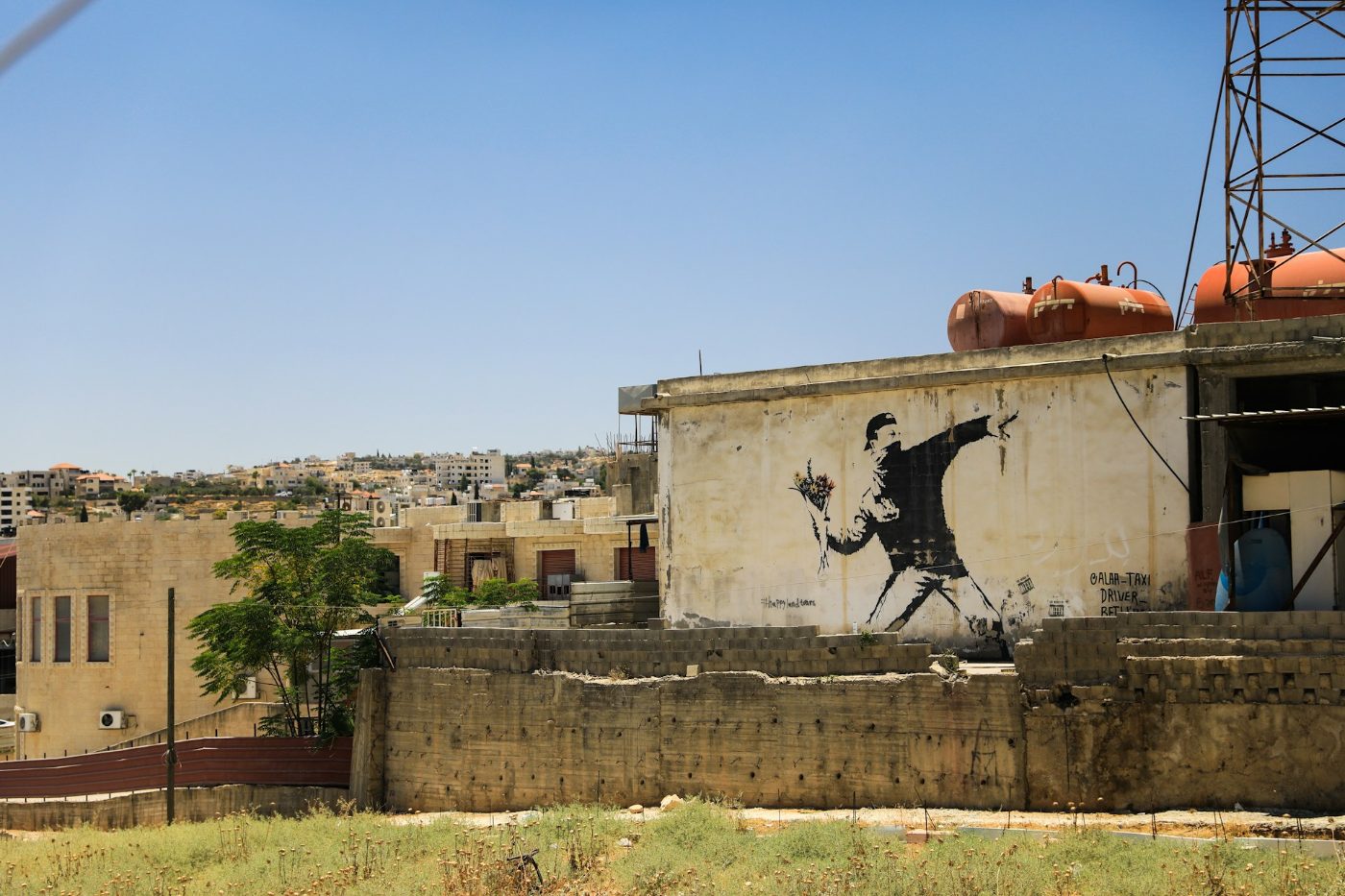
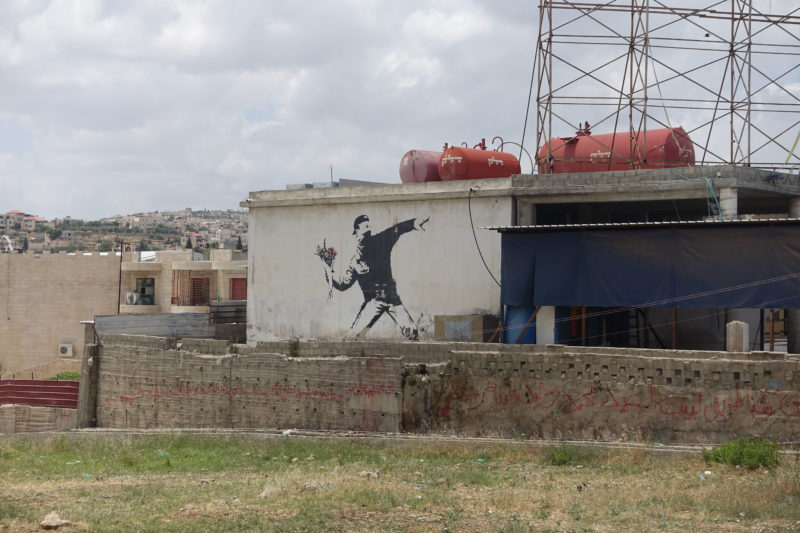
Its location inevitably intensifies this tension. Painted in the West Bank in 2003, during the Second Intifada and as construction of the Israeli West Bank barrier was underway, the image appeared within a landscape where demonstrations, soldiers, stones, weapons and physical restrictions on movement were immediate realities. The mural is therefore both universal and geographically specific: its central metaphor can travel almost anywhere, but in the vicinity of Bethlehem it acquired a political urgency that would become inseparable from its subsequent history.
Movement and Empty Space
Formally, Love Is in the Air is one of Banksy’s most dynamic compositions. Many of his figures stand, observe, hold signs or confront the viewer. The Flower Thrower is almost entirely movement. His body forms a powerful sequence of diagonals, from the planted legs through the twisting torso toward the outstretched arm. The hand holding the bouquet is drawn backward, storing the energy that will propel the flowers forward.
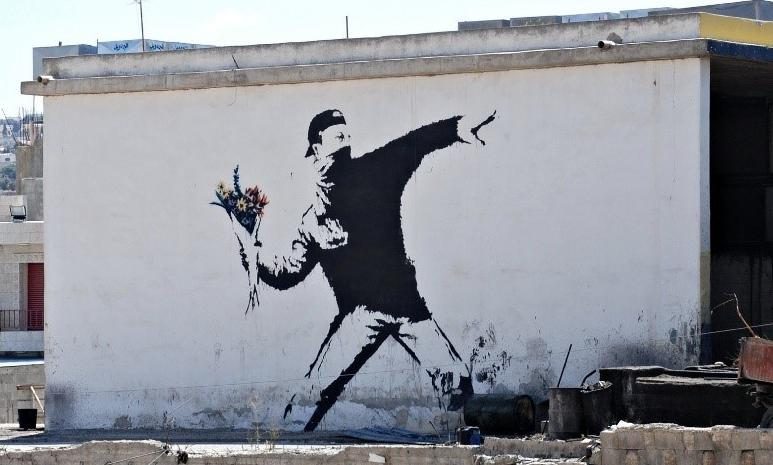
The empty wall in front of the figure is therefore essential. Banksy gives the protester somewhere to throw. Like the distance separating the child from the balloon in Girl with Balloon, negative space becomes an active component of the composition. The viewer instinctively completes an action that the frozen stencil can never perform.
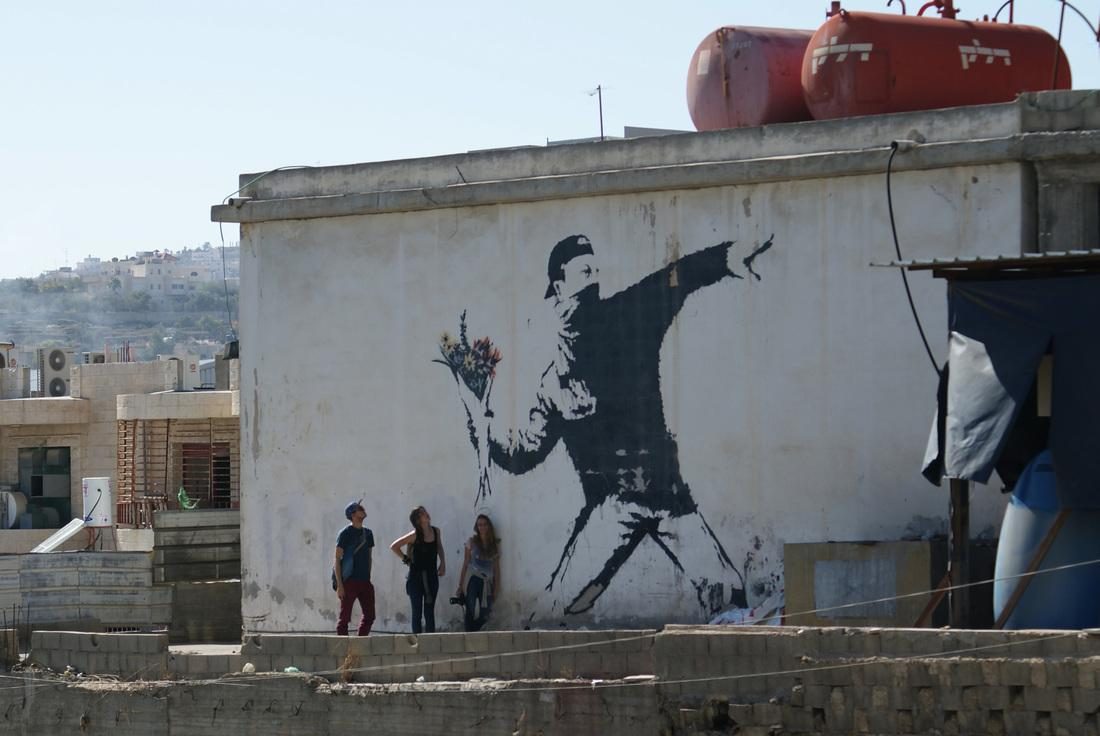
This physicality is particularly evident in photographs of the mural in situ. Removed from the wall and reproduced as a print, the Flower Thrower becomes an icon. On the street, surrounded by architecture and encountered at human scale, he becomes a presence. The wall provides not merely a surface but the space into which the imaginary bouquet is about to travel.
From Street Image to Icon
The Flower Thrower belongs to a small group of Banksy images that eventually became larger than any single physical work. The motif migrated between walls, paintings and prints, with Banksy repeatedly adapting it while preserving the fundamental contradiction between the aggressive body and the harmless object in its hand.
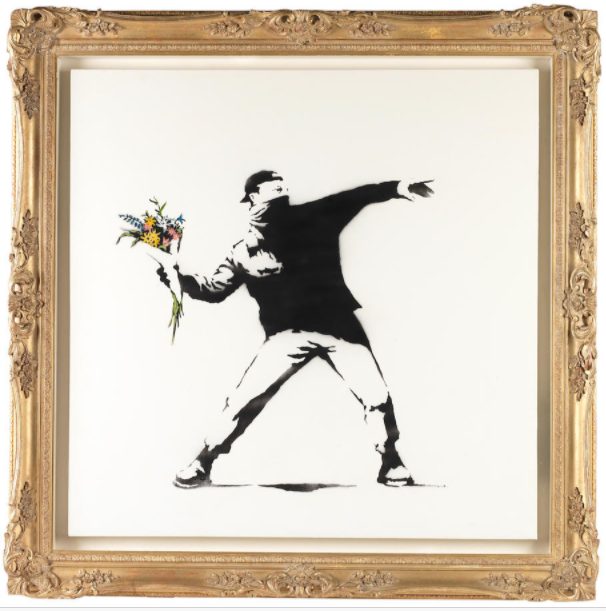
In 2003, the image entered Banksy’s print practice through Pictures on Walls and subsequently appeared in numerous paintings and variations. As with Girl with Balloon, Laugh Now and Bomb Hugger, repetition did not diminish the image so much as establish it as part of Banksy’s visual vocabulary. The silhouette became sufficiently recognizable that the figure could eventually function almost independently of its original setting.
Yet the surviving mural near Bethlehem retains something those later iterations cannot reproduce. It remains attached to a particular wall, place and political landscape. More than two decades of exposure have faded and damaged the stencil, and its present condition is visibly different from early photographs. That deterioration is part of the history of the work: unlike a print preserved behind glass, the mural has continued to experience the weather, pollution, alterations to the building and the passage of time.
Before Bethlehem: The London Flower Thrower
Although Love Is in the Air has become inseparable from Banksy’s work in Palestine, the famous Bethlehem mural was not the beginning of the Flower Thrower. The image was already part of Banksy’s vocabulary by 2002, when he produced a small group of spray-painted canvases for Existencilism, his first Los Angeles exhibition at 33⅓ Gallery. These early works establish that the masked protester hurling a bouquet was already a developed motif before Banksy brought it to the West Bank.
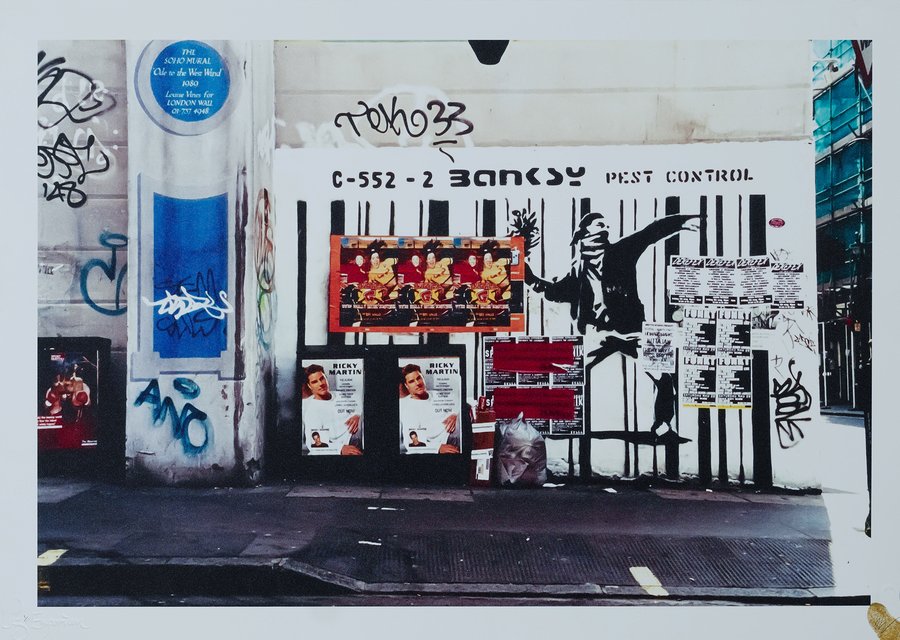
The Flower Thrower also appeared on the streets of London around 2003. Phillips records the image as having originally been spray-painted on a wall off Rivington Street in Shoreditch, and surviving photographs document a striking early street variation. The masked figure appears against a barcode-like field of vertical black lines, beneath the enigmatic inscription “C-552-2 BANKSY PEST CONTROL.” Posters, tags and layers of street advertising gradually encroached upon the mural, embedding the figure within the dense visual landscape of early-2000s Shoreditch.
These photographs reveal how different the Flower Thrower originally looked from the isolated icon familiar from later prints and paintings. On the London wall, the figure competes with concert posters, graffiti tags, pasted advertisements and the accumulated visual debris of the city. The surrounding street is not incidental to the work but participates in it. The appearance of the words PEST CONTROL is also intriguing in retrospect, predating the later institutional role of Pest Control Office as the body responsible for authenticating Banksy’s work.
The relationship between London and Bethlehem is fundamental to understanding the development of Love Is in the Air. Banksy did not invent the Flower Thrower specifically for the Israeli-Palestinian conflict. He took an existing image and placed it somewhere that radically intensified its meaning. In Shoreditch, replacing a rioter’s projectile with flowers reads broadly as an anti-violence gesture and a characteristic Banksy inversion. Near Bethlehem, amid the violence of the Second Intifada and the developing architecture of separation, the same gesture inevitably acquired a far greater political charge.
This transformation illustrates something essential about Banksy’s street practice: location can function almost like another layer of paint. The stencil may remain unchanged while the wall, neighborhood and political circumstances surrounding it completely alter what we see. The London Flower Thrower is therefore much more than a preliminary version of the Bethlehem mural. It allows us to witness an already powerful Banksy image before it found the geographical and historical context that would transform it into one of the defining icons of his career.
Love Is in the Air has become so familiar that it is easy to overlook the precision of its original proposition. Banksy takes an image constructed entirely around aggression and changes a single object. The stance remains violent, the face remains concealed and the body remains charged with anger. Only the anticipated weapon disappears.
That single substitution allows apparently incompatible ideas to coexist. Anger does not exclude love; resistance does not necessarily require destruction; peace need not mean passivity. The flowers are powerful precisely because Banksy refuses to make the man holding them gentle.
The history of the motif adds another dimension. London demonstrates that the image could operate as a broad visual statement about violence and rebellion. Bethlehem demonstrates how dramatically a street image can change when geography becomes part of its meaning. Later prints and paintings demonstrate its ability to escape both locations and become universal. The image did not change. The world around it did.
STAY INFORMED
Receive the latest news, exhibitions, artworks and market updates on Banksy.