LOVE PLANE
Love Is in the Air
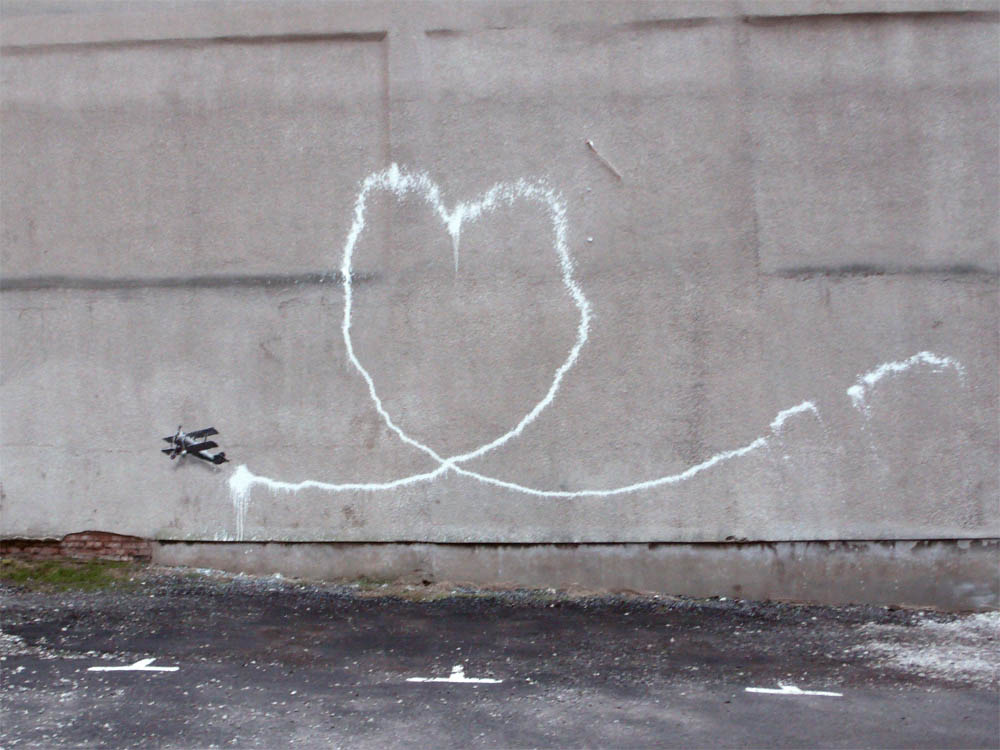
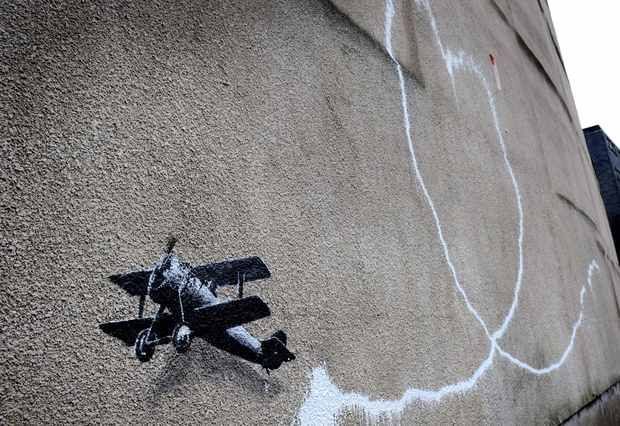
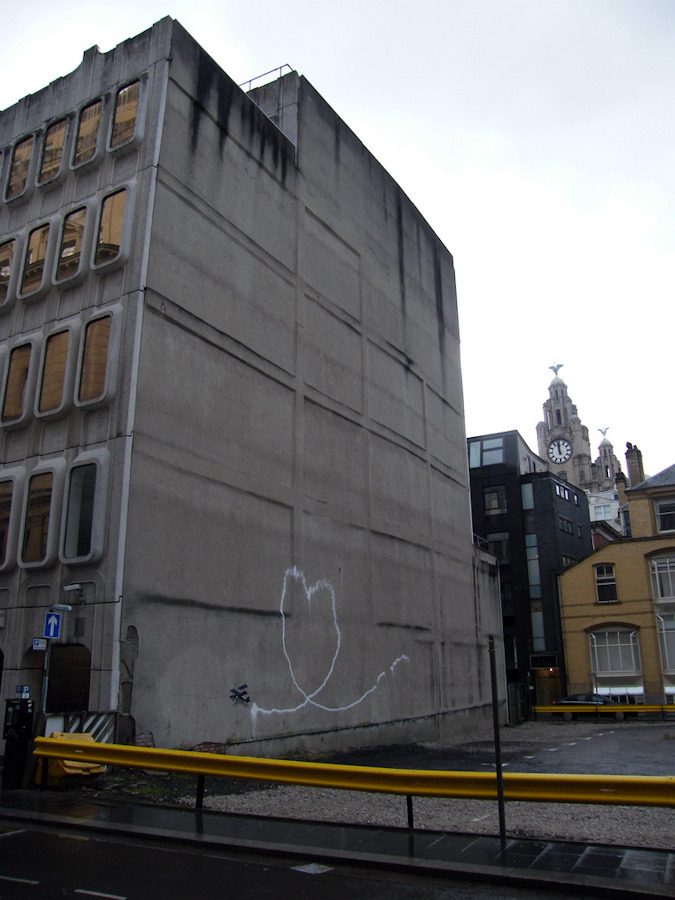
In December 2011, a small black-and-white biplane appeared on the side of Norwich House in central Liverpool, flying across an otherwise unremarkable rendered wall. Behind it, a loosely sprayed white contrail loops upward into an enormous heart before continuing beyond the composition.
The image could hardly be simpler. Banksy combines the mechanical precision of the stencilled aircraft with a deliberately imperfect line of white spray paint. The plane is tiny in relation to the heart it creates, giving the work a wonderful sense of disproportion: a small machine produces an enormous gesture.
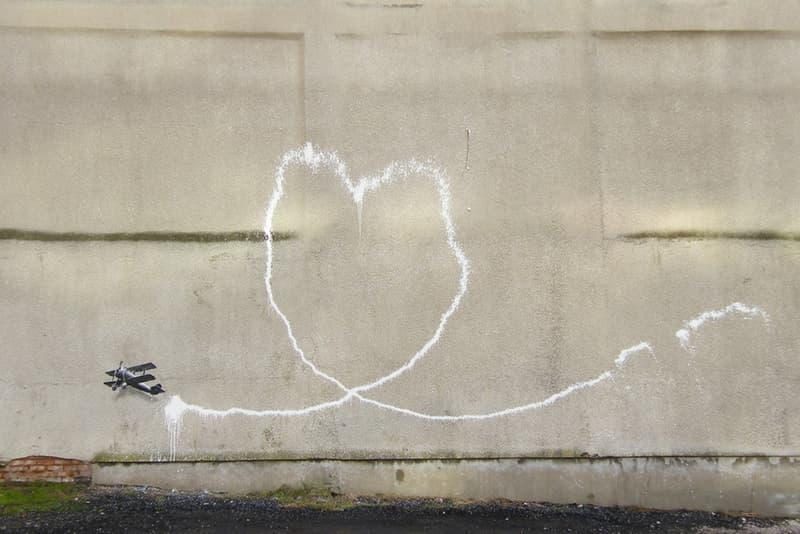
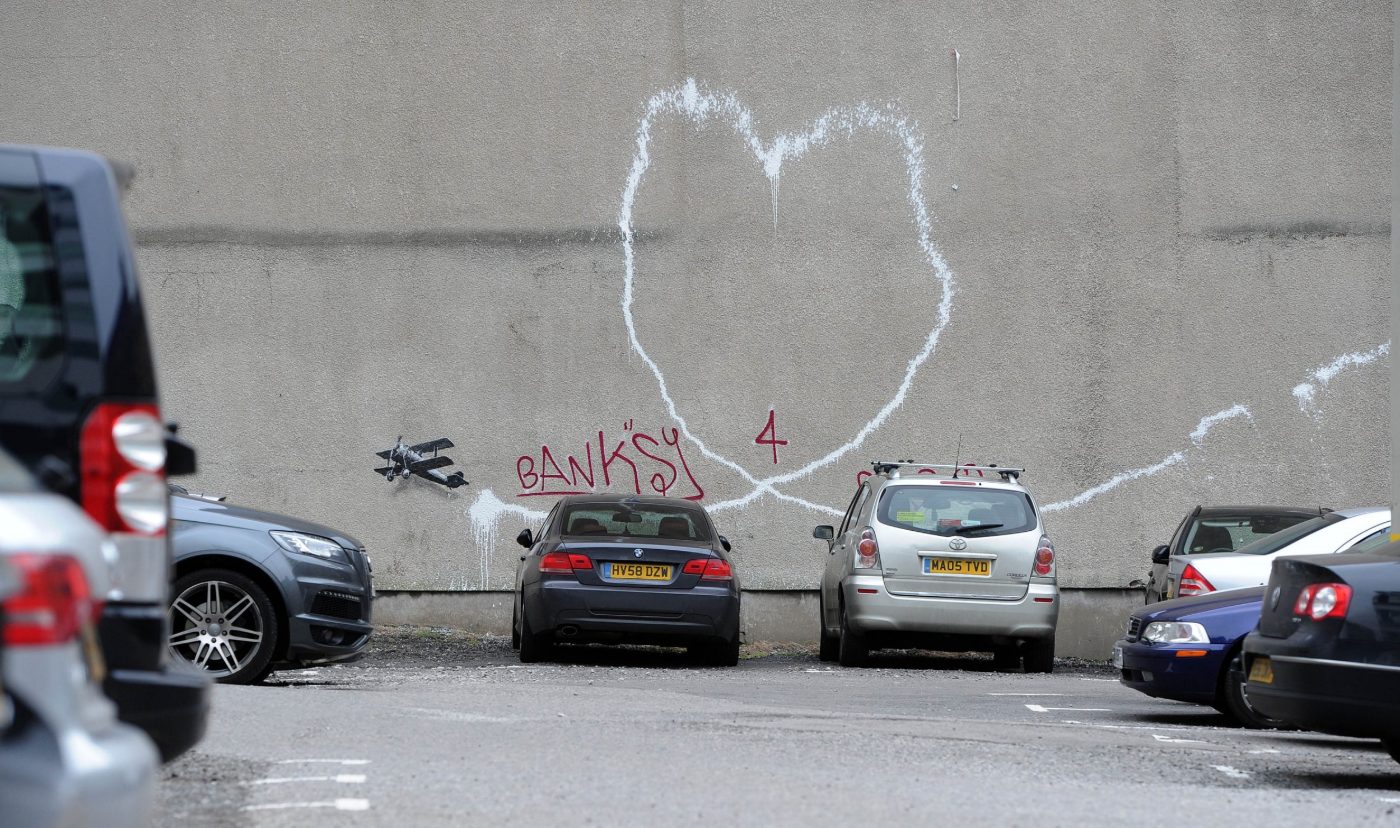
The location was equally important. The mural occupied the side of Norwich House, backing onto the Rumford Street car park, opposite what was then the Liverpool War Museum. Contemporary sources recorded its arrival in December 2011, while Banksy's own website subsequently featured the work.
A Machine Made Romantic
Love Plane operates through a contradiction Banksy has used repeatedly: taking an object associated with technology, power or violence and making it unexpectedly tender. The aircraft resembles a vintage military biplane, yet instead of leaving destruction behind it, its trail draws a heart.
That reversal recalls the underlying mechanism of Love Is in the Air, Bomb Hugger and Happy Choppers. Banksy does not remove the potentially threatening object; he changes its relationship with what surrounds it. A protester throws flowers. A child embraces a bomb. Military helicopters wear bows. Here, an aircraft performs aerial calligraphy and writes love across the wall.
There is also something particularly effective about the contrast between stencil and freehand gesture. The plane is mechanically reproducible and precisely delineated; the heart is irregular, spontaneous and almost childlike. Machine and emotion are expressed through two entirely different ways of making an image.
The Missing Banksy
The story became considerably stranger in September 2016, when the plane itself was physically cut from the building.
The Sincura Group, which had previously removed other Banksy street works, said the mural was being “salvaged” because Norwich House was due for redevelopment. A notice left behind explained that it would be restored and eventually displayed as part of a proposed Liverpool Street Art Museum at Berry House in the Baltic Triangle. The removal generated considerable local criticism, particularly because a work created for the street had suddenly disappeared from public view.
The museum never materialized.
Subsequent reporting uncovered an even more complicated story. Several Liverpool Banksy works intended for the project were ultimately sold rather than returned to public display. Reporting by The Post states that five works were sold together to an anonymous Middle Eastern buyer for approximately £3.2 million. Sincura later maintained that its responsibility had been to remove, restore and return the works to the development project, rather than to operate the proposed museum itself.
For a work about a plane leaving a trail behind it, Love Plane had itself rather spectacularly disappeared.
“I'm Back!”
Then, on Valentine's Day 2019, something extraordinary happened. A biplane appeared again at the original Liverpool location. This time it carried a banner reading: I'M BACK!
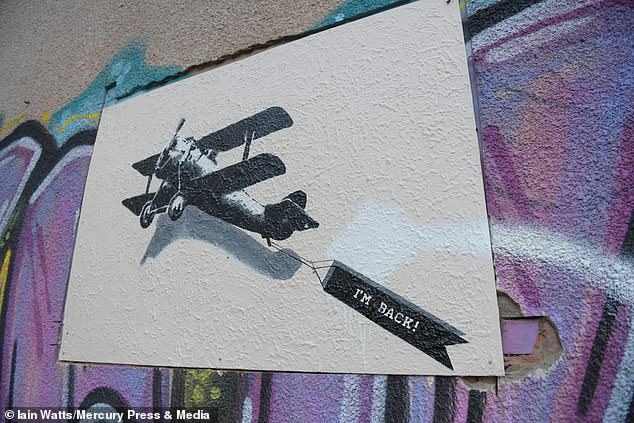
Nearby, a notice declared that street art belonged in the street and should be available for everyone rather than confined to museums or accessible only to an elite. The intervention immediately generated speculation that Banksy himself had returned the work. But Banksy never authenticated the 2019 intervention.
That distinction is important. The returning plane should therefore not be catalogued as a confirmed second Banksy. It is better understood as an anonymous response to the controversial removal of the original—a piece of street-art commentary using Banksy's own visual language against those who had removed his work from the street.
Ironically, this unofficial sequel understood something fundamental about the original. Love Plane had ceased to be merely an image of a plane and a heart. Its removal had transformed it into an argument about who owns street art once the street decides that it is valuable.
From Wall to Object
The physical treatment of the original work created another fascinating transformation.
Because removing the entire enormous heart-shaped contrail would have required taking a substantial section of the building, only the portion of wall containing the biplane was ultimately preserved. The salvaged section measures approximately 82 × 114 × 10 cm, dramatically changing the character of the work. What had originally been a tiny plane moving through an enormous architectural composition became a transportable rectangular art object.
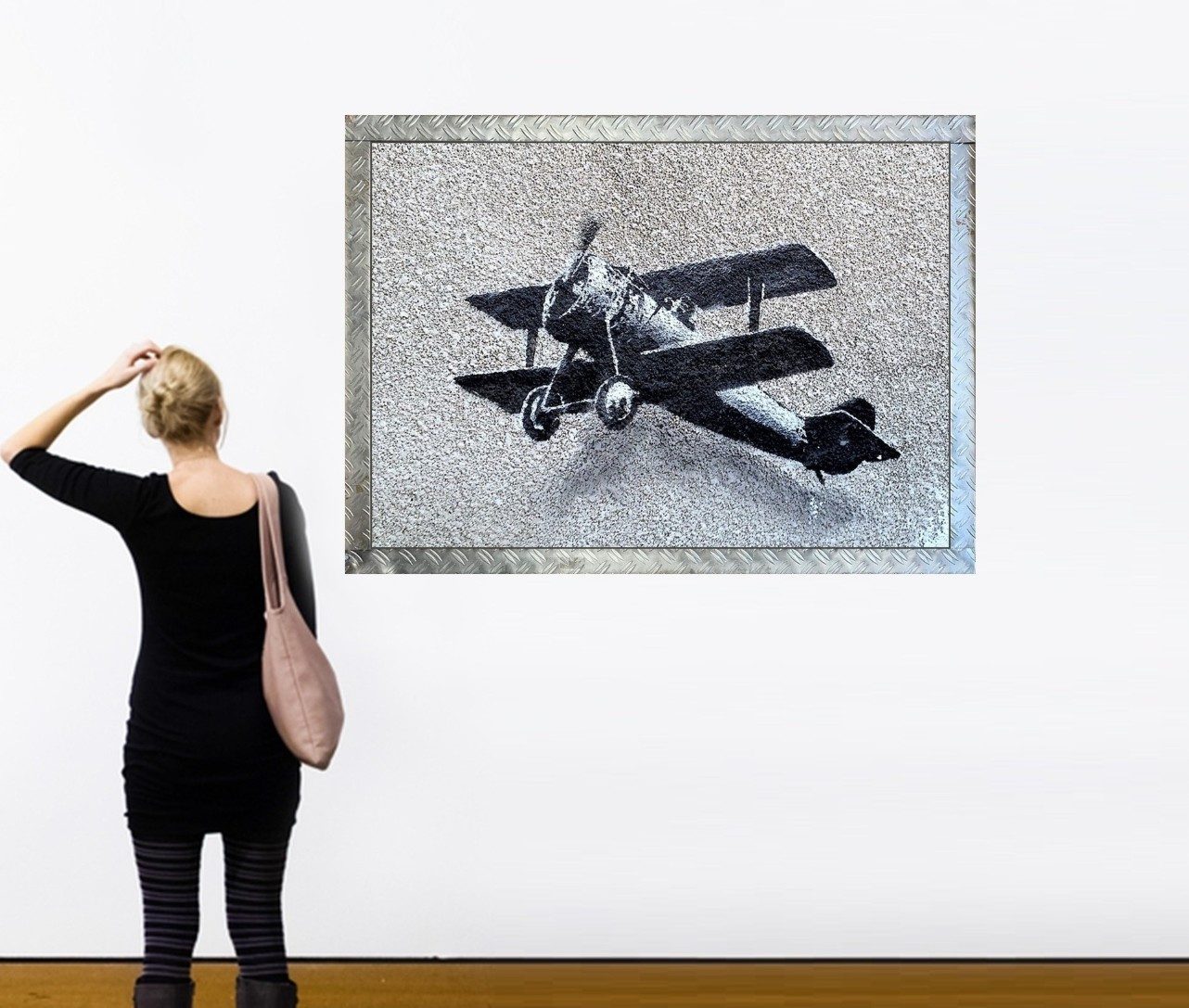
That fragment eventually appeared at Hessink's in December 2021, catalogued as Love Plane (Liverpool 2011). Estimated at €200,000–250,000, it achieved €288,000 including premium (approximately $323,735).
This creates an interesting distinction between the mural and the market object. The mural was the entire visual event: plane, enormous white heart, architecture and surrounding urban space. The object sold at auction preserved only the stencilled aircraft and a small portion of its trail.
The heart—the element that gave the work its title and much of its meaning—remained behind.
Love Plane begins as one of Banksy's most charmingly uncomplicated images. A tiny aircraft draws an enormous heart across a Liverpool wall. Yet its subsequent history turned that simple gesture into something considerably more revealing about the contradictions surrounding street art.
A work freely visible from a car park became valuable enough to cut from a building. It was removed ostensibly so that it could eventually be shown publicly in a street-art museum that was never completed. The original fragment entered private hands and ultimately the auction market, while an anonymous artist returned a substitute plane to the wall declaring that street art belonged to everyone.
The history therefore produces two very different versions of Love Plane. One became a valuable, transportable art object. The other remained where Banksy's original idea had begun: a plane, a heart and a wall in Liverpool.
STAY INFORMED
Receive the latest news, exhibitions, artworks and market updates on Banksy.