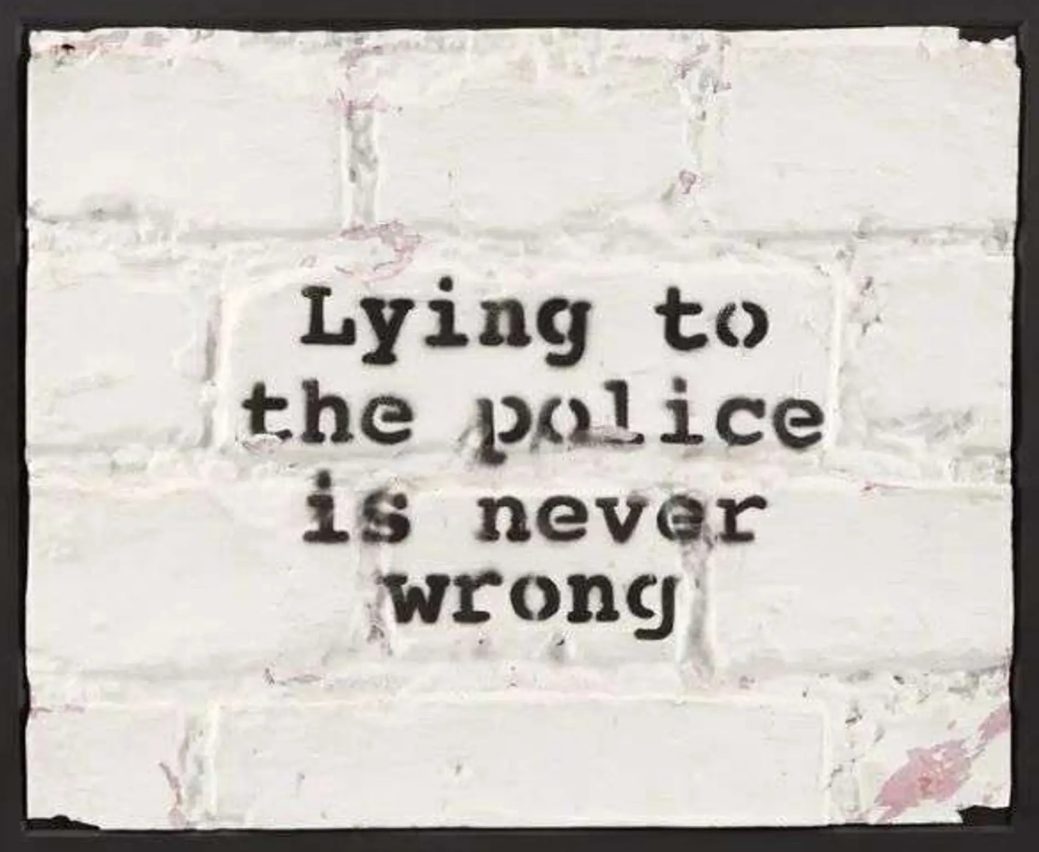
LYING TO THE POLICE IS NEVER WRONG, 2001
Exhibited
- Banging Your Head Against a Brick Wall, Cargo Club, London, 2001
- Vanina Holasek Gallery, New-York, USA, 2007
- Doge's Palace, Genoa, Italy, 2019
Literature
- Banksy Captured (Vol 1), Steve Lazarides
Auction History
Prices are inclusive of buyer’s premium unless stated otherwise, as reported by the auction houses.
Catalogue Note
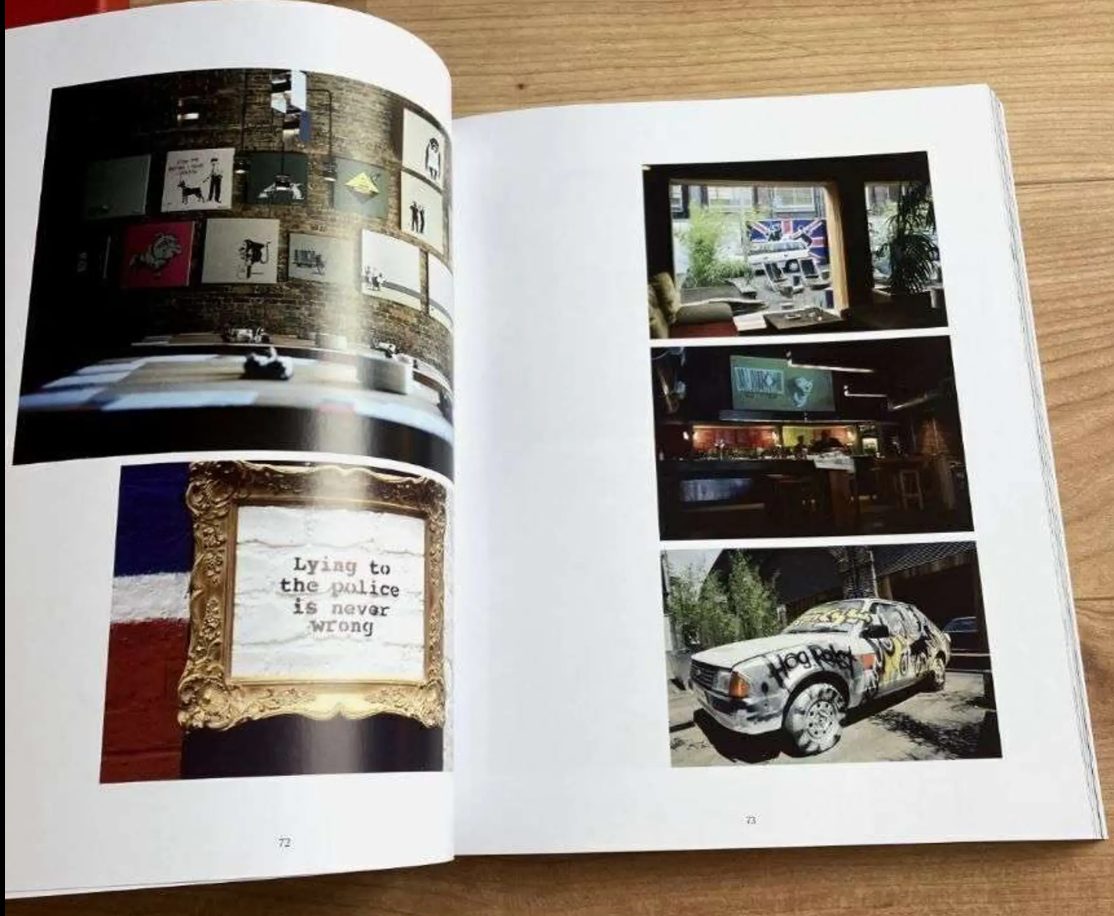
First shown at the "Banging Your Head Against a Brick Wall" exhibition at the Cargo Club on Rivington Street, London, June 22 to July 5 2001. The work was originally displayed in the outer courtyard of the Cargo Club in a gilded frame next to a mural of two wind-up policemen beating a man in front of a Union Jack background. Images of the artwork, taken by Banksy's manager Steve Lazarides, can be seen in the book "Banksy Captured." At some point, the original gilded frame was removed and reused by Banksy for a different artwork, titled "Image Not Currently Available," which was displayed at Banksy's 2005 exhibition "Crude Oils."
A Very Simple Moral Proposition
Lying to the Police Is Never Wrong consists of little more than five lines of black text against a battered white surface: "Lying to the police is never wrong"
There is no rat, monkey, child or policeman to carry the narrative. There is barely an image at all. Banksy reduces the work to a sentence and asks language to perform the act of provocation normally entrusted to his stencils.
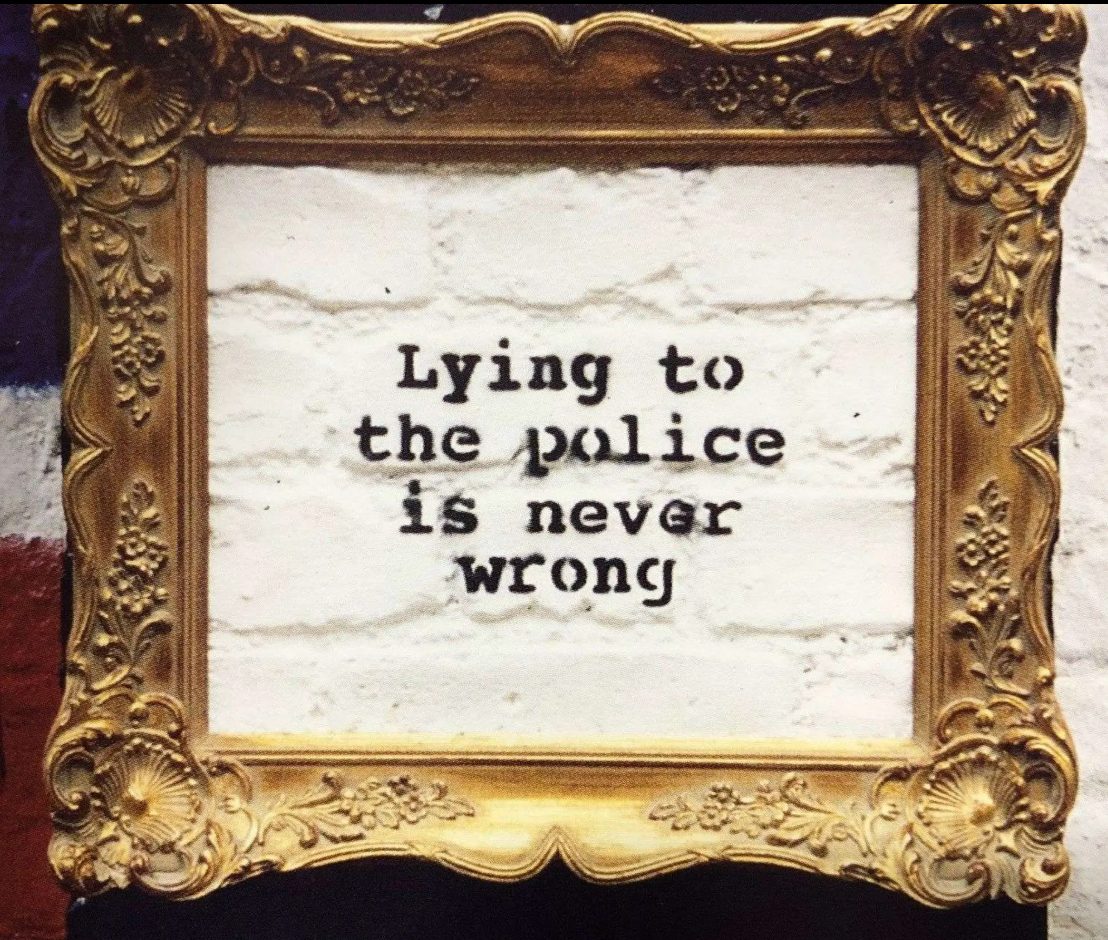
The wording is deliberately absolute. Banksy does not suggest that lying to the police is sometimes justified, or that circumstances might make dishonesty understandable. He eliminates every qualification with the word “never.” It transforms a mischievous statement into a mock moral principle.
The joke is that it sounds almost like advice one might receive from a parent—except that the conventional lesson has been turned completely upside down.
The Morality of the Wrongdoer
The sentence becomes more interesting because graffiti begins from an unusual relationship with legality. To the city, unauthorized graffiti is property damage. To the graffiti writer, illegality may simply be one of the conditions under which the work exists. The person making the image and the authority policing it therefore begin with fundamentally different definitions of what constitutes wrongdoing.
Banksy's statement exploits that contradiction. If an authority considers your creative activity criminal, does deceiving that authority automatically become immoral? Or can legality and morality occasionally occupy different sides of the argument? Banksy supplies his answer before we have even finished asking the question.
The work therefore contains a characteristic inversion. The institution normally empowered to determine who has done something “wrong” becomes the institution against which wrongdoing is declared impossible. It is a tiny piece of anarchic philosophy masquerading as graffiti etiquette.
Bristol, Graffiti and the Police
This work can also be placed within the history of Banksy's relationship with authority and the Bristol graffiti culture from which he emerged. It could relate to Operation Anderson, the major police operation against Bristol's graffiti scene in 1989 that resulted in arrests and prosecutions, including that of Inkie.
That context matters. Graffiti culture developed not simply through making images but through avoiding the systems designed to prevent them: surveillance, identification, arrest and prosecution. Secrecy was not incidental to the culture; it was often necessary for its survival.
Banksy's anonymity can be understood within that same logic, albeit taken to an extraordinary extreme. The artist who tells us that lying to the police is never wrong has built one of contemporary art's most famous careers while withholding the very piece of information authority—and increasingly the public—would normally demand first: who he is.
A Piece of Wall That Isn't a Wall
The material construction of the work is particularly clever. Banksy does not place his slogan against a pristine canvas. The support resembles a battered section of painted brickwork, complete with uneven joints, stains, abrasions and traces of previous colour.
It creates a peculiar illusion. We appear to be looking at graffiti photographed or removed from a wall, yet we are looking at a deliberately constructed portable artwork.
That distinction is important. Banksy brings the visual conditions of the street into the object itself. The roughness of the surface contrasts with the preciousness normally associated with an artwork designed to be collected, framed and protected. The gallery object effectively disguises itself as vandalism.
Even the lettering retains the imperfections of its supposed street origin. The edges are soft, areas of overspray remain visible and the letters sit awkwardly across the simulated masonry. Nothing has been cleaned up for polite consumption.
Words as Weapons
Banksy has always understood that an image does not need to be complicated to be memorable, and the same economy governs his use of language. The sentence works almost like one of his best visual stencils: immediate recognition followed by delayed complication. At first it is simply funny. Then the problems begin.
Is lying wrong? Does the identity of the person being deceived change the answer? Does an unjust law deserve obedience? Who decides when authority is legitimate? And perhaps most dangerously, what happens when everybody begins constructing their own exceptions?
Banksy provides no philosophical machinery for resolving any of this. He simply leaves five lines of text on the wall and walks away.
Lying to the Police Is Never Wrong demonstrates how little Banksy actually needs to make a Banksy. There is no elaborate composition and almost no conventional imagery. A fake piece of wall and a sentence are sufficient.
Yet the work touches something fundamental in his practice. Banksy's art has always existed in an uneasy territory between permission and transgression, property and expression, legality and legitimacy. Here, rather than illustrating that conflict, he compresses it into a single mischievous rule.
And perhaps the funniest thing about the statement is its certainty. Moral philosophy has spent thousands of years struggling with the distinction between right and wrong. Banksy settles the matter in five lines of spray paint.
STAY INFORMED
Receive the latest news, exhibitions, artworks and market updates on Banksy.