MICHELANGELO
From Renaissance Hero to Bullet Proof David
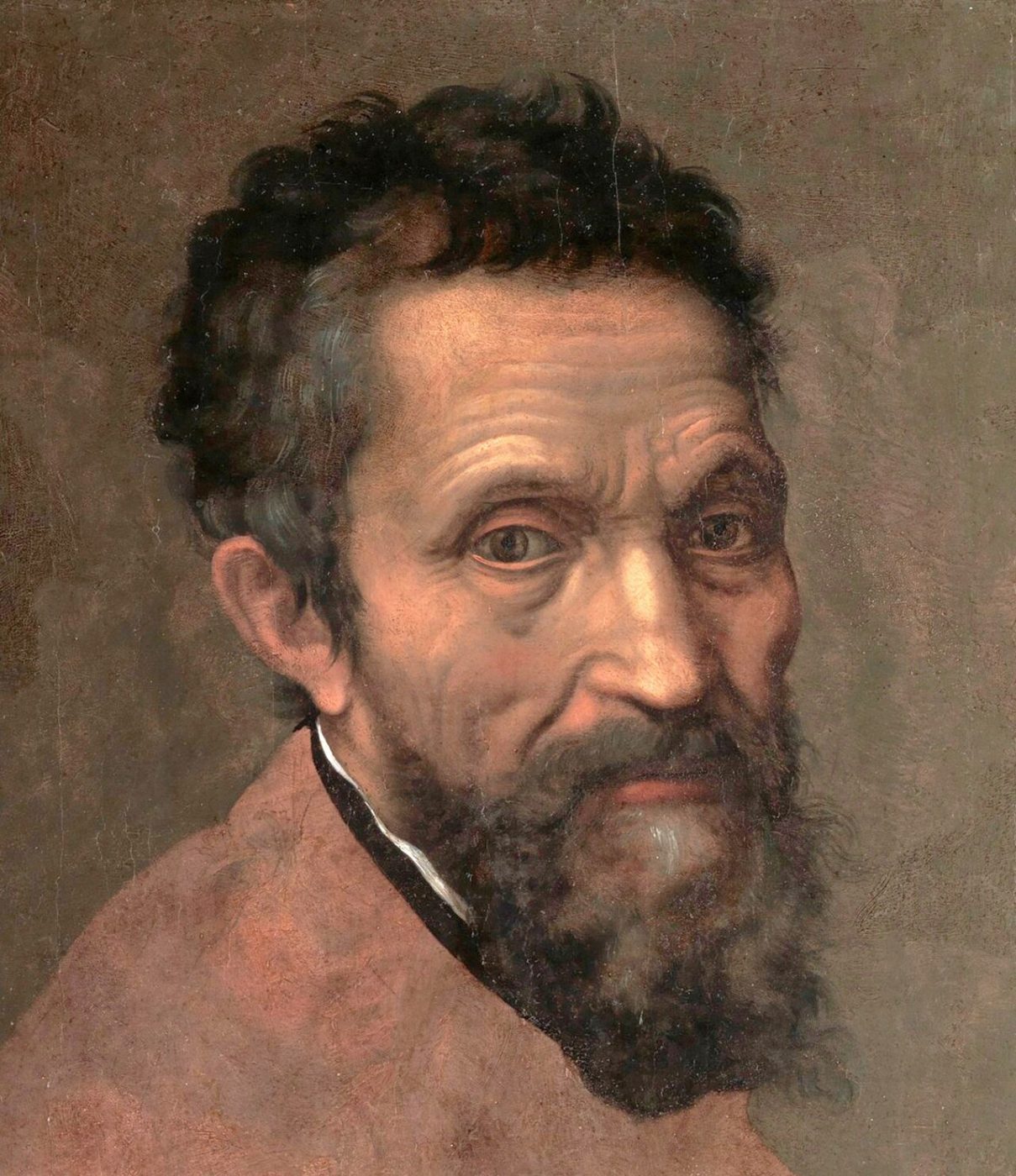
Few works in the history of Western art have acquired the symbolic authority of Michelangelo's David. Created in Florence between 1501 and 1504, the colossal marble figure transformed a familiar biblical hero into an ideal of physical beauty, intellectual concentration and civic courage. More than five centuries later, Banksy returned to this universally recognisable body for Bullet Proof David, created in 2006 and exhibited at Barely Legal in Los Angeles. His intervention is remarkably economical: Michelangelo's naked hero is left essentially intact, but a modern bulletproof vest has been strapped across his torso.
The addition is almost absurdly simple, yet it fundamentally changes the sculpture's meaning. Michelangelo's David confronts danger through courage, intelligence and the perfection of the human body; Banksy's David inhabits a world in which courage apparently requires protective equipment. The Renaissance celebration of human potential has entered the age of body armor.
MICHELANGELO AND THE RENAISSANCE IDEAL
Michelangelo Buonarroti was only twenty-six when, in 1501, he received the commission to create a monumental figure of David from an enormous block of Carrara marble that had already defeated earlier attempts by other sculptors. The sculpture was originally intended for the cathedral complex in Florence, but when it was completed in 1504 its extraordinary quality prompted a committee of leading Florentine artists—including Leonardo da Vinci and Sandro Botticelli—to consider a more prominent location. David was ultimately installed outside the Palazzo della Signoria, the centre of Florentine civic government.
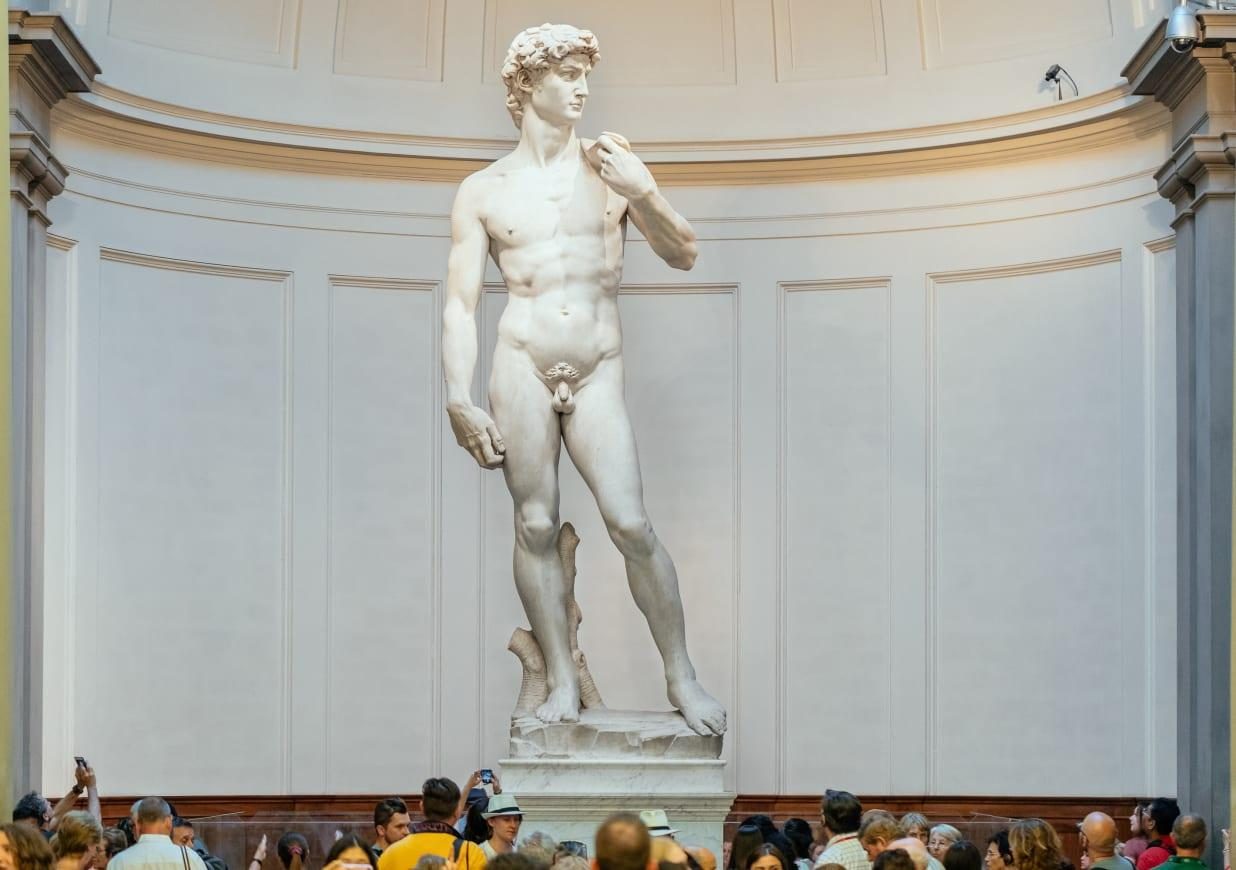
That change of location profoundly affected the sculpture's meaning. The biblical shepherd who defeated the giant Goliath became an emblem of the Florentine Republic, a relatively small political state fiercely conscious of its independence and surrounded by more powerful rivals. David's victory through intelligence and courage rather than brute strength offered Florence an ideal political metaphor.
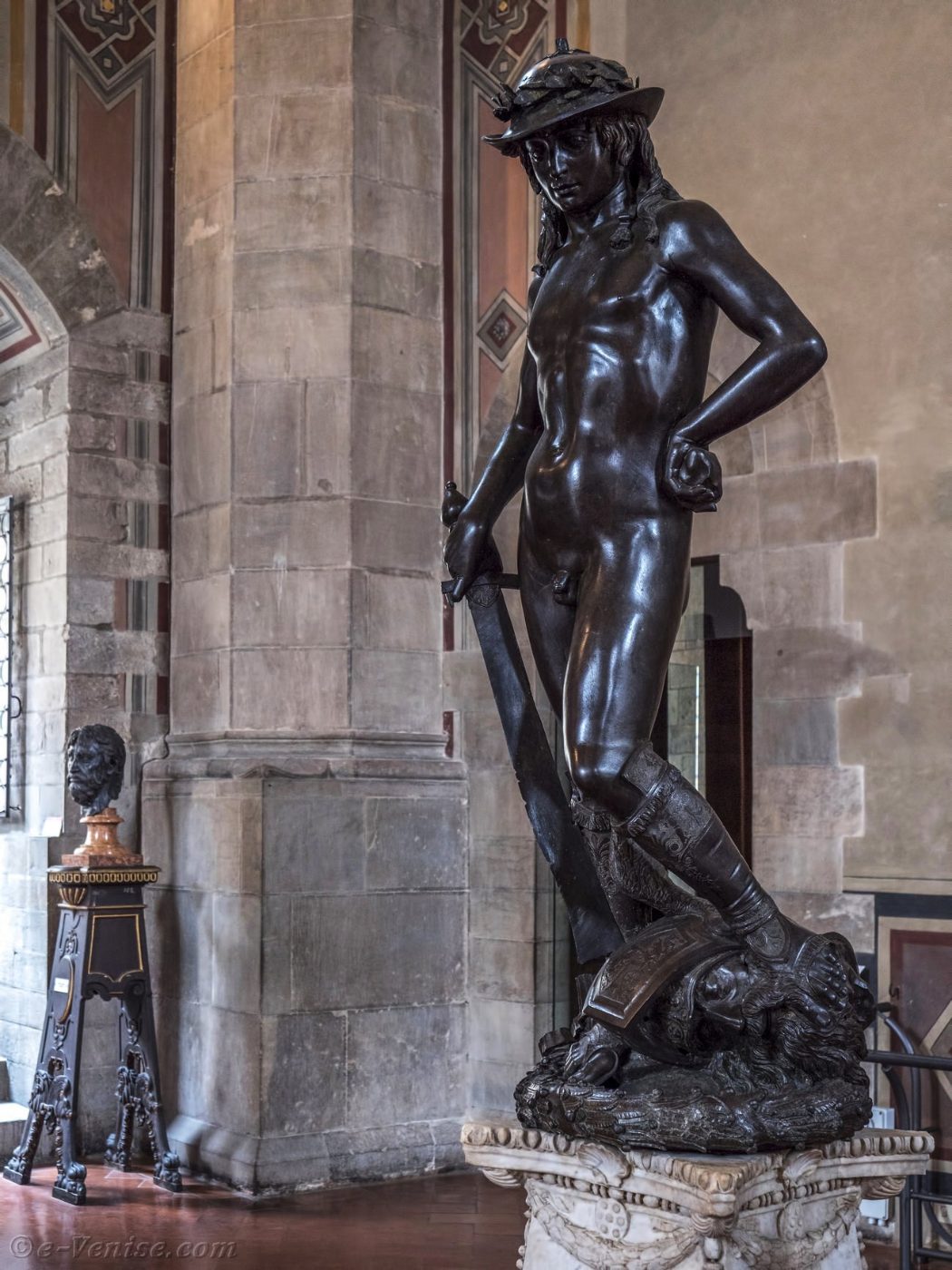
Michelangelo's treatment of the subject departed significantly from earlier Renaissance representations. Donatello and Verrocchio had shown David after the confrontation, victorious over the severed head of Goliath. Michelangelo eliminates the defeated giant altogether. His David is represented before the battle, at the moment of psychological concentration preceding action. The sling is almost casually carried over his shoulder, while the body appears calm but alert. The drama has moved from the physical consequences of combat to the anticipation of it.
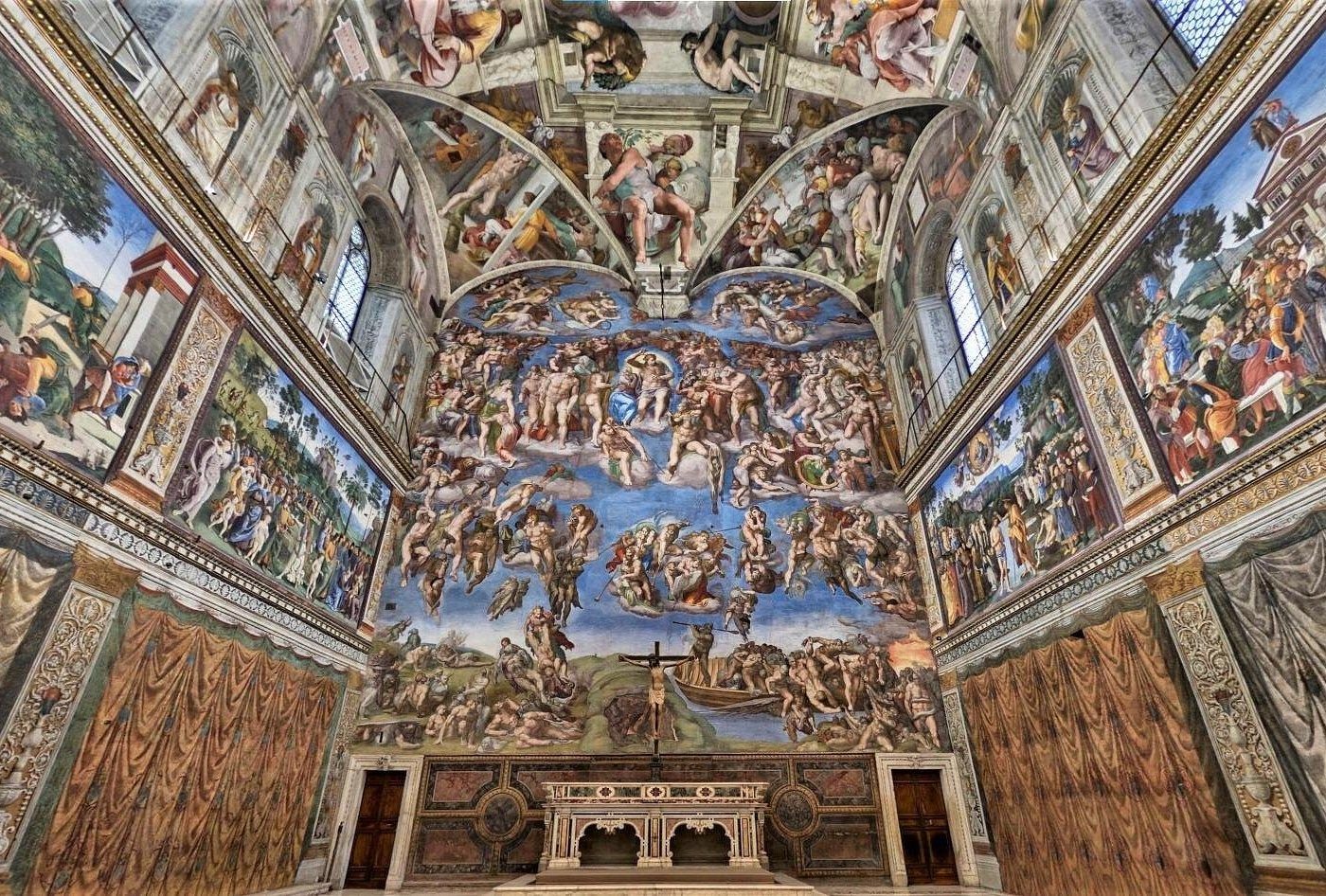
Michelangelo returned to the ideal human body on an even more ambitious scale in the frescoes of the Sistine Chapel ceiling, painted between 1508 and 1512. Among them, The Creation of Adam has become one of the most recognisable images in Western art. Derived from the Book of Genesis, the scene depicts the moment in which God gives life to Adam. Michelangelo dispenses with elaborate narrative detail and concentrates the composition around two monumental figures whose hands approach one another across a narrow interval. Adam reclines upon the earth as an idealised nude, his powerful anatomy recalling classical sculpture, while God advances dynamically through the air surrounded by a group of figures. The Vatican Museums describe Adam as resembling a “resting athlete,” an appropriate formulation for a body that appears physically complete but still awaits the animating force that will make it fully human.
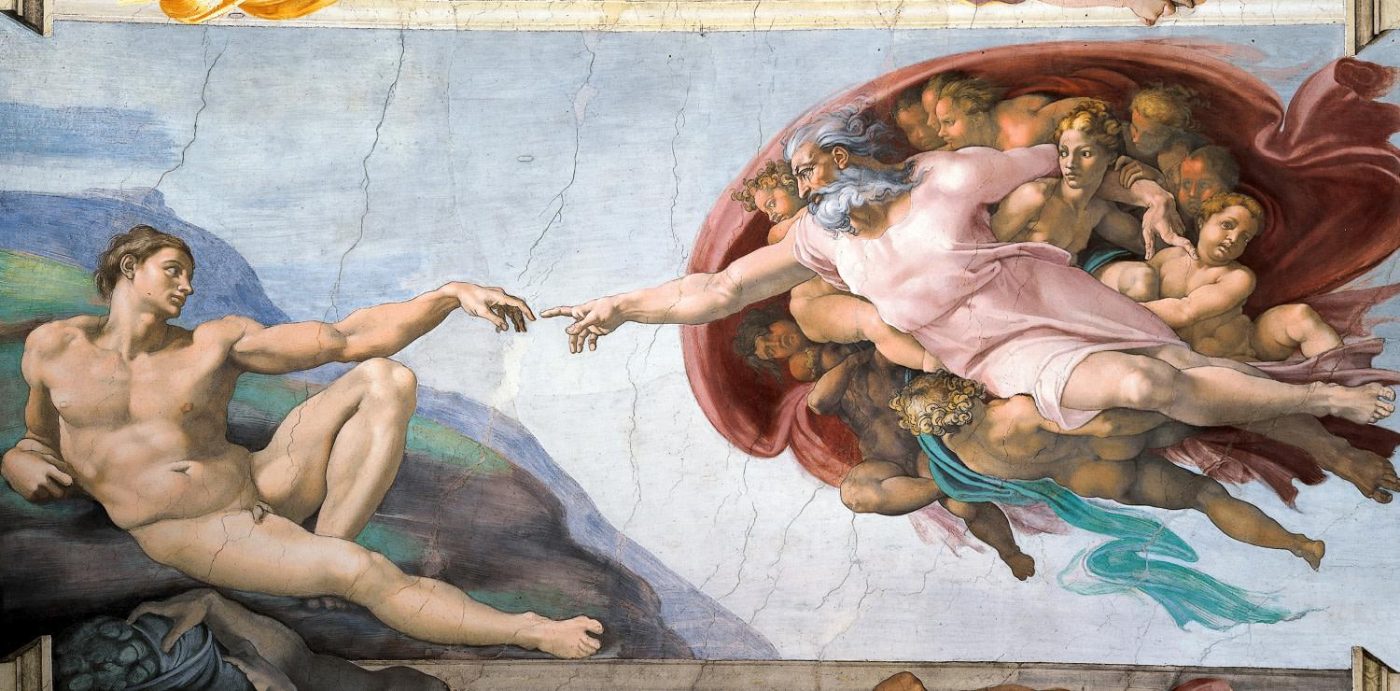
See The Creation of Adam at the Vatican
The fresco provides an important counterpart to David because both works place the male body at the centre of Michelangelo's conception of human potential. Yet their meanings are subtly different. David presents humanity as active and self-determining: the young hero concentrates his intelligence and physical capacity upon the challenge ahead. Adam, by contrast, is shown at the threshold of existence, his relaxed hand reaching towards the extraordinary energy contained in God's extended finger. In both works Michelangelo transforms the nude body into something more than anatomical perfection. It becomes a vehicle for intelligence, spiritual dignity and the Renaissance conviction that humanity occupies a privileged place within creation. This makes Banksy's decision to cover Michelangelo's ideal body with a bulletproof vest particularly resonant: five centuries after the Renaissance celebrated the human figure in its exposed perfection, Bullet Proof David asks whether the modern world still permits that body to remain unprotected.
THE BODY BEFORE BATTLE
This moment of suspended action explains much of the sculpture's extraordinary psychological power. Michelangelo's David is neither relaxed nor actively fighting. The classical contrapposto distributes his weight primarily through one leg, creating an apparently effortless equilibrium, while the enlarged hands, tense neck and concentrated gaze reveal a body preparing itself for action.
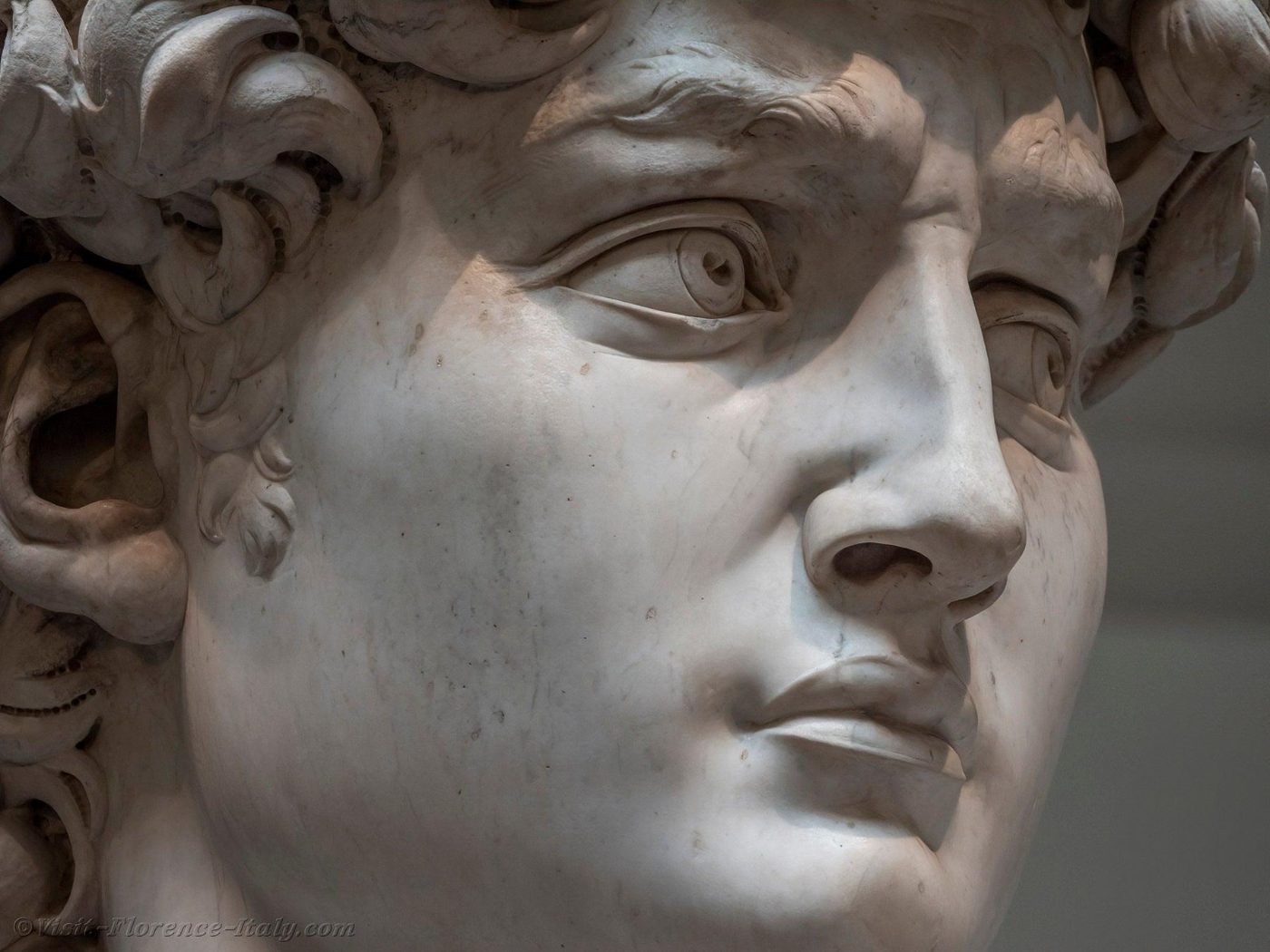
The nude body is essential to this conception. Michelangelo drew upon the rediscovery and study of Greco-Roman sculpture that had transformed Renaissance art, but the classical vocabulary was adapted to a Christian and civic hero. Physical perfection becomes an outward expression of inner capacity. David needs neither armor nor elaborate weaponry because the human body itself has become the monument.
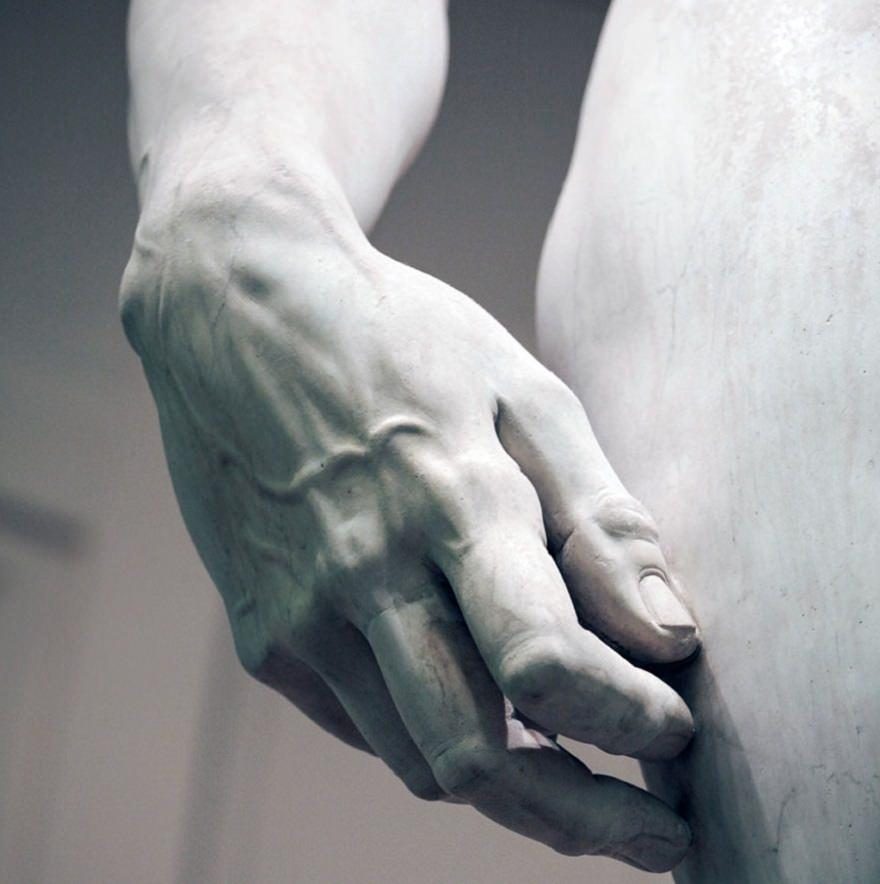
The sculpture therefore embodies several ideals associated with Renaissance humanism: confidence in human intelligence, admiration for classical antiquity and the conviction that the human form could express moral as well as physical greatness. Its monumentality reinforces that ambition. At 5.17 meters high, David greatly exceeds normal human scale while remaining anatomically and psychologically recognizable. The individual has become heroic without becoming supernatural.
DAVID, GOLIATH AND THE POWER OF THE UNDERDOG
The biblical story gives this ideal body a further political dimension. In the First Book of Samuel, the young David confronts Goliath, the heavily armed Philistine champion whom the Israelite soldiers fear to face. David rejects conventional armor and defeats the giant using a sling and a stone before cutting off his head with Goliath's own sword. The contrast between the two opponents is fundamental. Goliath possesses size, armor and military technology; David possesses intelligence, confidence and precision. The story became one of Western culture's archetypal narratives of the underdog defeating overwhelming power, which helps explain why it resonated so strongly within republican Florence.
This is also where Michelangelo and Banksy begin to meet. Banksy's practice repeatedly gives agency to apparently powerless figures: children confront soldiers, protesters challenge armed police, rats occupy the city and monkeys announce that they will eventually assume control. David belongs to a much older version of the same cultural archetype. He is the apparently weaker figure who refuses the hierarchy imposed upon him. Banksy does not need to invent that symbolism. Michelangelo has already supplied it.
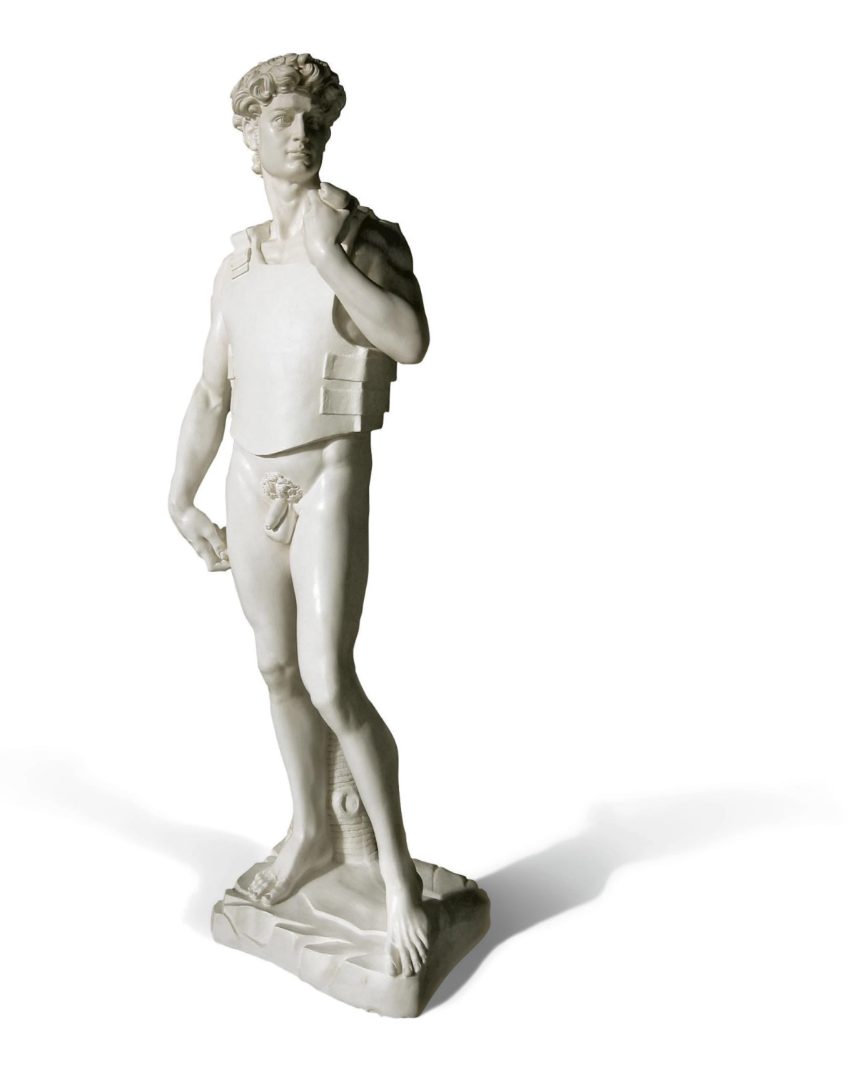
Banksy's intervention initially appears almost comically straightforward. He reproduces Michelangelo's David at reduced scale and places a contemporary bulletproof vest over the torso. The classical nude remains immediately recognisable, but the protective garment introduces an entirely different visual language: Renaissance Florence encounters the equipment of modern policing, military operations and personal security.
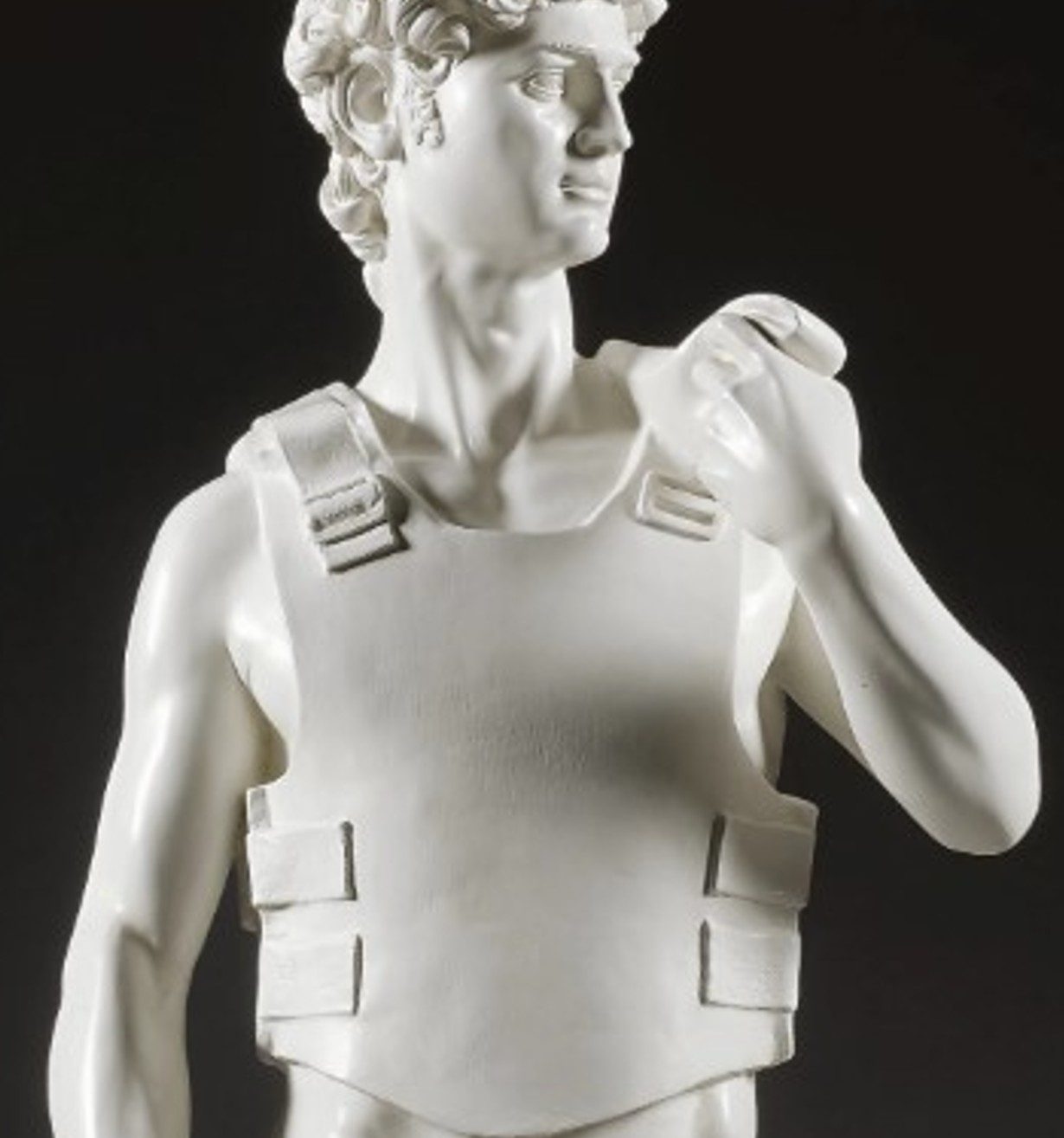
The vest fundamentally alters David's relationship with danger. Michelangelo had deliberately presented a hero who confronts his enemy without armour, carrying only the unobtrusive sling with which he will defeat Goliath. Banksy protects precisely the body Michelangelo had exposed. The addition therefore does not merely modernise the sculpture's appearance; it reverses one of the central conditions of the original narrative.
The contrast between the two works is consequently richer than a simple opposition between old and new. Michelangelo's David embodies confidence in the capacity of the individual to confront danger; Banksy's version reflects a society increasingly organized around the anticipation and management of threat. The body is still heroic, but it is no longer permitted to remain vulnerable.
THE RENAISSANCE BODY IN THE AGE OF SECURITY
The date of Banksy's sculpture is important. Bullet Proof David was created in 2006, five years after the attacks of September 11 and during the wars in Afghanistan and Iraq, at a moment when terrorism, military conflict, surveillance and public security had become defining themes of Western political life. The bulletproof vest belonged to the visual vocabulary of that environment, appearing on soldiers, armed police, journalists and security personnel with increasing regularity.
Banksy's intervention can therefore be understood as a collision between two conceptions of security. Michelangelo's David stands exposed because his defense lies in intelligence, courage and divine favor; Banksy's David has been equipped according to the logic of contemporary risk management. Protection is no longer metaphorical but technological.
Yet the work does not necessarily ridicule its protagonist. The original heroic posture remains intact beneath the armor, producing an ambiguity characteristic of Banksy's strongest appropriations. The vest may represent fear and defensive paranoia, but it may equally acknowledge that vulnerability has changed. The twenty-first-century David confronts a world in which Goliath no longer necessarily stands visibly across the battlefield; danger may be anonymous, distant or anticipated before it materializes.
BARELY LEGAL AND THE VANDALISED CLASSICAL BODY
Bullet Proof David was exhibited at Banksy's landmark Barely Legal exhibition in Los Angeles in September 2006, where sculpture formed an important part of a presentation that extended considerably beyond stencil painting. The exhibition also included Bullet Hole Bust, in which an apparently classical sculptural head is pierced by a bullet wound, and Homeless di Milo, Banksy's reworking of another canonical sculptural body.
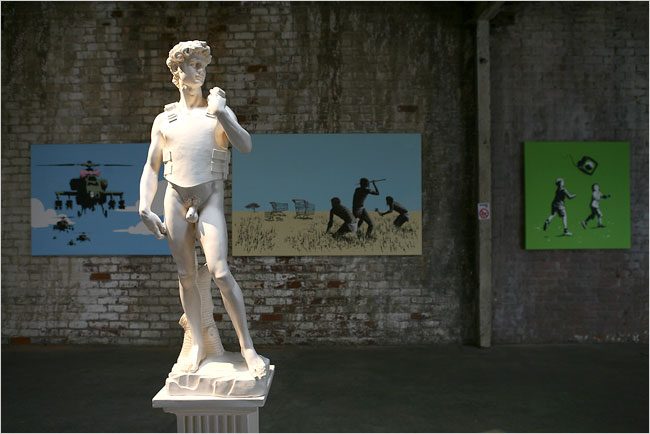
These works reveal a coherent interest in the cultural authority of classical sculpture. Museums traditionally present the white marble or marble-like body as an object separated from ordinary contemporary existence, preserved and protected precisely because it belongs to an idealized historical past. Banksy returns these bodies to the problems of the present. One is shot, another becomes homeless, while David is issued protective armor.
The strategy recalls Banksy's earlier clandestine museum interventions and the modified paintings of Crude Oils. His relationship with art history is rarely one of simple rejection. Recognition of the original is essential to the joke, and the intervention succeeds precisely because the inherited image retains its authority. Banksy effectively treats the canon as an existing visual language that can be edited rather than a sacred collection that must remain untouched.
FROM FLORENCE TO LOS ANGELES
The journey from Michelangelo's Florence to Banksy's Los Angeles also produces a revealing shift in the idea of the public hero. In Renaissance Florence, David became a civic symbol displayed outside the seat of republican government. Its nudity, monumentality and confidence projected an idealized image of a community that understood itself as courageous in the face of more powerful enemies.
Banksy's sculpture was presented five centuries later in a Los Angeles warehouse during an exhibition preoccupied with inequality, consumer culture, war, authority and spectacle. The heroic body remains recognizable, but its confidence has been complicated by the apparatus of contemporary security. Michelangelo's figure embodies the moment before a specific confrontation; Banksy's version belongs to a culture in which protection is worn because the next confrontation cannot necessarily be identified in advance.
Bullet Proof David therefore succeeds through an exceptionally small alteration to an exceptionally familiar image. Banksy does not need to dismantle Michelangelo's masterpiece or parody its beauty. He leaves the Renaissance hero standing and changes only the conditions under which that hero must survive. The resulting sculpture preserves Michelangelo's celebration of courage while introducing a distinctly contemporary uncertainty about whether courage, by itself, remains sufficient.
STAY INFORMED
Receive the latest news, exhibitions, artworks and market updates on Banksy.